Category Archives: Canonically Weird (The List)

251. PLAYTIME (1967)

(G. Smalley contributed additional commentary and background to this article.)

Play Time

“Playtime is a film that comes from another planet, where they make films differently.”–attributed to Francois Truffaut

Recommended

DIRECTED BY:

FEATURING: Jacques Tati, Barbara Dennek

PLOT: A nearly plotless “day in the life” of 1967 Paris: a group of American tourists arrive in the city, but instead of visiting the monuments they are taken to a complex of skyscrapers to shop. Meanwhile, Monsieur Hulot is trying to keep an appointment, but gets lost in a mazelike building in the same downtown complex. After business hours, everyone converges on a restaurant on its opening night for a chaotic celebration as the building falls apart around them.
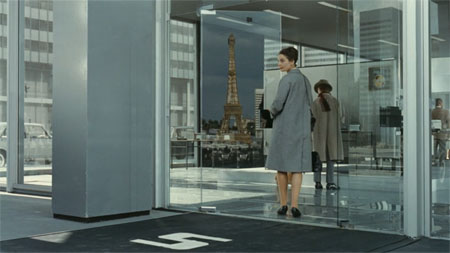
Still from Playtime (1967)

BACKGROUND:

  • The third of four features in which Jacques Tati played the affable, bumbling Monsieur Hulot.
  • Playtime was in production for three years; the downtown sets were constructed by hundreds of workers and were nicknamed “Tativille” among the crew.
  • The film was incredibly expensive to make and Tati took out personal loans to finance it; it was a disappointment at the box office and he went into bankruptcy, giving away Playtime‘s rights in the process.
  • Tati shot the film in 70mm (which was capable of a 2.20:1 aspect ratio, one of the widest formats), and initially insisted the film be screened only in that format in venues with stereophonic sound, despite the fact that very few theaters could meet these specifications. (Partially for this reason, the movie was not screened at all in the United States until 1972). He later relented and allowed 35mm prints to be struck.
  • Humorist and newspaper columnist Art Buchwald wrote the English dialogue for Tati.

INDELIBLE IMAGE: Many people will best remember Hulot’s view from the second-floor view of a factory-like job site composed of a maze of cubicles—a workplace prophecy that’s come true. We chose a scene—one of three in the film—where straggling Barbara opens a door to one of her tour’s commercialized sightseeing destinations, only to see the Eiffel Tower (or the Arc de Triomphe, or the Sacré Coeur) perfectly reflected in the plate glass. These shots express Tati’s theme of the disappearance of culture under the ugliness of modernity, while retaining the wistful hopefulness that is characteristic of his work.

THREE WEIRD THINGS: Faux Hulots; cubicle labyrinth; doorman with no door

WHAT MAKES IT WEIRD: Playtime is about the alienating, isolating influence technology has on human beings. It’s not the standard elements of plot, narrative, character development or dialogue that pulls an equally alienated audience into this unfurling drama, but the careful choreography of hapless humans navigating a barely recognizable hypermodern Paris. Play Time is a sort of anti-Brazil.


Short Clip from Playtime

COMMENTS: Do you remember when watching “Tom and Jerry” on Continue reading 251. PLAYTIME (1967) →

250. THE CREMATOR (1969)

Spalovac Mrtvol

366 Weird Movies may earn commissions from purchases made through product links.

“The Lord arranged it very well when he told people: ‘Remember, dust thou art and to dust thou returnest.’ A crematorium, dear friends, is clearly a God-pleasing object, because it helps God to speed up the transformation of people into dust.”–Kopfrkingl, The Cremator

Recommended

DIRECTED BY:

FEATURING: , Ilja Prachar, Milos Vognic, Jana Stehnová, Jirí Lír

PLOT: Kopfrkingl is a crematorium operator in Czechoslovakia in the late 1930s who holds odd opinions about the liberating nature of death, based largely on his self-study of the Tibetan Book of the Dead. Because he has German blood, an old army buddy recruits him into the Czech branch of the Nazi party. His beloved wife’s half-Jewish parentage, however, soon becomes an issue that threatens his advancement both in the party, and in his chosen profession.

Still from The Cremator (1969)

BACKGROUND:

  • The movie is based on a novel by Ladislav Fuks, a Czech who had been a forced laborer (arbeitseinsatz) during the Nazi occupation. Fuks collaborated with director Juraj Herz on the screenplay.
  • Although he was their contemporary, Herz did not consider himself part of the In school he studied puppetry (in the same class as ) rather than film, and had few friends in the New Wave clique. (One exception was director , who plays the small role of Dvorák in The Cremator). He did sneak in to film screenings at FAMU (the national film school that incubated the New Wave movement) and filmed a segment for the 1966 anthology Pearls of the Deep, which was rejected because of its length (30 minutes).
  • The Cremator began filming during the Prague Spring, but was interrupted by the Soviet invasion in 1968, which made completing it a challenge. The film was released and screened but removed from circulation soon after.
  • Czechoslovakia submitted The Cremator to the Oscars as Best Foreign Film, but the Academy did not grant it an official nomination.
  • The Cremator won best film, actor (Rudolf Hrusínský) and cinematography (Stanislav Milota) at the Sitges Film Festival, but not until 1972, three years after its initial release.

INDELIBLE IMAGE: Most likely it’s frequently tuxedoed cremator-in-chief Rudolf Hrusínský’s round face, the subject of so many closeups, that will stick with you the most. We chose to highlight the moment when he is invited into the rear tent at the freaskshow to gaze at the embalmed two-headed specimens and faces ravaged by syphilis, in which he shows a strange fascination.

THREE WEIRD THINGS: Buddhist Nazism; the throne in Lhasa; girl in black

WHAT MAKES IT WEIRD: A WWII drama soaked in an atmosphere of Gothic psychological horror, The Cremator seems like a screenplay might have written if he’d lived to see the Holocaust. Distorted lenses and madcap montages track the cremator’s bent descent from eccentric mortician to megalomaniacal tool of ultimate evil.


Second Run DVD trailer for The Cremator

COMMENTS: The IMDB categorizes The Cremator as, among other Continue reading 250. THE CREMATOR (1969) →

249. BLANCANIEVES (2012)

Snow White

“Blancanieves combines the characteristic language of documentary, a typical feature of Spanish realist cinema, with other devices from the opposite end of the aesthetic spectrum (fades, magical connections, etc.), typical of silent film – which in some cases call to mind Luis Buñuel’s surrealist aesthetic. These paradoxical styles help to create a visual atmosphere which is appropriate to the somewhat sinister tale by the Brothers Grimm which serves as the pretext of the film.”–Jorge Latorre

Must See

DIRECTED BY: Pablo Berger

FEATURING: Maribel Verdú, Macarena García, Sofía Oria, Daniel Giménez Cacho, Sergio Dorado

PLOT: Antonio Villalta is a famous bullfighter with a pregnant wife who is distracted in the ring and gored by a bull. The accident leaves him wheelchair-bound, his wife dies giving birth to his daughter, and he marries his nurse Encarna, a cruel and manipulative sociopath who only wants him for his fortune. Encarna at first keeps Carmen, Antonio’s daughter, as a servant girl and virtual slave on the estate, but orders her killed when she is found visiting her father against her stepmothers will; Carmen escapes and is rescued by a band of dwarfs who travel Spain performing a novelty bullfighting act.

Still from Blancanieves (2102)

BACKGROUND:

  • The folk tale “Snow White” was first set down in print by the Brothers Grimm in 1812.
  • Dwarf matadors (known as “charlotada”), who would warm up the crowd before the main event, were a real phenomenon in Spanish bullfighting.
  • Writer/director Pablo Berger cites ‘s Freaks (1932) as one of his main inspirations for the script.
  • Blancanieves was in development for eight years before filming began. This means that it was conceived before The Artist, the revivalist silent film that won the Academy Award in 2011.
  • The film won 10 Goyas (the Spanish equivalent of the Oscar), including Best Film and Best Actress for villainess Maribel Verdú. Spain submitted it to the Academy Awards but it was not one of the five foreign film finalists.

INDELIBLE IMAGE: Pablo Berger’s film utilizes simple tricks that would have been available to filmmakers in the 1920s, including frequent use of superimposed double images. The most effective of these is the shadowy skull that flashes over the skin of the apple as the wicked stepmother poisons it (using a syringe), while her intended victim basks in the crowd’s adulatory applause in the background, out of focus.

THREE WEIRD THINGS: Rooster cam; transvestite bullfighting dwarf; crying corpse

WHAT MAKES IT WEIRD: “I have this idea for a Snow White adaptation set among Spanish bullfighters in the 1920s, but how can I make it weird? I know! I’ll make it an expressionistic silent film, and make one of the dwarfs a transvestite and give the wicked stepmother a penchant for S&M!” Well done, Pablo Berger.


Original U.S. release trailer for Blancanieves

COMMENTS: As the early career of Guy Maddin reminds us, silent Continue reading 249. BLANCANIEVES (2012) →

248. DJANGO KILL! (IF YOU LIVE, SHOOT!) (1967)

Se sei Vivo Spara; AKA Oro Hondo

“That [If You Live, Shoot!] should be part of the small group of films that become a part of film history, embedded in the viewer’s imagination, obviously pleases me greatly… But I have to quickly add that it is a cult phenomenon for a few young likable nutcases. Every generation has a few of those.”–Giulio Questi

Recommended

DIRECTED BY:

FEATURING: Tomas Milian, Roberto Camardiel, Francisco Sanz, Piero Lulli, Ray Lovelock

PLOT: Two wandering Indians find a half-dead Stranger climbing out of a makeshift desert grave. They also find a bag of gold on his body, which they melt down and fashion into bullets for him. They then take him to the nearest town, which the Indians call “the Unhappy Place,” where the Stranger goes after the man who betrayed him, stole his share of the gold, and left him for dead.

Django Kill (If You Live, Shoot!) (1967) still

BACKGROUND:

  • Franco Arcalli served as editor and collaborated on the screenplay. Arcalli later became a big name in the Italian film industry, going on to collaborate with (on Zabriske Point), Bernardo Bertolucci (on The Conformist and Last Tango in Paris) while also collaborating on screenplays for Last Tango and Sergio Leone’s Once Upon a Time in America, among others. As his fame grew, he continued to work on Questi’s movies, as well.
  • Questi drew on his experiences as a paramilitary resistance fighter during WWII for the action sequences.
  • Italian audiences complained to censors about gruesome scenes where a man’s torso is torn apart to get at the golden bullets inside and another where a man is scalped. These scenes were immediately re-edited—in different countries, between twenty and thirty minutes of violence were cut out. Since they weren’t included in prints sent to the U.S., these scenes were never dubbed into English; therefore, when watching the restored version on Blu-ray, these scenes suddenly appear subtitled when the rest of movie is dubbed.
  • Originally titled If You Live, Shoot!, distributors later added Django Kill to the title (against Questi’s wishes) in a shameless attempt to cash in on the popularity of ‘s Django series. Thomas Millian does not play Django, and If You Live, Shoot! has nothing to do with the series.
  • Repo Man director is one of this film’s champions; he provided a 1997 introduction for a BBC series called “Forbidden Films,” where he he called it “the creepiest film I’d ever seen.”

INDELIBLE IMAGE: Based on sheer grisly shock value, it’s the scene where the villagers rip into Oaks’s still-breathing body trying to dig out the golden bullets inside it. Due to skillful editing, you don’t actually see as much blood and torn flesh as you imagine you do, but that’s part of what makes the scene so masterful—you and the filmmakers collaborate on building it in your mind’s eye.

THREE WEIRD THINGS: Golden bullets; gay cowpokes of the Old West; alcoholic oracle parrot

WHAT MAKES IT WEIRD: With its ambiguously dead antihero who shoots golden bullets fights Mr. Sorrow and his gang of gay fascist cowboys, Django Kill‘s subversive, surreal subtext befuddled 1967 viewers expecting warmed-up Spaghetti Western leftovers. It still has the power to perturb the unsuspecting today. Go into it looking for weirdness, and you’ll be amply rewarded.


British DVD release trailer for Django Kill

COMMENTS: Halfway down the dusty road that leads from A Fistful Continue reading 248. DJANGO KILL! (IF YOU LIVE, SHOOT!) (1967) →

247. WOMAN IN THE DUNES (1964)

Suna no onna

“TO see a World in a grain of sand,
And a Heaven in a wild flower,
Hold Infinity in the palm of your hand,
And Eternity in an hour…”

–William Blake, Auguries of Innocence

Recommended

DIRECTED BY:

FEATURING: Eiji Okada,

PLOT: A schoolteacher and amateur entomologist’s search for an elusive beetle takes him to a remote seaside village. Needing a place to stay, he asks the townspeople for lodging and is offered shelter with an odd young widow who lives in a shack at the bottom of a pit. The next morning, as he prepares to leave, he finds that the villagers have tricked him and he is trapped in the pit, forced to shovel sand in return for food and water, presumably for the remainder of his days.

Still from Woman in the Dunes (1964)

BACKGROUND:

  • Kōbō Abe wrote the novel “The Woman in the Dunes” in 1962 and was in the rare and enviable position of adapting it for the screen himself two years later. Abe wrote a total of four screenplays for director Hiroshi Teshigahara, all of which were scored by legendary composer Tôru Takemitsu.
  • Takemitsu’s score was recorded by a string ensemble, then electronically distorted.
  • The film was cut by  about twenty minutes during its original release. The full length film runs about two and a half hours.
  • Woman in the Dunes was nominated for a Best Foreign Language film Oscar, and, more impressively for a Hollywood outsider, Teshigahara was nominated for Best Director. Dunes lost in 1965 to Italy’s Yesterday, Today, Tomorrow, while Teshigahara was personally nominated for the 1966 awards instead (losing to Robert Wise for The Sound of Music).
  • The nudity and sex in the film were daring by 1964 standards, causing the import to be marketed in the U.S. with the tagline “The most provocative picture ever made.”
  • Teshigahara retired from filmmaking in 1979 to enter the family business—flower arranging!

INDELIBLE IMAGE: Sand, endless sand. Shifting sand, cascading sand, crumbling walls of sand, grains of sand stuck between toes. But to narrow it down, the dream sequences where the entomologist sees women superimposed over the sand, once with the sand ripples mimicking strands of hair, and once with a dune tracing the curve of a hip.

THREE WEIRD THINGS: Feminine mirages; rotting sand; voyeur drum circle

WHAT MAKES IT WEIRD: The plot of Woman in the Dunes—a man trapped into slavery in a remote village, forced to labor to earn his keep—is almost plausible, allowing the unimaginative to view it as a dull version of an escape movie. The hypnotic pace, bleakly beautiful cinematography, and Toru Takemitsu’s unnerving score inform this fable’s weird construction, however, creating a sense of strangeness that slowly gets under your skin like beach sand gets under your swimsuit.


Original Japanese trailer for Woman in the Dunes

COMMENTS: A man, a woman, sand: those are the triangular borders of Woman in the Dunes. Within this minimal landscape, the Continue reading 247. WOMAN IN THE DUNES (1964) →