366 Weird Movies may earn commissions from purchases made through product links.
September 24 marks the 90th anniversary of the birth of Jim Henson, in this writer’s opinion one of the greatest creative artists of the 20th century. Even though we have been without his imagination and humanism for nearly four decades, the loss is still keenly felt.
Although we have never enshrined any of his productions here, Henson’s projects make a legitimate bid for full-fledged weirdness. The vaudevillian surrealism of the Muppets borrows as much from Ernie Kovacs as it does from Kukla, Fran, and Ollie, and The Muppet Movie (1979) is an unexpectedly metatextual work, to the point where Dr. Teeth and the Electric Mayhem come riding to the rescue by virtue of having read the script. And this was no accident. Blessed with a blank check from the success of the Muppets, Henson opted to direct the dark fantasies The Dark Crystal and Labyrinth, At the very least, he’s weird-friendly.
There is another Jim Henson, though, one prone to seeing doom around the corner. You get hints of it in his most popular works, like the way “The Muppet Show” is always just one Gonzo-led stunt away from disaster. It’s likely that this was a holdover from his earliest days in show business, when he was finding different kinds of success, but none that brought stability or security. In the years between his first foray into television, “Sam and Friends,” and his eventual arrival on Sesame Street, Henson was a hustler, grabbing work wherever it might be found. The Muppets were regulars on “The Jimmy Dean Show,” frequent guests on Ed Sullivan, and leading lights in TVadvertising. Amidst all this, Henson was a movie director, and two films from this period represent an inflection point, a moment when Henson could have legitimately become a pessimistic avant-garde filmmaker. Fate intervened, arguably for the betterment of all mankind, but it’s interesting to glance at the road not taken.
PLOT: Having received a new heart via transplant, a man reassesses his priorities and goes in search of rapprochement with his estranged son.
WHY IT MIGHT JOIN THE APOCRYPHA: Claire Denis crafts a film that may be entirely metaphorical. Under the pretense of narrative, she links together a series of scenes that are best explained as analogues for the brain’s capacity to remember past events and to imagine future ones, often imperfectly. You can’t believe anything you see in L’intrus, and everything in L’intrus is true.
COMMENTS: Sometimes a film will have its script credited as “inspired by” some other work, often as a ploy to forestall the payment of rights and residuals. However, the term could not be better suited to describe the way this film is informed by the memoir/philosophical treatise of the same name that Jean-Luc Nancy penned about his own heart transplant and the subsequent dissociation he felt from his own body. Claire Denis crafts characters and situations that have no connection to the philosopher: Nancy never kept a string of lovers in the frozen tundra, or abandoned a son he had fathered in French Polynesia, or killed a man in cold blood. Yet our hero Louis seems to be living out the emotional experiences that Nancy encountered. Truly, she was inspired.
We know that Louis is facing a health crisis, one that necessitates the acquisition of a new heart. His circumstances are such that not only can he get it without difficulty, but he’s in a position to make demands. “I want a young heart,” he tells his organ broker. “Not an old man’s heart, or a woman’s heart.” It’s the arrogant proclamation of the rich, knowing he can get anything he wants and uninterested in who might suffer as a consequence. Up to this point, Louis lives a charmed life, residing in the mountains with a mistress, a pair of loyal dogs, and not a care in the world. His new heart will not only upend his existence, but shatter his confidence. Much of L’intrus is committed to watching his sense of control and certainty steadily unravel. Maybe you can have it all, but you rarely can keep it.
Denis teases us with genre expectations. When Louis visits a Swiss bank to obtain the money for his operation, we’re inclined to think that he’s some sort of retired secret agent or assassin putting his illicit earnings to work, but the film provides no evidence for that scenario, and the brush with “spy thriller” soon gives way to another mood. Louis’ quest to reconnect with his lost son feels like it will head to a meeting of tremendous importance, but Denis has no interest in such melodramatics. There’s reason to believe that Louis is confronted with a horrible twist at film’s end, but given all we’ve seen, this could easily just be a visual metaphor for the guilt he feels, or a flash-forward to an event that ties together two characters who have stayed far apart, or simply a dreaded outcome given form. We’ll never know for sure, and the feeling is the point, anyway.
What’s most unsettling, the thing that makes the ground so unsteady for the viewer, is that Denis uses the language of film in service of a presentation that intends to do none of the things that we expect a film narrative to do. We’re used to unreliable narrators and visualizations of things that never happened, but Denis provides no guide to help us sort one from another. We are familiar with nonlinear narratives, but we usually count on signifiers to help us work out the chronology in our own heads. We even understand the tricky nature of the Kuleshov effect—using edits to put two scenes together in a kind of shared meaning. Denis uses that technique as a cudgel to shame us out of our assumptions, following a lengthy scene of a grave being dug with a shot of the expected corpse recuperating in a hospital. We don’t have names (the dogsledder played by Dalle is identified in the credits as “The Queen of the Northern Hemisphere”), we don’t have places so much as climates, and we have so little dialogue that every word becomes laden with meaning. Denis is not here to play ball with us, and she makes sure we know it.
Even if you are familiar with Denis’ penchant for obscuring meaning, L’intrus is an impressively opaque work. It also happens to be a strikingly beautiful movie. Cinematographer Agnès Godard captures the exotic beauty of Tahiti, but she also finds character in a South Korean ship foundry or a remote border crossing. Faces look remarkable, too, especially that of Subor, whose handsome aged looks remain striking even when prone in bed running his fingers along the fresh transplant scar on his chest. The majestic professionalism of the production only enhances the sense of disassociation: how can you look at something so immaculately conceived and not be able to figure out what’s going on? You can, though, and Denis seems to think that you should. Maybe to recognize that fact, what you need is a whole new heart.
366 Weird Movies may earn commissions from purchases made through product links.
DIRECTED BY: Joël Rabijns, Yves Sondermeier
FEATURING: Pascal Maetens, Karel Vingerhoets, Celine Verbeeck
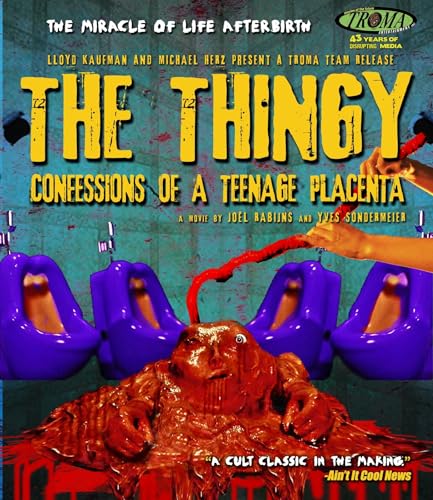
PLOT: Marianne loses her child at birth but the placenta miraculously lives, is named and baptized, and grows up to endure scorn and loneliness.
WHY IT MIGHT MAKE THE APOCRYPHA: When trying to describe Thingy, you inevitably think of Basket Case, but in doing so you miss the mile-wide streak of pathos that this movie feels for its grotesque hero. Here is a film that dares to place an oozing lump of Silly Putty at its center, and insists on presenting it as a cautionary tale about intolerance. The film sees the obvious joke of this ridiculous premise, but forces you to view it through the saddest possible lens.
COMMENTS: Whenever you think life is handing you the short end of the stick, poor Luke is here to assure you that it could be so, so much worse. Just being a teenager is difficult enough, what with having to navigate the land mines of high school hierarchies, recognizing your elders for the flawed human beings they are, and trying to get a sense of your own personality. It’s infinitely more complicated to look in the mirror and see, looking back at you, an unholy mashup of Grimace, tandoori chicken, and a Pink Pearl eraser.
You could easily be misled by the title into thinking that this is a wild romp through the fields of giddy indecency. It’s a marketing ploy suggesting a level of camp and silliness appropriate to the Troma label. But Luke is never addressed by the title’s demeaning sobriquet, and he never confesses to anything. Curiously enough, the sensationalist approach lends the film a certain credibility, because despite the creepy extremism of the scenario, this is a painfully serious film, a sympathetic plea for tolerance for all the sentient birth membranes out there whom society treats appallingly.
If ever a character manifested his own disappointment into existence, Luke is that hero. He has just one eye, uses what remains of the umbilical cord as his only limb, relies on a toy jeep to get around, and he speaks with a sad, resigned voice that can only be described as Flemish Bud Cort (the actual actor goes uncredited). He’s utterly ridiculous, which is the cue for Rabijns and Sondermeier to keep putting him in the most normal of situations and watching as he completely fails to fit in. At school, at home, at work (as a front-of-the-house order taker at a fast food joint notably called “Hamburger Holocaust”): everywhere Luke goes he meets with derision. It’s just drawn to him, as it would be. He is truly a sad sack.
Even if the movie didn’t have Luke, it still has a collection of parts just as unusual, just as disturbing. Leading the pack is Luke’s mother Marianne, played for no obvious reason by male actor Maetens. She isn’t played for laughs or irony or even to make a point. In fact, the casting becomes completely irrelevant once Marianne fully gives in to her work-out addiction, which consists of exclusively building the muscle of her right arm to ‘roided extremes. (Why only one arm? She explains: “I get what I want with only half the work.”) Less showy but equally strange is Father Gritty, the priest who magnanimously grants the little lump the rites of baptism. It initially feels like a gesture of supreme grace, but it starts to seem like he has no other parishioners, and the man of the cloth has a peculiar interest in his godson’s growth, eagerly asking for details about the legs of a girl Luke is sweet on. Plus, there’s the overall sense that everyone in the film is committed to the fact of Luke’s existence, but equally as certain that he will endure nothing but scorn. The Thingy has the feel of a Weekly World News article transformed into an ABC Afterschool Special.
The Thingy feels peculiarly American, a strange sensation given that this Belgian production barely tries to hide its accents. It’s tempting to look for some trace of satire: the sensationalized news perpetually running on TV, the familiarity of the class-conscious high school, the fact that Marianne has been passing Luke’s father off as having been fighting in Vietnam for seemingly years… it all of it points to a strangely cartoonish view of the States. Even so, the film seemingly has no axes to grind. In fact, it’s only in its final scenes that the movie loses the sheen of its strangeness by descending into an orgy of nihilistic violence. Only here, in pursuit of its final tragic punchline, do the filmmakers run out of story and decide to punctuate the climax with a series of horrible acts. If The Thingy falls apart just short of the finish line, the fact is it remains a singular work, creating an unthinkable situation and treating it with the gravity, sincerity, and honesty that it demands. Poor Luke. There but for the grace of God go you and I.
PLOT: A look inside the troubled mind of a teenage girl who is dealing with a hostile school atmosphere, emotionally hostile parents, a fixation on the cool new boy, a random drugged-out loser who may be the best friend she has, and the disappearance of her little brother.
COMMENTS: Split-screen photography has been a filmmaking tool almost since the beginning of the cinema. The technique took a giant leap, though, with the debut of filmmaker Christopher Chapman’s “A Place to Stand,” the groundbreaking short that he created as part of Canada’s Expo 67. Far from merely dividing the image in twain, Chapman developed a technique of isolating images and enabling them to move through the frame in concert with other images, like a moving mosaic. It was called “multi-dynamic image technique,” and it gained a foothold in popular culture a year later when Norman Jewison deployed it in The Thomas Crown Affair.
Maybe it’s a Canadian thing, because Bruce McDonald’s The Tracey Fragments may boast the most splits any screen has ever seen. The story of a girl whose mind is shattered by disaffection and tragedy (a simile Tracey employs in her first monologue) is suitably embodied by a narrative and a screen image that is similarly fractured. Humans are notorious for holding multiple viewpoints and emotional states at the same time, and the mosaic method allows the film to display all of them at once. Unexpressed rage and undelivered ripostes share space with silent pain and vast landscapes, while grids of pictures give way to clouds of dozens of images, sometimes with a sharp triangle piercing the frame. One particularly memorable image features Tracey in a desperate run for freedom, perfectly overlaid with shots of a horse in full gallop while the score by Broken Social Scene lays down an appropriately desperate groove. Rarely has the complexity of the mind, especially that of a teenager, been captured with such fidelity.
The Tracey Fragments is a technical marvel. The film supposedly took a month to film and nine more to assemble, and the work shows as McDonald, editors Jeremiah Munce and Gareth C. Scales, and sound designer Steve Munro create an impressively clear story out of a deliberately jumbled set of pieces. It’s frankly remarkable that it works as well as it does, given that Tracey’s story is pretty one-note. While her life does seem legitimately grim, the nonlinear approach represents her situation as an unchanging condition: disaffected teen girl, touched by tragedy, cast among the losers in high school, disdainful of her aggressively distant parents, and yearning for a bland boy who promises escape but evidently is a cruel, cavalier lover. (If we can believe what we see; our point of view is entirely Tracey’s.) It’s authentic, but it’s not dramatic.
This was Page’s first release following the starmaking breakthrough of Juno (although Tracey was shot first), and it solidifies the actor’s inclination toward challenging material. Page doesn’t always look as scruffy and homely as the character’s situation would suggest, and Tracey’s monologues sometimes feel inappropriately formal and clear-minded for a girl in such distress. The whole film rests on Page’s shoulders, though, and he carries it with confidence. Notably, some scenes have taken on a stranger veneer with the passage of time. One of Tracey’s tormentors verbally taunts her for her lack of perceived hot-girl femininity, calling her “It” and demanding, “Is It a boy or a girl?” Scenes with Tracey and her therapist are particularly odd, with the trans actor playing opposite Richings in drag in an ex post facto head-scratcher.
Split-screen is hardly an obscure technique. If you’ve seen any heist movie, you’ve probably been treated to a collage of lasers, hands, and beads of sweat. What distinguishes The Tracey Fragments is the way it gives the split-screen a psychological dimension. Instead of delivering information, it delivers character and mood. It’s not an entirely successful effort, as that mood has little chance to develop and grow. It does serve as a valuable reminder that all the cool things we can do with image and sound have the potential to do much more, if we give them a shot.
366 Weird Movies may earn commissions from purchases made through product links.
Konec srpna v Hotelu Ozon
DIRECTED BY: Jan Schmidt
FEATURING: Beta Poničanová, Ondrej Jariabek, Magda Seidlerová, Hana Vítková, Jana Novaková, Vanda Kalinová, Natalie Maslovová, Irena Lžičařová, Jitka Hořejšías
PLOT: In the wake of a nuclear apocalypse, a group of women wander the desolate landscape in search of life and sustenance, eventually discovering an old man living in the shattered remains of a hotel.
COMMENTS: There wasn’t a whole lot of software available for the early iterations of the Macintosh computer, but one of the more popular and memorable programs was a simulated game of diplomacy called “Balance of Power.” As leader of either the United States or the Soviet Union, you were tasked with responding to world events in a way that burnished your own country’s reputation and boxed out your opponent. Of course, this leads to political brinksmanship, with each escalation inching the two powers ever closer to the ultimate conflict. If you misjudged the situation, the game concluded with a black screen that provided a particularly chilling finale: “You have ignited a nuclear war. And no, there is no animated display of a mushroom cloud with parts of bodies flying through the air. We do not reward failure.” It was a real gut-punch to a 15-year-old who only wanted to prevent the USSR from Finlandizing Austria.
I hearken back to this example of video game shaming because it matches the mood set by Late August at the Hotel Ozone. The suggestions of familiar tropes—the post-nuclear landscape, a group of young women fending for themselves, small traces of the world before—set expectations that this film is only too happy to crush. Director Schmidt crafts a stark future with a documentarian’s eye, depicting a world cleaved of hope, where even death loses its power to shock—because there’s nothing else left.
Most of the film is spent in the company of Dagmar, an older woman who recalls the times before the world ended and hopes there might be enough people left to rebuild humanity. In her charge are a group of young women who have learned the fundamentals of survival but have had little opportunity to develop their souls. They don’t say much, but their actions speak volumes. Finding a drum of petrol, they refill their canisters, but then one of them decides to set it on fire, for fun. Another takes the cache of bullets she has found and throws them into the flames, again for amusement. We’re quickly learning that life holds little allure to this group, something reflected in their treatment of animals. A girl rips apart a snake with her bare hands. Another teases a hungry stray dog before killing it with a bullet to the head. When they find a cow that they can kill for sustenance, the women tear at the flesh like ravenous hyenas. (The film’s lore says that none of these animal encounters are faked; if true, we’re also dealing with a snuff film.) Whatever rules we think society should have, they don’t matter here.
So stumbling across the old man at the hotel is like crossing a generational gap. Despite everyone around him having died, Hubert has persisted, maintaining the place in expectation of the day when guests will return as part of a pleasure trip. Dagmar and Hubert find some comfort in their shared experiences, and their very tastes mark them as alien. The girls are repulsed by the idea of drinking milk, and they are clearly baffled by the rituals of a dinner with silverware and candles. Reportedly, several of the performers were not professional actors (one account suggests they were members of the Czech military), and there’s something chilling about their sense of detachment. Hubert’s proudest possession, a Victrola with a recording of “Roll Out the Barrel,” is notable as the one thing that inspires something deeper in the women, a piece of art amidst the desolation. Naturally, it’s more important than life itself.
While the two old people are our connection to the familiar, the fact is that this is not their world. It belongs to the young women who have inherited the dying wasteland, and the violence that ends the film is woefully inevitable. This is an apocalypse for a reason, and this film takes the position that the world will not end with gut-wrenching action or even tear-stained melancholy, but rather with ignorance laced with id-fueled apathy. If we leave our children nothing, nothing is what they will take to their hearts. There will be no reward for failure.

 Although we have never enshrined any of his productions here, Henson’s projects make a legitimate bid for full-fledged weirdness. The vaudevillian surrealism of the Muppets borrows as much from Ernie Kovacs as it does from Kukla, Fran, and Ollie, and The Muppet Movie (1979) is an unexpectedly metatextual work, to the point where Dr. Teeth and the Electric Mayhem come riding to the rescue by virtue of having read the script. And this was no accident. Blessed with a blank check from the success of the Muppets, Henson opted to direct the dark fantasies The Dark Crystal and Labyrinth, At the very least, he’s weird-friendly.
 “Time Piece” has its place in history as the project that earned Henson the only Academy Award nomination of his career. A meticulously planned short film, “Time Piece” features Henson himself (looking, in the words of Boston Phoenix critic David Harris, “like a beatnik posing as an office worker”) as he flits about his imagination Continue reading DIRECTED BY JIM HENSON: TIME PIECE (1965) / THE CUBE (1969)