Tag Archives: Lesbian

156. STRANGE FRAME: LOVE & SAX (2012)

“How fortunate are those who can frame the beauty of the strange.”–opening title of Strange Frame

DIRECTED BY: G.B. Hajim

FEATURING: Claudia Black, Tara Strong, Ron Glass, 

PLOT: In the 28th century, saxophonist Parker falls in love with songwriter and escaped debt slave Naia on Jupiter’s moon Ganymede. The two women form a band, which catches the eye of a music producer. When the producer kicks the sax player out of the band to set Naia up as a solo act, hooks the singer on drugs and isolates her from the outside world, Parker teams up with two interplanetary trash haulers to penetrate the corporate defenses that separate the women.

Still from Strange Frame: Love & Sax (2012)
BACKGROUND:

  • This is the first feature film from Hawaii-based director G.B. Hajim and the first script and soundtrack from co-writer/co-composer Shelley Doty.
  • Hajim and Doty began discussing the project in 1999, and began writing the script in 2002. They envisioned Love & Sax as the first in a series of four films.
  • More than forty Hawaiian high school students worked as interns on the film over its seven years of production.
  • The black and white live action footage edited into the film comes from the all-black feature The Duke Is Tops (1938), starring Lena Horne as a singer who is manipulated into leaving her lover behind with promises of becoming a star in New York City.
  • “Star Trek” alumnus George Takei has a vocal cameo.

INDELIBLE IMAGE: Strange Frame is at its visual best when it’s a free-flowing montage: cut-out mutant space lesbians in the foreground, swirling psychedelic backgrounds drifting in and out of focus in the background. It is therefore a difficult task to isolate a single strange frame from this movie; every image is in a constant state of flux. One of the best sequences occurs when Satanically suave agent Dorlan Mig plies the women with powders and rare liquors in an upscale Ganymede nightclub populated by horned celebrity dominatrices and their monocle-wearing cat-person managers. Immediately before the lovers are launched into a trip that’s visually unhinged even by this movie’s extreme standards, we see them reflected in his mirrored shades, one girl improbably and perfectly framed in each lens, before their visages dissolve and morph into pink lips and tongues. That’s about as standout a standalone image as you’ll be able to find in this Heraclitan river of psychedelic cinema.

WHAT MAKES IT WEIRD: This story of two renegade lesbian rock stars gigging among the moons of Jupiter is a bit odd, but really not all that weird in and of itself. It’s the visuals that (as the movie’s legend promises) “frame the beauty of the strange.” Imagine dropping a hefty dose of LSD on the set of Blade Runner, and you walk through a door and suddenly you’re in the Star Wars cantina. Now, imagine that experience animated by the team behind Fantastic Planet working under the direction of , take that result and square the weirdness quotient, and you have some inkling of Strange Frame‘s visuals.


Original trailer for Strange Frame

COMMENTS: Strange Frame is an animated psychedelic lesbian science fiction musical. Just to be clear, I would have been happy with any three Continue reading 156. STRANGE FRAME: LOVE & SAX (2012)

136. VALERIE AND HER WEEK OF WONDERS (1970)

Valerie a Týden Divu

“…one of those haunting, dream-like films that once seen is difficult to forget.”–Tanya Krzywinska

Recommended

DIRECTED BY:

FEATURING: Jaroslava Schallerova, Petr Kopriva, Helena Anyzova, Jiri Prymek, 

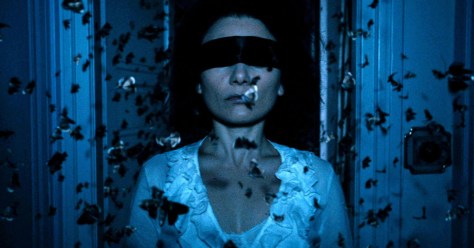
PLOT: Young Valerie lives in a farmhouse on the edge of a small town with her Granny. She flirts with “Eagle,” a boy about her age who is either a neighbor or her brother, and they both fear a pale-faced bogeyman they call “the Weasel.” On the day she becomes a woman (symbolized by blood drops appearing on a daisy), Valerie’s life suddenly becomes a strange dream involving family betrayals, lusty priests, constantly shifting identities, and a vampire infestation.

Still from Valerie and Her Week of Wonders (1970)

BACKGROUND:

  • Valerie and Her Week of Wonders is an adaptation of the novel of the same name by Vítězslav Nezval, which was written in 1935 but not published until 1945. Nezval was a co-founder of the Czech Surrealist group (one of the first Surrealist groups organized outside of France).
  • This is considered one of the last works in what was known as the , although that term more commonly refers to Czech movies made or released just before or during the Prague spring of 1968. In contrast to most of the New Wave canon, Valerie was released after the Soviet invasion of Czechoslovakia and the installation of a hardline government who redoubled censorship efforts. Despite the fact that it’s a Surrealist work, equally offensive to the official aesthetic of Socialist Realism as a banned New Wave movie like 1967’s Daisies, Valerie appears to have evoked little objection from the censors. This may be because the film’s heavily anticlerical tone meshed with the Communist Party’s official stance on the Church.
  • A Philadelphia “freak folk” supergroup dubbed “The Valerie Project” wrote an alternate soundtrack to the film, and toured across the U.S. from 2006-2008 performing the score while the film screened as a silent movie.

INDELIBLE IMAGE: Drops of blood on white daisy petals.

WHAT MAKES IT WEIRD: Valerie and Her Week of Wonders is often, and accurately, described as a Freudian version of Alice in Wonderland, with the confusion of new hormones surging through the young heroine’s body coloring her encounters with a dark and fearful tinge: Valerie faces vampires and rapist priests instead of Alice’s White Rabbits and Cheshire Cats. The plot makes no literal sense, because characters keep changing into different characters, the way they might in a dream; but overall Valerie’s welter of wonders hangs together as a mosaic of a girl’s anxieties about impending adulthood and the enticing but scary world of sex.

Clip from Peter Hames Criterion Collection commentary Valerie and Her Week of Wonders

COMMENTS: Valerie and Her Week of Wonders opens with images of pretty young Valerie drinking from a waterspout, petting a dove, sniffing Continue reading 136. VALERIE AND HER WEEK OF WONDERS (1970)

CAPSULE: FASCINATION (1979)

DIRECTED BY:

FEATURING: Jean-Marie Lemaire, Franca Maï, , Fanny Magier

PLOT: A highwayman burns his fellow brigands and holes up in a chateau, where he meets two seductive women who are expecting mysterious guests at midnight.

Still from Fascination (1979)

WHY IT WON’T MAKE THE LIST: It’s one of Rollin’s most polished and conventional horror movies; the surrealistic dalliances are kept to a minimum, and the rough edges of his earlier lesbian vampire films (like the crazy Nude Vampire) have been smoothed out. That makes it a good choice for fans atmospheric horror of with lots of sex—who will find it a fairly odd period terror–but lacks true fascination for the weird film fan.

COMMENTS: Fascination starts out fascinatingly enough, with a woman opening a tome on witchcraft and caressing the pages sensually with her lace-sleeved hands, followed by a credits sequence with two women waltzing on a stone bridge. After this prologue comes an eye-widening first scene where two women—one dressed in bridal white and the other in funereal black—stand in a slaughterhouse and drink ox’s blood as a doctor helpfully informs them, “today, in April 1905, we find it’s the best way to cure anemia.” Unfortunately for lovers of the bizarre, however, the ride smooths out after that opening and we get a familiar-feeling story about a desperate man who seeks refuge in a house inhabited by fairy tale femme fatales. This is a well made film: as per usual with Rollin, the cinematography, sexual choreography, locations (featuring another memorable château, this time isolated on an island with a stone bridge being the only approach) and music (ranging from medieval inspired chants to waltzes to heavy horror cues) are all top notch. But lovers of the bizarre will find this love triangle in a misty universe of sex and death only mildly titillating; devotees of erotic Eurohorror will get far more satisfaction from the ample female flesh on display (the stage blood, on the other hand, is both thin and rare for this type of production). Fascination does show remnants of Rollin’s slightly illogical, dreamlike signature style, with impassioned romances compressed into hours and a clueless protagonist who remains irrationally cocky even as evidence mounts that things are not as they seem. Characters say things like “beware, death sometimes takes the form of seduction” and “the love of blood may be more than that of the body in which it flows” and “it’s all very melodramatic…” Brigitte Lahaie supplies Fascination‘s highlight when she transforms into a buxom grim reaper; armed with a scythe, she goes on a killing spree wrapped only in a thin black cloak that reveals her bosom when the slightest breeze blows. The fatalistic (if predictable) final scene, set in what seems to be some sort of bizarre, cavernous aviary, is also a keeper. For the most part, however, Fascination is a polished product, containing little that the mainstream horror fan would find alienatingly weird. Predictably, this leads some to proclaim it Rollin’s best film. But the absence of surreal gambles doesn’t make it his best; it merely prevents it from being his worst.

Although she’s not the featured star, curvaceous and sensual Brigitte Lahaie steals the show, ruling the screen whenever she’s on it. Lahaie began her career in hardcore porn, in the era when adult films had scripts and the players actually acted in between sex scenes. Rollin, who also directed adult films to pay the bills, gave her her first role in a horror film in 1978’s The Raisins of Death, then gave her a larger part in Fascination. Although France’s top adult actress at the time, Lahaie always seemed too beautiful, elegant and talented for porn, and she indeed retired from hardcore in 1980. She appeared mainly in horror and softcore films afterwards, but landed a bit part in the NC-17 arthouse hit Henry and June (1990) and a small but memorable role in the very weird Calvaire (2004). She currently hosts a French radio talk show about sexuality. Fascination may well mark the high point of her acting career.

WHAT THE CRITICS SAY:

“The sex scenes are more intense and explicit than Rollin’s previous horror outings but remain suffused with a heady surrealism that makes the encounters play like animated works of art… this DVD is a sight for sore eyes and should serve as a nice aid for introducing new viewers to Rollin’s strange, wonderful cinematic world.”–Mondo Digital (DVD)

LIST CANDIDATE: KABOOM (2010)

DIRECTED BY: Gregg Araki

FEATURING: Thomas Dekker, Haley Bennett, , Chris Zylka, James Duval

PLOT: A sensitive college freshman experiences sexual awakening, stumbles upon a murder mystery, and uncovers secrets about his family while once in a while working on his film studies major, all set amidst scores of colorful visions, voodoo hallucinations, and sexy encounters.

Still from Kaboom

WHY IT MIGHT MAKE THE LIST: Kaboom is a tough one to pin down.  It takes a while to get a handle on itself, combining a wealth of different ideas and subplots that don’t quite add up, but it does command my respect with its delightfully trippy visual approach and boldly unhinged ending.  It must be said: this movie is definitely weird.  But is it List-worthy?

COMMENTS: Enrolled in a clean and modern college replete with impossibly beautiful, voraciously horny undergrads, Smith (Dekker) has plenty of free time to sleep with or fantasize about most of the people he comes across.  While he becomes a surprise sex-buddy for the blunt and sexy London (Temple), his best friend Stella (Bennett) begins dating a real-life witch with a clingy personality.  Through many sexual escapades and relationship woes, a lingering murder mystery involving a scantily-clad redhead and some creepy men in animal masks worries Smith for months.  The more he delves into the puzzle, the more he seems to get konked on the head or chased by mysterious figures no one else sees.  And it all seems to tie into his recurring dream featuring those closest to him and a bright red dumpster.

With its over-exposed, over-saturated cinematography and frequent use of dreams and hallucinations, Kaboom definitely finds its way into “surreal” territory.  The vibrant color schemes, kooky mod fashion, slightly pornographic sex scenes, and sarcastic one-liners belie the dark undertones involving mysterious killings and abductions, masked men, witchcraft, and a sinister doomsday cult.  This dichotomy can work against the film as a whole; the tone is uneven and the script flits back and forth with awkward attempts at cohesion.  However, seeing these distinct narrative halves somehow come together in a completely unexpected way makes for an admittedly compelling and memorable viewing.

Kaboom has its drawbacks—dialogue that tries too hard to be funny, a few too many sex scenes (which I didn’t think was possible), some stilted performances—but I can’t say I didn’t enjoy myself.  Everything (and everyone) was just so pretty!  It gets weirder as it progresses, and it’s better for it, and the brash, unexpected ending definitely has a special effect on audiences (there was a good mix of “Huh…”, “Ha!”, and “What the hell?!” at my screening).  It is riddled with twists and turns, and is sure to keep anyone with a libido somewhat interested, but I’m still not quite sure just what to make of it.

WHAT THE CRITICS SAY:

“Araki lets his absurdist imagination run wild, and ‘Kaboom’ takes the time-honored gambit of gradually revealing that nothing is as it seems to delightfully cockamamie extremes.”–Kevin Thomas, The LA Times (contemporaneous)

CAPSULE: JESUS CHRIST VAMPIRE HUNTER (2001)

DIRECTED BY: Lee Demarbre

FEATURING: Phil Caracas, Maria Moulton, Murielle Varhelyi

PLOT: The Son of God recruits retired Mexican wrestler “Santos” to help him defeat the

Still from Jesus Christ Vampire Hunter (2001)

vampires who are preying on Ottawa’s lesbian population.

WHY IT WON’T MAKE THE LIST:  It’s defiantly odd, but not consistently funny or entertaining enough to rank among the all-time greats.  If you saw any two-minute stretch of JCVH selected at random, you might be convinced that this was a work of camp genius; but string 45 such segments together, and the comedy value runs a little thin.  It’s a hard movie to peg: in its own way, given its low budget, its a sort of masterpiece, and at the same time it’s sort of a disaster.  I think that if it had offered us one less overlong kung fu battle, and one more song and dance number, it might have had a shot at exalted weirdness. Ultimately, though, just as the tone is more irreverent than blasphemous, the style is more zany than weird, and that should keep it off this particular List.

COMMENTSJesus Christ Vampire Hunter is a stew of pop-cinema leftovers, mixing kung fu with horror, Mexican wrestling and even scraps of blaxploitation, all seasoned with a hint of sacrilege.  Like all peasant cuisine, it will be comfort food for many, but offend some refined palates—it’s definitely an acquired taste.  The technical aspects effectively evoke the feel of late seventies/early eighties exploitation movies, with drab urban cinematography, sound obviously added in post-production, and even a cheesy “waka-waka” funk theme as the heroes cruise down the highway. The action scenes are a problem here: for one thing, there are too many, and they’re too long. They’re just competent enough to remind us that they’re not quite up to snuff; Phil Caracas’ Jesus shows reasonable high-kicking athleticism, but he’s no action hero, and it would have been funnier and more endearing if he’d been clumsier. At any rate, the movie can’t be accused of false advertising. The campy/sacrilegious title scares off the squares and the fundies (though it’s obvious the filmmakers are clearly fans of JC’s philosophy of love and tolerance, if not proponents of his divinity). More to the Continue reading CAPSULE: JESUS CHRIST VAMPIRE HUNTER (2001)