CAPSULE: CANDY (1968)

DIRECTED BY:  Christian Marquand

FEATURING: , John Astin, , , , , , Walter Matthau, Charles Aznavour

PLOT: A nubile girl separated from her father wanders the U.S. meeting a poet, gardener, general, doctor, guru, and more, learning that men only want one thing from her.
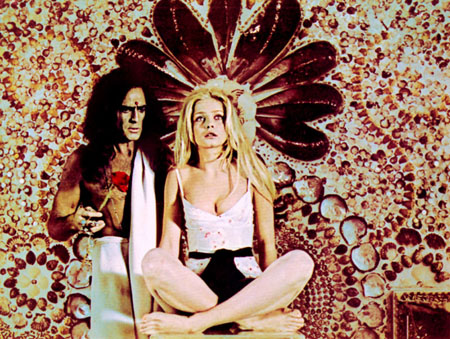
Still from Candy (1968)

WHY IT WON’T MAKE THE LIST: Ah, the late 1960s all-star wacky counter-culture cash-in flop. I have a personal affection for this suspect subgenre, which includes Casino Royale and Myra Breckinridge among other campy disasters. The whole mini-movement was inspired equally by “Laugh-In,” screenwriters with LSD connections, and Hollywood execs’ hopes of wringing the spare cash that hadn’t been blown on grass from out of hippies’ pockets. Sadly, as the number of available remaining slots on the List of the 366 Best Weird Movies grows ever smaller, we have to be ever more selective, and Candy has neither the balls-to-the-walls weirdness nor the cinematic competence to challenge for a spot among the very strangest films. Having the even more stunning and misconceived Skidoo on the List to represent this movement takes some of the sting out of reluctantly passing on this wild and wooly folly.

COMMENTS: , fresh off an Oscar for The Graduate, wrote Candy‘s script. Douglas Trumbull (the man responsible for 2001: A Space Odyssey‘s “cosmic gate” scenes) did the opening and closing effects. The Byrds, Steppenwolf and Dave Grusin appear on the impressive soundtrack. With that lineup of talent, along with a cast sporting multiple Oscar winners, it’s a shock how awful Candy can be at times. The blame can go to none other than director Christian Marquand (a successful French actor), whose second and final turn at the helm of a major motion picture was this financial shipwreck. Fortunately, at its best (er, worst), Candy is laughably awful, with enough “WTF?” moments (both intentional and unintentional) to keep your eyes glues to the tube.

The plot is a series of nearly-satirical vignettes in which a cross-section of American manhood attempts to grope, seduce, and violate the naïve Candy, who only wants to find her missing father. It is, as the kids today say, kind of rapey; but the menaces the nubile Ewa Auin faces are so silly and absurd that it’s hard to take offense. Candy appears confused rather than frightened by the men’s advances, and whenever someone does score, she enjoys it, in the free love spirit of the times. Her molesters are, in turn, a drunken poet (Burton, as a teen idol version of Dylan Thomas); a Mexican gardener (Ringo Starr, who makes look like a Guadalajara native by comparison); an air force commander (Walter Matthau); her father’s twin brother; two medical professionals (Coburn and Huston); an underground filmmaker; a hunchback (Azvanour); a self-appointed guru traveling the country in a big rig (Brando); and a mysterious cloaked figure. Among the male cast, opinions are divided on who comes off best and worst, but even if their performances are halfway decent (Coburn), the actor’s star is tarnished just by appearing in this mess.

If you’re looking for weird bits beyond the spectacle of big names embarrassing themselves, we only need to point to the opening and closing, which imply that Candy is some sort of star child sex messiah. Then there’s the scene in a glass-bottomed limousine, shot from below; a drunken Burton making love to a mannequin; a wall-scaling hunchback; and every moment of Brando’s politically incorrect brownface performance as an Indian guru who teaches Candy both levitation and the advanced spine-warping version of the Kama Sutra. Individually, some of the sequences work, but the movie never gets a comic rhythm going, and even the horrible acting rarely elicits a chuckle. It does, however, get weirder as it goes on, coming to resemble a softcore “Alice in Wonderland” more than its original inspiration, Voltaire’s “Candide.” It’s one of those fabulous extravagances that could only have emerged out from behind of a cloud of smoke in the psychedelic era.

The eclectic cast and crew of the film adaptation fits Candy’s curious history. It started life in 1958 as a satirical pornographic novel by Terry Southern and Mason Hoffenberg, which was originally banned but became a succès de scandale when it was republished in the 1960s. “Candy” helped launch Southern’s career: he went on to write or contribute to screenplays for Dr. Strangelove, Barbarella, Easy Rider, and the adaptation of his own novel The Magic Christian. (Reportedly, Southern was not a fan of this 1968 adaptation). Candy was remade twice in 1978 (without authorization, with just enough changes to avoid lawsuits), as dueling hardcore sex films: The Erotic Adventures of Candy and Pretty Peaches. Pretty Peaches, at least, was quite accomplished for an adult film, with bubbleheaded Desiree Cousteau arguably outperforming debuting Ewa Aulin, and has probably been seen far more often than this official studio-backed adaptation. Long neglected, in 2016 Kino Lorber re-released Candy on DVD and Blu-ray, with interviews with Buck Henry and film critic Kim Morgan (‘s wife) among the extras.

WHAT THE CRITICS SAY:

“…a trippy, candy colored comedy with sci-fi and fantastic overtones, complete with a mindblowing cosmic finale. There really hasn’t been another movie quite like it, and for those who can handle cinematic head trips laced with chuckles and gorgeous visuals, this Candy is dandy indeed.”–Mondo Digital (DVD)

(This movie was nominated for review by “kengo,” who rhapsodized “Cheesy sleazy patchy fun, with a bit of hit and miss satire and no discernible plot, but it does have McPhisto! – Richard Burton at his best. Hollywood was good in the sixties.” Suggest a weird movie of your own here.)

LIST CANDIDATE: TALE OF TALES (2015)

Il Racconto dei Racconti

DIRECTED BY:

FEATURING: , , , Bebe Cave

PLOT: Peace and harmony reign between three neighboring kingdoms, but all is not well with the countries’ monarchs: in her desire for an heir, the Queen of Longtrellis goes to extremes; trying to avoid marrying off his daughter, the King of Highhills accidentally dooms her to wed an ogre; and the King of Strongcliff attempts to woo an unseen (and unsightly) singer that won his heart.

Still from Tale of Tales (2015)

WHY IT SHOULD MAKE THE LIST: Director Matteo Garone weaves together three differently unsettling fairy tales with a sure hand and A-list actors. Sea monsters, giant fleas, and creepy albino twins are just a few of the wondrous sights to see in this medieval fantasy. The undercurrents of death, deformity, and violence make for an unsettling amalgam when coupled with picturesque castles and countrysides.

COMMENTS: An international cast, sumptuous European locales, familial conflict—yessir, Tale of Tales screams “Film Festival” and “Art House.” Fortunately for us, attributes like bloody murder, spontaneous gestation, and youth-bringing lactation also make it scream “weird”! Indeed, looking over some of the “Weirdest Search Terms” from my time here, I suspect at the very least that last one will notch 366 another visitor from the far corners of the web. Tale of Tales delivers a strong dose classic European fairy-tales without skimping on the grisly elements that made them such macabre stories.

Using three stories from Giambattista Basile’s early 17th-century collection of Neapolitan fairy-tales, director Matteo Garrone allows an unlikely group of fantasy characters to stumble toward their fates, occasionally stumbling into each other. The Queen of Longtrellis’ (Salma Hayek) husband is slain while killing a sea beast he hunted so that his wife could devour the monster’s heart—a solution, we are told, for the couple’s infertility. Attending the funeral is the kind-hearted King of Highhills (Toby Jones) together with his daughter Violet (Bebe Cave). We also meet the lusty lord of Strongcliff (Vincent Cassel), appearing from beneath the skirts of two courtesans in his coach before arriving at the procession. Things bat back and forth between their tales throughout the movie, and needless to say, the roads these monarchs and their families take are a bit bumpy.

Judging the “weird” merits of a fantasy movie can be a challenge, for while unreal things necessarily go on, that is expected from the genre. However, the defense of my bold claim in the case of Tale of Tales is made easier because of the extremes the movie goes to with its material. The story of the Queen of Longtrellis alone cements things firmly in our realm of the weird. Not only did the Queen need to eat the serpent’s heart, but during the preparation thereof (by, as specified, a solitary virgin) the young cook becomes with child herself; both women are pregnant just one day before delivering, separately, identical albino twins. Disapproving of her own son, Elias ((“Elias” is a variant of “Elijah”, the prophet known, among other things, to be the harbinger of the End of Days; he twice fills this role vis-à-vis his own parents.)), fraternizing (as it were) with the peasant’s son, Jonah (( That a boy conceived by the consumption of the heart of a giant fish should be named “Jonah” is, in my view, more than a bit gratifying.)), the Queen eventually makes a second Faustian bargain resulting in, to put it crudely, “Form of Bat!” …And on top of that there’s the mightily growing flea-pet of the King of Highhills and the sad tale of the two crones who accidentally steal the heart of the King of Strongcliff.

I’m generally skeptical of the “interlocking narrative” structure found in some films — I regard it as a poor excuse to cobble together what should have been multiple short ones. However, the tone in Tale of Tales is consistent throughout, and any potential disjointedness is mitigated both by the very smooth editing work and the presence of a troupe of carnival performers who appear at key points throughout the three narratives. And did I mention there’s ? Showing up barely in time for his own demise, I like how he can always be counted on to add a touch of pathos. Tale of Tales is a beautiful, weird movie that is a reassurance to fantasy genre fans everywhere.

WHAT THE CRITICS SAY:

“There was already something wonderfully weird and carnivalesque about Italian filmmaker Matteo Garrone’s past films… Now, the director has let his circus ringmaster’s instinct flower with the bold, barmy ‘Tale of Tales’… the sheer, obstinate oddness of ‘Tale of Tales’ sends crowd-pleasers like ‘Game of Thrones’ and ‘The Hobbit’ scuttling into the shadows of the forest in terror.”–Dave Calhoun, Time Out London (contemporaneous)

WEIRD HORIZON FOR THE WEEK OF 11/11/2016

Our weekly look at what’s weird in theaters, on hot-off-the-presses DVDs, and on more distant horizons…

SCREENINGS – (New York City, IFC Center, Nov 11 & 12 at midnight):

Blue Velvet (1986): Read the Certified Weird entry! IFC has made ‘s sadomasochistic 80s nightmare into a welcome midnight staple. “Now it’s dark…” Blue Velvet at IFC Center.

FILM FESTIVALS – AFI Fest (Los Angeles, CA., Nov. 10- 17):

The American Film Institute’s official film festival strictly hosts premieres. It occurs so late in the year, however, that many movies with awards aspirations choose to debut elsewhere, so programmers cheat just a little for big names like Jackie, La La Land, and Moana, which have played all over the country but make their California premieres here. It’s still a prestigious feather in the cap for smaller art films and late-debuting foreign movies. We’ve already covered the mermaid musical The Lure, which we hope will make a splash here, but here are some more artily weird offerings that are new to us:

  • Buster’s Mal Heart – Buster has two (or maybe more) personalities, literally existing in two separate bodies: one a family man, the other a bearded hermit. Debuts Nov. 11 (tonight), with an encore on Nov. 16.
  • A Dragon Arrives! – A police inspector buries the body of an assassinated politician found in a shipwreck in the middle of the desert in a nearby cemetery, causing a localized earthquake, in tis absurdist Iranian experimental film. Nov. 15 & 16.
  • Fear Itself – A “stream of consciousness” documentary about horror films incorporating clips from several Certified Weird movies: Altered States, Antichrist, Brazil, Carnival of Souls, Don’t Look Now, Lost Highway, Mulholland Drive, Night of the Hunter, Nosferatu, Repulsion, Suspiria, Tetsuo: The Iron Man, and Videodrome (credit goes to this IMDB post for the list). Nov. 13 & 14.
  • Kati Kati – Kenyan magical realist movie where Purgatory exists on the savanna. Nov. 15 & 16.
  • Malgré la Nuit – An abstract thriller about a man going undercover to search for his lost love, whom he fears may have become the victim of a snuff film ring. Nov. 15 & 16.

AFI Fest homepage.

FILM FESTIVALS – Ithaca Fantastik Festival (Ithaca, NY, Nov. 9- 13):

In only its fifth year of operation, this out-of-the-way festival held in a college town in upstate New York doesn’t get the big premieres, but they have snapped up some very cool, obscure and, yes, weird films from the second tier. Some of the films we’ve noted playing at other festivals are the Filipino bloodfest Alipato–The Very Brief Life of an Ember, the Swiss psychological detective fantasy Aloys, and the highly recommended outsider ode She’s Allergic to Cats. Here are some others to check out:

  • Altered States (1980) – Ken Russel’s creates the world’s big-budgeted trip movie. See it on the big screen Nov 13.
  • Nova Seed – Created frame-by-frame by Nick DeLiberto, it’s a post-apocalyptic fantasy that looks like a (nostalgically) cheap 1980s Saturday morning cartoon. Playing today, Friday Nov. 4, at 4 PM, so if you’re in Ithaca and you’re reading this get out there now! The rest of us will wait on a DVD.
  • A Page of Madness (1926) – Japan’s first Surrealist film is a silent movie about a man getting a job as a janitor at an insane asylum to be near his mentally ill wife. Avant-garde composer Tenzin Chopak conducts live electronic accompaniment to the Nov. 13 screening.
  • Terror 5 – This Argentinian horror import about five horrific events that occur on one night is one of the few films making its American debut at Ithaca; programmers describe it as “experimental,” “dream-like,” and “surreal.” Check it out Nov. 12.

Ithaca Fantastik Festival homepage.

NEW ON BLU-RAY:

Bubba Ho-Tep (2002): Read the Certified Weird entry! Nursing home Elvis and black JFK fight a mummy in this Shout! Factory Collector’s Edition with new commentary from the short story’s original writer, new interviews with cast and crew, and more (although sadly, it looks like they couldn’t get the rights to the in-character commentary track by ). Buy Bubba Ho-Tep [Collector’s Edition Blu-ray].

Night Has a Thousand Desires (1984): A woman who works in a telepathic nightclub act who dreams of murders that come true. It’s a typical uneven erotic horror of the post-Franco period, complete with a nude Lina Romay, although some say it’s both weirder and better-made than some of Jess’ other schlock cheapies. Buy Night Has a Thousand Desires.

What are you looking forward to? If you have any weird movie leads that I have overlooked, feel free to leave them in the COMMENTS section.

DOCTOR STRANGE (2016)

Created by Steve Ditko, Doctor Strange was an authentically odd character in the Marvel universe of the 1960s. Aptly, he debuted in the “Strange Tales” comic. The character almost perfectly encapsulated Ditko’s idiosyncratic, surreal pencil work, even more so than his better known co-creation, Spiderman. Complementing Ditko’s art, Stan Lee scripted the character as a hybrid mixture of Jungian archetypes with a theosophist cocktail of Eastern mysticism and Egyptian mythology. When other artists took over Doctor Strange after Ditko’s departure, it never had quite the same texture, and quickly became bland before descending into parody as the good doctor could be found in superhero team-ups with the likes of Hulk and Spiderman (!)

A pulp mystic, the character hardly seemed like a viable nominee for big screen treatment, and when Doctor Strange (2016) was announced as the next Marvel movie, the prospects didn’t look hopeful, considering director Scott Derrickson’s execrable resume.  Surprisingly,  Derrickson and his co-writers went straight to Ditko and Lee’s original source material, delivering an entertainingly psychedelic production, which is helped by actor Benedict Cumberbatch in the title role, , the ever reliable , and .

Still from Doctor Strange (2016)As much as embodies Iron Man, Cumberbatch does the same for this surgeon with the Trump-sized ego. However, an accident leaves Doc’s precious surgical hands mutilated, prompting him to seek enlightenment via the Ancient One (Tilda Swinton, filling in for ), Mordo () and Wong (Benedict Wong). Before you can say Expecto Patronum, Strange sees the light and transforms into Chandu the Magician heading to the next Hare Krishna meeting. Despite the here-we-go-again St. Paul conversion myth, it plays out much more uniquely, viscerally, and tongue-in-cheek than one might expect.  As Strange perfects his new metaphysical trade, the CGI actually enhances the narrative, as opposed to distracting us from it—and, yes, see it in 3D, because that’s the best route for trippy 60s symbolism. Derrickson and company faithfully recreate and expand upon Ditko’s peculiar brand of surrealism and the havoc they wreak with illusionary imagery from the mirror universe is refreshingly off-kilter.

In a rarity for something churned out by Marvel, the director and team have been given room to play outside of conveyor-belt dictates. The fun they have is contagious, but such a subject can only be as good as its villain. Fortunately, they have one in the outlaw mystic Kaecilius (Mikkelsen) who engages in a phantasmagoric battle with Strange on the streets of New York (aided considerably by Michael Giacchino’s galvanizing score). Mikkelsen’s Kaecilius could very well be his astral, Dark Dimension, bony version of Hannibal Lecter (and shame on those who missed that late series, which rendered the /Jonathan Demme version obsolete), delivering his hocus-pocus dialogue with such aridity, he scares the hell out of you just by speaking. Mikkelsen is cast well (although underused) against Cumberbatch’s in-the-know remote wit. Likewise, McAdams is smartly cast as Strange’s ex-girlfriend who literally assists in his physical and metaphysical healing. The actors, coupled with visuals blatantly inspired by MC Escher, give Doctor Strange an all too uncommon individuality. This is not the Avengers taking turns pounding away at big shiny black, metallic thingamajigs. Rather, the good doctor, with his cloak of levitation, takes his battles to the realm of pop nightmares, which makes the late hint to an inevitable Avengers tie-in all the more disappointing. Is it weird? Nah, but it’s an empyrean burlesque and, for this studio, that is a surprising treat.

Celebrating the cinematically surreal, bizarre, cult, oddball, fantastique, strange, psychedelic, and the just plain WEIRD!