Tag Archives: Surrealism

LIST CANDIDATE: THE ORNITHOLOGIST (2016)

O Ornitólogo

366 Weird Movies may earn commissions from purchases made through product links.

DIRECTED BY:

CAST: Paul Hamy, Xelo Cagiao Teijo, Han Wuen, Chan Suan

PLOT: After being swept away by rapids, Fernando, an ornithologist looking for black storks, finds himself in a mysterious forest where he’ll undergo a transformative spiritual journey mirroring the life of Saint Anthony of Padua.
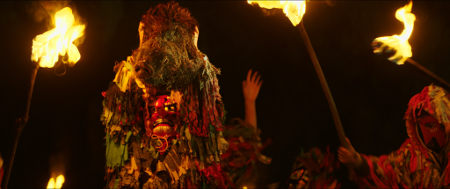
Still from The Ornithologist (2016)

WHY IT SHOULD MAKE THE LIST: The Ornithologist is the allegorical tale of an atheist ornithologist’s conversion through a succession of increasingly bizarre occurrences. Given that these moments vary from slightly odd to truly surreal, the film plays the weirdness card, although the limited number of remaining slots in the List make its inclusion uncertain.

COMMENTS: The first shots of The Ornithologist, after an introductory quote by Saint Anthony, depict a dark, calm river with a bird and plant life, accompanied by the ambient sounds of nature. After the film’s weird notes kick in, the atmosphere remains remarkably the same: quiet and naturalistic, persistently treating the strange sights of Fernando’s mystical journey as perfectly normal. The stunningly shot setting, a Portuguese forest that director João Pedro Rodrigues populates with strange images and figures, also persists for the entirety of the movie (save for the very last, and very weird, scene).

After he crashes his kayak, the titular protagonist is rescued by two female Chinese pilgrims, on their way to Santiago de Compostela, with whom he spends the night. This moment marks the film’s first foray into Fernando’s symbolic journey, as well as a turn to a darker tone. When a menacing sound is heard, the frightened pilgrims assume it’s a demonic entity just as quickly as Fernando casually rebuts their belief, claiming there’s no God or Devil. Shocked by his lack of faith, they oblige him to sleep outside of their tent, and the next morning finds him tied to a tree.

From that point on, the steps on the ornithologist’s conversion grow progressively surreal; some are blatant in their symbolism (such as the appearance of the Holy Spirit as a white dove), others more obscure (naked amazons shooting him with a rifle, only to have a quick chat with him after he revives). Most are blasphemous and/or contain homoerotic undertones. They include Fernando’s baptism in urine (!), sex with a mute shepherd named Jesus (!!!), and the appearance of what appear to be embalmed animals in the woods, among other outrageous stops in his mystical-existential self-discovery arc.

These episodes are consistently engaging and reveal Rodrigues’ fascination with Christian iconography, mysticism and eroticism (a potently heretical mix), as well as his intention to filter universal religious symbols through his personal sensibilities. The “enlightenment quest” narrative will likely remind weirdophiles of ’s El Topo or The Holy Mountain, but the film is stylistically much closer to ’s Uncle Boonmee Who Can Recall His Past Lives. Like that film, The Ornithologist‘s bizarre and phantasmagorical apparitions seamlessly blend in the environment as if they were no less natural than a tree or a bird. Accordingly, our main character remains stoic throughout his adventure. Speaking only when needed (that is, sparsely), his language, like the film’s, is mostly non-verbal. Actor Paul Hamy subtly conveys feelings of confusion and curiosity; interestingly, he has explained in interviews that he likes physical expression, comparing himself to a sculpture that the director shapes in front of the camera. The Ornithologist displays this particularly well, as Hamy’s character is aloof and his metamorphosis occurs internally, manifesting itself mostly in his careful physicality and expressions.

Even if you have difficulty relating to Fernando, it’s apparent that this is a very personal affair for Rodrigues. At one point near the end, the director himself literally steps into the shoes of the main actor. The character’s name changes to António (another reference to Saint Anthony), signalling that his transformation is complete. Fernando is not meant to be an avatar of the audience but, rather, of his creator; as a result, viewers without familiarity or investment in the narrative of Saint Anthony may find themselves estranged. The story is clearly very important to Rodrigues, and ultimately asserts itself as vaguely autobiographical. This is not to say, however, that its deeper meaning is impenetrable. Surely, watching The Ornithologist is, above all, an experience, and the beautiful cinematography and pervading atmosphere, languid and sometimes sinister, will please the adventurous viewer. But I believe exploring the film’s symbolism is a rewarding enhancement. Like Fernando, we feel shipwrecked and disoriented in such a strange environment, but by the end, we’ll probably have changed.

WHAT THE CRITICS SAY:

“Rodrigues toys with his audience with the deadpan playfulness of Luis Buñuel, whose films The Ornithologist sometimes recalls in its tricky approach to religious themes… If nothing else, the film reminds one of how strange and beautiful existence can be.”–Ben Sachs, The Chicago Reader (contemporaneous)

309. DEATH LAID AN EGG (1968)

La morte ha fatto l’uovo, AKA Plucked

“I think that’s a peculiar way to put it, men and chickens mixed up like that.”–Death Laid an Egg (dubbed version)

RecommendedWeirdest!

DIRECTED BY:

FEATURING: , Gina Lollabrigida, Jean Sobieski 

PLOT: The movie opens with a prostitute killed in a hotel room. The action then moves to an experimental poultry farm, largely automated but overseen by Marco, his wife Anna, and their beautiful live-in secretary Gabri. The plot slowly reveals a love triangle, with multiple betrayals, with Marco’s growing disgust at the poultry business brought to a boil when he finds a scientist has bred a species of headless mutant chickens for sale to the public.

Still from Death Laid an Egg (1968)

BACKGROUND:

  • The title was almost certainly inspired by a line from Surrealist icon ‘s “Lament for Ignacio Sanchez Mejias“: “Death laid eggs in the wound/at five in the afternoon.” Late in the movie Marco will mutter to himself “At 5 o’clock… the machine… the egg… the work…” and several shots focus on a clock approaching the 5 PM mark.
  • The second of an unofficial trilogy of surrealist movies director Giulio Questi made in “disreputable” genres. For more on Questi’s odd career, see the last paragraph of the Django Kill… If You Live, Shoot! review.
  • Death Laid an Egg was restored in 2016 by Nucleus Films from a newly discovered negative that contained a couple minutes of footage not seen in previous releases. The film was available on VHS in a dubbed version, but outside of suspect bargain versions from overseas, it was unavailable on DVD or Blu-ray until 2017.
  • Bruno Maderna, who wrote the atonal score, was an accomplished classical composer and conductor who died of cancer at the relatively young age of 53, a mere five years after Death Laid an Egg was completed.

INDELIBLE IMAGE: The exotic Lollabrigida and the nubile Aulin are a tempting pair of birds, but they’re upstaged by the actual poultry in this one. The oddest sight of all is hens stuffed into file folders for alphabetization (?) in a chicken functionary’s office.

THREE WEIRD THINGS: Playboy chickens; filed chickens; all-breast chickens

WHAT MAKES IT WEIRD: A juicy slice of breaded with a coating of and seasoned with a sprinkling of , Death Laid an Egg was the world’s first (and so far, only) deep-fried, chicken-centric Surrealist giallo.


Original Italian trailer for Death Laid an Egg

COMMENTS: Personal anecdote: the first time I watched Death Laid Continue reading 309. DEATH LAID AN EGG (1968) →

308. FUNERAL PARADE OF ROSES (1969)

Bara no sôretsu 

“Elle est dans ma voix, la criarde!
C’est tout mon sang ce poison noir!
Je suis le sinistre miroir
Où la mégère se regarde.”

“It’s in my voice, the raucous jade!
It’s in my blood’s black venom too!
I am the looking-glass, wherethrough
Megera sees herself portrayed!”

–Baudelaire, “L’Héautontimorouménos,” Fleurs du Mal (English translation Roy Campbell)

Recommended

DIRECTED BY: Toshio Matsumoto

FEATURING: Peter (Pîtâ), Yoshio Tsuchiya, Osamu Ogasawara, Toyosaburo Uchiyama

PLOT: Eddie is a rising star in a Japanese drag cabaret; he is having an affair with the bar’s owner, Gondo. The club’s “madame,” Leda, who is also sleeping with Gondo, grows jealous of Eddie and devises a revenge against him. This story is served up out-of-sequence, however, and often broken up by stand-alone vignettes and documentary-style interviews where the actors are questioned about their alternative lifestyles and their roles in the film.

Still from Funeral Parade of Roses (1969)

BACKGROUND:

  • This was director Toshio Matsumoto’s first feature film after producing nine shorts (mostly documentaries). Matsumoto would continue to work largely in the short format: among his thirty-four credited directorial works, only four are categorized as full-length features. He was also a critic and theorist whose collected writings span six volumes. He died in 2017.
  • The “gay boys” were played by non-professional actors from the Tokyo homosexual community. The star, Peter, developed an acting career afterwards, advancing far enough to land the role of the Fool in ‘s Ran.
  • The Japanese word meaning “roses” was also derisive slang for homosexuals.
  • The avant-garde short screened within the film is “Ecstasis,” which also stars Peter and Toyosaburo Uchiyama.  Matsumoto released it separately.

INDELIBLE IMAGE: Eddie’s face, not androgynous, but wholly feminine, though glamed-up with an array of tiaras, false eyelashes, and decorative star stickers. We particularly like the scene where Leda (dressed as a geisha) is admiring herself in the mirror (and silently incanting “Snow White”‘s “mirror, mirror, on the wall…”), as an image of Eddie strides up from behind, invading Leda’s looking-glass in his black evening gown.

THREE WEIRD THINGS: Ladies at a urinal; drag queen shootout; too-literal Oedipus complex

WHAT MAKES IT WEIRD: Helped along by an earnestly queer cast of amateurs, Funeral Parade of Roses is a masquerade drag burlesque, a tragic and absurd procession of countercultural confusion among “gay boys” in a tumultuous Japan. A psychedelic-era movie set in Tokyo’s underground homosexual community that takes its bearings from “Oedipus Rex” and name-checks Jonas Mekas and Jean Genet along the way—pausing for a liberal dose of slapstick—is bound to turn out weird.


Brief fan-edit of scenes from Funeral Parade of Roses

COMMENTS: “Each man has his own mask,” says the voice from the Continue reading 308. FUNERAL PARADE OF ROSES (1969) →

304. LAST YEAR AT MARIENBAD (1961)

L’Année Dernière à Marienbad

366 Weird Movies may earn commissions from purchases made through product links.

Must SeeWeirdest!

“Who knows what true loneliness is, not the conventional word—but the naked terror? To the lonely themselves it wears a mask. The most miserable outcast hugs some memory, or some illusion.”–Joseph Conrad, Under Western Eyes

DIRECTED BY:

FEATURING: , Giorgio Albertazzi, Sacha Pitoëff

PLOT: In the confines of the corridors, salons, and gardens of an outlandishly extravagant spa hotel, one man attempts to persuade a female guest that they met a year prior and had planned to run off together. At first she resists his suggestions, but as he repeats his reminiscences, her denial becomes more and more strained. As they flit about the hotel, other guests fade in and out of focus, and the young woman’s male companion looms ever more ominously.

Still from Last Year at Marienbad (1961)

BACKGROUND:

  • Last Year at Marienbad was born of a collaboration between , who had achieved fame for his revolutionary non-narrative novels (dubbed nouveau roman), and Alain Resnais, who had recently completed Hiroshima, Mon Amour. In the opening credits, Robbe-Grillet is billed before Resnais. Afterwards, Robbe-Grillet was inspired to become a (defiantly strange) director himself, eventually notching two Certified Weird films (L’Immortelle and Eden and After) under his own leadership.
  • Cannes had refused to accept the movie as an entry, officially citing the fact that the lead actor was not French, but according to rumor because of Resnais’ public stance against the Algerian War.
  • Winning the Golden Lion award at the Venice Film Festival in 1961 forced the distributors to rethink their strategy of a very limited release.
  • In hopes of recreating a “silent movie” feel for Marienbad, Resnais requested some old-fashioned film stock from Eastman Kodak. Unfortunately, they were unable to provide it.
  • (The Tin Drum) apprenticed on this film as second assistant director.
  • Included in both Harry Medved’s “The Fifty Worst Films of All Time (And How They Got That Way)“ and Steven Shneider’s “1001 Movies You Must See Before You Die.” The movie divided contemporary critics and audiences, as well.
  • The alternately somber and jarring score (performed mostly on solo organ) was written by Francis Seyrig, the lead actress’ brother.
  • Robbe-Grillet was nominated for a “Best Original Screenplay” Oscar (losing to Divorce Italian Style).
  • Selected by 366 Weird Movies readers as one of two winners of our penultimate readers’ choice poll.

INDELIBLE IMAGE: Talk about being spoiled for a choice! Any given scene in Marienbad is a showcase of divinely arranged formalist beauty. What sets the tone (and stands out the most), however, is the alternately freezing and unfreezing of the actors immediately following the play performance that begins the film’s “action” (so to speak). The camera gracefully slinks around the the hotel’s inhabitants as the characters’ action and chatter stop dead, only to start anew a few moments after being silenced.

THREE WEIRD THINGS: Living freeze-frames; “I always win”; shadowless trees

WHAT MAKES IT WEIRD: Narratively speaking, Marienbad is about as bare-boned as a film can be without slipping into the realm of incomprehensible. A man and a woman met, or possibly didn’t meet, a year ago, and now the man wants the woman to run away with him. Alain Resnais brings Alain Robbe-Grillet’s dreamy script to geometric life with time fluxes, repetitions, and stylized acting by stylized hotel patrons. The black and white cinematography and challenging edits heighten the sense of shattered narrative that, much like the vicissitudes of human memory, can’t fully coalesce.


Original Trailer for Last Year at Marienbad

COMMENTS: As an art form, film exceeds its competition in manipulation: manipulation of emotions, of perceptions, and of ambiguity. Continue reading 304. LAST YEAR AT MARIENBAD (1961) →