Tag Archives: Recommended

CAPSULE: SLACKER (1991)

Recommended

DIRECTED BY:

FEATURING: The citizens of Austin, Texas

PLOT: Slacker spies on the aimless exploits of the slackers of Austin, TX; the camera follows one character for a few minutes, then veers off to chase another through a series of comical, philosophical, and absurd vignettes involving hit-and-run drivers, elderly anarchists and video fetishists.
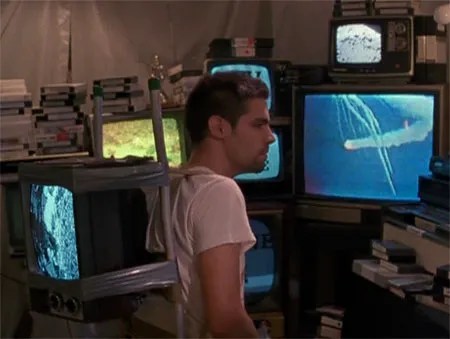
Still from Slacker (1991)

WHY IT WON’T MAKE THE LIST: Slacker is a seminal, interesting, and at times incisive storytelling experiment, but it’s of interest to weirdophiles mainly as the spiritual prequel to Waking Life, which is virtually Slacker remade as a dream.

COMMENTS: The batty cast list—credited characters include “Dostoevsky Wannabe,” “Recluse in Bathrobe” and “Hit Up for Cigarettes”—accurately reflects the mix of mundanity and eccentricity on display in writer/director Richard Linklater’s slice-of-life tour of the coffee shops and crash-pads and on the fringes of Austin, Texas in 1991. Slacker is a character study of the subculture of bright but unambitious dropouts and unemployed postgrads bent on extending their undergrad lifestyles that exists in every college town. At the time of its release it was seen as emblematic of “Generation X”‘s alienation and withdrawal from mainstream culture, but in reality this Bohemian substrata of unmotivated aesthetes and anti-establishment hedonists has always been with us under various names (if the movie had been made in 1291 in Saint-Rémy-de-Provence it would have been entitled Goliard). For this peripatetic essay Linklater borrows the elegant but seldom used narrative device invented by Luis Buñuel for The Phantom of Liberty: two characters walk down the street discussing whether they should leave the country, then the cameraman suddenly gets bored and starts following a man who enters a coffee shop where an insane woman advises him that he should “never traumatize a woman sexually,” then decides instead to see where the guy who just entered the shop wearing a bathrobe is headed to, and so on. The result is a series of vignettes which are occasionally funny, occasionally disturbing, and often repetitive, but which capture a peculiar, laid-back, mad energy of a particular place at a particular point in time. Still, as the film’s oldest character rhapsodizes when remembering Charles Whitman, “this town has always had its share of crazies—I wouldn’t want to live anywhere else.” Memorable characters range from the UFO enthusiast who accosts passersby to explain his theory that we’ve been on the moon since the 1950s to the tomboy who’s looking to fence stolen celebrity gynecology artifacts, cheap. Linklater, who delivers the first of the film’s many discursive monologues himself in the role of “Should Have Stayed at the Bus Stop,” shows an attitude of fond disdain for a town where everyone sleeps in late and is working on an unfinished novel or playing in an unsigned band. The director may have arisen out of the Austin milieu, but if he’s a slacker, then he’s a type-A personality slacker; he’s obviously a much harder worker than the guy who earnestly muses “who’s ever written a great work about the tremendous effort required not to create?” over a cup of cappuccino.

If Slacker has one downside (besides excusably spotty acting by the amateur cast), it’s that the movie turns repetitive and arguably outstays its welcome. Somewhere between twenty and forty-five minutes in we start to get the picture; although the UFO guy and the JFK guy have totally different obsessions, ultimately they’re both just proselytizers with a passion for explaining stuff we don’t care about to us in ridiculous detail. The overall portrait Linklater manages to paint is still very impressive; Slacker may be the most passionate and invigorating movie about doing nothing ever made.

On a personal note, I was lucky enough to see Slacker in Austin, TX in 1991 in a theater in a strip mall (I lived in Dallas at the time but had a friend attending UT with a couch I could crash on). The movie, which was playing nowhere else in the country, had been held over for a second week, and the afternoon matinee showing was standing room only; everyone in the audience but me probably had a friend or two who was an extra in it. I had an aisle seat; a middle-aged woman came in late and stood next to me during the entire show, shooting me nasty looks as she shifted from foot to foot. I recall thinking it ironic that the Austinite had to stand through the whole performance simply because she had slacked off on getting to the show on time.

WHAT THE CRITICS SAY:

“…funny, surreal and weird… Linklater traces the dehumanized weirding of America — as collectively defined by David Lynch, Errol Morris, Jim Jarmusch and others. But he does it with a detached, yet sympathetic sense of irony.”–Desson Howe, The Washington Post (contemporaneous)

(This movie was nominated for review by nicolas, who suggested that all of Linklater’s films were “pretty weird and deep with one or two exceptions.” Suggest a weird movie of your own here.)

CAPSULE: LIKE SOMEONE IN LOVE (2012)

Recommended

DIRECTED BY:

FEATURING: Tadashi Okuno, Rin Takanashi,

PLOT: Akiko is a young female student moonlighting as a call girl; her pimp sends her on an assignment in the suburbs, where her client, Takashi, is an elderly professor who doesn’t seem terribly interested in her carnal services. When he deigns to drive her back to the city the next day, he begins to take on an unexpectedly intimate role in her life, becoming personally involved in her troubled relationship with Noriaki, her possessive boyfriend.

Still from Like Someone in Love (2012)

WHY IT WON’T MAKE THE LIST: The weirdest thing about Like Someone in Love is that it eschews the most predictable filmmaking conventions: a traditional narrative arc, gratifying resolution, and explanatory coherence. This results in a powerful film, but not one that breaks dramatically with film language or narrative logic. It’s a moody, sensitive character study with the rhythms of an art film, not a groundbreaking work of cinematic weirdness.

COMMENTS: Like Someone in Love doesn’t have much of a traditional narrative arc, and it doesn’t play much with our expectations… as a result, there’s a pronounced lack of suspense and release, a tendency to eschew those kinds of narrative pleasures that normally attend these things we call “movies.” In a way, it feels more like a self-contained art object, a constellation of characters and relationships that’s designed to intrigue the active mind.

There’s nothing so radical about the film that it should de facto qualify for the Weird Movies list. Its organic rhythms and intentional ambiguity should be familiar to anyone who’s seen some art films. On its own merits, though, it’s a masterful work of cinema, an ideal case study in style, technical proficiency, and unified vision.

One of the great things about Like Someone in Love is how it demonstrates the strength of this kind of ambiguous, minimalist filmmaking: within its naturalistic treatment of its subjects, it creates huge fertile spaces for the proliferation of symbolic meanings and psychological resonance. It’s shot painstakingly, with the camera always intensely aware of its space. Doorways, reflections, confined interiors, obstructions, and the space outside the frame: all these become Kiarostami’s playthings. In his control of objects and the camera’s eye, he is reminiscent of , whose style was similarly deliberate, ostensibly naturalistic, but profoundly self-aware.

The result of this high level of control is that many objects take on cosmic symbolic (or psychological) significance. Windows and glass are especially important to this story, protecting various characters from outside forces, allowing them to maintain their distance and their illusions. Telephones are also rich in meaning, providing vectors and blind spots where each character’s defenses can be penetrated. Cars? Another symbol with apparently endless significance: Takashi’s car is one of his domains of safety and control, and Noriaki seems to have an unusual power over cars, being a mechanic himself.

As an “art object,” Like Someone in Love is not merely an assemblage of these kinds of thematic adornments. It also has weight and substance to it, especially in its complex characters and their occasional poignant moments. One of the earliest scenes is an extended car ride to the suburbs, as Akiko watches the city lights slide by and listens to a series of phone messages from her grandmother. The power in this lengthy scene is tremendous, and I can’t hope to describe its emotional effect. It has the touch of a genuinely brilliant filmmaker.

A great deal of the film concerns the difference between the young and the elderly, which Takashi evokes when he talks about “experience.” The young people in the film—Akiko and Noriaki—are swallowed up by ambitions and pretenses and delusions, and their attitudes contrast sharply with that of Takashi, who faces the world with a wealth of patience and composure. These characters are rendered richly in gestures and pauses and hesitations, and in this regard, Kiarostami recalls the work of Ozu, who often addressed this theme, and did it with many of the same tools.

These characters are drawn into mysterious constellations of authenticity and deception and mistaken identity. In this regard, Someone in Love feels like Certified Copy, Kiarostami’s last film. Both films dealt with the fluidity of identity and the shifting of roles, and even as both films hinged on a broad self-imposed deception, both seemed to find a deeper truth in the lie. Regarding Like Someone in Love, this prompted Richard Brody of The New Yorker to suggest the following thesis: “Love is a lie, but it’s one that’s best not to ask questions about.”

Brody’s attempted thesis statement is one excellent way of reading the film, but it’s certainly not the only one. One of the best things about this curious, multifaceted cinematic work is that it’s about many things at once, even as it seems to be a simple, if oblique, story fragment about love and mistaken identity. It may not be among the weirdest films, but I would certainly count it among the best.

WHAT THE CRITICS SAY:

“It’s odd in a film when you can’t imagine what the next shot is going to be, where a character’s ‘arc’ is going to leave him or her, whether you’re watching a drama or a tragedy.”—David Edelstein, Vulture (contemporaneous)

138. DOGVILLE (2003)

“To take ‘Dogville’ primarily as the vehicle for this [anti-American political] view, however, is to make it a much less interesting movie than it is… Mr. Von Trier offered, ‘I think the point to the film is that evil can arise anywhere, as long as the situation is right.’ It is the pervasiveness of that evil — the thoroughness of the film’s pessimism — that may seem most alien of all to doggedly optimistic American sensibilities.”–A.O. Scott quoting Lars von Trier in his New York Times article on Dogville

Recommended

DIRECTED BY:

FEATURING: , , , , , , Philip Baker Hall, Chloë Sevigny, , Siobhan Fallon,

PLOT: Tom Edison, who fancies himself an intellectual and a moralist and dreams of becoming a writer, is bored with life in the tiny, isolated mountain township of Dogville, until one day he comes across a beautiful, refined young woman who is fleeing gangsters for unknown reasons. Tom falls in love with her and convinces the town to take the woman in and hide her; they agree that the woman, Grace, will do chores for the townspeople to earn her keep and gain their trust. But the more the self-effacing Grace offers to the people of Dogville, the more they abuse her forgiving nature, until they have turned her into the town’s slave; then, the men who were searching her out arrive…

Still from Dogville (2003)
BACKGROUND:

  • Dogville is the first movie in a proposed trilogy from von Trier entitled (ironically) “America: Land of Opportunity.” The second in the series, Manderlay (2005), was shot on a similar minimalist set, also narrated by John Hurt, and featured the character of Grace (played by Bryce Dallas Howard). Manderlay was not as well received and was a financial flop. The third film has not been announced. Von Trier refuses to fly and has never been to the United States.
  • Von Trier set up a reality-show style confessional booth next to the set where (sometimes disgruntled) actors could enter and speak to the camera. This footage was edited into the 52-minute documentary Dogville Confessions, which appears as an extra on some DVD releases of the film.

INDELIBLE IMAGE: The shot of Nicole Kidman lying in the truck bed among the apples, seen through the transparent canvas, is probably the film’s most beautiful image. Dogville itself, however, is the film’s most memorable image: a single blank set, with house walls and gooseberry bushes indicated on the floor with chalk.

WHAT MAKES IT WEIRD: Think that maybe Dogville may not be such a weird movie? Imagine you are about to pop this DVD into your player when your friend with the most ultra-conservative movie tastes walks in the room and asks what you’re about to watch. You respond, “Nicole Kidman plays a saintly woman fleeing mobsters who’s taken in by a small American town and used as a sex slave. Oh, and it’s shot in a warehouse with the buildings painted on the floor.” If your friend doesn’t immediately leave the room muttering “sounds too weird for me” then congratulations! Your most normal friend is a complete and utter weirdo.


Misleading original American release trailer for Dogville

COMMENTS: What director has a lower opinion of humanity than Lars von Trier? An acid moral parable, Dogville is almost weirdly ultra-rational, in Continue reading 138. DOGVILLE (2003)

137. THE TIN DRUM [DIE BLECHTROMMEL] (1979)

“[Günter Grass] called our [first draft] script ‘Protestant and Cartesian.’ It was lacking the irrational dimension of time, the nodal points where everything becomes confused and collapses in an illogical and tragicomic way. He wants more hard realism on the one hand, and on the other, more courage in the unreal. Imagination as a part of unreality –Oskar’s reality… Another visit to Grass, almost a year after the first, this time with the finished script. It is now more ‘Catholic,’ and less rational…”–Volker Schlöndorff, in his Tin Drum production diary

Recommended

DIRECTED BY: Volker Schlöndorff

FEATURING: David Bennent, Mario Adorf, Angela Winkler, Daniel Olbrychski, Katharina Thalbach

PLOT: At the age of three, Oskar, a boy who always carries his beloved tin drum and whose scream can shatter glass, decides that he does not want to grow up, and throws himself down the cellar stairs to stunt his growth. As Hitler rises to power, his mother becomes depressed and kills herself by eating raw fish; his uncle, who may be his real father, is killed by the Nazis. Still looking like a child, Oskar lives through Fascism and World War II and has love affairs, eventually joining the Nazis and entertaining the soldiers with his drum.

Still from The Tin Drum (1979)

BACKGROUND:

  • Die Blechtrommel [The Tin Drum] is based on Nobel Prize winner Günter Grass’ schizophrenic 1959 novel of the same name. The film adaptation only covers approximately the first half of the book.
  • Prolific screenwriter  was a frequent collaborator with Luis Buñuel; scripts for the Certifed Weird films Belle de Jour and The Milky Way count among his 138 writing credits. Carrière appears in the film (in the director’s cut) as Rasputin.
  • Actor David Bennent had a “growth disorder” and was actually twelve years old when the movie was filmed.
  • The Tin Drum is set in Danzig, which at the time of Oskar’s birth was a Free City located between Germany and Poland, although the population was mostly German.
  • The Tin Drum shared the 1979 Palme D’Or with Apocalypse Now. It also won the Academy Award for Best Foreign Film.
  • In the United States, New World Pictures—s company—distributed the picture. Some of New World’s other releases that year were Humanoids from the Deep and Shogun Assassin.
  • The movie ran into censorship problems due to brief sex scenes between David Bennent and Katharina Thalbach (then 24 years old, but portraying a 16-year-old). The oddest case occurred in Oklahoma in 1997, almost twenty years after the film’s release, when a judge ruled that the film violated state child pornography laws which banned even non-explicit depictions of sex between minors. Police seized videotapes from the homes of people who had rented the movie. The documentary Banned in Oklahoma, included on some editions of The Tin Drum as an extra, details the controversy. The film was later vindicated, and today Oklahomans no longer need fear being labeled as pedophiles for watching 1979’s Best Foreign Film winner.
  • In 2010 Volker Schlöndorff created a director’s cut of the film, restoring about 20 minutes of footage which had been removed to shorten the running time.

INDELIBLE IMAGE: Wild-eyed Oskar pounding away on his drum in an insane, trance-like fury is undoubtedly the film’s emblematic image, although the horse’s head filled with eels is probably the most shocking one.

WHAT MAKES IT WEIRD: The Tin Drum is a comic nightmare about “little people’s” acquiescence to Fascism in the 1930s and 1940s; as Germany goes insane, children refuse to grow up, eels breed in horse’s heads, and Santa Claus turns into the Gas Man.


English language trailer for The Tin Drum

COMMENTS: Many people believe that Oskar’s decision in The Tin Drum not to grow up past the age of three is a refusal to succumb to adult Continue reading 137. THE TIN DRUM [DIE BLECHTROMMEL] (1979)

136. VALERIE AND HER WEEK OF WONDERS (1970)

Valerie a Týden Divu

“…one of those haunting, dream-like films that once seen is difficult to forget.”–Tanya Krzywinska

Recommended

DIRECTED BY:

FEATURING: Jaroslava Schallerova, Petr Kopriva, Helena Anyzova, Jiri Prymek, 

PLOT: Young Valerie lives in a farmhouse on the edge of a small town with her Granny. She flirts with “Eagle,” a boy about her age who is either a neighbor or her brother, and they both fear a pale-faced bogeyman they call “the Weasel.” On the day she becomes a woman (symbolized by blood drops appearing on a daisy), Valerie’s life suddenly becomes a strange dream involving family betrayals, lusty priests, constantly shifting identities, and a vampire infestation.

Still from Valerie and Her Week of Wonders (1970)

BACKGROUND:

  • Valerie and Her Week of Wonders is an adaptation of the novel of the same name by Vítězslav Nezval, which was written in 1935 but not published until 1945. Nezval was a co-founder of the Czech Surrealist group (one of the first Surrealist groups organized outside of France).
  • This is considered one of the last works in what was known as the , although that term more commonly refers to Czech movies made or released just before or during the Prague spring of 1968. In contrast to most of the New Wave canon, Valerie was released after the Soviet invasion of Czechoslovakia and the installation of a hardline government who redoubled censorship efforts. Despite the fact that it’s a Surrealist work, equally offensive to the official aesthetic of Socialist Realism as a banned New Wave movie like 1967’s Daisies, Valerie appears to have evoked little objection from the censors. This may be because the film’s heavily anticlerical tone meshed with the Communist Party’s official stance on the Church.
  • A Philadelphia “freak folk” supergroup dubbed “The Valerie Project” wrote an alternate soundtrack to the film, and toured across the U.S. from 2006-2008 performing the score while the film screened as a silent movie.

INDELIBLE IMAGE: Drops of blood on white daisy petals.

WHAT MAKES IT WEIRD: Valerie and Her Week of Wonders is often, and accurately, described as a Freudian version of Alice in Wonderland, with the confusion of new hormones surging through the young heroine’s body coloring her encounters with a dark and fearful tinge: Valerie faces vampires and rapist priests instead of Alice’s White Rabbits and Cheshire Cats. The plot makes no literal sense, because characters keep changing into different characters, the way they might in a dream; but overall Valerie’s welter of wonders hangs together as a mosaic of a girl’s anxieties about impending adulthood and the enticing but scary world of sex.

Clip from Peter Hames Criterion Collection commentary Valerie and Her Week of Wonders

COMMENTS: Valerie and Her Week of Wonders opens with images of pretty young Valerie drinking from a waterspout, petting a dove, sniffing Continue reading 136. VALERIE AND HER WEEK OF WONDERS (1970)