Tag Archives: Japanese

246. BELLADONNA OF SADNESS (1973)

Kanashimi no Beradonna

“With all of this splendid weirdness—Michelet’s occult/feminist novel, Fukai’s ravishingly beautiful, X-rated illustrations, and Satoh’s brain-shredding score—what could possibly go wrong? Everything, according to director Yamomoto.”–Dennis Bartok, explaining Belladonna of Sadness‘s commercial failure at the time of its release in the liner notes to the Cinelicious Blu-ray release.

Recommended

Weirdest!

DIRECTED BY: Eiichi Yamamoto

FEATURING: Voices of Chinatsu Nakayama, Aiko Nagayama, , Katsuyuki Itô, Masaya Takahashi

PLOT: In medieval Europe, peasants Jean and Jeanne go to their local Lord to bless their unconsummated marriage, but the royals gang-rape the bride instead because Jean cannot afford the outrageous matrimonial tax. Later, Jeanne is visited by a demon who promises to give her power to oppose the Lord’s might and get revenge. At first she resists, but as the Lord’s outrages mount, she finally gives herself to Satan fully and becomes a powerful witch.

Still from Belladonna of Sadness (1973)

BACKGROUND:

  • This film was the third part of a trilogy of adult animation features on Western themes commissioned by legendary anime pioneer Osama Tezuka (famous for the television manga adaptations “Astro Boy” and “Kimba the White Lion”) and his Mushi studio. The first in the series was 1969’s erotic version of “The Arabian Tales,” A Thousand & One Nights (also directed by Yamamoto). Nights was a commercial hit (although it remains unavailable on home video), so the studio went ahead with Cleopatra in 1970 (which Yamamoto co-directed with Tezuka). Cleopatra was a commercial and artistic flop, but the studio went ahead with Belladonna of Sadness anyway. Tezuka left Mushi before the final film was completed, and Belladonna bombed even harder than Cleopatra. Mushi went bankrupt soon after. Belladonna was exhibited in only a handful of lower echelon theaters in Japan and only lightly released outside of that country until 2015’s rediscovery and reappraisal.
  • The unlikely source material for Belladonna of Sadness was Jules Michelet’s 1862 non-fiction book “Le sorciere” (AKA “Satanism and Witchcraft“), a sympathetic treatment which cast the practice of witchcraft as a protest against the feudal system and the power of the Church.
  • “Belladonna” literally means “beautiful woman” in Italian, but it is also the name of a toxic hallucinogenic plant thought to have been used in ancient witchcraft rituals.

INDELIBLE IMAGE: Without a doubt, the initial rape scene. Although the movie contains shocking, unforgettable, wild and weird imagery throughout, the expressionistic violation of Jeanne, showing her being split in twain like a wishbone as her crotch emits a bloody geyser that morphs into crimson bats who fly away, was the only one that made me mutter out loud “wow”!

THREE WEIRD THINGS: Bloody rape bats; Satan is a dick; surrealist daisy chain orgy

WHAT MAKES IT WEIRD: Belladonna of Sadness is like watching Saturday morning cartoons mixed with high art mixed with hentai, laced with acid. It’s some damned thing that you’ve never seen before.


U.S. release trailer for Belladonna of Sadness

COMMENTS: We owe a huge debt of gratitude to whoever’s idea it Continue reading 246. BELLADONNA OF SADNESS (1973) →

244. WHY DON’T YOU PLAY IN HELL? (2013)

Jigoku de naze warui

“We’re in reality, and they’re in the fantastic. Reality is going to lose!”–Ikegami, Why Don’t You Play in Hell?

Recommended

DIRECTED BY:

FEATURING: Hiroki Hasegawa, , Jun Kunimura, , , , Tomochika

PLOT: Director Hirata leads a group of anarchic filmmakers who dub themselves “the Fuck Bombers”; he wants to make one great movie in his life, or die trying. Meanwhile, the Muto clan is at war with a rival bunch of yazkuza, and Boss Muto’s daughter, Mitsuko, is starting her career as a child actress with a popular toothpaste commercial. Ten years later these two plotlines collide when, through a string of coincidences, Boss Muto hires Hirata to film his raid on rival Ikegami’s headquarters, in hopes that the footage will be used in a movie that will make Mitsuko a star.

Still from Why Don't You Play in Hell? (2013)

BACKGROUND:

  • Shion Sono belonged to an amateur filmmaking group in high school and drew on those experiences for writing the script. (Future director was also a member of the group). The character of Hirata is based on an acquaintance, however, not on Sono himself. (Sono relates that he was cast in the “Bruce Lee” role in their amateur productions).
  • Sono wrote the script about fifteen years before it was produced.
  • Many viewers incorrectly assume that the yellow tracksuit Tak Sagaguchi wears is a reference to ‘s outfit in Kill Bill. In fact, both and Sono are referencing Bruce Lee’s costume from Game of Death. Sono was so irritated by the constant misidentification that he included an explicit reference to it in his next feature, Tokyo Tribe (2014).
  • Why Don’t You Play in Hell? was the winner of this site’s 6th Readers’ Choice poll.

INDELIBLE IMAGE: It’s a close call between the scene of a darling little Mitsuko singing a toothpaste commercial jingle while standing ankle deep in a pool of blood in her living room, or the rainbow-colored jets of blood that stream from yakuza hearts punctured by adult Mitsuko’s katana as she stabs her way through a field of flowers. Take your pick.

THREE WEIRD THINGS: Singing in the blood, vomiting on a prayer, rainbow arterial spray

WHAT MAKES IT WEIRD: Up until the final thirty minutes, Hell appears only mildly unusual; the characters and situations are exaggerated, but besides one bloody hallucinatory memory and a broken-bottle French kiss, not too much happens that you couldn’t see in a Japanese version of Get Shorty. When it comes time for the movie-within-a-movie to roll, things change: decapitated heads fly about like bats and stylish machismo flows as freely as blood as logic flees the scene in abject terror.


U.S. release trailer for Why Don’t You Play in Hell?

COMMENTS: Ambitious high-school director Hirata addresses the Continue reading 244. WHY DON’T YOU PLAY IN HELL? (2013) →

LIST CANDIDATE: ANGEL’S EGG (1985)

Tenshi no Tamago

DIRECTED BY:

FEATURING: Voices of Mako Hyôdô, Jinpachi Nezu, Kei’ichi Noda

PLOT: In a desolate city, an angelic young girl cherishes an egg.

Still from Angel's Egg (1985)

WHY IT MIGHT MAKE THE LIST: This haunting animation more or less entirely forgoes dialogue and narrative for a large helping of theistic symbolism and rich visuals.

COMMENTS: It’s often said that we anime fans fetishize the “otherness” of anime—or, put less pretentiously, it’s often said we like stuff simply because it’s Japanese.

To be honest, there’s some accuracy to that. But can you blame us? As one of the only non-Western entertainment mediums to gain measurable popularity here, anime represents, for many of us, the one substantial deviation from our entertainment norms. Hell, for many people, it’s more or less the only reminder that a norm even exists.

Of course, it’d be obscenely simplistic to say that’s what makes a work like Angel’s Egg so deeply engaging—but it’s definitely a factor.

Released in 1985, this 71-minute OVA (non-theatrical video feature) is the brainchild of director Mamuro Oshii (best known, at least around here, for his sci-fi philosophy-fest Ghost in the Shell) in collaboration with artist Yoshitaka Amano. One of the earlier efforts—and his second OVA—on Oshii’s extensive resume, Egg showcases that familiar blend of surrealism, introspection, and distinctly grit-flavored sci-fi that defines not only Oshii’s own work, but also a great deal of anime’s other “weird” offerings (End of Evangelion and “Serial Experiments Lain” come to mind).

Like so many of the movies featured here, Angel’s Egg largely supplants narrative with hefty symbolism and visual indulgence. Set in a grey and empty city of desolate Victorian/Gothic architecture—every single frame of it rendered with almost dizzying artistic excellence—the film follows a young girl who ekes out a lonely existence scavenging among the ruins and, for reasons known only to her, collecting hundreds of glass bottles of water. The girl tends to a large egg, carrying with her everywhere, believing that it holds a beautiful bird within it.

One day, a young man wielding a cross-shaped staff intrudes on the girl’s lifeless world, following her to her lonely abode. Other stuff happens, but really, to try and describe any aspect of this film with words is to sell it short.

Angel’s Egg is—again, like so many of the List’s films—a work of cinema defined by more than what happens on screen. It is defined by its atmosphere; a heavy, heavy atmosphere. The Gothic elements of this animation extend well beyond the architecture. Every frame of this film oozes ghostliness and desolation. The girl and the young man exist in a world of crumbling greyness and deafening silence, and every moment of the film’s striking visuals, ominous choral soundtrack, and heavy, lingering shots ensures that the viewer shares in every bit of the characters’ haunting isolation. Some may Continue reading LIST CANDIDATE: ANGEL’S EGG (1985) →

LIST CANDIDATE: SYMBOL (2009)

Shinboru

DIRECTED BY:

FEATURING: Hitoshi Matsumoto, David Quintero, Luis Accinelli

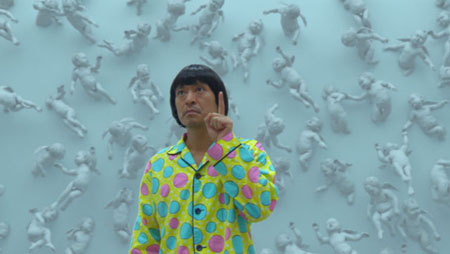
PLOT: A Japanese man wakes up in an enormous white chamber whose walls and floor are littered with cherubic phalluses; meanwhile a Mexican luchador, “Escargot Man,” prepares for a wrestling match.

Still from Symbol (2009)

WHY IT MIGHT MAKE THE LIST: The main narrative, following the action in the white room, is so absolutely removed from reality it demands a place on the List, while the Mexican wrestling scenes remain incongruous and weirdly exotic throughout.

COMMENTS: It’s difficult to talk about why Symbol is so arresting and oddly rewarding without spoiling details of the story or the reveals near the film’s end. Suffice to say the two seemingly unrelated narratives come together in a most unexpected and ridiculous way, and the torture experienced by the Japanese protagonist in the white room leads to a truly transcendent revelation by the film’s end.

The film is structured under three headings: “Learning, Practice and Future.” Learning refers to the rough education the Japanese man receives in the white room from the mischievous owners of the Cherubic phalluses, while the particulars of Practice and Future I’ll leave viewers to discover on their own.

Much of the early joy of the film involves watching Matsumoto interact with the white room and the objects released therein, seeing his mounting frustration at the “bait and switch” as the Cherubs deliver alternately helpful or useless items. They give him an endless stream of sushi rolls, but no soy sauce until after he’s eaten the very last one; 3D glasses direct him to press a particular button, only to have an enormous Cherub behind break wind on him. Another scene sees him releasing an endless pile of chopsticks before he finally presses a different phallus, sending an office trolley careening into his shin. This comedic torment in the vein of silent film comics like or Harold Lloyd continues until Matsumoto recognizes a means of escape…only to be led to earth-shattering alternatives.

There is very little to fault in this film; from its production values to its execution it is equally unique, vibrant and visually arresting. The pacing is surprisingly jaunty for an episodic film, and it actually rewards a re-watch to see how all the various threads build towards the film’s close. Some viewers may find the ridiculous payoffs a little too surreal to be satisfying; to them I can only recommend the consolation to be found in the philosophical treatise “In Praise of Silly,” the book never written by comedian Mike Myers’s father, who believed silliness “was our natural state, and we only get serious to get to silly.” Symbol contains moments of textbook Japanese cinematic weirdness.

A possible weak element of the film (other than two unnecessary moments of flatulence humor) could be identified in Matsumoto’s performance; while his timing is excellent and he works as a hapless, unassuming everyman, his constant screaming is often irritating. A more skilled slapstick performer like , Lee Evans or Rowan Atkinson could have made the physical comedy transcendent and ballet-like rather than merely solid and amusing. This is a rare case where I would not mind a U.S. remake.

I know little about director and star Matsumoto, other than he is one half of a comic duo—the boke or “funny man” of a team called “Downtown”—on Japanese television, just like his contemporary Takeshi “Beat” Kitano (Hana-bi, Violent Cop) was at the beginning of his career. The comparison to Kitano is apt due to the similar career trajectory the two men have followed, although Matsumoto only has four feature film directorial credits to his name and none of the Kitano’s international recognition—at least for the time being. Also, from a cursory YouTube glance, Matsumoto’s TV persona appears to be that of a histrionic, put-upon weed (the character he develops here follows a similar vein) whereas Kitano’s comedy always came from his role as bully.

WHAT THE CRITICS SAY:

“…one of the most bizarre, impenetrable films of the year. That doesn’t mean it is not funny, intriguing and visually impressive, just don’t expect to come out being anything less than baffled.”–Owen Van Spall, “Eye for Film” (contemporaneous)

(This movie was nominated for review by many people, but “Roy” was first when he advised us in 2010 “You gotta check out this flick ‘Symbol’ by the director of Big Man Japan.” Suggest a weird movie of your own here.)

CAPSULE: CUTIE HONEY (2004)

AKA Cutie Honey: Live Action

DIRECTED BY:

FEATURING: Eriko Satô, Mikako Ichikawa, Jun Murakami, Eisuke Sakai; voices of Carrie Keranen, Eva Kaminsky, Vinnie Penna, Madeleine Blaustein (English dub)

PLOT: A naive, upbeat female superhero battles the alien organization “Panther Claw” after they abduct her professor uncle, while simultaneously trying to keep her temp job and find a true friend.

Still from Cutie Honey (2004)

WHY IT WON’T MAKE THE LIST: It is weird, in that Japanese pop way, but it’s also extremely lightweight, and we have to draw the line somewhere.

COMMENTS: “She’s that trendy girl/The one with the teeny butt… She’s that popular girl, the one with the bouncy boobs.” So goes Cutie Honey‘s theme song, which omits any reference to her crimefighting abilities. Our first view of Honey is of her soapy legs and feet in the bubble bath. She gets a phone call in the tub, learns her uncle is abducted, and has to rush to the scene of the crime—only she has no clothes available, so she runs through the street in her underwear, partially covered by a trash bag that doesn’t conceal much. Her regular crimefighting costume features skintight black pants and a heart-shaped cutout for her cleavage; during her off hours she favors midriff-baring mini-skirts and stiletto heels. Somehow, the camera always finds that the upskirt angle best captures the energy of the fight sequences. But, even though Cutie’s body is relentlessly sexualized—virtually fetishized—the story never compromises the innocence of her character. Cutie herself has no sexuality; she seeks only harmless friendship, and any impure thoughts others might have about her stem strictly from their own corruption. (The bosses clearly get an erotic charge out of battling her, especially Cobalt Claw, the vampire dominatrix Honey defeats with a searing embrace). Japanese movies have a way of pulling off this innocent fanservice without making it seem too skeevy, and director Hideaki Anno’s background in anime clearly served him well in the endeavor.

Former swimsuit model Eriko Satô’s considerable physical appeal aside—and to be fair, she does do a nice job rounding out her character between all the cheesecake shots, locating Honey’s legitimate grrl power—Cutie Honey is a wild, electric affair, one of the best live-action translations of anime style. Anno even splices in some brief, stylized animation at times, such as when Honey dodges Gold Claw’s missiles in the sky or hurls Scarlet Calw’s energy beam back at the villainous supergeisha. Of course, reality is a distant cousin to the characters of this world, and they’re not really on speaking terms. Panther Claw’s human henchmen dress in snazzy black Zorro-inspired uniforms, carry golden guns, and generally act like disposable buffoons from Adam West’s “Batman.”  The big baddie—Sister Jill—is some sort of tree goddess who eats virgins, and her tuxedo-clad butler wears eyeliner and a very fake mustache. There’s also a giant holographic uncle. And what would a weird Asian movie be without out-of-place musical numbers, including some drunken karaoke from the three principals, plus a quartet of henchmen playing violins as Black Claw croons a jazzy mid-tempo challenge (your toe will tap as he sings “for the sake of my own happiness, please wither away beautifully, baby.”) Cutie Honey is like an extended sugar-rush episode of “Power Rangers,” if the solo Ranger was played by a teenage pop star who dresses like a hooker.

The “Cutie Honey” franchise began life as an ecchi manga, then became a more innocent animated children’s TV series in the 1970s, followed by various video and television revivals of varying degrees of naughtiness. This feature version was followed by a live-action TV series, with a new live-action feature film scheduled for release in October 2016. Hideaki Anno, of course, is best known around here for directing two separate “Evangelion” anime series; we’re still awaiting the final installment of the second series, which seems to have stalled since Evangelion 3.0: You Can (Not) Redo rolled out in 2012.

WHAT THE CRITICS SAY:

“…those who like their films with a distinctly Western sensibility should be warned – Cutie Honey is loaded with trademark Japanese kookiness, and is at times just plain weird.”–Craig Villinger, “Digital Retribution” (DVD)

(This movie was nominated for review by a reader whose comment was lost in a server crash years ago. Suggest a weird movie of your own here.)