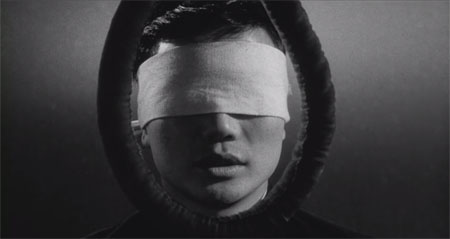
Tag Archives: Japanese

239. TEKKONKINKREET (2006)

“It was a strange time in Japan: just after the Kobe earthquake and in the midst of Aum’s sarin attacks. Helicopters flying overhead at all hours, police on the streets, yakuza killing cult members on television. Weird with a big W. But my friend had a good manga collection and I was getting bored, so I asked him for a recommendation. And, without stopping to think, he handed me the just-released books of Tekkon… that was it. Hooked. Even the first illustration of Black and White looking over the city – it just felt so real, felt like what I was doing, staring from above at the construction in our neighborhood, listening to helicopters at night, searching for something solid to hold on to in those pre-apocalyptic days.”–Michael Arias on why he decided to adapt Tekkonkinkreet for the screen

DIRECTED BY: Michael Arias

FEATURING: Voices of Kazunari Nimomiya, Yu Aoi (Japanese); Scott Menville, Kamali Minter (English dub)

PLOT: Black, a master fighter despite his young age, and White, a naïve smaller boy given to prophetic pronouncements, live unsupervised on the streets of an urban district nicknamed “Treasure Town.” A gang of yakuza move into the area with the intent of tearing down much of the district to create an amusement park, which requires them to get rid of the powerful Black. As he consolidates his power, the leader of the yakuza sends three superhuman assassins to kill the two boys; but when White is placed under protective police custody, can Black survive without him?

Still from Tekkonkinkreet (2006)

BACKGROUND:

  • The story was adapted from a manga (comic) by Taiyô Matsumoto.
  • The title is a mispronunciation (presumably by White) of the Japanese phrase “Tekkin Konkurito” (steel and concrete). The phrase also evokes the Japanese word for “muscle.”
  • Director Michael Arias is an American, the first non-Japanese director to ever helm a major anime film. The screenplay adaptation was also written by an American, Anthony Weintraub. The graphics were done almost exclusively by Japanese artists.

INDELIBLE IMAGE: Although we chose Black’s fall to Earth from the climactic cosmic battle as our illustrative still, the most striking imagery in Tekkonkinkreet are the baroque urban backgrounds. When you think back on the film, what arises in your mind is some non-specific impression of the phantasmagorical cityscape of Treasure Town, like the raven’s-eye view we get of the district in the opening credits. Treasure Town is a lived-in home town neighborhood in a larger megalopolis, a maze of alleyways cluttered with neon signage. It’s a multicultural never-never land where a peek around the next corner is as likely to reveal a shrine to Ganesha or Betty Boop graffiti as a Shinto pagoda or a noodle stall.

THREE WEIRD THINGS: Eyeball-wallpapered saloon; the Minotaur; fall to Earth

WHAT MAKES IT WEIRD: Anime, which often takes place in obsessively invented fantasy worlds built from the ground up, is an almost inherently weird genre. It takes a lot to impress us, both in terms of imagination and in terms of quality. Tekkonkinkreet may not offer much in the way of philosophical depth, but it more than makes up for it with eye candy. If you’re looking for superhero-type action in an unreal world, and you value weirdness over cameos by Hollywood stars and comic book moguls, don’t turn to the costumed mutants of the Marvel Universe; come to Treasure Town, where orphans battle yakuza real estate developers and their alien assassins. No half-baked origin stories here, just teenagers battling Minotaurs in space, with their psyches hanging in the balance.


U.S. release trailer for Tekkonkinkreet

COMMENTS: Tekkonkinkreet is as thematically simple as it is visually Continue reading 239. TEKKONKINKREET (2006) →

233. DEATH BY HANGING (1968)

Koshikei

“You mustn’t think our film is just labored theorizing. The officials’ attempts to convince R that he is R are amusing and bizarre. I think it’s a spot-on depiction of all us Japanese in all our amusing bizarreness.”–Nagisa Ôshima

Recommended

DIRECTED BY:

FEATURING: Yung-Do Yun, Fumio Watanabe, , Akiko Koyama

PLOT: After the failed execution of a Japanese-Korean double murderer, various state functionaries are at a loss as how to proceed when the criminal’s body refuses to die. Going to increasingly outlandish lengths to remind the convict of why he is there and condemned, the prison’s officials inadvertently explore the nature of crime, nationality, and culpability. Eventually a young woman is introduced to the group, and the captors decide to get drunk.

Still from Death by Hanging (1968)

BACKGROUND:

  • The criminal in Death By Hanging is based on Ri Chin’u, who also murdered two Japanese school girls. In addition to his crimes, Ri Chin’u gained a degree of fame for his extensive writings while in prison.
  • Much of the dialogue between R and his “sister” is taken from actual correspondences between Ri Chin’u and a Korean journalist.
  • Death by Hanging came during Ôshima‘s most experimental period, made back-to-back with the Certified Weird satire Japanese Summer: Double Suicide. Like most of Ôshima‘s mid-to-late 1960s work, Hanging was initially ignored in America, not even screening for the first time until 1974 and not officially reaching home video until 2016.

INDELIBLE IMAGE: The movie is stuffed to the gills with claustrophobic shots of slapstick fused with philosophy, none more so than the penultimate scene: an unlikely combination of prison officials getting hammered around a “table” while the convict “R” and his (probably imaginary) sister consider the nature of guilt. The drinkers take turns discussing how they came to this kind of work while R, reclining with the young woman beneath a Japanese flag, comes to the conclusion that though he committed his crimes, he is not responsible for them.

THREE WEIRD THINGS: Stubborn corpse; rape re-enactment; hallucination participation

WHAT MAKES IT WEIRD: Death By Hanging starts with a very traditional documentary approach, including narration reeling off statistics and some expository shots of a nondescript execution facility in a prison compound. Quickly, however, the aura of formality disintegrates as the hapless officials endeavor in vain to make sense of the film’s central conceit: a young convict refusing to die. Their efforts to restore his memory and edge him toward accountability grow desperate and extreme until a point is reached where everyone involved in the process begins to believe in the unreal.


Original trailer for Death by Hanging

COMMENTS: While most leftist directors merely point a shotgun at Continue reading 233. DEATH BY HANGING (1968) →

CAPSULE: AIR DOLL (2009)

DIRECTED BY: Hirokazu Koreeda

FEATURING: Doona Bae, Arata Iura, Itsuji Itao, Joe Odagiri, Sumiko Fuji

PLOT: Nozomi, an inflatable sex doll, develops consciousness and comes to life, wandering through the streets while her owner is at work, encountering various lonely souls including a video store attendant, with whom she falls in love.

Still from Air Doll (2009)

WHY IT WONT MAKE THE LIST: The central conceit (and character) of the inflatable sex doll is the only weird element in this film. The people surrounding Nozomi and the contemporary Japanese setting are grounded in naturalism, positioning the film in the genre of magical realism rather than surrealism.

COMMENTS: The concept of an outsider or alien force experiencing human existence is a familiar trope in cinema. Ex Machina (2015), Her (2013), A.I. (2001), City of Angels (1998) and even Terminator 2: Judgment Day (1992) all explore similar concepts. In the main, these films present a robot or artificial intelligence evolving human characteristics, whereas Air Doll posits a less likely protagonist: an inflatable vinyl sex doll.

Nozomi, a “sexual surrogate” as she lamentably reminds us through the film, lives with her owner, Hideo, in modern urban Tokyo. She passively listens to his self-important ramblings about work (which we later learn are lies), and then later serves as an equally passive recipient to his sexual advances. The following morning, after Hideo leaves for work, Nozomi inexplicably comes to life (Nozomi describes the process as “finding a heart”) in a sequence where an animated puppet becomes actress Doona Bae, enjoying the sensual thrill of dripping water running over her hand. Her first thoughts on her newfound consciousness are “beau-ti-ful!,” but this will change by the film’s end.

Nozomi is a curiosity to those she encounters, but their reactions are no match for her own wonder at everything she sees. Even the garbage men fascinate her. Nozomi’s wonder and simple satisfaction with life remains a stark contrast to the thwarted happiness of the human characters throughout the film

Nozomi’s position as outsider is reinforced both by her status as an animated doll and the casting of Korean actress Bae in a Japanese film. This is purposeful casting by director Koreeda to throw his observations of modern urban life into sharper relief. Like Swift’s “Gulliver’s Travels,” the satire or analysis of a culture is strengthened the more alien the presence of the other observing it. Bae, the alien in question, seems incapable of delivering a poor performance; even if the film is weak (witness the failed splendor of Cloud Atlas) she is always in top form and her portrayal here is no exception. Nozomi is by turns curious, ebullient, playful, saddened, sensual and emphatic. Her small, staccato, childlike walk in her French Maid’s dress is also a lovely touch, emphasizing Nozomi’s innocence and vulnerability.

Despite the potential here for an incisive and engaging investigation of modern Japanese life—and by extension human existence—the overall tone remains light and humorous , although the film does take a much darker turn in its final act. Even the bleaker aspects of the human characters’ lives fail to inspire sympathy because they are so underdeveloped (many of them we only see once or twice in small cutaways). You could argue the conceit of a sex doll coming to life is farcical and thus the comic tone is appropriate, but elsewhere Koreeda teases us with more involved drama (for example, Nozomi’s boss blackmailing her for sex) without ever really committing to it.

That the film is a slight work that sadly never lingers in the memory is evidenced by the lack of interviews and production materials surrounding it online. Even the links on its Wikipedia page are dead and its archived page on the Cannes Film Festival comes up with an “error.” This is not to say that the film doesn’t have very beautiful and tender moments: for example the gentle touch the old man asks Nozomi to place on his forehead, or Nozomi opening up a tear on her arm in order to smell the breath of her lover; its simply that there is nothing significant about the human experience mined in any great depth. Akira Kurosawa’s Ikiru (To Live) (1952) is a much more palpable and urgent examination of what it means to be human and why life is so precious. (I mention it only because the initial pleasure in life Nozomi experiences is similar to the renewed urgency found by Ikiru’s protagonist).

As a rumination on urban loneliness and inertia, defeated dreams and the loss of innocence transitioning to adulthood, this film is arguably successful; however in addressing the larger questions of what it means to human it falls flat, suffering from a lack of focus and peripheral characters in need of further development.

WHAT THE CRITICS SAY:

“What’s most interesting about the story is not its apparent oddness, but the fact it maintains a sense of fairy tale magic even while it’s set in a cold and seemingly hollow world.”–Sara Maria Vizcarrondo, Boxoffice Magazine

LIST CANDIDATE: NIGHT ON THE GALACTIC RAILROAD (1985)

Ginga-tetsudo no Yoru; AKA Night on the Galactic Express

DIRECTED BY: Gisaburo Sugii

FEATURING: Voices of Mayumi Tanaka, Chika Sakumoto

PLOT: In a fictional town in a fictional universe during the annual star-worshiping festivities, a boy and his friend find themselves on a metaphysical train that takes them on an existential journey through space. Oh, and everybody is a cat.

Still from Night on the Galactic Railroad (1985)

WHY IT MIGHT MAKE THE LIST: Even without delving into the film’s brutally in-depth takes on loneliness, death and depression, Railroad is a tripper’s paradise, filled to the brim with such weirdness as glowing, candy-flavored herons, self-replicating apples, stairways that lead to the center of the universe, and beaches where each grain of sand is a jewel filled with fire. Rich in imagery and philosophy, it treads that always intriguing line between children’s entertainment and adult existentialism.

COMMENTS: A little background is very useful when approaching Night on the Galactic Railroad, else it might sucker punch you into hating it. Based on a 1927 book by Kenji Miyazawa, the film takes many liberties with the foundations of what was a very personal story to turn the novel into something with a distinctly anime flavor. The most controversial of these decision is to have (almost) everybody in the film drawn as a cat, an early indication that realism and logic will be thrown out the window despite the fact the film follows a very human path in regards to its character’s crises. The explanation for this decision has never really been given, but some have suggested it was simply due to the fact that it was easier to animate a cat than a human. Who knows if this is true, but nevertheless this town of star-worshiping felines all have very human characteristics. It isn’t difficult to sympathize with Giovanni, our young protagonist, as he is ostracized by his peers, bullied and insulted; he has no time to socialize due to his commitment to pick up milk for his sick mother.

Esoteric creative decisions lend even the relatively dull first fifteen minutes of the film an undeniable beauty. Tilted camera angles and close ups as Giovanni goes about his work in a publishing house after school turn the mundane into the mysterious, the bland into something otherworldly. The opening scenes’ dedication to create an alien world out of the familiar, along with the stillness and quiet tension on show, is closer to than anything else I have seen within (or outside of) the animation genre.

The film doesn’t stay on this route, though, and soon whisks us out of the medieval town. Giovanni and his only friend, Campanella, leave the occult stargazing festivities (complete with Carnivale-style masks) and find themselves on a train hurtling through space.

While the audience sits in a mild shock at these events, the two cats Continue reading LIST CANDIDATE: NIGHT ON THE GALACTIC RAILROAD (1985) →