Tag Archives: Japanese

CAPSULE: RAMPO NOIR (2005)

DIRECTED BY: Suguru Takeuchi, Akio Jissôji, Hisayasu Satô, Atsushi Kaneko

FEATURING:

PLOT: Four experimental stories of sex and madness adapted from the works of Edogawa Rampo: a man regrets a rape, a killer strikes through mirrors, a wife cares for a husband who is a human torso, and a limo driver is obsessed with a stage actress.

Still from Rampo Noir (2006)

WHY IT WON’T MAKE THE LIST: We’ll dismiss it for uneveness, although even the best segments probably would not merit inclusion in a list of the greatest weird movies of all time.

COMMENTS: Rampo Noir is more of a series of visual and stylistic calling cards than it is a tribute to the literary talents of Edogawa Rampo (Tarō Hirai, “the Japanese Edgar Allen Poe,” who selected his pseudonym to pay tribute to the American horror/mystery writer). The narratives here are either nonexistent (“Mars’s Canal,” the impressionistic Rampo-inspired first course), slight (“Caterpillar” and “Crawling Bugs”), or founded on dated pseudoscience (“Mirrored Hell”). Of course, one would not sense what made Poe great by watching ‘s Tales of Terror; the four directors here aim at capturing Rampo’s perverse atmosphere (with greater explicitness) rather than showing accuracy to his texts. The results, as might be expected, are all over the map (sometimes within the same segment).

The first film (“Mars’s Canal”) begins with a warning advising your that your disc is not defective. Entirely silent, with deliberately glitchy video, it’s an indulgence by heretofore (and hence) unknown director Suguru Takeuchi. It’s built around one magnificent shot (filmed in Iceland), but even at six minutes long it tries the patience of the average viewer.

In contrast, Akio Jissôji’s “Mirror Hell” is a (relatively) conventional murder mystery, probably the most accessible segment of the omnibus. There is a (somewhat) rational explanation to the mystery of beautiful tea-ceremony teachers who turn up dead, although it does depend on strained early-twentieth century science fiction-style explanations (undiscovered elements with properties that mimic magic, that sort of thing). It also features a Rampo-esque theme that dreams are reality, and that what we think of as life is but a reflection in a mirror, “neither real nor unreal.” It as, as might be expected, filled with multiple mirrors in almost every shot (there’s an interesting composition of mirrors on a beach, each reflecting a different landscape, that evokes a vintage Continental Surrealist painting).

Hisayasu Satô savors the sickness inherent in “Caterpillar.” The story involves the unhealthy relationship between a resentful wife and her war hero husband, now a mute quadruple-amputee, whom she must care for. Satô takes Rampo’s original anti-war parable (which was adapted more accurately in ‘s feature length film) and focuses almost entirely on the salacious sadomasochistic aspects of the story. Like all of the entries, “Caterpillar” is visually superior, but this one lacks a meaningful reason to exist: Satô’s treatment bludgeons the original’s subtleties, and due to a lack of substance in the main tale he introduces an unnecessary character (a nosy collector  who considers the caterpillar a work of art) and shoehorns in a ridiculous appearance by Rampo detective Kogorô Akechi (Asano, reprising his role from “Mirror Hell”). “Caterpillar” may impress some with its perversity, but it doesn’t so as much with the premise it was handed as it should have.

Although this rarely happens in anthologies, in Rampo Noir the best is saved for last. In an inversion of the dynamic we saw with “Caterpillar,” Atsushi Kaneko’s “Crawling Bugs” takes a well-worn idea (the shy, unhinged man obsessed with an unobtainable iconic beauty) and uses style and psychological details to make it feel fresh. There are many odd touches here, from the actress’ bizarre pyramidal hairstyle to alternating inserts of a nebula and an amoeba. While our timid limo-driver suffers from an itchy psychosomatic condition that causes him to feel like he has bugs crawling over his skin, his obsession plays a strange sexual game involving a leech-like bug that crawls over her neck. The glowing forest glade he constructs as an altar to his lady inside of his shabby apartment is a rainbow fantasy refuge that makes us feel as disconnected from reality as he is. “Bugs” is the only segment here that feels like it could stand on its own, and singlehandedly raises the quality of the anthology from “take it or leave it” to “worth watching.”

Tadanobu Asano appears in every episode and is clearly the main domestic draw. Of the directors, only Hisayasu Satô is somewhat known in the West, for exploitative sadomasochistic pink movies like Unfaithful Wife: Shameful Torture (AKA The Bedroom) and Splatter: Naked Blood. Akio Jissôji has made numerous movies not widely seen outside of Japan, but Suguru Takeuchi and Atsushi Kaneko have done nothing of note before or since this.

WHAT THE CRITICS SAY:

“Rampo Noir’s hallucinogenic approach to narrative and visuals is nothing short of invigorating.”–Jasper Sharp, Midnight Eye (DVD)

(This movie was nominated for review by “Kat,” who said she was “amused, intrigued and sickened; sometimes simultaneously” by the experience. Suggest a weird movie of your own here.)

224. JAPANESE SUMMER: DOUBLE SUICIDE (1967)

Muri shinjû: Nihon no natsu

“I think that our only route to freedom and our only route to pleasure can come after we have first recognized that freedom and pleasure are not possible in this world.”–Nagisa Ôshima

Recommended

DIRECTED BY:

FEATURING: Keiko Sakurai, Kei Satô, Masakazu Tamura, Taiji Tonoyama

PLOT: An oversexed eighteen-year old girl wanders a city looking for a man to sleep with her—any man. She takes up with a strange, reserved older army deserter, but fails to convince him to service her, as he has a death wish and is only interested meeting someone who will kill him. The two are abducted and taken to a compound where outlaws are being recruited to fight in a secret underground war; meanwhile, television reports tell of a foreign sniper killing civilians on the streets, driving all of Japan to hide in their homes.

Still from Japanese Summer: Double Suicide (1967)

BACKGROUND:

  • Disappointed by the timidity of the Japanese studio system and the political controversy surrounding his 1960 movie Night and Fog in Japan, Nagisa Ôshima formed his own production company in 1965. Japanese Summer: Double Suicide was one of the baker’s dozen of self-produced films he directed between 1965 and 1972, and the first one to indulge in wall-to-wall surrealism.
  • Stars Keiko Sakurai and Kei Satô also appeared in Nagisa Ôshima’s next film, Death by Hanging, which was Sakurai’s only other acting credit.
  • Ôshima would go on to cult success in the West with his sexually explicit provocation In the Realm of the Senses (1976), and with Merry Christmas, Mr. Lawrence (1983) starring .
  • This feature should not be confused with Masahiro Shinoda‘s 1969 arthouse hit Double Suicide, a fourth-wall breaking adaptation of an 18th century Japanese play about doomed lovers. Although entirely unrelated, Shinoda‘s film is worth seeing in its own right.

INDELIBLE IMAGE: In what just might be a bit of symbolic foreshadowing, the two main characters lie down on top chalk outlines around which, moments ago, reverent monks had been circling and chanting. (Curiously, the outlines are sketched on what should be a busy four-lane highway, yet there is no traffic).

THREE WEIRD THINGS: Virgin nympho; deserted highways; “a Japanese Dallas”

WHAT MAKES IT WEIRD:  Starring a nympho who can’t get laid and a suicidal man who can’t get killed, Ôshima’s surrealistic Sixties satire carves out a unique space somewhere between a ian joke and an extended zen koan.


Original trailer for Japanese Summer: Double Suicide

COMMENTS: When our on-the-make nymphomaniac meets the Continue reading 224. JAPANESE SUMMER: DOUBLE SUICIDE (1967) →

LIST CANDIDATE: BLIND WOMAN’S CURSE (1970)

Recommended

DIRECTED BY: Teruo Ishii

FEATURING: Meiko Kaji, Hoki Tokuda, Makoto Satô, Tatsumi Hijikata

PLOT: A female yakuza leader blinds an enemy in a sword fight, then years later is hunted by a blind woman seeking revenge.

Still from Blind Woman's Curse (1970)

WHY IT MIGHT MAKE THE LIST: Blind Woman’s Curse is an odd stir-fry of yakuza, samurai and ghost story genres with psychedelic seasoning. It’s also a good example of how Japanese genre films of the period had every bit of the style and technical prowess of their arthouse competitors like Kurosawa and Ozu, giving it a good outside shot at making the List.

COMMENTS: Teruo Ishii made Blind Woman’s Curse at Nikkatsu Studios only three years after the studio fired for making the “incomprehensible” yakuza pic Branded to Kill. Curse is not quite as bizarre as Suzuki’s notorious film, but it suggests that by this time the studio heads may have lightened up on their aversion to pop-surrealism—as long as the film in question also contained ample bloodshed, tattoo flaying, and a duel between sexy swordswomen. Still, the colorful, hallucinatory carnival sequence in the film’s first act may have raised some suit’s eyebrows: cat women in bikinis crawl on a bamboo roof, an old man fishes doll parts out of a hot wok, and a hunchback hops around while a woman simulates copulation with a dog wrapped in the Japanese flag. Other elements that smear the film with a disreputable weirdness include a blood-licking ghost cat, a thug in a thong, and a topless opium-smoking scene shot from under the floorboards.

But, besides the tangy surrealism, Curse‘s biggest asset is Meiko Kaji (the future Lady Snowblood) in one of her earliest leading lady roles. Kaji only sports one expression in this movie, but it’s a great one: dread wrapped in a mantle of determination. She’s beautiful, graceful, and handles a sword as well as she does a song (she sings the theme song). Kaji has an undeniable presence, and it’s no surprise she went on to cult stardom. She has a male counterpart in Makoto Satô, a wandering mercenary with a taste for justice, but the men are subsidiary here, relegated to subplots or secondary villains. Kaji’s primary antagonist (setting aside the black cat that stalks her) is Hoki Tokuda as the blind swordswoman; her stoic countenance is striking in a very different way from Kaji, making for a mythic contrast in the morally ambiguous final showdown. The incestuous mixing of genres, the arthouse technical skills combined with exploitation sensibilities, and the under-the-radarness make Blind Woman’s Curse a wet dream.

Blind Woman’s Curse was supposedly the third entry in Nikkatsu’s “Rising Dragon” series, although it’s a thematic connection only since the first two entries featured a different actress (Hiroki Ogi) with a different character name. Ishii also directed the first in the series, Rising Dragon’s Iron Flesh (1969).

WHAT THE CRITICS SAY:

“Ishii keeps the film straddling the border—quite successfully—between bizarre, surreal horror film and period yakuza tale.”–Chris D., “Gun and Sword: An Encyclopedia of Japanese Gangster Films 1955-1980”

222. SPIRITED AWAY (2001)

Sen to Chihiro no Kamikakushi

“It was just too bizarre.“

“Honestly, when I watched Spirited Away for the first time back in 2008, I didn’t like it for the same reason as you. I just found it too weird.”

–IMDB message board dissenters on Spirited Away

Must See

DIRECTED BY:

FEATURING: Voices of Rumi Hiiragi, Miyu Irino, Mari Natsuki; , Jason Marsden, (English dub)

PLOT: While moving to a new town, ten-year-old Chihiro and her parents take a detour to a seemingly abandoned amusement park in rural Japan. Once the sun sets, the park transforms into an otherworldly resort for spirits and gods overseen by the cruel witch Yubaba. Now separated from her parents, Chihiro must learn to survive among an array of weird creatures as she attempts to reunite her family and return home.

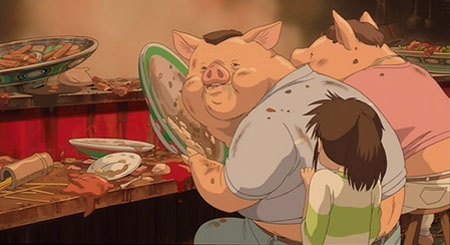
Still from Spirited Away (2001)

BACKGROUND:

  • Hayao Miyazaki had announced his retirement from feature filmmaking in 1998, after completing Princess Mononoke. He came out of retirement in 2001 to make Spirited Away.
  • Disney Studios had distributed Studio Ghibli’s previous film, Princess Mononoke, in the United States, with disappointing results. They put little money into marketing the film, but strong reviews and word of mouth turned it into a hit, and Disney’s partnership with Ghibli was cemented from that point on.
  • Spirited Away won the Academy Award for Best Animated Feature (along with 52 wins granted by other organizations).
  • Spirited Away is the highest-grossing film of all time in Japan.
  • Hayao Miyazaki had announced his retirement from feature filmmaking in 2001, after completing Spirited Away. He came out of retirement in 2004 to make Howl’s Moving Castle.

INDELIBLE IMAGE: Lured into the park by a delicious scent, Chihiro’s parents come upon a vacant restaurant filled with sumptuous, exotic dishes. The two immediately begin to fill their plates, ignoring their daughter’s worries that they’ll be punished for taking the food. After the park begins its transformation, Chihiro returns to find her parents bloated and hunched over piles of scraps. She tries to warn her father about what is happening, but when he looks at her she sees only the sweating, engorged face of a pig. The grunting pig ignores Chihiro and climbs over the restaurant’s counter, only to be swatted away by an unseen figure’s reptilian arm. The pig then crashes to the ground with a primal squeal, frightening Chihiro as she cries out for her parents and runs into a street filled with tall, anonymous ghosts.

THREE WEIRD THINGS: Pig parents; “No Face” eats; three heads and a giant baby

WHAT MAKES IT WEIRD: In Spirited Away, Hayao Miyazaki plays on the normal fears of lost children as the basis for an outlandish, frightening fantasy about a young girl being thrust into the incomprehensible life of an adult. The imagination of the setting is so immense that it seems to dwarf the film itself, suggesting a fully realized universe of magic and monsters with borders that extend far beyond the frame of the story.


Disney Trailer for Spirited Away

COMMENTS: Spirited Away begins with the main character, Chihiro, Continue reading 222. SPIRITED AWAY (2001) →

219. THE PORNOGRAPHERS (1966)

“Erogotoshitachi” yori Jinruigaku nyūmon

“What kind of fish is that? What is it doing there?

“Very strange…”–dialogue spoken over the opening credits of The Pornographers

Recommended

DIRECTED BY: Shôhei Imamura

FEATURING: Shôichi Ozawa, Sumiko Sakamoto, Keiko Sagawa, Masaomi Kondô

PLOT: Ogata makes illicit pornographic films to support his widowed landlady, who is also his lover, and her two teenage children. The widow believes her ex-husband was reincarnated as a carp she keeps in a fishbowl next to the bed and that he disapproves of the arrangement, but she cannot control herself. When she dies, she insists Ogata marry her daughter, but the pornographer has become impotent and obsessed with building a mechanical woman to be the perfect mate.

Still from The Pornographers (1966)

BACKGROUND:

  • Shôhei Imamura apprenticed as an assistant director under Yasujirô Ozu, and although he was considered a major figure in the Japanese New Wave, his movies are little known outside his native land. In the West, The Pornographers is his best-known work.
  • The scenario was based on a 1963 novel by Akiyuki Nosaka (who also wrote the story on which Grave of the Fireflies was based).
  • The Pornographers was made by Nikkatsu studios, who ironically turned from producing art films to making pornography (“pink films”) soon after the scandal over ‘s “incomprehensible” Branded to Kill in 1967.

INDELIBLE IMAGE: Shôhei Imamura frames many of the shots in The Pornographers oddly, including a couple of bedroom scenes viewed through a fish tank; the idea is that we are watching the jealous carp as he spies on his human wife making love to Ogata. The weirdest of these shots, however, has to be a Haru’s deathbed scene, also shot through the carp cam—improbably, this time, from above, as if the fish is looking down from heaven on the spouse who is soon to join him.

THREE WEIRD THINGS: Carp ex-hubby; slow schoolgirl porn star; Ogata floats away

WHAT MAKES IT WEIRD: A cavalcade of perversions flecked with short dream sequences and unannounced flashbacks, almost every scene in The Pornographers is eccentric, if not flatly surreal. The main character delivers a philosophical monologue as he walks though an orgy, the matron freaks out to the surf-rock soundtrack in her head, and a new wife strips to garter and stockings as she walks down the corridor to meet her mother-in-law for the first time. Although the story is based in realism, the film’s tone is melodramatic and dreamily erotic—but, ironically, hardly pornographic at all.


Original trailer for The Pornographers

COMMENTS: The key to understanding The Pornographers may be Continue reading 219. THE PORNOGRAPHERS (1966) →