Tag Archives: Guilt

CAPSULE: IN A GLASS CAGE (1986)

Tras el Crystal

DIRECTED BY:

FEATURING: Günter Meisner, , Gisela Echevarria, Marisa Paredes

PLOT: Hiding out in Brazil, an ex-Nazi pedophile and child killer is confined to a iron lung after a botched suicide attempt; it turns out that his new young male nurse knows about his past crimes.

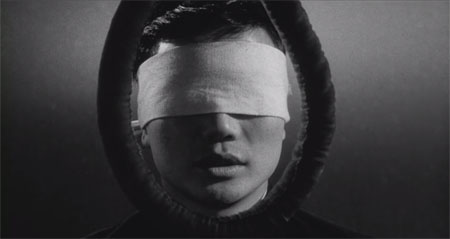
Still from In a Glass Cage (1986)

WHY IT WON’T MAKE THE LIST: Disturbing, but there’s nothing exactly weird about this horrific pedophilic psychodrama, other than its enigmatic ending.

COMMENTS: Well-acted and suspenseful, as well as brutally sadistic, In a Glass Cage has a clever setup: a decrepit ex-Nazi, confined to an iron lung after a suicide attempt, becomes both a prisoner and an unwilling accomplice to further crimes at the hands of one of his former victims. The film, while seriously intended, depends on the type of shock torture tactics usually seen in films, with an even more unsettling pedophiliac edge. Any film that starts out with a young boy stripped, hung from the ceiling, and beaten to death with a plank is probably unsuitable to watch with your mother (or pretty much anybody’s mother). There are not many of these scenes, but it doesn’t take many shots of a torturer sticking a needle into a child’s heart to make an impact.

Technical aspects of the film are superb, from the shadowy blue-grey cinematography to the music by Javier Navarette. Villaronga shoots suspense well, drawing out the stalking and alternating closeups, pans and overhead shots with sinister little details (Griselda’s black stocking falling around her ankle) in a way that recalls Dario Argento at his most nerve-wracking. David Sust is chilling as the second generation killer, and Günter Meisner expertly portrays Klaus with hardly a word, conveying  warring emotions of horror and guilty pleasure purely by facial expressions. All of this quality makes the movie more difficult to dismiss; the producers spent too much money and artistic effort for accusations that they were merely trying to make a quick buck off salacious material to stick.

The torture Angelo devises for Klaus is subtle. He demonstrates that there is no escape from the Nazi’s past atrocities, that mere regret will not absolve him from the evil he has unleashed in the world. He forces Klaus to relive his crimes not as memories, but as actual ongoing atrocities for which he is still responsible, despite long ago having lost the ability to commit them. For Angelo the sadist, this may be the biggest turn-on; knowing that a part of Klaus still enjoys watching these horrors, while another part of his mind is screaming in anguish. Through this complexity Glass Cage transcends exploitation—although just barely. Its insights into the psychology of sadism don’t cut deep enough to compensate for all of the scarring imagery, making it a good, but not great, movie about capital-E Evil. Those who like their horror served up with a side of extreme moral depravity will consider it a classic; others may want to pass.

Cult Epics DVD or Blu-Ray includes a 30 minute interview/documentary about Villaronga (mainly focused on Glass Cage), a screening Q&A, and three (not scary) experimental shorts from Villaronga spanning 1976-1980.

WHAT THE CRITICS SAY:

“Like the film’s characters, we find ourselves party to scenarios involving the most extraordinary fetishisation of suffering and death, horrors which invoke a troubling combination of impressions: they are sensual, grotesque, dreamlike, oddly beautiful, almost pornographic, usually painful to witness. But however horrifying the experience, Tras el cristal is bound to make for rewarding viewing… easily one of the most lyrical nightmares ever concocted.”–Chris Gallant, Kinoeye, Nov. 2002

(This movie was nominated for review by “w depaul.” Suggest a weird movie of your own here.)

282. DEMENTIA [DAUGHTER OF HORROR] (1955)

“Do you know what madness is, or how it strikes? Have you seen the demons that surge through the corridors of the crazed mind? Do you know that in the world of the insane you’ll find a kind of truth more terrifying than fiction? A truth… that will shock you!”–Opening narration from Daughter of Horror

Recommended

DIRECTED BY: John Parker

FEATURING: Adrienne Barret, Bruno VeSota, Ed MacMahon (voice in Daughter of Horror cut)

PLOT: A nameless woman awakens from a nightmare and makes her way out onto the city streets. She meets a wealthy man and agrees to go with him, and imagines a bloody family drama enacted in graveyard while riding in his limousine. Later, she stabs the man and throws his body off his penthouse balcony; she is then pursued by a cop with the face of her father, who chases her into a jazz club.

Still from Dementia (Daughter of Horror) (1955)

BACKGROUND:

  • The film contains no dialogue, although it’s not technically a silent film as some sound effects can be heard.
  • Director John Parker has only Dementia and one short film (a dry run for this feature) in his filmography. We know little about him except that his parents were in the film distribution business.
  • Star Adrienne Barrett was Parker’s secretary, and the film was inspired by a nightmare she related to Parker.
  • Co-star and associate producer Bruno VeSota is perhaps better known for his work as a character actor in numerous pictures, including a memorable turn as a cuckolded husband in Attack of the Giant Leeches. VeSota later claimed to have co-written and co-directed the film (no director is listed in the credits).
  • Cinematographer William C. Thompson also lensed Maniac (1934) and Glen or Glenda? (1953), making him the rare craftsman to serve on three separate Certified Weird movies (all for different directors).
  • Dwarf (Freaks) plays the uncredited “newsboy.”
  • The score was written by one-time bad boy composer George Antheil, whose career had plummeted into film and TV scoring after having once been the toast of Paris’ avant-garde with “Ballet Mechanique” (1924).
  • Dementia was submitted to the New York Censor’s board in 1953, and refused a certificate (they called it “inhuman, indecent, and the quintessence of gruesomeness”—which they didn’t mean as praise). It was approved in 1955 after cuts. (Reportedly they requested removal of shots of the severed hand). The film was banned in Britain until 1970 (!)
  • After failing to find success in its original dialogue-free form, Dementia was re-released in 1957 with narration (from future late night talk show sidekick Ed McMahon) and retitled Daughter of Horror.
  • Daughter of Horror is the movie teenagers are watching in the theater when the monster strikes in The Blob.

INDELIBLE IMAGE: Our protagonist (the “Gamin”) surrounded by faceless onlookers, who silently and motionlessly stare at her victim’s corpse. (Daughter of Horror‘s narrator unhelpfully informs us that these unearthly figurants are “the ghouls of insanity”).

THREE WEIRD THINGS: Precognitive headline; graveyard memories; throw on a dress

WHAT MAKES IT WEIRD: A skid row nightmare, Dementia dips into post-WWII repression and exposes the underbelly of the American night. It’s a boozy odyssey through a netherworld of newsboys, flower peddlers, pimps, murderers, and hot jazz, with our heroine pursued by cops and faceless demons. It’s noirish, expressionist, and nearly silent, except when Ed MacMahon interrupts the proceedings with pulpy purple prose. Perhaps it was not quite “the strangest motion picture ever offered for distribution,” as Variety famously claimed, but, warts and all, it’s like nothing else you’ve seen. It was too much naked id for its time, taking the spirit of Allen Ginsburg’s “Howl” and channeling it into a guilt-drenched B-movie dream.


Original trailer for Daughter of Horror

COMMENTS: The first thing the Gamin sees when she wakes from Continue reading 282. DEMENTIA [DAUGHTER OF HORROR] (1955)

274. NUIT NOIRE [BLACK NIGHT] (2005)

“Often when we go to the cinema we feel like we’re being taken for fools because things we have instantly understood are laboriously explained. Here it’s a little the other way round.”–Olivier Smolders

Weirdest!

Recommended

DIRECTED BY: Olivier Smolders

FEATURING: Fabrice Rodriguez, Yves-Marie Gnahoua, Iris Debusschere

PLOT: A solitary entomologist works at a natural history museum in a world where it is only light for fifteen seconds a day. One day, he comes home to his empty apartment and discovers an African woman sleeping in his bed. She is ill and pregnant and eventually dies, leaving him to deal with the body.

Still from Nuit Noire (2005)

BACKGROUND:

  • Olivier Smolders was born in the Congo, which explains the source of the film’s African imagery.
  • A prolific short film maker, Nuit Noire is Smolders’ only feature film to date.
  • The movie received a very limited theatrical release even in its native Belgium, and did not appear in U.S. theaters (outside of a few film festivals) at all. Little has been written about Nuite Noir in the English language (an only a little more in French).

INDELIBLE IMAGE: The African woman’s dead body turning into a pupae, then splitting open as a new life emerges.

THREE WEIRD THINGS: 15 seconds of sun; elephant in the alley; African corpse cocooning

WHAT MAKES IT WEIRD: Set in a world of eternal midnight, with troubled dreams of dead children and troubling realities of sick foreign women who mysteriously show up in your bed, Nuit Noire manipulates time and concepts in ways that only film can. One woman changes into another, and then into another. This story could not take place in the light of day.

Short clip from Nuit Noire

COMMENTS: Closeups of squirming bugs a la Blue Velvet. A reserved protagonist taking care of a sick charge in his isolated apartment a la Eraserhead. Billowing red curtains a la… every Continue reading 274. NUIT NOIRE [BLACK NIGHT] (2005)

233. DEATH BY HANGING (1968)

Koshikei

“You mustn’t think our film is just labored theorizing. The officials’ attempts to convince R that he is R are amusing and bizarre. I think it’s a spot-on depiction of all us Japanese in all our amusing bizarreness.”–Nagisa Ôshima

Recommended

DIRECTED BY:

FEATURING: Yung-Do Yun, Fumio Watanabe, , Akiko Koyama

PLOT: After the failed execution of a Japanese-Korean double murderer, various state functionaries are at a loss as how to proceed when the criminal’s body refuses to die. Going to increasingly outlandish lengths to remind the convict of why he is there and condemned, the prison’s officials inadvertently explore the nature of crime, nationality, and culpability. Eventually a young woman is introduced to the group, and the captors decide to get drunk.

Still from Death by Hanging (1968)

BACKGROUND:

  • The criminal in Death By Hanging is based on Ri Chin’u, who also murdered two Japanese school girls. In addition to his crimes, Ri Chin’u gained a degree of fame for his extensive writings while in prison.
  • Much of the dialogue between R and his “sister” is taken from actual correspondences between Ri Chin’u and a Korean journalist.
  • Death by Hanging came during Ôshima‘s most experimental period, made back-to-back with the Certified Weird satire Japanese Summer: Double Suicide. Like most of Ôshima‘s mid-to-late 1960s work, Hanging was initially ignored in America, not even screening for the first time until 1974 and not officially reaching home video until 2016.

INDELIBLE IMAGE: The movie is stuffed to the gills with claustrophobic shots of slapstick fused with philosophy, none more so than the penultimate scene: an unlikely combination of prison officials getting hammered around a “table” while the convict “R” and his (probably imaginary) sister consider the nature of guilt. The drinkers take turns discussing how they came to this kind of work while R, reclining with the young woman beneath a Japanese flag, comes to the conclusion that though he committed his crimes, he is not responsible for them.

THREE WEIRD THINGS: Stubborn corpse; rape re-enactment; hallucination participation

WHAT MAKES IT WEIRD: Death By Hanging starts with a very traditional documentary approach, including narration reeling off statistics and some expository shots of a nondescript execution facility in a prison compound. Quickly, however, the aura of formality disintegrates as the hapless officials endeavor in vain to make sense of the film’s central conceit: a young convict refusing to die. Their efforts to restore his memory and edge him toward accountability grow desperate and extreme until a point is reached where everyone involved in the process begins to believe in the unreal.


Original trailer for Death by Hanging

COMMENTS: While most leftist directors merely point a shotgun at Continue reading 233. DEATH BY HANGING (1968)

CAPSULE: THE SUICIDE THEORY (2014)

DIRECTED BY: Dru Brown

FEATURING: Steve Mouzakis, Leon Cain

PLOT: A suicidal man hires a hitman to off him, but there’s a catch: the intended victim claims he’s under a curse and can’t be killed, and he miraculously survives every attempt on his life.

Still from The Suicide Theory (2014)

WHY IT WON’T MAKE THE LIST: The Suicide Theory is a psychological thriller with an intriguing Twilight Zone-ish premise, but it’s not weird enough by a long shot.

COMMENTS: A hitman who can’t kill and a suicidal man who can’t die star in a psychological thriller that can’t… wait, we’ll cut that gibe short, because although The Suicide Theory doesn’t ultimately hit the mark it aims at, there is enough here to count as an interesting attempt. First, there is the macabre scenario, which offers opportunities for moments both chilling and blackly comic. Even more beneficial are the performances by the two leads, who forge a bond that is both sick and touching. Steve Mouzakis’ troubled assassin come off like a seedy, psychotic . Leon Cain’s role is less demonstrative, but the desperate resignation he shows as a suicidal immortal provides the appropriate counterpoint to Mouzakis’ fury.

That said, The Suicide Theory has a script whose ambitions exceed its ability to meet them. Although plot strands meet up at the end, they are more crammed into place than flowing together naturally. The resolution works, in one sense, but it doesn’t wholly satisfy, either on a literal level or a metaphorical level. Potential plot holes come to mind. If Steven were truly as ruthless as portrayed, it seems like there are at least a couple of more severe, less avoidable options for disposing of Percy that come to mind: decapitation, for example, or dissolving his body in acid. An arbitrary rule (Percy’s “theory”) requires Steven to spend time getting to know his victim; a useful contrivance from a dramatic standpoint, but it’s not successfully sold to us as a necessity. The story also arguably goes one twist to far at the end, and ultimately, the lattice of guilt the film proposes can’t support the weight of the premise. A great setup, and well-acted, but it runs out of steam at the end; it doesn’t slay, but call it a near-miss.

WHAT THE CRITICS SAY:

“…a contrived but weirdly compelling thriller…[l]arded with bizarre twists…”–Justin Chang, Variety (contemporaneous)

(This movie was nominated for review by “michael.” Suggest a weird movie of your own here.)