Tag Archives: Flop

259. THE NINTH CONFIGURATION (1980)

AKA Twinkle Twinkle Killer Kane

“Kane said quietly, ‘Why won’t you go to the moon?’

‘Why do camels have humps and cobras none? Good Christ, man, don’t ask the heart for reasons! Reasons are dangerous!'”

–William Peter Blatty, The Ninth Configuration (novel)

Recommended

DIRECTED BY:

FEATURING: , Scott Wilson, Ed Flanders

PLOT: Col. Kane, a U.S. Marines psychiatrist, is assigned to an experimental program in a castle housing delusional military officers who are suspected malingerers. There, he bonds with Cutshaw, a militantly atheist and misanthropic astronaut, with whom he engages in passionate dialogues about the existence of God. One night, Cutshaw breaks out of the compound and heads for a bar frequented by a rough motorcycle gang; Kane follows.

Still from The Ninth Configuration (1980)

BACKGROUND:

  • William Peter Blatty (“The Exorcist”) adapted the screenplay from his own 1978 novel, which was itself a reworking of a 1966 novel (“Twinkle, Twinkle, ‘Killer’ Kane”) with which he had been dissatisfied. This was his directorial debut (in a career that reached three films with 2016’s Legion).
  • Blatty originally wrote a “Kane” screenplay that he hoped would be filmed by in the early Seventies, but they could not find a studio willing to produce it. Blatty and Friedkin collaborated on The Exorcist (1973) instead.
  • Although the script made the rounds in Hollywood for years, no studio would back The Ninth Configuration. Blatty eventually funded the film half with his own money and half with a donation from Pepsico, who were willing to provide funds for complicated international tax reasons so long as the film was shot entirely in Hungary.
  • Blatty has fiddled with the editing through the years, deleting and restoring scenes, so that cuts run anywhere from 99 minutes to 140 minutes.
  • According to Blatty, The Ninth Configuration‘s Cutshaw is the same character as the astronaut who attended the dinner party in The Exorcist.

INDELIBLE IMAGE: What else could it possibly be besides the crucifixion on the moon?

THREE WEIRD THINGS: Lunar Calvary; lunatic with a jet-pack; dog Hamlet

WHAT MAKES IT WEIRD: Obsession is fertile soil for a weird movie. The Ninth Configuration is a movie in a madhouse that sets out to do nothing less than to prove the existence of God; it doesn’t, naturally, but the ambition involved makes for some strange choices, invoking a passion that carries the story over some rough patches.


Clip from The Ninth Configuration

COMMENTS: The Ninth Configuration posits that a world without Continue reading 259. THE NINTH CONFIGURATION (1980)

CAPSULE: CANDY (1968)

DIRECTED BY:  Christian Marquand

FEATURING: , John Astin, , , , , , Walter Matthau, Charles Aznavour

PLOT: A nubile girl separated from her father wanders the U.S. meeting a poet, gardener, general, doctor, guru, and more, learning that men only want one thing from her.
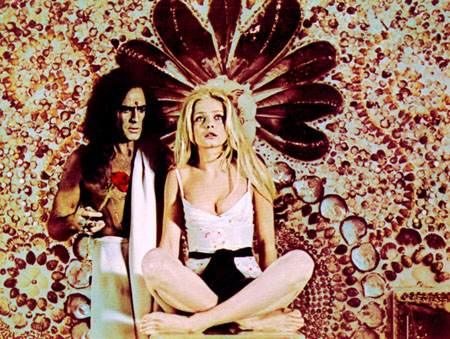
Still from Candy (1968)

WHY IT WON’T MAKE THE LIST: Ah, the late 1960s all-star wacky counter-culture cash-in flop. I have a personal affection for this suspect subgenre, which includes Casino Royale and Myra Breckinridge among other campy disasters. The whole mini-movement was inspired equally by “Laugh-In,” screenwriters with LSD connections, and Hollywood execs’ hopes of wringing the spare cash that hadn’t been blown on grass from out of hippies’ pockets. Sadly, as the number of available remaining slots on the List of the 366 Best Weird Movies grows ever smaller, we have to be ever more selective, and Candy has neither the balls-to-the-walls weirdness nor the cinematic competence to challenge for a spot among the very strangest films. Having the even more stunning and misconceived Skidoo on the List to represent this movement takes some of the sting out of reluctantly passing on this wild and wooly folly.

COMMENTS: , fresh off an Oscar for The Graduate, wrote Candy‘s script. Douglas Trumbull (the man responsible for 2001: A Space Odyssey‘s “cosmic gate” scenes) did the opening and closing effects. The Byrds, Steppenwolf and Dave Grusin appear on the impressive soundtrack. With that lineup of talent, along with a cast sporting multiple Oscar winners, it’s a shock how awful Candy can be at times. The blame can go to none other than director Christian Marquand (a successful French actor), whose second and final turn at the helm of a major motion picture was this financial shipwreck. Fortunately, at its best (er, worst), Candy is laughably awful, with enough “WTF?” moments (both intentional and unintentional) to keep your eyes glues to the tube.

The plot is a series of nearly-satirical vignettes in which a cross-section of American manhood attempts to grope, seduce, and violate the naïve Candy, who only wants to find her missing father. It is, as the kids today say, kind of rapey; but the menaces the nubile Ewa Auin faces are so silly and absurd that it’s hard to take offense. Candy appears confused rather than frightened by the men’s advances, and whenever someone does score, she enjoys it, in the free love spirit of the times. Her molesters are, in turn, a drunken poet (Burton, as a teen idol version of Dylan Thomas); a Mexican gardener (Ringo Starr, who makes look like a Guadalajara native by comparison); an air force commander (Walter Matthau); her father’s twin brother; two medical professionals (Coburn and Huston); an underground filmmaker; a hunchback (Azvanour); a self-appointed guru traveling the country in a big rig (Brando); and a mysterious cloaked figure. Among the male cast, opinions are divided on who comes off best and worst, but even if their performances are halfway decent (Coburn), the actor’s star is tarnished just by appearing in this mess.

If you’re looking for weird bits beyond the spectacle of big names embarrassing themselves, we only need to point to the opening and closing, which imply that Candy is some sort of star child sex messiah. Then there’s the scene in a glass-bottomed limousine, shot from below; a drunken Burton making love to a mannequin; a wall-scaling hunchback; and every moment of Brando’s politically incorrect brownface performance as an Indian guru who teaches Candy both levitation and the advanced spine-warping version of the Kama Sutra. Individually, some of the sequences work, but the movie never gets a comic rhythm going, and even the horrible acting rarely elicits a chuckle. It does, however, get weirder as it goes on, coming to resemble a softcore “Alice in Wonderland” more than its original inspiration, Voltaire’s “Candide.” It’s one of those fabulous extravagances that could only have emerged out from behind of a cloud of smoke in the psychedelic era.

The eclectic cast and crew of the film adaptation fits Candy’s curious history. It started life in 1958 as a satirical pornographic novel by Terry Southern and Mason Hoffenberg, which was originally banned but became a succès de scandale when it was republished in the 1960s. “Candy” helped launch Southern’s career: he went on to write or contribute to screenplays for Dr. Strangelove, Barbarella, Easy Rider, and the adaptation of his own novel The Magic Christian. (Reportedly, Southern was not a fan of this 1968 adaptation). Candy was remade twice in 1978 (without authorization, with just enough changes to avoid lawsuits), as dueling hardcore sex films: The Erotic Adventures of Candy and Pretty Peaches. Pretty Peaches, at least, was quite accomplished for an adult film, with bubbleheaded Desiree Cousteau arguably outperforming debuting Ewa Aulin, and has probably been seen far more often than this official studio-backed adaptation. Long neglected, in 2016 Kino Lorber re-released Candy on DVD and Blu-ray, with interviews with Buck Henry and film critic Kim Morgan (‘s wife) among the extras.

WHAT THE CRITICS SAY:

“…a trippy, candy colored comedy with sci-fi and fantastic overtones, complete with a mindblowing cosmic finale. There really hasn’t been another movie quite like it, and for those who can handle cinematic head trips laced with chuckles and gorgeous visuals, this Candy is dandy indeed.”–Mondo Digital (DVD)

(This movie was nominated for review by “kengo,” who rhapsodized “Cheesy sleazy patchy fun, with a bit of hit and miss satire and no discernible plot, but it does have McPhisto! – Richard Burton at his best. Hollywood was good in the sixties.” Suggest a weird movie of your own here.)

255. RUBIN & ED (1991)

“People try to make me sound a lot… weird… and just, strong, you know, I’m strong!”–Crispin Glover on “Late Night with David Letterman”

“Talk about el weirdo.”–Ed, on Rubin

Recommended

DIRECTED BY:

FEATURING: Howard Hessman, , , Michael Greene

PLOT: Ed is a recently-separated loser who joins “the Organization,” a cult-like real estate pyramid scheme. Rubin is a shut-in nerd whose mother takes away his boom box and refuses to return it until he makes a single  friend. When Ed tries to recruit Rubin to attend an Organization seminar, Rubin agrees to go, on the condition that Ed helps him find a place to bury his dead pet cat.

Still from Rubin and Ed (1991)

BACKGROUND:

  • Rubin & Ed was Utah-based director Trent Harris’ first feature film after making the three documentary/narrative hybrid shorts known as “The Beaver Trilogy” (the first installment is a documentary featuring an oddball kid who performs in drag as Olivia Newton-John, while the next two recreate the first using actors and Crispin Glover, respectively).
  • Glover created Rubin Farr for another role that never materialized. He convinced Harris, who was looking for a project for his feature film debut, to write a script around the character.
  • In 1987, three years before Rubin & Ed began filming, a stuttering, awkward Crispin Glover appeared in character as Rubin on “Late Night with David Letterman.” Letterman thought Glover was there to promote River’s Edge, and walked off his own set when Glover almost kicked him in the head while wearing Rubin’s giant platform shoes. The segment only lasted a little over four minutes. Many Americans who saw it live assumed Glover was wasted on psychedelic drugs.
  • Although it had a reasonable degree of star power and was produced by major independent Working Title Films (who released the Palme d’Or winning Barton Fink the same year), Rubin & Ed initially received terrible reviews made a mere $15,000 in its original theatrical run. The film flopped so badly that the studio pulled funding for another Trent Harris project that had already been greenlit. Rubin & Ed later found a small cult following on VHS.

INDELIBLE IMAGE: Rubin’s happy hallucination, which features his previously-dead cat alive and waterskiing while its owner relaxes in a floating inner-tube wearing shoes with two foot heels, on which the bikini babe motoring the speedboat compliments him.

THREE WEIRD THINGS: Weaponized platform shoes; waterskiing cat; insole slurping

WHAT MAKES IT WEIRD: Though structured as a quirky comedy, not too different from the usual outing of the period, Rubin and Ed has a gaggle of weird points in its favor, including a hallucination scene with a water skiing cat and a lunatic Crispin Glover playing something very near the Crispin Glover-iest character ever written. Its sense of humor is so eccentric that it’s been forced off-road to become strictly a cult curiosity.


Trailer for Rubin & Ed

COMMENTS: “It’s going to get weird now, isn’t it?,” frets Ed, after Continue reading 255. RUBIN & ED (1991)

251. PLAYTIME (1967)

(G. Smalley contributed additional commentary and background to this article.)

Play Time

Playtime is a film that comes from another planet, where they make films differently.”–attributed to Francois Truffaut

Recommended

DIRECTED BY:

FEATURING: Jacques Tati, Barbara Dennek

PLOT: A nearly plotless “day in the life” of 1967 Paris: a group of American tourists arrive in the city, but instead of visiting the monuments they are taken to a complex of skyscrapers to shop. Meanwhile, Monsieur Hulot is trying to keep an appointment, but gets lost in a mazelike building in the same downtown complex. After business hours, everyone converges on a restaurant on its opening night for a chaotic celebration as the building falls apart around them.

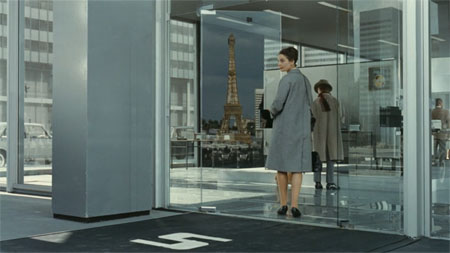
Still from Playtime (1967)

BACKGROUND:

  • The third of four features in which Jacques Tati played the affable, bumbling Monsieur Hulot.
  • Playtime was in production for three years; the downtown sets were constructed by hundreds of workers and were nicknamed “Tativille” among the crew.
  • The film was incredibly expensive to make and Tati took out personal loans to finance it; it was a disappointment at the box office and he went into bankruptcy, giving away Playtime‘s rights in the process.
  • Tati shot the film in 70mm (which was capable of a 2.20:1 aspect ratio, one of the widest formats), and initially insisted the film be screened only in that format in venues with stereophonic sound, despite the fact that very few theaters could meet these specifications. (Partially for this reason, the movie was not screened at all in the United States until 1972). He later relented and allowed 35mm prints to be struck.
  • Humorist and newspaper columnist Art Buchwald wrote the English dialogue for Tati.

INDELIBLE IMAGE: Many people will best remember Hulot’s view from the second-floor view of a factory-like job site composed of a maze of cubicles—a workplace prophecy that’s come true. We chose a scene—one of three in the film—where straggling Barbara opens a door to one of her tour’s commercialized sightseeing destinations, only to see the Eiffel Tower (or the Arc de Triomphe, or the Sacré Coeur) perfectly reflected in the plate glass. These shots express Tati’s theme of the disappearance of culture under the ugliness of modernity, while retaining the wistful hopefulness that is characteristic of his work.

THREE WEIRD THINGS: Faux Hulots; cubicle labyrinth; doorman with no door

WHAT MAKES IT WEIRD: Playtime is about the alienating, isolating influence technology has on human beings. It’s not the standard elements of plot, narrative, character development or dialogue that pulls an equally alienated audience into this unfurling drama, but the careful choreography of hapless humans navigating a barely recognizable hypermodern Paris. Play Time is a sort of anti-Brazil.


Short Clip from Playtime

COMMENTS: Do you remember when watching “Tom and Jerry” on Continue reading 251. PLAYTIME (1967)

246. BELLADONNA OF SADNESS (1973)

Kanashimi no Beradonna

“With all of this splendid weirdness—Michelet’s occult/feminist novel, Fukai’s ravishingly beautiful, X-rated illustrations, and Satoh’s brain-shredding score—what could possibly go wrong? Everything, according to director Yamomoto.”–Dennis Bartok, explaining Belladonna of Sadness‘s commercial failure at the time of its release in the liner notes to the Cinelicious Blu-ray release.

Recommended

Weirdest!

DIRECTED BY: Eiichi Yamamoto

FEATURING: Voices of Chinatsu Nakayama, Aiko Nagayama, , Katsuyuki Itô, Masaya Takahashi

PLOT: In medieval Europe, peasants Jean and Jeanne go to their local Lord to bless their unconsummated marriage, but the royals gang-rape the bride instead because Jean cannot afford the outrageous matrimonial tax. Later, Jeanne is visited by a demon who promises to give her power to oppose the Lord’s might and get revenge. At first she resists, but as the Lord’s outrages mount, she finally gives herself to Satan fully and becomes a powerful witch.

Still from Belladonna of Sadness (1973)

BACKGROUND:

  • This film was the third part of a trilogy of adult animation features on Western themes commissioned by legendary anime pioneer Osama Tezuka (famous for the television manga adaptations “Astro Boy” and “Kimba the White Lion”) and his Mushi studio. The first in the series was 1969’s erotic version of “The Arabian Tales,” A Thousand & One Nights (also directed by Yamamoto). Nights was a commercial hit (although it remains unavailable on home video), so the studio went ahead with Cleopatra in 1970 (which Yamamoto co-directed with Tezuka). Cleopatra was a commercial and artistic flop, but the studio went ahead with Belladonna of Sadness anyway. Tezuka left Mushi before the final film was completed, and Belladonna bombed even harder than Cleopatra. Mushi went bankrupt soon after. Belladonna was exhibited in only a handful of lower echelon theaters in Japan and only lightly released outside of that country until 2015’s rediscovery and reappraisal.
  • The unlikely source material for Belladonna of Sadness was Jules Michelet’s 1862 non-fiction book “Le sorciere” (AKA “Satanism and Witchcraft“), a sympathetic treatment which cast the practice of witchcraft as a protest against the feudal system and the power of the Church.
  • “Belladonna” literally means “beautiful woman” in Italian, but it is also the name of a toxic hallucinogenic plant thought to have been used in ancient witchcraft rituals.

INDELIBLE IMAGE: Without a doubt, the initial rape scene. Although the movie contains shocking, unforgettable, wild and weird imagery throughout, the expressionistic violation of Jeanne, showing her being split in twain like a wishbone as her crotch emits a bloody geyser that morphs into crimson bats who fly away, was the only one that made me mutter out loud “wow”!

THREE WEIRD THINGS: Bloody rape bats; Satan is a dick; surrealist daisy chain orgy

WHAT MAKES IT WEIRD: Belladonna of Sadness is like watching Saturday morning cartoons mixed with high art mixed with hentai, laced with acid. It’s some damned thing that you’ve never seen before.


U.S. release trailer for Belladonna of Sadness

COMMENTS: We owe a huge debt of gratitude to whoever’s idea it Continue reading 246. BELLADONNA OF SADNESS (1973)