Tag Archives: 1974

CAPSULE: PERFUME OF THE LADY IN BLACK (1974)

DIRECTED BY: Francesco Barilli

FEATURING: Mimsy Farmer, Maurizio Bonuglia, Mario Scaccia, Jo Jenkins, Daniela Barnes, Orazio Orlando

PLOT: A wealthy, workaholic bachelorette chemist begins seeing visions of a lady in black, and a young blond girl; is she going mad or being tricked (or both)?

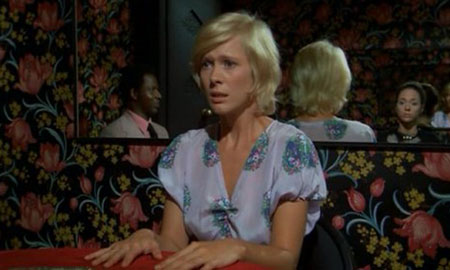
Still from The Perfume of the Lady in Black (1974)

WHY IT WON’T MAKE THE LIST: With its hysterical hallucinations and hints of witchcraft, plus a grisly surprise ending, a case could be made for certifying this quality offbeat occult giallo; but ultimately, it falls into the category of “you gotta draw the line somewhere.”

COMMENTS: In his interview comments accompanying the Raro Video release, writer/director Francesco Barilli acknowledges The Perfume of the Lady in Black’s debt to , but you’d probably sniff the lingering scent of Repulsion early on even without that admission (not to mention a whiff of Rosemary’s Baby, too). Perfume is part of a line of 60s and 70s horrors playing on the anxieties of young single working women. Thanks to sexual liberation, a class of working women living on their own without a live-in male protector was a relatively new phenomenon, and for all the necessary freedom, the fact is that it can be scary to be a woman in a man’s world. Lone females have more to fear than solo males: they fear all the same things men do, plus, they have to fear men. Silvia is competent enough to manage a chemistry lab, but she can’t trust her surroundings, her neighbors, strangers who stare at her on the street, or her even own senses in the dead of night. Whenever she’s alone, she’s endangered, and returns to sanity only when her boyfriend rushes to her side.

Perfume takes place in that lush giallo world, an existence full of tennis dates, elegant silk robes, and apartment courtyard’s with Roman fountains. The art direction is sumptuous, and at times a little outrageous, such as the jungle mural that hovers above Silvia’s friend’s bedpost. Surely such bourgeois elegance can only be there to cover up the stench of decadence. Mimsy Farmer, while not star material, is a treat in this role, constantly frightened and almost reluctantly sexy. The plot seems to be being made up as it goes along. It turns out that there are really two storylines, one of which involves oblique divulged secrets from Silvia’s childhood. The dual plots are mashed together, which produces extra confusion, but less satisfaction, since there’s not a single resolution, and nothing in particular to tie them together. Highlights include a ghostly little girl, “Alice in Wonderland” references, and a séance with a blind psychic (which may be the most giallo scenario ever). The ending is a genuine shock surprise, leaving a strong enough impression to make you forget the somewhat tedious early moments.

Raro Video upgraded Perfume to Blu-ray in 2016. The disc includes an interview with writer/director Barilli (which might be cut down from a longer one included on the DVD release) and a bonus short film, the 23-minute “The Knight Errant,” a shot-on-video variation on Death Takes a Holiday with a couple of surreal surprises that’s well worth a watch.

WHAT THE CRITICS SAY:

The Perfume of the Lady in Black piles on the weird, somewhat to its detriment.”–Jamie S. Rich, DVD Talk (2011 DVD)

CAPSULE: THE ENIGMA OF KASPAR HAUSER (1974)

Jeder für sich und Gott gegen alle (Every Man for Himself and God Against All)

DIRECTED BY:

FEATURING: , Walter Ladengast, Willy Semmelrogge

PLOT: After nearly two decades growing up in a basement cell, Kaspar Hauser is abandoned in the town square of a nearby village. Illiterate and knowing virtually no words, the man is adopted by the townsfolk, first by the town jailer and then by a local professor who finds him on display at a fair. As his awareness of this new world grows, Kaspar becomes increasingly disenchanted with his surroundings.

Still from The Enigma of Kaspar Hauser (1974)

WHY IT WON’T MAKE THE LIST: While the story is based on an historical oddity that morphed into something of a legend, the movie structure, flow, and presentation are conventional. The tragedy of Kaspar Hauser is rather weird, but Herzog tells his tale through traditional storytelling methods.

COMMENTS: The Enigma of Kaspar Hauser proves that the young Werner Herzog had the golden touch. It could be argued he single-handedly launched the volatile to art-house superstardom with the success of Aguirre, the Wrath of God. Right on that movie’s heels, he cooked up a heartwarming tragedy for the then-very-unknown street performer, Bruno S. In the titular role in  Kaspar Hauser, Herzog directs the non-actor in a performance that is moving, amusing, and, most impressively, believable.

Herzog took the historical but semi-legendary story of Kaspar Hauser at face value. The movie begins, as with so many Herzog pictures, with shots of mesh-enveloped nature. As in Aguirre, an informative title card is presented to provide the viewer with background—in this case, ironically, to introduce him to the protagonist’s lack of background. Having spent all his formative years from birth locked in a dimly lit cellar, with only one man’s company (limited to feeding time and perhaps cleanings), Kaspar Hauser has no basis for experience other than four walls, a straw covered floor, bread, water, and a wheeled toy horse. For unknowable reasons, one day the captor releases Kaspar and then ditches him, standing in a daze with a letter in hand, in the center of a prosperous 19th century German town.

The truly blank slate of Kaspar allows Herzog to force the audience to observe mankind from the character’s detached perspective. The town is bewildered by Kaspar’s presence and lack of interactivity. The authorities, one of whom is an excitable clerk keen on getting everything recorded in his reports, are officious, slightly suspicious, but ultimately kind. The children of the jail keeper teach Kaspar all they can. When the town government are irked at the stranger, they force him to act as one of the “Four Riddles of the Spheres at a town fair. Kaspar engineers an escape for himself and the three other “riddles,” only to be found later in an apiary by a kindly professor. Things do get better for Kaspar, but also worse.

The movie is sprinkled with amusing moments, largely observational oddities from the unworldly Kaspar, but it is ultimately a tragedy. Throughout, Herzog’s camera digresses into gossamer fields, dunes, and water. These signature shots ably convey Kaspar’s sense of wonder, but also his detachment from the world in which he finds himself. Near the beginning, he lightly sobs to the jail keeper’s wife,  “Mother, I am so far from everything”; later, he remarks to the professor, “It seems to me that my coming into this world was a very hard fall.” At a sort of “coming out” party put on for a visiting prat of a nobleman, he glibly tells the assembled bourgeois gawkers that life was better for him in his cell.

Kaspar Hauser has many moments of quiet beauty to behold, and Herzog further demonstrates his mastery of his craft with this addition to his oeuvre. The reality it creates is as wondrous and sad as the reality Kaspar experiences when he finally gains his bearings.

WHAT THE CRITICS SAY:

“In Herzog the line between fact and fiction is a shifting one. He cares not for accuracy but for effect, for a transcendent ecstasy… The last thing Herzog is interested in is ‘solving’ this lonely man’s mystery. It is the mystery that attracts him.”–Roger Ebert, Chicago Sun-Times (contemporaneous)

CAPSULE: THE CARS THAT ATE PARIS (1974)

AKA The Cars That Eat People

DIRECTED BY:

FEATURING: Terry Camilleri, John Meillon

PLOT: Mild-mannered Arthur survives a car crash that kills his brother and finds himself stranded in the insular, automobile obsessed town of Paris, Australia.

Still from The Cars That Ate Paris (1974)
WHY IT WON’T MAKE THE LIST: Like its director’s last name, this one falls just a little short of “weird.”  Park The Cars That Ate Paris in the oddity yard.

COMMENTS: You could look at The Cars That Ate Paris as a psychological horror, or a semi-surreal black comedy about a fish out of water, or as a satire of Australian car culture, or even as a dramatic character study of a broken, phobic orphan desperate for acceptance. The movie even starts, rather inexplicably, with what appears to be a cigarette commercial, for further confusion. Without revealing too much, the plot revolves around the town of Paris, New South Wales, an isolated burg with a junkyard barter economy based on salvaged car parts, and Arthur, an annoyingly meek wreck survivor with an automobile phobia who finds himself stranded in a community that insists on taking him in and teaching him their way of life. There are also out-of-control teenagers in roving automobile gangs and a hospital that, given the out-of-the-way hamlet’s low population, is surprisingly stocked with brain-damaged “veggies” (of the full, half and quarter varieties).

Cars zooms back and forth between understated comedy and looming horror, constantly grinding its gears. Scenes like the one where the town’s psychiatrist/surgeon slips disturbing photos into Arthur’s Rorschach-type test have a dark-alley-of-the-mind quality to them. At other times, the movie jaunts off in a different direction, suddenly rolling into a Sergio Leone parody. The ending, quite naturally, is a violent demolition derby, complete with growling cars, wherein the entire town is trashed while costumed loonies wander the street. Cars offers a bumpy ride, and goes pretty much nowhere, but the scenery out the window can be astonishing.

Understandably, The Cars That Ate Paris was a hard movie to market. In the VHS era, it was housed in the “horror” section (sometimes under the misleading alternate title The Cars That Eat People) with a box cover that stressed the cool spikemobile and copy that suggested it was something like an Australian version of Death Race 2000. The movie got bad word-of-mouth through this mismarketing when legions of teenagers rented it expecting a fast-paced horror movie about killer cars and instead getting a thoughtful, weird little arthouse drama. Its reputation changed for the better after the Criterion Collection picked up the film, repositioning it as a cult classic.

WHAT THE CRITICS SAY:

“Effortlessly employing surrealist and fantasy tropes in a story that is, ultimately, never very far from the possible, Weir steers us on a dizzying journey through autophilia, survivalist politics, and the darker side of human nature.”–Jennie Kermode, Eye for Film (DVD)

(This movie was nominated for review by the Awful Dr. Orloff, who believed it to be “much, much weirder” than Picnic at Hanging Rock. Suggest a weird movie of your own here.)

179. PHANTOM OF THE PARADISE (1974)

“The reason Fox found it unwieldy — the scabrous humor about the music industry, the unhappy love story and the weirdness of some of the characters — are exactly the reasons why people love it now.”–Gerrit Graham on Phantom of the Paradise (quoted in the New York Times)

Recommended

DIRECTED BY:

FEATURING: William Finley, , , Gerrit Graham, George Memmoli

PLOT: Swan is the world’s most powerful music producer, who dreams of opening a grandiose concert venue called the Paradise, while Winslow is a composer who has created a rock cantata version of “Faust.” Swan steals Winslow’s work; while seeking revenge, an accident disfigures Winslow’s face and destroys his vocal cords. Now wearing a mask, Winslow takes up residence in the basement of the Paradise and strikes a deal with Swan to rewrite the opera for Phoenix, a female singer whom both men lust after.

Still from Phantom of the Paradise (1974)
BACKGROUND:

  • Although Brian De Palma became famous for thrillers and action movies like Dressed to Kill, Scarface, The Untouchables, and Mission Impossible, he began his career making subversive underground comedies, and his earliest films for major studios were oddball farces. Phantom of the Paradise marks the apex of De Palma’s comedic phase; his next film would be the horror hit Carrie, following which he would largely abandon his burlesque and experimental impulses.
  • De Palma was inspired to write a satire on the commercialization of rock music when he heard a Muzak version of the Beatles’ “A Day in the Life” in an elevator.
  • Paul Williams, a successful songwriter who had penned hits for The Carpenters, wrote and performed the soundtrack (dubbing in William Finley’s singing voice). Williams was originally cast in the role of Winston, but asked to play Swan instead, and proved a natural for the role.
  • The movie was a financial flop, but Williams’ score was nominated for an Academy Award.
  • A bizarre bit of trivia: although Phantom was a box office bomb, for some reason it was immensely popular in Winnipeg, Canada, where it played screens on and off for over a year. (I like to imagine famous weird Winnipegian , who would have been about 18 at the time, was a repeat customer).

INDELIBLE IMAGE: We’ll go with the assassination of Beef, who is killed in improbable fashion by a neon lightning bolt. To ecstatic applause from the spectacle-hungry audience. Not only is it an unforgettable sight, it’s also the moment when the operatic Phantom solidifies its weird credentials.

WHAT MAKES IT WEIRD: It’s a wadded-up plot of “Phantom of the Opera” and “Faust,” with a bit of “Dorian Gray,” rolled up into a music biz satire ball and sprinkled with a dusting of crazy.


Edgar Wright commentary on the original trailer for Phantom of the Paradise (from Trailers from Hell)

COMMENTS: There’s a critical cliche that says that you can’t deliberately fashion a cult movie; it must be discovered. In other words, it’s the Continue reading 179. PHANTOM OF THE PARADISE (1974)

BLAXPLOITATION ZOMBIES: SUGAR HILL (1974)

Guest review by Brandon Engel, a freelance writer specializing in entertainment and pop culture, as well as an aspiring filmmaker.

What if a real zombie outbreak occurred during a zombie pub crawl? Imagine everyone liquored and latexed up to such a degree that nobody could differentiate the real zombies from the fake zombies. My point, I guess, is that this zombie thing has gotten out of hand.

Hearken back to a time when people were still appropriately freaked out by the living dead. Because of directors like George A. Romero, zombies became a fashionable cinematic device to address a myriad of social issues, starting in the late sixties. The films might have made more of an impression because zombies still elicited a strong reaction from viewers. Romero’s frequently remade and frequently cited Night of the Living Dead (1968), for instance, addressed the increasingly violent and sensational mass media coverage of the Vietnam war, and was notable also for featuring a black actor (Duane L. Jones) as the film’s leading man. Dawn of the Dead (1978), Romero’s follow up, offered a satire of North American consumerism by having a bunch of zombies putter mindlessly around a shopping mall.

Dawn also, incidentally, also featured a black male in it’s lead (Ken Foree), and even delved thematically into race issues with the extended segment that shows how the zombie apocalypse might manifest in the projects. But a few years prior to Dawn, the blaxploitation/horror film Sugar Hill (1974) had also appropriated the zombie motif to comment on race relations and social inequities.

The film was directed by Paul Maslansky, whom some may know as producer of the Police Academy films and Return to Oz (1985).  In the film, Diana “Sugar” Hill (Marki Bey) is engaged to marry the owner of a lucrative Haitian-themed bar. At the beginning of the film, members of a predominantly white crime syndicate approach Sugar’s fiance. When he refuses to acquiesce to the gang’s protection racket, Sugar’s fiance is beaten to death.

Still from Sugar Hill (1974)Sugar seeks the assistance of a voodoo priestess, Mamma Maitresse (Zara Cully), who in turn summons Baron Samedi, the Voodoo Loa who presides over funerals and acts a medium between the realm of the living and the realm of the dead. Samedi enlists an army of Voodoo zombies to avenge Sugar’s lover’s murder. The white gangsters are picked off, one by one. One guy is fed to a pack of hogs. One guy is thrown into a coffin filled with dangerous snakes. Blaxploitation films usually depicted black characters in positions of power over the “archetypal white oppressor” character. The title character from Superfly accomplishes this by dominating the drug trade. Shaft and Cleopatra Jones were cunning law enforcement agents. Part of what makes Sugar’s story so compelling in the annals of blaxploitation/revenge films, however, is the supernatural element. The film even evokes the transatlantic slave trade directly by suggesting that Sugar’s band of voodoo zombies were all slaves transported to the United States from Guinea. So, it becomes a revenge film in a much broader sense. It’s not merely about Sugar avenging her boyfriend’s death, but she’s also avenging (symbolically, at least) the wide-scale oppression and dehumanization of her ancestors.

The film was produced by American International Pictures, who were eager to follow up on the success of their earlier blaxploitation/horror genre blenders Blacula and Scream, Blacula, Scream. Part of what distinguishes Sugar Hill is that it isn’t based on a piece of 19th century European literature, but is instead a more distinctly black American narrative which synthesizes elements of Voodoo iconography, fairy tales, and classic b-horror film tropes. It’s occasionally clumsy and highly stylized script offers all of the cliches that you’d hope for in a blaxploitation film.

While Sugar Hill is frequently overlooked (even by cult film fanatics), it’s now enjoying a resurgence in popularity thanks to midnight screenings throughout the U.S., and regular showing on ‘s El Rey Network. Vintage horror fans (especially anyone with a fondness for either blaxploitation or seventies Italian zombie films) should absolutely check this one out.