366 UNDERGROUND: THE KINGDOM OF SHADOWS (2016)

DIRECTED BY: ,

FEATURING: Joana Castro, Bruno Senune, Carina de Matos, Falvia Barabas, Daniel Pires

PLOT: Shuffling between the interior and exterior of a building (with guest appearances from some jagged cliffside rocks), various symbolic events occur because of the actions of various symbolic people.

Still from The Kingdom of Shadows (2016)

WHY IT WON’T MAKE THE LIST: This clutter of film scenes might be interpreted as “weird”, but I’m leery to describe the onscreen capering as a “movie”. Perhaps it’s just my staggering lack of interpretive skills, but when the characters are only somewhat explainable because you read the opening credits, I find the “movie” part a bit wanting. Not much is clear, and the lack of dialogue handily augments the altogether excessive incoherence of the narrative.

COMMENTS: I shall begin by saying that Daniel Fawcett and Clara Pais may well have accomplished something impressive with their symbol-ridden film, The Kingdom of Shadows. Throughout the film there are little hiccups of inspired images that, in isolation, would make for compelling photographs to ponder. The lack of dialogue lends itself to a lack of explanation, but that allows for a mutuality of incomprehension across the globe. Unfortunately, it leaves the viewer grasping blindly for what it is the filmmakers are trying to say.

The story proper (I am guessing) begins weirdly enough with a pair of golden hands magically boiling up a pot of water. What ensues is a long-form mishmash of figurative images and sequences that vaguely intrigue, and certainly baffle, the viewer. A furtive young man appears during the bridging sequences, who may be acting as witness, along with us viewers. Inside a 19th-century (?) house, a clutch of people (indicated in the credits as “mother”, “daughter”, “uncle”, and so on) interact in strange ways with motives that are impossible to divine. An inspector comes along at some point (again, we know his vocation only from the credits) and twirls his mustache a lot. Eventually the gang inside the house takes up arms against the “daughter,” driving her outside. Interrupting the action is a pair of (usually naked) young people having quasi-dance-like interactions of joy, terror, and sundry other feelings.

As I’ve hinted in the preceding paragraphs, while there may be a lot going on in the movie, very little of it makes any sense. It would help if I knew what the directors were trying to say, and a commentary would no doubt be illuminating. That said, this presents a problem: any movie that cannot stand up to unsupervised viewing is of dubious merit. If there isn’t clarity, there needs to be a “vibe” of some sort, or at least an ambience. However, The Kingdom of Shadows is too scattered to have such a vibe, and any ambience is sabotaged by incoherent or careless touches. To support the latter, I give the example of a slow-moving “pursuit” scene through one of the house’s corridors. The turn-of-the-last-century feel is utterly destroyed by a very obvious smoke detector on the wall. Its square plastic frame and glowing electric light immediately crush whatever mood may have been built.

I have no doubt that all those involved poured their hearts and souls into making this movie, so it pains me a little to have to be so down on it. After the sturm und drang of various troubled moans from the young observer, after the not-quite balletic artiness of the “Adam and Eve” vignettes, and after the cranked up symbolism, we’re still left with something that’s a bit amateurish and more than a bit boring. If there were an unhealthy halfway point between How the Sky Will Melt and Begotten, this movie hits it, and hits it hard. ‘s piece—while perhaps incomprehensible—has that dream-like “thing” required for such an exercise in post-narrative film. That “thing” is never found by the directors of The Kingdom of Shadows, which is more the pity.

WHAT THE CRITICS SAY:

“…a film that does never try to make perfect sense, instead using impressive, often tableau-like imagery to get its point across… a film like this might not be for everybody, but those with open minds are up for a fascinating journey…”–Mike Haberfelner, [re]Search My Trash (contemoraneous)

WEIRD HORIZON FOR THE WEEK OF 1/27/2017

Our weekly look at what’s weird in theaters, on hot-off-the-presses DVDs, and on more distant horizons…

Trailers of new release movies are generally available at the official site links.

SCREENINGS – (Cinefamily, Los Angeles, Fri., Jan 27):

Belladonna of Sadness (1973): Read the Certified Weird entry! Seeing as how the ‘Family had a big role in rediscovering this psychedelic rape revenge musical anime, screenings have become a semi-regular thing there. Belladonna of Sadness at Cinefamily.

SCREENINGS – (Planeta, New York City, Sun., Jan 29):

Gutboy: A Badtime Story (2015): A flayed puppet fights the Man. All-marionette. This film proudly advertises itself as “the weirdest movie in the world,” which has obviously scared away distributors thus far. Check out this rare screening if you’re in the New York area. Gutboy at Planeta Facebook event page and Gutboy official site.

NEW ON DVD:

“Dirk Gently’s Holistic Detective Agency”: The title character investigates the murder of a millionaire and meets lots of strange characters in this comedy mystery series. The BBC America television show is based (far too loosely, according to fans) on the Douglas (Hitchhiker’s Guide to the Galaxy) Adams books. Buy “Dirk Gently’s Holistic Detective Agency”.

The Man Who Fell to Earth (1976): Read Alice Stoehr’s List Candidate review! This welcome, newly restored re-release contains a Blu-ray, DVD, and a disc of special features, including new interviews with the surviving crew, and may give us an excuse to revisit this old / favorite. Buy The Man Who Fell to Earth [40th Anniversary Limited Edition DVD/Blu-ray combo].

The Vessel (2016): On a remote island, a man survives a drowning that should have killed him and creates a monument to the schoolchildren who lost their lives in a tsunami. This enigmatic parable, the writing/directing debut of Julio Quintana, was executive produced by and has been described as “dreamlike” more than once. Buy The Vessel.

NEW ON BLU-RAY:

“Dirk Gently’s Holistic Detective Agency”: See description in DVD above. Buy “Dirk Gently’s Holistic Detective Agency” [Blu-ray].

The Man Who Fell to Earth (1976): See description in DVD above. Buy The Man Who Fell to Earth [40th Anniversary Limited Edition DVD/Blu-ray combo].

The Vessel (2016): See description in DVD above. Buy The Vessel [Blu-ray].

What are you looking forward to? If you have any weird movie leads that I have overlooked, feel free to leave them in the COMMENTS section.

1968 EXPLOITATION TRIPLE FEATURE: NIGHT OF THE LIVING DEAD, THE DEVIL RIDES OUT, AND SPIRITS OF THE DEAD

366 Weird Movies may earn commissions from purchases made through product links.

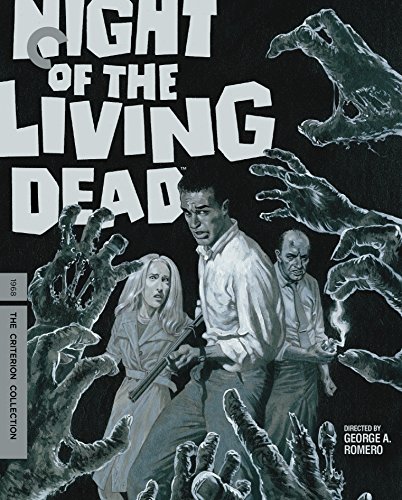
In 1968 released one of the most relentlessly frightening movies ever made in Night of the Living Dead, but it took a couple of years for the midnight movie crowd to make it into an epic cult phenomenon. Seen today, it holds up effectively, even with our sensibilities jaded from countless hack imitations. Its grainy black, white, and gray palette serves its otherworldliness well during a late night viewing on big screen, which I how I first encountered it. Even Romero could never quite match it, although he continued to try for forty years.

The argument can be made that Romero’s best post-Night of the Living Dead films were outside the zombie genre (The Crazies, Martin, NightRiders, and Creepshow). Still, no one does zombies like Romero (as proved with his 1990 NotLD remake), and the movie closest to the impact of the original was its immediate sequel, Dawn of the Dead (1978), which was a shock satire on Western consumerism, brutalizing in its late 70s comic book colors and deliberate plays on banality. Some claim Dawn is Romero’s masterpiece, although it lacks the original’s reinventing-the-wheel, rough-edged freshness. In 2004, Dawn was remade by who completely missed Romero’s acerbic wit. The underrated Day of the Dead (1985) was the third in Romero’s original zombie trilogy, but did not attain the cult status of its predecessors. Its financial disappointment seemed to render it a finale to Romero’s zombie oeuvre. However, Romero, who has always been a sporadic filmmaker, returned with The Land of the Dead in 2005, which was followed by Diary of the Dead (2007) and what looks to be his last film, Survival of the Dead (2009). Each of Romero’s zombie sequels has its equal share of fans and critics, but at the very least, he has tried to say something new with each entry.

Still from Night of the Living Dead (1968)None have attained the compact rawness of that 1968 yardstick, however. Duane Jones became a cult icon as the doomed protagonist Ben. Previously an English professor, Jones was the first African-American to have a starring role in a horror feature (the script does not specify Ben’s ethnicity). Judith O’Dea, as Barbara, is the eternal victim ( in Savini’s remake, the character is recast as a feminist femme fatale). Together, they hole up in a farmhouse and fight off the marching dead, but are inevitably at the mercy of hayseeds with guns. The shot-on-the-cheap crudeness and novice acting actually add to the mundane horror. It was riveting enough to create an entirely new genre, but predictably, its unique qualities have eluded pale imitations.

Elsewhere in 1968, AIP’s Wild in the Streets (directed by ) Continue reading 1968 EXPLOITATION TRIPLE FEATURE: NIGHT OF THE LIVING DEAD, THE DEVIL RIDES OUT, AND SPIRITS OF THE DEAD →

267. FEMALE TROUBLE (1974)

“The world of the heterosexual is a sick and boring life.”–Aunt Ida, Female Trouble

Recommended

DIRECTED BY:

FEATURING: ,  , , , , Michel Potter

PLOT:  Baltimore rebel Dawn Davenport runs away from home, gets knocked up by a rapist, and turns to a life of crime to help pay for the daughter she hates. After a brief and disastrous marriage, Dawn is scarred for life after her ex-husband’s Aunt Ida throws acid in her face. Transformed into a freak celebrity by a salon-owning couple, Dawn embarks upon a murder spree before an inevitable trip to the electric chair.

Still from Female Touble (1974)

BACKGROUND:

  • Shot on a $25,000 budget, Female Trouble is puke poet laureate John Waters’ riotous followup to his midnight cult hit, Pink Flamingos. Waters capitalized on the previous film’s surprise success and advertised Female Trouble as having the returning cast of Pink Flamingos. It is the second entry in what Waters later called his “Trash Trilogy,” which begins with Flamingos and ends with Desperate Living.
  • After acting in Waters’ films for twelve years, this was David Lochary’s last screen appearance. He was cast for 1977’s Desperate Living but bled to death as the result of a fall while under the influence of PCP shortly before filming began.
  • Waters’ tagline for Female Trouble was “A high point in low taste.”
  • Divine based part of her portrayal of Dawn on her nightclub act, during which she threw mackerel at the audience and claimed to be a mass murderer.
  • Female Trouble was dedicated to Charles “Tex” Watson, of the Manson Family, who partly inspired the film’s theme of “crime is beauty.” The wooden toy helicopter in the film’s credits was Watson’s gift to Waters after a prison visit. (Waters later said that he regretted the dedication).
  • Alfred Eaker‘s Staff Pick for a Certified Weird movie.

INDELIBLE IMAGE: Dawn jumping up and down on a trampoline, wearing a mohawk and a sparkly pantsuit, at her big performance art showcase.

THREE WEIRD THINGS: Divine rapes Divine; chewed umbilical cord; Auntie in a birdcage

WHAT MAKES IT WEIRD: An expressionistic nightmare set in the hell of East Coast suburbia highlighting the rise and fall of a 300 pound transvestite mass murderer, Female Trouble reaches its first climax of lunacy when Dawn chops off Aunt Ida’s hand, locks her up in an oversized birdcage, and goes on her daughter for joining the Hare Krishnas. A second bouncing-off-the-wall climax follows when Dawn murders audience members as performance art before going down in a blaze-of-glory finale that could compete with Cody Jarrett blowing himself up or Tony Montana rat-a-tat-tatting away after being riddled with bullets. Accompanying all that is a beauty myth from the bowels of a white trash hell that would send Naomi Wolf screaming for sanctuary. Female Trouble is even more subversive than Pink Flamingos.


Short clip from Female Trouble (1974)

COMMENTS: On the surface, Female Trouble may appear to be Continue reading 267. FEMALE TROUBLE (1974) →

Celebrating the cinematically surreal, bizarre, cult, oddball, fantastique, strange, psychedelic, and the just plain WEIRD!