Tag Archives: The creative process

POP MEETS THE VOID (2015, WILLIAM CUSICK)

‘s Pop Meets The Void (2015) is what independent film should be: an alternative to mainstream cinema, as opposed to a low budget imitation of Hollywood fare.

Cusick sees the artist as in revolt against common sense and repressive conventions of the social order. The musician protagonist of Pop Meets the Void encounters the fingernails-down-chalkboard inquisition that almost every artist endures from bourgeoisie muggles: “Are you a real artist or do you just wanna be?” Fill in the appropriate follow-up blank: “Are you famous? Are you rich? Do you have a recording contract with a big label? Have you published a book? Have you acted in a real movie, like the ones from Hollywood? Have you sold a painting for a million dollars yet?” Followed by “So, what’s the point?”

German Expressionist painter Franz Marc astutely addressed the artist’s encounter with the bourgeoisie in an entry from the famous “Blue Rider Almanac”: “It is strange that people should value spiritual treasures so differently than material ones. If someone conquers a new colony for his country, the whole country rejoices for him and does not hesitate to take possession of that colony. Technological achievements are met with the same rejoicing. On the other hand, if someone should think of giving his country a spiritual treasure, it is almost always rejected with anger and irritation; his gift arouses suspicion and people to try and do away with it. Why new paintings and why new ideas? What can we buy with them? We already have too many old ones.”

Painter Paul Gauguin advised young artists to worry less about the finished work and locate sacrament in the artistic process. This is Cusick’s spirit. He retreats and takes the role of artist as hermit, keeping his music attic-bound. As a hermit, his worldview encompasses the artist as misfit prophet.

Still from Pop Meets the Void (2015)The narrative of artist as contrarian to the world has been around as long as there has been artists, and will continue until the artist goes the way of the dinosaur. If Cusick had merely followed an orthodox route, his film would be dishonest and pedestrian. Cusick knows such a retreat must inspire a genre-rejecting, authentic composition, and Pop Meets The Void‘s fantasia qualities make it a startling work that validates the narrative as both immortal and relevant. History does not exist. Rather, the artistic expression is fluid. Marc sees continuity as opposed to an historical valve which shuts on and off: “Cezanne and El Greco are spiritual brothers, despite the centuries that separate them.” We can, of course, subscribe to the maxim there is nothing new under the sun, but Cusick stubbornly refuses to be fence-bound, charismatically imprinting his own process.

Criticizing the historical development of cinema, wrote: “Moving pictures merely repeat what we have been told for centuries by novels and plays. Thus, a marvelous instrument for the expression of poetry and dreams (the subconscious world) is reduced to the role of simple REPEATER of stories expressed by other art forms.” Cusick utilizes the liberty of dreams to convey boundless paradoxes presiding in the asphyxiating mirage of adulation and celebrity.

Smarter still, Cusick forgoes the aloofness which often permeates and hinders the surreal aesthetic. In ambitiously attempting to construct something akin to a Mahlerian universe, Cusick does not shy away from bathos. If it is all-encompassing, then his work must be imbued with all facets of the mortal experience. Pop Meets The Void is coarse and sleek, opaque and diaphanous, textured and emotional, a visual work about music. As the late composer Pierre Boulez advised: “We must be cultural omnivores and raid all the art forms to enhance our own medium.” Cusick’s impetuously earnest effort does just that, and is a List contender.

226. CONSPIRATORS OF PLEASURE (1996)

Spiklenci Slasti

366 Weird Movies may earn commissions from purchases made through product links.

Conspirators is actually a film about liberation, and about gaining a freedom.”–Jan Svankmajer explaining why he considered Conspirators his most Surrealistic film up to that point

Recommended

DIRECTED BY: Jan Svankmajer

FEATURING: Petr Meissel, Gabriela Wilhelmová, Barbora Hrzánová, Anna Wetlinská, , Pavel Nový

PLOT: A man enters a newsstand and furtively buys a pornographic magazine as the owner nods conspiratorially at him. At home, he leafs through the pages but is interrupted by the postwoman, who has him sign for a letter that simply reads “on Sunday.” Over the next several days the man constructs an elaborate chicken costume; meanwhile, the postwoman, his next door neighbor, the newsstand owner, and another couple are all involved in their own strange, surreptitious projects.

Still from Conspirators of Pleasure (1996)

BACKGROUND:

  • Conspirators of Pleasure began life as a screenplay for a short written in 1970 but never filmed. That short would have told the parallel stories of the “chicken man” and his neighbor across the hall. Svankmajer resumed work on the project in 1996, thought of four more characters to include, and expanded the film to feature length.
  • In 1975 Svankmajer wrote a (satirical?) essay entitled “The Future Belongs to Masturbation Machines.”
  • Originally known for his stop-motion animated shorts, Conspirators was Svankmajer’s third feature film, and it continued a trend of having less and less animation in each successive film (there are only a few accent scenes here, which amount to about one minute of animation).
  • The end credits list Sacher-Masoch, the , Freud, , and Bohuslav Brouk (a Czech psychoanalyst who wrote up a series of case studies about masturbatory practices) as having provided “professional expertise.”
  • The , animators who paid tribute to the Czech director with the 1984 film “The Cabinet of Jan Svankmajer,” are listed in the credits as “musical collaborators” (although the soundtrack is prerecorded classical music).

INDELIBLE IMAGE: The man in a chicken suit doing a ritualistic (and sometimes literally animated) dance in front of a doll-like effigy tied to a chair.

THREE WEIRD THINGS: Stop-motion submissive; dough-snorting; carp shrimping

WHAT MAKES IT WEIRD: We follow six people engaged in complicated, intensely personal fetishistic rituals; adding to the odd, voyeuristic atmosphere, there is no dialogue, other than what’s overheard in the background on television. Each of the conspirators crosses the others’ paths, but continue to work on their own private obsessions, until all of them appear to receive their ultimate gratification. Then, Jan Svankmajer launches us into a new stratosphere of strangeness at the finale, when the chickens come home to roost (so to speak).


Short clip from Conspirators of Pleasure

COMMENTS: Case study: a man, Eastern European, balding but fit Continue reading 226. CONSPIRATORS OF PLEASURE (1996)

225. ADAPTATION. (2002)

CHARLIE KAUFMAN: I’ve written myself into my screenplay.

DONALD KAUFMAN: That’s kind of weird, huh?

Adaptation.

Must See

DIRECTED BY:

FEATURING: , , Chris Cooper, Brian Cox

PLOT: Screenwriter , fresh off the hit Being John Malkovich, is contractually and mentally trapped as he is forced to plow his way through an impossible project: “writing a movie about flowers.” Things go from bleak to bizarre as he finds himself competing with his endearingly oblivious twin brother, Donald, who also aspires to be a screenwriter. Charlie slips further and further past the deadline, until things come to a head in the film’s swampy denouement where he comes face-to-face with both the writer of and titular character from “The Orchid Thief,” the book he is adapting for the screen.
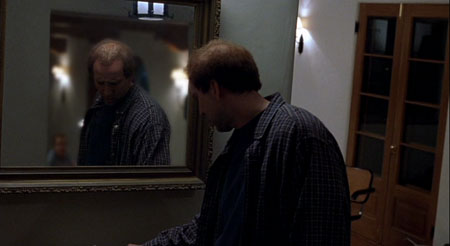
Still from Adaptation. (2002)

BACKGROUND:

  • The screenplay for Adaptation. was on Charlie Kaufman’s to-do list since the late ’90s. Tasked with adapting Susan Orlean’s novel-length essay “The Orchid Thief” and suffering the same problems as his doppelganger, he kept his progress secret from everyone other than Spike Jonze until 2000, when the movie was green-lit for production.
  • Screenwriting guru Robert McKee and his seminars are real. He personally suggested Brian Cox play him in the movie.
  • Adaptation. handily recouped the producers’ investment, with a return of $32.8 million worldwide on a $19 million outlay.
  • Nominated for four Oscars: best actor for Cage, supporting actor for Cooper, supporting actress for Streep, and adapted screenplay for Charlie and Donald Kaufman. Cooper was the only winner.
  • Though “Donald” Kaufman’s serial killer script The 3 was never shot, the idea may have inspired two subsequent movies, 2003’s Identity and 2006’s Thr3e.

INDELIBLE IMAGE: Returning from a misfired date, Charlie finds his twin brother already back home from a writer’s seminar, brimming over with newly adopted wisdom. As Charlie stands in front of his hallway mirror, Donald’s face is captured in the reflection as he expounds upon his own screenplay’s “image system” involving broken mirrors. Charlie’s expression goes from dour to disbelieving at this inanity, and the viewer sees the movie mock both itself and screenplay tricks. A further twist is added by the fact that the blurry reflection in the mirror is the face of the actual Charlie Kaufman talking to Nicolas Cage.

THREE WEIRD THINGS: Film-within-a-film-within-a-screenplay-within-a-screenplay ; Ouroboros; orchid-snorting

WHAT MAKES IT WEIRD: For all its unconventionality, Adaptation is amazingly self-deprecating. Spoilers unravel in opening scenes and are tossed aside, coastal city elites are presented as real people with the petty little problems real people have, and Nicolas Cage gains a bit of weight and loses a bit of hair to provide the compelling double performance as the Kaufman brothers. Events seem scattershot, only to have their purposes later clarified as the tightly structured flow keeps the viewer jumping from moment to moment, always questioning which parts of this convoluted tale are actually true.

COMMENTS: Between its thorough description of the protagonist Continue reading 225. ADAPTATION. (2002)

CAPSULE: MEMPHIS (2013)

DIRECTED BY: Tim Sutton

FEATURING: Willis Earl Beal

PLOT: An R&B singer wanders through Memphis, Tennessee, struggling to find inspiration to complete a second album after a successful debut.

Still from Memphis (2013)
WHY IT WON’T MAKE THE LIST: It’s only slightly weird, and while there are moments of unquestionable beauty, its vast empty spaces make it a real wristwatch checker.

COMMENTS: Although anyone who’s ever worked in any creative medium can identify with its torments, writer’s (or musician’s) block is a hard thing to convey to an audience in a fascinating way. Although the cinematography here is sublime, and Willis Earl Beal has a weird funky charisma, Memphis is not up to the challenge of engaging us with this artist’s disengagement. What Memphis is best at is depicting the African American communities of it’s title city as a throwback to the ancient world of the blues, a place where men still wear felt hats and play dominoes and drink out of paper bags (I know men still play dominoes and drink out of paper bags, but not while wearing porkpie hats). With tree boughs hanging over the boulevards and weed-choked lots separating the bars from the churches, these neighborhoods look simultaneously urban and rural, like postcards from a pre-smart phone era.

Beale is a man out of time, too; he fits in better with the grizzled old men sitting on their porches than he does with folk his own age. As the movie progresses—to whatever degree such a deliberately static work can be said to progress—it becomes increasingly unclear whether the singer might actually be suffering from some form of mental illness. When he says in the opening scenes that he’s a wizard who conjures his own reality, it sounds like a metaphor for artistic creation, but the more he rambles about envying the trees or copulating with the dirt, the more you consider the frailty of the line between genius and madness. There are parallels between his alienation from his own creativity and alienation from God (and thus from his own church-centered culture). He refuses to sing at Sunday revival, and an old man’s midnight advice to him is chilling: “Using your talent is what God wants you to do. He gave it to you for a reason… I’d hate to be in your shoes, where you owe God.”

There are some very good shots in this sprawling, strange and obscure movie. Beale composes in a strange polygonal room with neural ductwork. He slow dances with his sweetie in a neon nightclub, continuing in a trance even when she withdraws. These are moment of poetry that will reward a certain breed of contemplative cinemagoer. Typical audiences are going to find this affair far too slow and inconclusive, however. Beale’s musical talent is only glimpsed in frustrating snatches. The movie is only seventy-five minutes long, but scenes of the melancholy protagonist walking around whistling or practicing his stick-fighting moves with a broom seem interminable. Memphis‘ non-story could have been conveyed with as much impact at a third of the length.

WHAT THE CRITICS SAY:

 “…Sutton at least keeps the running time trim. Perhaps he knew that the strange magic he and Beal occasionally conjured was destined to have a short shelf life. Better to leave the few audience members plugging into this cryptic oddity wanting more.”–Film Journal International (contemporaneous)

CAPSULE: BIRDMAN (2014)

Birdman or: (The Unexpected Virtues of Ignorance)

Recommended

DIRECTED BY: Alejandro González Iñárritu

FEATURING: , , , , , , Amy Ryan, Lindsay Duncan

PLOT: Aging actor Riggan Thomas, who became a superstar anchoring a blockbuster superhero franchise in the 1990s, writes, directs and stars in a Broadway show in an attempt to be taken seriously as an artist; unfortunately, he’s simultaneously battling the voices in his head, as his old alter-ego presses him to sign up to do “Birdman 4.”

Still from Birdman (2014)

WHY IT WON’T MAKE THE LIST: Birdman is a movie that adopts a weird methodology to tell its story, but it’s only weird by the diminished standard of movies that will be nominated for multiple Academy Awards.

COMMENTS: Birdman starts with a strange conceit. It’s about a former superstar actor, star of a superhero tentpole franchise, trying to be taken seriously as an artist by producing, writing, starring and directing a Broadway play based on a Raymond Carver short story. To throw a wrench into things, the actor is also insane, believing that he has telekinetic powers, and he hallucinates that his Birdman alter-ego is taunting him for his artistic pretensions. So, given that this is your story, why not sweeten the weirdness by scoring the film to solo jazz percussion and shooting the entire movie in what appears to be one unbroken take?

Birdman is not like any other film you’re likely to see this year, or anytime soon. It is a movie that (on the surface) insists that plays are more authentic artistic expressions than movies. It’s an extremely theatrical movie, one that’s bursting with smart dialogue, numerous subplots, and memorable monologues. It’s no wonder that a top-notch cast was attracted to the project. Most notable is Edward Norton, in a flamboyant role as an arrogant actor with so much talent he’s compelled to sabotage himself just to keep things interesting. Keeping pace is Emma Stone as Riggan’s wayward daughter, just out of rehab and more adept at spotting others’ b.s. than her own. Even Zach Galifianakis impresses in a rare straight-man turn as Riggan’s lawyer. Still, Keaton, willing to let the camera linger on his thinning hair and explore his deepening crow’s feet, carries an impressive load of the film’s ambition on his shoulders. Keaton, Norton and Stone will all be remembered come awards season.

The cinematography (by Emmanuel Lubezki, coming off an Oscar for his work on Gravity) plays as big a role as any of the stars. Unlike long-take record-holder Russian Ark, Birdman is not really a one-take movie, since it has at least a couple of invisible edits (as did Rope). The extended tracking shots, which wander around the labyrinthine theater ducking into various dressing rooms and rehearsal spaces, are nonetheless highly impressive. The long-take gimmick is impeccably realized, but it isn’t really formally necessary. This would essentially be the same movie if it were conventionally edited. You could argue that the one-take technique gives the camera a “gliding” sensibility (like a bird), or that it mimics the dangerous unpredictability of live theater, but I think the real reason the filmmakers did it is simply because it was difficult to do. Like art itself, its very unnecessariness is its justification.

It’s hard to believe that many people will find Riggan Thomas’ struggle—whether to turn his back on his colossal financial success and create something meaningful, or just give the idiots the pabulum they crave—very relatable. The implied insults to fans of superhero movies are a bit much, as is the strawman of a snobby theater critic who plans to shut down the show—sight-unseen—simply because it has the stink of Hollywood about it. (Pre-emptive shots at critics are almost always cringeworthy, and Birdman really should be above such shenanigans).  Birdman is Hollywood insiders navel-gazing, hang-wringing, and soul-searching about how to be taken seriously as artists, sure. But it’s also the best Hollywood has to offer: it’s unpredictable, bold, and unapologetic, manned by a completely committed cast and crew working at their collective peaks. By doing so, they ensure that they are taken seriously as artists, even though their movie has exploding helicopters and a guy gliding through digital clouds in a molded plastic bird costume.

WHAT THE CRITICS SAY:

“It’s a near-seamless concoction of onscreen surrealism that would make the likes of Terry Gilliam, Michel Gondry, and Spike Jonze green with envy.”–Gary Dowell, Dark Horizons (contemporaneous)