Tag Archives: Childhood

CURSE OF THE CAT PEOPLE (1944)

RKO was both surprised and elated over the success of Cat People (1942). Predictably, they ordered a sequel, and handed the title to producer: Curse of the Cat People. Lewton, eyes-rolling, took the assignment, but said: “What I’m going to do is make a very delicate story of a child who is on the verge of insanity because she lives in a fantasy world.”

Even today, viewers are split about the sequel. It’s akin to  delivering a prequel to Aliens without a plethora of H.R. Giger monsters. The bourgeois genre fanboys, wanting only the familiar, will aggressively bellow like the unimaginative and artless Neanderthals they are when confronted with something as fresh as Curse of the Cat People (1944). Although flawed, Curse is a haunting, sublime, cinematic dreamscape.

Irena’s widower from Cat People, Oliver Reed (Kent Smith), is even duller now that he has been married to Alice (Jane Moore) for several years. Upsetting poor Ollie’s Hallmark view of the world is a highly imaginative young daughter, Amy (Ann Carter), who is the occupant of a surreal interior terrain.

Still from Curse of the Cat People (1944)Oliver Reed may well serve as a metaphor for a conservative fan base, executive film producers and Promise Keepers. Ollie’s reaction to Amy’s fantasies is archaic hostility. Amy’s preoccupation with the magical constitutes all that is a threat to Ollie. Amy is fully effeminate, artistic, independent, free of the binding status quo.
First, Ollie attempts to mold Amy into a socially acceptable child. Highly introverted, Amy is spurned by the potential friends Ollie tries to force upon her. When chasing after those who reject her, Amy stumbles upon the garden of a faded, elderly actress Mrs. Farren (Julia Dean). Slowly, Amy befriends the lonely woman. Amy reminds Mrs. Farren of a deceased daughter. Mrs. Farren has a grown daughter, Barbara (Elizabeth Russell), but Barbara is consistently rejected by her mother. Mrs. Farren, in a mentally deteriorated state, imagines Barbara to be an impostor and rejects her, withholding maternal love. Barbara, jealous of the attention her mother is showing the stranger Amy, reacts with jealousy.

Amy discovers a photograph of Irena (). Shortly afterwards, a wishing well grants Amy a new friend: Irena. Amy’s garden shimmers with Debussian light when the radiantly passive Irena enters and is welcomed into a picturesque domain.

The edginess of childhood is not glossed over, and a retelling of Irving Washington’s “Legend of Sleepy Hollow” offers a memorable moment of adolescent dread. Amy’s further descent into the magical sends Ollie into a machismo fit. The artistically bankrupt office manager reacts by administering a thrashing. Eventually, Ollie and Barbara accept Amy. Irena has fulfilled her function.

RKO, predictably, reacted to the film with Oliver Reed-inspired hostility and mandated ill-fitting sequences. Gunther von Fritsch, the original director, was replaced by a young Robert Wise, working on his first film. While Curse lacks ‘s assured touch, it is, together with The Body Snatcher (1945, also directed by Wise), the best of the non-Tourneur Lewtons.

The great critic James Agee championed Curse of the Cat People. Captivated, Agee wrote that Lewton’s films “are so consistently alive, limber, poetic, humane, so eager toward the possibilities of the screen, and so resolutely against the grain of all we have learned to expect from the big studios.”

Curse of the Cat People was another unexpected critical and box office hit. Yet again, RKO was dumbfounded. Hit or not, they felt betrayed by their producer and Curse, inevitably, served as a prominent nail in Lewton’s RKO coffin.

Next week: The Body Snatcher (1945).

CAPSULE: LABYRINTH (1986)

Recommended

DIRECTED BY:

FEATURING: ,

PLOT: A dreamy teenage girl must rescue her kidnapped baby brother by journeying to the Goblin City at the center of a bizarre labyrinth.

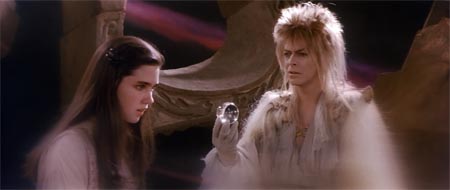
Still from Labyrinth (1986)
WHY IT WON’T MAKE THE LIST: Despite the MC Escher-inspired set-design, the unexpected sexual tension between teenaged Connelly and fruitily-dressed goblin king Bowie, and a devout cult following, Labryinth is ultimately just too close to a mainstream Muppet fantasy to place on a List of the 366 Weirdest movies. We’ve passed over slightly stranger movies in this genre—the visually similar Henson-directed The Dark Crystal and the thematically similar Henson-produced MirrorMask—and, although I think Labyrinth is a better film than either of those, it’s difficult to justify certifying this one when its companion films don’t even get to sniff the List.

COMMENTS: In The Wizard of Oz, Judy Garland’s breasts were famously flattened out with tape so the 16-year old could play a pre-pubescent girl. Labyrinth takes a different strategy: 14-old Jennifer Connelly plays exactly her age, portraying a hormonally testy girl-woman caught at the stage where her attention starts to shift from stuffed animals to the well-stuffed pants of strutting rock stars. That shot of rising estrogen distinguishes Labyrinth from other Oz/Alice in Wonderland fairy tale variations, giving it a subtext that goes over the heads of the tots in the audience but leaves adults with additional nuggets to ponder (and no, that’s not another reference to Bowie’s stretch pants).

There’s an impressive amount of imagination on display here, starting with Henson’s puppets, who reveal an almost limitless variety (each individual goblin looks like a representative of its own species) and a nearly human expressiveness (to be honest, the puppets out-act both Connelly and Bowie). The girl’s three companions—the cowardly dwarf Hoggle, the bestial Ludo, and Sir Didymus, the comic relief knight/terrier—are all worthy additions to Henson’s Muppet menagerie, and there is a zoo full of eccentric Wonderland-esque supporting creatures, including walking playing cards, Continue reading CAPSULE: LABYRINTH (1986)

99. THE TREE OF LIFE (2011)

“If the cosmic astronaut god-baby at the end of ‘2001’ could come back to Earth and make a movie? It would pretty much be ‘Tree of Life.'”–Film critic Andrew O’Hehir after the Cannes screening of Tree of Life (via Twitter)

“If you didn’t care for Tree of Life then genetically you are not a human being.”– (via Twitter)

Must See

DIRECTED BY: Terrence Malick

FEATURING: , Hunter McCracken, Jessica Chastain,

PLOT:  A couple learns about the death of one of their three sons.  Then, a flashback covers events from the birth of the universe to the birth of the couple’s first son, Jack.  A series of impressionistic scenes show Jack growing up in a small Texas town, afraid of the stern father who wants to toughen him up to face life’s trials.

Still from The Tree of Life (2011)

BACKGROUND:

  • The Tree of Life may be a partial reworking of Q, a discarded Malick script from the 1970s, which was said to involve “a Minotaur, sleeping in the water, and he dreams about the evolution of the universe…
  • Producer Grant Hill recalls that when he first saw Terrence Malick’s original script for The Tree of Life, it was “a long document that included photographs, bits of material from his research, paintings, references to pieces of music.  It was like something I’d never seen or even heard of before.”
  • Special photographic effects supervisor Douglas Trumbull had worked on 2001: A Space Odyssey (1968) and Blade Runner (1982).  He came out of retirement to work on this film at Malick’s request.
  • Won the Palme D’or at Cannes in 2011 and was voted “best film” in Sight & Sound‘s 2011 poll.
  • After some theatergoers asked for their money back after screenings of the movie, the Avon Theater in Stamford, Connecticut put up a poster reading, in part: “We would like to remind patrons that THE TREE OF LIFE is a uniquely visionary and deeply philosophical film from an auteur director.  It does not follow a traditional linear narrative approach to storytelling. We encourage patrons to read up on the film before choosing to see it, and for those electing to attend, please go in with an opened mind and know that the Avon has a NO-REFUND policy once you have purchased a ticket to see one of our films.”
  • A shorter version of the film, featuring expanded versions of the birth of the universe sequences, is planned for a separate release as an IMAX documentary at a later date.
  • Our original July 5, 2011 review rated The Tree of Life a “Must See,” but demurred that the film was not quite weird enough to merit a place on the List.  Readers disagreed, and in the 2nd Reader’s Choice Poll they voted Malick’s masterpiece be promoted to a List Candidate.

INDELIBLE IMAGE: Thanks to its cosmic visuals, The Tree of Life is compared to 2001: A Space Odyssey more often than any other movie.  That should tip you off that selecting a single indelible image is no easy task.  I could cheat and include the entire twenty minute birth of the universe montage.  I could select my personal favorite image: the child in a flooded, womb-like bedroom who swims out the window to be born as a teddy bear floats in the amniotic brine.  But I believe we will be forced to anoint the “gracious dinosaur” scene as the film’s most unforgettable gambit.  It’s Malick’s “chaos reigns” moment, the juncture at which you either get out of your seat and leave the theater, or experience your first weirdgasm of the evening.

WHAT MAKES IT WEIRD:  Sometimes, when you spend your cinematic time immersed in the surrealistic worlds of and , it’s easy to forget how uncompromisingly radical and bizarre a film like The Tree of Life appears to someone whose idea of an “out there” movie is Cowboys and Aliens. In our initial assessment of Malick’s grandiose God picture, we concluded that “surrealism is only used as an occasional accent here; overall, the mood is more accurately described as ‘poetic’ rather than ‘weird’” while acknowledging that “[a]ny movie that tells the story of a suburban Texas boy’s troubled relationship with his father—but uses a dramatic encounter between dinosaurs to illustrate its main point—is at least making a nod towards the bizarre.” In the months since that initial review, however, The Tree of Life‘s empyrean strangeness has continued to impress us as 2011’s best weird work. The clincher came when co-star Sean Penn complained to the French press, “A clearer and more conventional narrative would have helped the film without, in my opinion, lessening its beauty and its impact. Frankly, I’m still trying to figure out what I’m doing there and what I was supposed to add in that context! What’s more, Terry himself never managed to explain it to me clearly.” That’s all the endorsement we need: when a movie is too weird for its own Hollywood stars, we have to accept that it’s just weird enough for us.


Original trailer for The Tree of Life

COMMENTS: A boy’s tempestuous relationship with Brad the Father is used as a metaphor for Continue reading 99. THE TREE OF LIFE (2011)

BORDERLINE WEIRD: HANSEL AND GRETEL (2007)

DIRECTED BY: Pil-Sung Yim

FEATURING: Jeong-Myeong Cheon, Hee-soon Park, Shim Eun-Kyung, Eun Won-Jae

PLOT: Eun-Soo, a young man whose girlfriend has just told him she is pregnant, crashes his car on a lonely road and finds himself rescued by a young girl, who leads him to a strange cottage hidden in the depths of  a dense forest. The family living there tend his wounds and put him to bed. His gratitude soon turns to fear, as the “parents” disappear and he is left in charge of three children who have no intention of letting him leave.

Still from Hansel and Gretel (2007)

WHY IT’S ON THE BORDERLINE: Much as I love this film I doubt it makes the final cut. Yes, it’s odd, beautiful and moving, but it could stand more ruthless editing, something it shares with the director’s previous Antarctic Journal. The storyline is predictable in parts, especially if you’ve seen a number of “bad seed” films. The style makes it stand out but, honestly, some of the weird scares seem to be a little misplaced. Hansel and Gretel‘s weirdness seems tattooed on rather than bred in the bone.

COMMENTS: Watching Hansel and Gretel is like settling down to enjoy a nice cup of tea and a fondant fancy, only to discover that your cake is crawling with ants.  The set design is fascinating; wherever you look there is some odd detail  that catches the eye.  The color palette is lush, just the green of the woods is breathtaking.  The score is beautiful, composed by Byung-Woo Lee, who also composed the music for the sublime Tale Of Two Sisters.

In short this is a quality production, clearly made with love.  What prevents it from quite firing on all cylinders is the plot, which is a little predictable.  Sinister children with dangerous powers are something of a staple of the science-fiction and horror genres, and anyone who’s seen or read a few such stories will be fairly confident about where this is headed.  From the moment Eun-Soo sets foot in the fairy tale cottage where every day is Christmas Day and the decor makes your retinas bleed, our suspicions are roused.  They’re all but confirmed by the behavior of the “parents”.  Their rictus grins and desperate eyes scream that something is rotten in the state of Denmark.  They handle their “son” as if he’s a box of sweaty gelignite and Continue reading BORDERLINE WEIRD: HANSEL AND GRETEL (2007)