WEIRD HORIZON FOR THE WEEK OF 9/23/2016

Our weekly look at what’s weird in theaters, on hot-off-the-presses DVDs, and on more distant horizons…

Trailers of new release movies are generally available at the official site links.

IN THEATERS (LIMITED RELEASE):

Girl Asleep (2015): On her fifteenth birthday, a neurotic teen girl is thrown into a fantasy world. Looks like a less aggressively surreal version of Valerie and Her Week of Wonders, or a more aggressively surreal version of Labyrinth. Girl Asleep official site.

SCREENINGS – (Multiple U.S. locations, Sep. 24):

“A Town Called Panic: Double Fun”: Indian, Cowboy and Horse return in two shorts set in the childishly surreal world of A Town Called Panic: “Christmas Panic” has C & I nearly ruining the holiday, while “Back to School Panic” has the mischievous duo invading a pig’s brain in an attempt to cheat on a class assignment. A strange but very welcome event from GKids: a list of participating theaters can be found at GKids A Town Called Panic page.

SCREENINGS – (Fox Theater, Toronto, Ontario, Sep. 29):

The Holy Mountain (1973): Read the Certified Weird entry! Alejandro Jodorowsky‘s classics sure are making the rounds lately; they’ve even made it all the way up to Canada! Check out the Fox Theater site.

FILM FESTIVALS – Fantastic Fest (Austin, TX, Sep. 22-29):

The Alamo Drafthouse in Austin, TX may be America’s coolest theater. Their brand has grown so big that now they have franchised Drafthouses, and even distribute their own (generally weird) movies. One of the Alamo’s hippest projects is Fantastic Fest, going into its twelf th year. As per usual, there is a fantastic slate of weird movies and some neato revivals here.  Coming at the tail end of the film festival season, much of the movies are retreads, but the Drafthouse folks always find a way to save some surprise debuts. We won’t do more than mention films we’ve already mentioned from other festivals, including the sure-to-be-classic killer mermaid musical The Lure; Aloys, Assassination Classroom: Graduation, and Hentai Kamen 2 (all of which we missed at Fantasia Festival); ‘s post-apocalyptic cannibal effort Bad Batch and the animated My Entire High School Is Sinking into the Sea (two recent TIFF offerings); and the omnipresent Greasy Strangler. Here’s what we’ll be tracking down the road:

  • Bad Black – Tongue-in-cheek Ugandan action/comedy made for about $200. Screens Sep 25-26.
  • Colossal – An alcoholic woman (Anne Hathaway) discovers that the appearance of a giant monster in Seoul coincides perfectly with her blackouts in this absurd allegory. Sep. 29 only.
  • The Dwarves Must Be Crazy – A scatological comedy about a Thai village of dwarfs that is attacked by flatulent Krause spirits—floating heads with attached intestines. Sep. 24 & 27.
  • Goke, Body Snatcher from Hell – The Certified Weird Japanese vagina-faced space vampire horror screens on Sep. 26.
  • Jungle Trap – A reconstruction of a nearly-completed 1990 shot-on-video atrocity about loincloth-clad headhunter ghosts killing patrons at a hotel in the jungle. Sep. 24.
  • Phantasm: Remastered (1979) – The Certified Weird horror/fantasy/sci-fi classic screens in a new 4K print (Phantasm is also playing at AFI’s Silver Theater in Silver Springs, MD, with ‘s FF Q&A being streamed live afterwards). Sure to be a tough ticket on Sep. 24.
  • Phantasm: Ravager – The final installment in a franchise that has (to be frank) long outlived its welcome. Get closure on Sep. 25 or 28.
  • Salt and Fire – A scientist venturing to South America to study a volcano is abducted by shadowy men; the programmers call this “[Werner] Herzog‘s most wildly unpredictable film,” which seems like overselling. Sep 25 & 28.
  • Zodiac Killer (1973) – A restoration of the exploitation film speculating about the celebrity serial killer’s motives, including his telepathic conversations with his Satanist pet rabbits. Sep. 25 & 28.

Fantastic Fest official site.

IN DEVELOPMENT (KICKSTARTER):

Parts Unknown (est. 2018): A “deranged” horror movie set in the world of professional wrestling. Director Richard Chandler promises us it will be “a very surreal atmospheric film reminiscent of old school Euro-horror with practical effects and an all retro-wave/synth soundtrack.” The Boston Film Family seem like good eggs and they’ve already raised almost half of their modest $2,500 goal. Consider a donation. Parts Unknown Kickstarter page.

NEW ON DVD:

Cat People (1942): Read Alfred Eaker’s review!  and ‘s sublimated psychosexual horror classic gets the Criterion Collection treatment, in plenty of time to order for Halloween. Buy Cat People (Criterion Collection)

Labyrinth (1986): Read G. Smalley’s review.  Speaking of Labyrinth, which we just were, a 30th Anniversary home video re-release with new featurettes drops from Sony this week. Buy Labyrinth.

NEW ON BLU-RAY:

Cat People (1942): See description in DVD above. Buy Cat People [Criterion Collection Blu-ray].

Dead End Drive-In (1986): In a dystopian future, the Australian government solves the juvenile delinquency problem by creating drive-ins where teens check in, but they don’t check out. Arrow Films gives this odd Ozploitationer their usual Criterion-level treatment; special edition pressings include a special booklet. Buy Dead End Drive-In [Special edition Blu-ray].

Johnny Guitar (1954): Read Kevyn Knox’s review. Olive Films, who usually release bare-bones DVDs, have seen that special editions are the wave of the future, so their new “Signature” seies Blu-ray release of ‘s existential/feminist cult western includes multiple featurettes, a commentary track with critic Geoff Andrew, and an introduction by . Buy Johnny Guitar [Blu-ray].

Labyrinth (1986): See description in DVD above. Super-duper fans may want to spring for the expensive gift set, which comes in a weird triangular Escher-esque box. Buy Labyrinth [Blu-ray].

“Twin Peaks: The Original Series, Fire Walk With Me & The Missing Pieces”: Read our “Twin Peaks” review here, and our Fire Walk With Me review here. The entire run of ‘s seminal surreal soap was already on DVD, with copious extras; so was the prequel movie. But now you can have them all together on one reasonably-priced Blu-ray set. Buy “Twin Peaks: The Original Series, Fire Walk With Me & The Missing Pieces.

What are you looking forward to? If you have any weird movie leads that I have overlooked, feel free to leave them in the COMMENTS section.
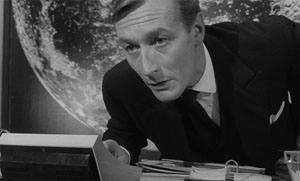
UNEARTHLY STRANGER (1963) AND CHAMBER OF HORRORS (1966)

Unearthly Stranger (1963, directed by John Krish) often showed up on late night television from the late 60s through the 70s. Surprisingly, it hasn’t been asked about on What Was That Weird Movie?, ((Now I Remember This Movie–ed.)) because it’s a film occasionally discussed in cult film forums.  Naturally, there is always a risk in revisiting a movie first seen during adolescence. Chances are that it may not hold up—and more often than not, that is the case. Or, one my find value in it, but for very different reasons.

Subdued, with a distinctly British flavor, The Unearthly Stranger has qualities similar to The Quatermass Experiment (1955), Invasion of the Body Snatchers (1956), I Married a Monster from Outer Space (1958), “The Twilight Zone,” and the “Outer Limits.” Shot on a low budget, this Independent Artists production does not rely on special effects, which would have inevitably dated by now anyway. Although short on action and surprises, its virtues are atmosphere, dialogue, and solid performances.

Unearthly Stranger opens with Dr. Mark Davidson (, best known for The Adventures of Baron Munchausen) running through an empty city at night before reaching his apartment. Finding a tape recorder, he leaves a message: “In a little while I expect to be killed by something you and I know is here,” which segues into an extended flashback.

Still from Unearthly Stranger (1963)Shortly after the mysterious murder of fellow researcher Dr. Munro (Warren Mitchell), Davidson and Professor Lancaster (Phillip Stone) resume work on their government funded project, one which enables people to telepathically travel to other planets and potentially contact alien life. In addition to investigating Munro’s death, project supervisor Major Clark (Patrick Newell) has taken an abnormal interest in Davidson’s new Swiss wife, Julie (Gabriella Licudi). Lancaster, a close friend of Davidson’s, is also curious and surprised that he has not been introduced to the new bride.

Rather than putting any potential mysteries to rest, a dinner invitation from Mr. and Mrs. Davidson leads to a startling discovery when Lancaster catches sight of his friend’s wife removing a roast from a 250 degree oven without gloves on. Nothing in the film’s remaining time is as subtly chilling. One very curious theme is the finale’s revelation that all the women in the film are aliens and all the victims male. It is, perhaps, a misogynist’s nightmare that ends suddenly, without further exploration or explanation. While not a classic like Invasion of the Body Snatchers, Unearthly Stranger is an obscure sleeper well worth seeking out.

Unfortunately, it is only available on a U.K. Pal Blu-ray. However, the Continue reading UNEARTHLY STRANGER (1963) AND CHAMBER OF HORRORS (1966) →

249. BLANCANIEVES (2012)

Snow White

“Blancanieves combines the characteristic language of documentary, a typical feature of Spanish realist cinema, with other devices from the opposite end of the aesthetic spectrum (fades, magical connections, etc.), typical of silent film – which in some cases call to mind Luis Buñuel’s surrealist aesthetic. These paradoxical styles help to create a visual atmosphere which is appropriate to the somewhat sinister tale by the Brothers Grimm which serves as the pretext of the film.”–Jorge Latorre

Must See

DIRECTED BY: Pablo Berger

FEATURING: Maribel Verdú, Macarena García, Sofía Oria, Daniel Giménez Cacho, Sergio Dorado

PLOT: Antonio Villalta is a famous bullfighter with a pregnant wife who is distracted in the ring and gored by a bull. The accident leaves him wheelchair-bound, his wife dies giving birth to his daughter, and he marries his nurse Encarna, a cruel and manipulative sociopath who only wants him for his fortune. Encarna at first keeps Carmen, Antonio’s daughter, as a servant girl and virtual slave on the estate, but orders her killed when she is found visiting her father against her stepmothers will; Carmen escapes and is rescued by a band of dwarfs who travel Spain performing a novelty bullfighting act.

Still from Blancanieves (2102)

BACKGROUND:

  • The folk tale “Snow White” was first set down in print by the Brothers Grimm in 1812.
  • Dwarf matadors (known as “charlotada”), who would warm up the crowd before the main event, were a real phenomenon in Spanish bullfighting.
  • Writer/director Pablo Berger cites ‘s Freaks (1932) as one of his main inspirations for the script.
  • Blancanieves was in development for eight years before filming began. This means that it was conceived before The Artist, the revivalist silent film that won the Academy Award in 2011.
  • The film won 10 Goyas (the Spanish equivalent of the Oscar), including Best Film and Best Actress for villainess Maribel Verdú. Spain submitted it to the Academy Awards but it was not one of the five foreign film finalists.

INDELIBLE IMAGE: Pablo Berger’s film utilizes simple tricks that would have been available to filmmakers in the 1920s, including frequent use of superimposed double images. The most effective of these is the shadowy skull that flashes over the skin of the apple as the wicked stepmother poisons it (using a syringe), while her intended victim basks in the crowd’s adulatory applause in the background, out of focus.

THREE WEIRD THINGS: Rooster cam; transvestite bullfighting dwarf; crying corpse

WHAT MAKES IT WEIRD: “I have this idea for a Snow White adaptation set among Spanish bullfighters in the 1920s, but how can I make it weird? I know! I’ll make it an expressionistic silent film, and make one of the dwarfs a transvestite and give the wicked stepmother a penchant for S&M!” Well done, Pablo Berger.


Original U.S. release trailer for Blancanieves

COMMENTS: As the early career of Guy Maddin reminds us, silent Continue reading 249. BLANCANIEVES (2012) →

CAPSULE: THE SHAPE OF THINGS (2003)

366 Weird Movies may earn commissions from purchases made through product links.

DIRECTED BY: Neil LaBute

FEATURING: , , , Frederick Weller

PLOT: A nerdy security guard falls for an anarchic art student; she encourages him to change his appearance and dress, increasing his self-confidence—but is she really good for him?

Still from The Shape of Things (2003)

WHY IT WON’T MAKE THE LIST: Neil LaBute’s pitch black adaptation of his own play falls into the category of “outside-the-box indie drama” rather than “weird.”

COMMENTS: On the surface, The Shape of Things appears to be about the lengths someone will go to change themselves to gain someone else’s approval. Evelyn transforms Adam from schlub to stud, but the changes to his body inevitably effect his mentality. But although the erotically-motivated malleability of the less confident romantic partner is one of the work’s themes, Shape reveals a different, more controversial, focus in the third act. The ending twist is easy to guess, particularly to anyone who has seen LaBute’s debut film (the venomous dissection of masculine manipulation In the Company of Men). But I was willing to forgive the obviousness, because I think that LaBute’s fundamental point—an attack on attitudes and platitudes prevalent in the postmodern art scene (Evelyn, the film’s antagonist, is the kind of artist who believes in spray painting classical sculptures as a “statement”)—needed to be said.

The Shape of Things‘s origins as a stage play are obvious—each transition might as well be preceded by intertitles of the format “Act 2, Scene 3”—but that’s not necessarily a bad thing. What it really means that this is an actor’s and writer’s movie; everything is built around dialogue, which is often very sharp, with only a couple of set changes. Each of the four characters gets at least one big scene with the other three: Adam and Evelyn, obviously, spend the most time together, but the male lead must also defend himself from a “you’ve changed, man” speech from bro Phillip and navigate a moment of awkwardness with his best friend’s girl, while Evelyn gets to argue with douchey Phillip about the nature of art and to confront Jenny about her supposed attraction to the new and improved Adam. The fact that each of the actors had played these characters on stage for a year beforehand inevitably helps their chemistry—the characters are a artificial, written as types to support a thesis, but the young foursome does everything possible to make them feel like real people.

LaBute is often accused of being misanthropic (or even misogynistic), but, like all satirists, he’s actually humanistic. It shocks me that so many critics and viewers come to the exact opposite conclusion—I guess they conclude that no writer could pen scenes of emotional sadism so convincingly without being a psychopath themselves. It seems obvious to me that LaBute shows us extreme cruelty not to titillate us, but to arouse our disgust—to encourage us to try to be better people. And, to encourage his peers to become better, more morally focused artists.

WHAT THE CRITICS SAY:

“This version of Neil LaBute’s ongoing project is crisp and aggressive, occasionally alienating or annoying, that is, effectively unlike other movies.”–Cynthia Fuchs, Pop Matters (contemporaneous)

(This movie was nominated for review by “noa.” Suggest a weird movie of your own here.)

CAPSULE: THE FITS (2016)

Recommended

DIRECTED BY: Anna Rose Holmer

FEATURING: Royalty Hightower, Alexis Neblett

PLOT: A preteen tomboy finds herself drawn into the dance classes at her local recreation center, but soon after she joins the group the older girls begin suffering mysterious seizures.

The Fits (2016)

WHY IT WON’T MAKE THE LIST: While definitely of interest to aficionados of weirdness, and a highly recommended film overall, it just doesn’t reach the levels of  bizarre we aim for with the List.

COMMENTS: Toni (Royalty Hightower) is a quiet, athletic 11-year-old girl who spends her afternoons at the local rec center with her older brother, training in the boxing gym with a group of teen boys. She finds herself compelled to join the dance drill team that rehearses down the hall, feeling shy around the girls but determined to show off her moves. Though she doesn’t appear to be naturally gifted at dance, she sticks with it and befriends some of the other new recruits, observing the older girls who lead the troupe with the curiosity of a child and the growing understanding of a young adult. When the seizures start, Toni and her friends are more intrigued than scared, and they watch from afar as more and more of the older girls are affected by this unexplained malady. Toni begins to suspect that it’s intentional, that they want it, and it becomes a kind of calling card for a cool inner circle.

Based on plot alone, The Fits sounds like a fairly standard coming-of-age drama, and in some ways it is: a shy and intelligent girl finds community within a larger group, learns about new adult realities, maintains her independence, etc. The parallels between the girls’s seizures and female puberty are obvious, as Toni feels the kind of ostracization and curiosity that preteen girls might experience as their friends start getting (and discussing) their periods. Along with fear of the unknown there is a pride attached to the phenomenon, a feeling of special knowledge and maturity. Throughout the film, we see our tomboy protagonist slowly acquiring visual markers coded as “girly,” including glitter nail polish and pierced ears, which help her fit in with her friends. But she slowly sheds them all, retaining her sense of difference. Eventually, Toni (and the audience) senses that there is a kind of freedom attached to the seizures—the precise, fluid movements of the drill team are liberally flung out the window in the sudden and erratic fits the girls exhibit. There is a beauty to letting go, to giving in to being a girl, to finding acceptance in her changing, awkward preteen body.

With a keen observational eye and resourceful use of a single location (the town recreational center), first-time director Anna Rose Holmer fully engages with the perspective of her central character. We see everything through Toni’s eyes, and the subtle, powerful performance of Royalty Hightower communicates a world of experience with little expository dialogue. But the most intriguing stylistic element of The Fits is its sound. While one might realistically expect a soundtrack of dance music, specifically pop or hip hop, to go with the performances of the drill team, the music rarely matches the action onscreen. Instead we are treated to bizarre, somewhat abstract soundscapes that create a sense of intrinsic eeriness, hinting that something must be wrong here. The surreal music serves to pick apart the weirdness of adolescence, and to heighten the anxiety and uncertainty Toni feels every day behind her stony exterior as she maneuvers the muddy waters between childhood and adulthood. Without it, the events of the film would be dramatic, but not necessarily extraordinary. With it, we are left with a distinct but ambiguous sense of strangeness, an itch we can’t quite scratch, a mystery never to be solved. And yet, thanks to an exuberant final dance number, there’s a contentment that goes along with it, suggesting the power of sisterhood.

WHAT THE CRITICS SAY:

“…a beautiful, hauntingly precarious coming of age film that uses mystery and an at times dream-like atmosphere to create a mesmerizing tale.”–Rob Hunter, Film School Rejects (contemporaneous)

Celebrating the cinematically surreal, bizarre, cult, oddball, fantastique, strange, psychedelic, and the just plain WEIRD!