251. PLAYTIME (1967)

(G. Smalley contributed additional commentary and background to this article.)

Play Time

“Playtime is a film that comes from another planet, where they make films differently.”–attributed to Francois Truffaut

Recommended

DIRECTED BY:

FEATURING: Jacques Tati, Barbara Dennek

PLOT: A nearly plotless “day in the life” of 1967 Paris: a group of American tourists arrive in the city, but instead of visiting the monuments they are taken to a complex of skyscrapers to shop. Meanwhile, Monsieur Hulot is trying to keep an appointment, but gets lost in a mazelike building in the same downtown complex. After business hours, everyone converges on a restaurant on its opening night for a chaotic celebration as the building falls apart around them.
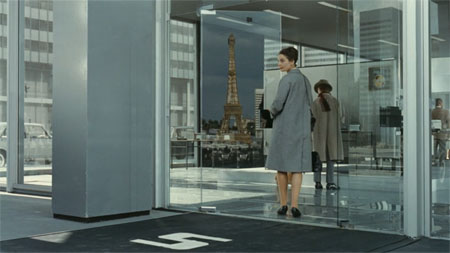
Still from Playtime (1967)

BACKGROUND:

  • The third of four features in which Jacques Tati played the affable, bumbling Monsieur Hulot.
  • Playtime was in production for three years; the downtown sets were constructed by hundreds of workers and were nicknamed “Tativille” among the crew.
  • The film was incredibly expensive to make and Tati took out personal loans to finance it; it was a disappointment at the box office and he went into bankruptcy, giving away Playtime‘s rights in the process.
  • Tati shot the film in 70mm (which was capable of a 2.20:1 aspect ratio, one of the widest formats), and initially insisted the film be screened only in that format in venues with stereophonic sound, despite the fact that very few theaters could meet these specifications. (Partially for this reason, the movie was not screened at all in the United States until 1972). He later relented and allowed 35mm prints to be struck.
  • Humorist and newspaper columnist Art Buchwald wrote the English dialogue for Tati.

INDELIBLE IMAGE: Many people will best remember Hulot’s view from the second-floor view of a factory-like job site composed of a maze of cubicles—a workplace prophecy that’s come true. We chose a scene—one of three in the film—where straggling Barbara opens a door to one of her tour’s commercialized sightseeing destinations, only to see the Eiffel Tower (or the Arc de Triomphe, or the Sacré Coeur) perfectly reflected in the plate glass. These shots express Tati’s theme of the disappearance of culture under the ugliness of modernity, while retaining the wistful hopefulness that is characteristic of his work.

THREE WEIRD THINGS: Faux Hulots; cubicle labyrinth; doorman with no door

WHAT MAKES IT WEIRD: Playtime is about the alienating, isolating influence technology has on human beings. It’s not the standard elements of plot, narrative, character development or dialogue that pulls an equally alienated audience into this unfurling drama, but the careful choreography of hapless humans navigating a barely recognizable hypermodern Paris. Play Time is a sort of anti-Brazil.


Short Clip from Playtime

COMMENTS: Do you remember when watching “Tom and Jerry” on Continue reading 251. PLAYTIME (1967) →

CAPSULE: THE LADY IN THE CAR WITH GLASSES AND A GUN (2015)

DIRECTED BY:

FEATURING: Freya Mavor, Benjamin Biolay, Elio Germano,

PLOT: When he’s away on business, a Parisian secretary who has never seen the ocean takes her boss’s Thunderbird on a road trip, but everywhere she goes people swear they’ve seen her before—is she going crazy?

Still from The Lady in the Car with Glasses and a Gun (2015)

WHY IT WON’T MAKE THE LIST: For a while, the Lady seems to be driving her borrowed car into French territory, but she ultimately crashes it into mere implausibility.

COMMENTS: Forget the car, glasses and gun: the Lady, portrayed by Freya Mavor, is something to see. Freya was the Norse goddess of love and sex, and with her red hair, willowy build and tempting freckles, Mavor could pass for Scandinavian love goddess (she’s actually Scottish). It’s the Lady (not the plot) that is Lady‘s chief asset, and the way he shoots Mavor, I think director Johann Sfar knows it. He begins the film with her dancing madly at the sea shore, flaming hair flying around her head and bare feet pattering on the sea-soaked concrete of the pier, then cuts to an earlier scene where the model/actress is shot in unflattering light to actually make her look kind of ugly (a remarkable feat of cinematography). But as her confidence increases throughout the story, her hemline rises. Mavor’s girlish looks and waifish figure lend her an air of forbidden innocence that makes her future behavior seem all the more shocking.

As the pseudo-doppelanger plot synopsis might suggest, mirrors will provide key imagery here, and an early scene where the Lady’s reflection disobeys her provides one of the first hints of an ever-increasing subjectivity that leads us to suspect that she’s headed for madness. The plot kicks into gear after the Lady has borrowed the car, and keeps running into people who insist they’ve seen her recently; for example, eating breakfast that morning in a country café when she was actually in Paris at the time. On her road trip, she’s also assaulted at random, and starts making poor decisions re: picking up sleazy drifters at roadside motels. Our attention is diverted by Sfar’s style (cool music, cool cars, sexy chicks, impossible occurrences); and the Lady seems to be turning schizophrenic, until fifteen minutes of closing exposition explain what’s really been going on all along. Many people criticized the climax as a clunky dénouement device, but I was more disappointed in the solution to the mystery, which relies too much on crazy coincidence for my satisfaction.

Johann Sfar has been hanging around on the fringes of weird films for a while now, starting with the mildly hallucinatory biopic Gainsbourg: A Heroic Life, and continuing with The Rabbi’s Cat, his arcane adaptation of his own graphic novel about a snarky, sacrilegious pet. In Lady‘s second act the thick, nearly surrealistic atmosphere makes this remake of the seldom-seen 1970 shocker of the same title seem like it’s going to be Sfar’s weirdest film; ultimately, however, it ends up as his most conventional. Sfar remains an unpredictable force with the potential to unleash something fantastically weird in the future, although each near-miss diminishes our enthusiasm for his work just a little.

WHAT THE CRITICS SAY:

“Sfar creates the eerie impression of being trapped in someone else’s dream. Relying on hallucinatory tricks in which time seems to roll back on itself, or else lurch forward to some possible future, the helmer makes everything feel surreal enough that we hardly stop to consider the only logical explanation, delivered in stultifying detail over a tedious, low-tension climax.”–Peter Debruge, Variety (contemporaneous)

LIST CANDIDATE: ON THE SILVER GLOBE (1977/1988)

Na Srebrnym Globie

366 Weird Movies may earn commissions from purchases made through product links.

DIRECTED BY:

FEATURING: Jerzy Trela, , Iwona Bielska, Grazyna Dylaq, Jerzy Gralek, , Elizabeth Karkoszka, Maciej Goraj, Leszek Dlugosz, Jan Frycz

PLOT: An expedition crash lands on a planet, and the surviving astronauts establish a tribe and a religion explaining their origins. After a recording of the crash is found, another astronaut, Marek, is sent to investigate and is received as a messiah whose arrival has been prophesied. He becomes involved in a struggle against the planet’s original inhabitants, a birdlike race called the Sherms.

Still from On the Silver Globe

WHY IT MIGHT MAKE THE LIST: One of the few science-fiction adaptations that can earn the adjective of “epic,” and not only in terms of not dumbing down its ideas in favor of effects. The Polish government attempted to kill it, and end its director’s career. Despite it being only 80% of a finished film, there are images that will remain in the mind long after.

COMMENTS: In the best of all possible worlds, On the Silver Globe would be more widely known for the epic saga it is intended to be rather than as an unfinished curiosity, and it would’ve been the blueprint for science-fiction cinema to follow, rather than George Lucas’ Star Wars. Or possibly not. After all, its source material, “The Lunar Trilogy” written by Jerzy Zulawski (Andrzej’s great-uncle), which Stanislaw Lem acknowledged as an influence on his own writing, STILL has never gotten an English translation, making it unknown in the U.S. and other English speaking countries. This is one of the few films where its backstory is as fascinating as the actual film.

To wit: after the success of The Most Important Thing Is to Love, the exiled Zulawski was allowed to return to Poland to work. It was at this time that his marriage collapsed and his wife left (we’ll get to that later on…), and he chose to adapt his great uncle’s trilogy. Two years of work went into the enterprise, with most of the shooting done in 1976 and 1977, until the Deputy Minister of Culture and Art, Janusz Wilhelmi, saw some of the footage and in June 1977, ordered the production to shut down. Props, scenery and costumes were warehoused and/or destroyed; Zulawski was once again persona non grata in Poland, couldn’t get any work, and was again forced to leave home. (Out of this experience came the cult favorite Possession). Wilhelmi died in a plane crash the following year (1978), but despite several attempts to resurrect the project, authorities refused to release the existing material; some of the crew members managed to save what they could, but to no avail. By 1986, the regime in Poland had collapsed, but it was too late—too much material had been lost, several actors had died, and cinematic sci-fi was by then firmly caught in the throes of Star Wars‘s aftermath. However, what was left of the film could indeed be presented in some Continue reading LIST CANDIDATE: ON THE SILVER GLOBE (1977/1988) →

WEIRD HORIZON FOR THE WEEK OF 9/30/2016

Our weekly look at what’s weird in theaters, on hot-off-the-presses DVDs, and on more distant horizons…

Trailers of new release movies are generally available at the official site links.

IN THEATERS (WIDE RELEASE):

Miss Peregrine’s Home for Peculiar Children (2016): A boy is informed he has “peculiar” powers and is whisked away to a school where mutant children are trained to use their talents. This adaptation of of popular children’s book seems custom made for ‘s cute-grotesque style, and many have high hopes it will prove a return to form after a string of mediocrities. Miss Peregrine’s Home for Peculiar Children official site.

IN THEATERS (LIMITED RELEASE):

The Apostate (2015): “Gently absurdist” tale (with ian touches) of a man who tries to formally and officially leave the Catholic Church, only to find himself lost in a labyrinth of clerical bureaucracy. The message may be: apostates are from Mars, prelates are from Venus. The Apostate distributor’s site (in Spanish).

SCREENINGS – (Barnsdall Art Park, Los Angeles, CA, Sun., Oct 2):

Fellini Satryicon (1969): Read the Certified Weird review! Enjoy Fellini’s wildest indulgence in an outdoor setting, with wine tasting beforehand. No word on whether the facilities include vomitoria. Sponsored (naturally) by Cinefamily. Satyircon at Barnsdall Art Park.

FILM FESTIVALS – Beyond Fest (Los Angeles, Sep. 30 – Oct. 11):

LA’s Beyond Fest may not land a lot of exclusive premieres, but we like their taste. There’s nothing of particular weird interest premiering here, but you can check out recent favorites from other festivals like ‘s post-apocalyptic cannibal flick Bad Batch (on Oct. 7, with the director in attendance) and the flatulent Thia dwarf horror/comedy The Dwarves Must Be Crazy (Oct. 9, a free screening). You also have to love a festival that features three Certified  Weird classic revivals. The Holy Mountain  screens on Oct. 6, and 2001: A Space Odyssey plays Oct. 9, hosted by Kier Dullea and Gary Lockwood. The biggest event may be the double feature of Phantasm with the fifth film in the series, Phantasm: Ravager (which, unexpectedly, is getting good reviews), with and Ravager director David Hartman both on hand. And that’s just the movies we’re focusing on; the undercard looks good for genre fans, too, so Los Angelinos will want to check this one out.

Beyond Fest official site.

FILM FESTIVALS – New York Film Festival (New York City, Sep. 30 – Oct. 16):

Don’t get us wrong, the New York Film Festival has some quality screenings—just not a lot that would be of particular interest to weirdophiles. Plus, with all the revival and specialty cinemas inside the Big Apple showing movies that never play outside the city limits, the town is almost like a film festival all year round. Nonetheless, there are a couple of movies we’ve highlighted elsewhere that might be of some interest: the animated My Entire High School Is Sinking Into the Sea (screening Oct. 10 & 11) and Hong Sang-soo’s doppelganger romance Yourself and Yours (Oct. 7, 10, 14 and 16). You might check them out if you’re in town.

New York Film Festival Official Site.

IN DEVELOPMENT (ANNOUNCED):

Jojo’s Bizarre Adventure (est. 2017): Live action version of a superhero family manga. The interesting part is that it’s a co-production between Japan’s Toho studios and Hollywood’s Warner Brothers; the even more interesting part is that is set to direct. Surely Warners will reign Miike in until he’s no longer interesting—although, as a counterargument, the outsider auteur has produced some kid friendly fare (Zebraman, The Great Yokai War) that nonetheless brought us bizarre visions (Zebra Nurse, anyone?) We remain skeptical, but intrigued. Jojo’s Bizarre Adventure announcement at “Variety”.

NEW ON DVD:

Beyond the Valley of the Dolls (1970): Read Alfred Eaker’s review. ‘s big budget movie about big busted musicians features a great transsexual freakout at the climactic acid orgy. Buy Beyond the Valley of the Dolls (Criterion Collection).

The Neon Demon (2016): Read our List Candidate review! ‘s fashion-industry horror movie is shallow but beautiful and—yeah—pretty damn weird. Buy The Neon Demon.

NEW ON BLU-RAY:

Beyond the Valley of the Dolls (1970): See description in DVD above. Did you ever expect to see Russ Meyer make the Criterion Collection? Buy Beyond the Valley of the Dolls [Criterion Collection Blu-ray].

Blood Diner (1987): Read the Certified Weird entry! Thanks to Vestron Video for finally putting out this bad taste cannibal classic on a modern video format; maybe now this should-be cult classic will get the respect it deserves. Buy Blood Diner [Blu-ray].

The Neon Demon (2016): See description in DVD above. Buy The Neon Demon [Blu-ray].

YOU LINK  US! YOU REALLY LINK US!:

Копипаста:Кинопоиск: I don’t read Russian, so even with the help of automatic translation I have little idea what’s going on here. This appears to be some sort of wiki-site, and the writer of this article goes on a long rant about a redesign and over-commercialization of a Russian-language movie site called “kinopoisk.” I really have no idea whether the writer’s complaints are valid or not, but the key takeaway is that, along with the IMDB, Rotten Tomatoes, and Variety, the writer lists 366weirdmovies.com as an alternative to kinopoisk. So I just want to use this space to officially welcome all kinopoisk refugees to 366 Weird Movies! Original post (in Russian).

What are you looking forward to? If you have any weird movie leads that I have overlooked, feel free to leave them in the COMMENTS section.

Celebrating the cinematically surreal, bizarre, cult, oddball, fantastique, strange, psychedelic, and the just plain WEIRD!