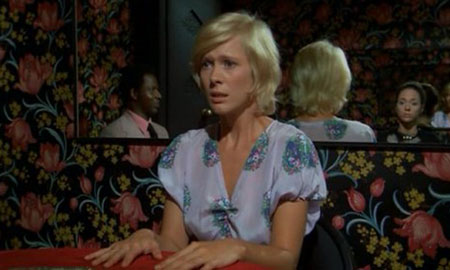
FEATURING: Mimsy Farmer, Maurizio Bonuglia, Mario Scaccia, Jo Jenkins, Daniela Barnes, Orazio Orlando
PLOT: A wealthy, workaholic bachelorette chemist begins seeing visions of a lady in black, and a young blond girl; is she going mad or being tricked (or both)?
WHY IT WON’T MAKE THE LIST: With its hysterical hallucinations and hints of witchcraft, plus a grisly surprise ending, a case could be made for certifying this quality offbeat occult giallo; but ultimately, it falls into the category of “you gotta draw the line somewhere.”
COMMENTS: In his interview comments accompanying the Raro Video release, writer/director Francesco Barilli acknowledges The Perfume of the Lady in Black’s debt to Roman Polanski, but you’d probably sniff the lingering scent of Repulsion early on even without that admission (not to mention a whiff of Rosemary’s Baby, too). Perfume is part of a line of 60s and 70s horrors playing on the anxieties of young single working women. Thanks to sexual liberation, a class of working women living on their own without a live-in male protector was a relatively new phenomenon, and for all the necessary freedom, the fact is that it can be scary to be a woman in a man’s world. Lone females have more to fear than solo males: they fear all the same things men do, plus, they have to fear men. Silvia is competent enough to manage a chemistry lab, but she can’t trust her surroundings, her neighbors, strangers who stare at her on the street, or her even own senses in the dead of night. Whenever she’s alone, she’s endangered, and returns to sanity only when her boyfriend rushes to her side.
Perfume takes place in that lush giallo world, an existence full of tennis dates, elegant silk robes, and apartment courtyard’s with Roman fountains. The art direction is sumptuous, and at times a little outrageous, such as the jungle mural that hovers above Silvia’s friend’s bedpost. Surely such bourgeois elegance can only be there to cover up the stench of decadence. Mimsy Farmer, while not star material, is a treat in this role, constantly frightened and almost reluctantly sexy. The plot seems to be being made up as it goes along. It turns out that there are really two storylines, one of which involves oblique divulged secrets from Silvia’s childhood. The dual plots are mashed together, which produces extra confusion, but less satisfaction, since there’s not a single resolution, and nothing in particular to tie them together. Highlights include a ghostly little girl, “Alice in Wonderland” references, and a séance with a blind psychic (which may be the most giallo scenario ever). The ending is a genuine shock surprise, leaving a strong enough impression to make you forget the somewhat tedious early moments.
Raro Video upgraded Perfume to Blu-ray in 2016. The disc includes an interview with writer/director Barilli (which might be cut down from a longer one included on the DVD release) and a bonus short film, the 23-minute “The Knight Errant,” a shot-on-video variation on Death Takes a Holiday with a couple of surreal surprises that’s well worth a watch.
FEATURING: Dan Eberle, Alexandra Hellquist, Nick Bixby, and Alexandra Chelaru
PLOT: In hopes of starting life anew, a man with a nebulous past agrees to take on a job from an organization that promises to provide him with a legit history; while waiting for “the call,” he takes up with a nearby prostitute and becomes embroiled in a plot involving Russian pimps, Honduran gangsters, French molls, and a missing bag stuffed with money.
WHY IT WON’T MAKE THE LIST: With smoothness, competence, and a fair degree of ambiguity, Sole Proprietor nicely fills a space in the “noir-esque thriller” gap for those willing to settle for direct-to-video fare. Described as an “elliptical crime story,” Dan Eberle’s latest feature does some shuffling of shot and sound, but decidedly hews close to gritty realism: a poor man’s The Limey, if you will.
COMMENTS: For reasons entirely nostalgic, a part of me is pleased to see that there are still filmmakers out there producing low-budget movies like Sole Proprietor. Out in the world of Hollywood Cinema, and to a lesser degree in the world of Underground Cinema, there are people filling all manner of genre gaps with either expensive or offbeat fare. Eberle’s picture reminded me of the nerdy misspent days of my youth when I used to visit the little video rental place daily to find a new movie to watch that evening. Perhaps I wasted a lot of time, but, as they say, it kept me off the streets. Sole Proprietor goes about its business without much fanfare, but it rewards the viewer with a pretty neat story and a derivative, but satisfying, style.
“I am the man with no name,” says the protagonist never. Becoming known to us (and listed in the credits) only as “Crowley from the Internet” (Dan Eberle), we slowly learn the nature of Sole Proprietor‘s hero. He’s your run-of-the-mill deadly but swell guy, possibly ex-CIA, who is keen on disappearing from the sordid world of crime and black-ops, hoping to “join the human race.” There is a major hitch, though, in that he has one last job to get done (of course) before unspecified powers will give him the new identity he craves. Killing time while waiting for a phone call, he decides he might better while away the hours by seeing a local prostitute (Alexandra Hellquist). Enter the hooker with the heart of fool’s gold, and a mountain of complications.
Those of you familiar with Steven Soderbergh‘s The Limey and, to an extent, Abel Ferraras King of New York will immediately recognize the style Eberle hopes to, and more or less does, achieve. Beginning with a very unclear establishing scene involving a (probably) dead person and a French-speaking woman with a gun, the movie zips quickly back to the story’s start. From there, scenes move forward chronologically, but within them are oscillations where the timing becomes jumpy and perspectives can shift. This potentially confusing effect is greatly mitigated by the fact that each occurrence is self-contained, requiring no long-term memory to speak of. Other than that legerdemain, the audience has nothing to chew on but the grit of the characters as their lives circle closer and closer to each other during the hunt for a whole lot of money that slipped the hands of an Honduran bag-man who partied a little too hard.
Though the huge advantages provided to me these days by Vimeo and Netflix (the mail-delivery part, anyway), I was able to briefly relive my days of being a do-nothing high-schooler who would just as soon see a no-name film than socialize with my peers. Sole Proprietor brings nothing new to the table, but ultimately I wouldn’t want it to—and it made no promises it would do so. Yes, I may be ninety minutes closer to death than I was before watching it, but as with the sub-classics churned out in the ’90s starring the likes of Michael Madsen and (Chris) Penn, I found some entertainment, now spiked with a warm-and-fuzzy feeling of sentimentality. Not a bad thing.
Ship of Fools (2016) is a beautifully animated art piece without a clear message. It skips around to different characters in different timelines. It gets existential and serious, and then jumps to some lowbrow humor.
Content Warning: This short contains brief vulgarity and language.
Phantasm: Ravager (2016): The Phantasm series comes to an end in this fifth installment that sees Reggie Bannister battling the Tall Man (the late Angus Scrimm) across a series of alternate realities. Reviews are all over the place, but Variety calls it “the surreal thing.” Phantasm: Ravager official site.
Voyage of Time: The IMAX Experience (2016): Essentially, this is Terrence Malick‘s remake/reworking of the “birth of the universe” sequence from The Tree of Life. The IMAX version, which runs a trim 45 minutes, is garnering more universal praise than the 90 minute cut that will play regular theaters. Voyage of Time official site.
FILM FESTIVALS – London Film Festival (London, UK, Oct. 5-16):
The London Film Festival is large, but features relatively few premieres (at least, outside-of-the-U.K. premieres). The programming is not exceptionally adventurous but we did catch sight of a few weird and near-weird titles we’ve seen playing elsewhere, such as Phantasm: Remastered;Natalie Portman and Lily-Rose Depp as psychic sisters in Planetarium; and the soon-to-be cult favorite Psychonauts. Here are a few offerings we’re highlighting here for the first time:
Blue Velvet Revisited – A non-narrative, experimentally altered selection of behind-the-scenes footage from Blue Velvet. Screens Oct 7-8.
On the Milky Road – Emir Kusturica‘s latest features the actor/director as a character in three magical realist roles: a milk deliveryman during a war, a star-crossed lover, and a rock-collecting monk. Screening October 15-16.
Spaceship – Gothy teenage girl with headbanging archeologist dad is (possibly) abducted by aliens. Oct. 6, 8, 16.
FILM FESTIVALS – Sitges International Fantastic Film Festival (Sitges, Spain, Oct. 7-16):
Although Sitges as always has a fine slate of fantastic films, they’re more into quantity than exclusivity. We’ve seen many of the choicest offerings at other film festivals. Skipping those, here are a few notable films and longshots we noticed (along with some special screenings of older cult films):
Alipato – The Very Brief Life Of An Ember – Filipino film with a “bizarre” atmosphere about a street gang that robs a bank and then gets bumped off one by one. Screens on the 11th and 13th.
Antiporno – Shion Sono‘s latest is set in the Japanese softcore porn industry. Oct. 12 & 13.
Artist of Fasting – Japanese adaptation of Franz Kafka‘s “The Hunger Artist.” Oct. 15 only.
Bubba Ho-Tep (2002) – Elvis and now-black JFK battle a mummy in the old folks home in another Certified Weird revival. Catch it on Oct. 13.
Likely Stories – An anthology of fantastical Neil (Mirrormask, Coraline) Gaiman short stories. The full two hour, four episode version screens on the 8th and 12th, while a shorter 90 minute cut plays on the 9th.
Perfect Blue (1997) – Satoshi Kon‘s anime classic about a retired J-pop star, her stalker, and the labyrinth of memory. See it on the big screen Oct. 14.
Remainder – Amnesia pic in which the victim hires actors to re-enact his dreams to try to spur his recollection; the hitch is his memories turn increasingly violent. Oct 10 & 12.
The Wailing (2016): Read our Fantasia Film festival review. We judged this Korean Exorcist variation very good but not weird enough for the List; it would still make great Halloween fare for anyone who loves occult arthouse horror with a side of comedy. Buy The Wailing.
Novelist Ransom Riggs and Tim Burton should have been an ideal match, but Miss Peregrine’s Home For Peculiar Children (2016) is yet another verification that this director is at the end of his tether.
Burton can’t take the sole blame. He shares that honor with screenwriter Jane Goldman, who previously scripted two of the better X-Men sagas. This is part of the problem: they treat the material as if it’s the initial entry in a new and potentially profitable X-Men-styled franchise. For a director who has long made claims to specializing in films for the peculiar, Burton shows no genuine enthusiasm for his newest project and, with Goldman, sucks all the peculiarity out of its source material. This has been Tim Burton’s modus operandi for a long time, apparent to almost everyone (the director’s zealous, in-denial cult excepted). Burton likewise neutered all the surrealism of Lewis Carroll’s Alice and Disneyfied Barnabas Collins, Sweeney Todd, and Willy Wonka. Even Disney itself, teamed with Bing Crosby, was more adept at interpreting Washington Irvin’s Ichabod Crane. There’s a problem when two paragons of artistic conservatism have a better feel for the kooky-souled than a self-proclaimed specialist.
Burton came closest to a return to form with The Corpse Bride (2005), which he co-directed with Mike Johnson, along with Big Eyes (2014), the story of Margaret Keane. Despite being a personal project, the latter film eventually faltered in focusing on a kitsch suburban artist who simply wasn’t as interesting as the working relationship between the world’s worst director and one the worst ham actors of all time in Ed Wood. Still, this is the director who took a pre-existing pulp character (Batman) and managed to produce two comic book-inspired masterpieces stamped with highly personalized weirdness (especially Batman Returns, which really should be one for the List). He probably would have done the same for Superman, or at least that appears to be the case from the fascinating documentary Death of Superman Lives: What Happened? (2015).
With his latest misfire, however, Burton is yet again crippled by his own brand crutch, producing a caricature of himself that imitates imitator’s imitations of Tim Burton, with Riggs’s narrative ending up a casualty. In addition to borrowing from his own past “hits,” Burton throws in a sink-full of other sources, including Groundhog Day, Back to the Future, X-Men, and Harry Potter, but this Burton is not the Burton of the Eighties and Nineties, nor is he a Robert Zemeckis, Harold Ramis, Bryan Singer, or even journeyman David Yates. By now, Burton heading a project is an almost as guaranteed a recipe for disaster as is hiring Zack Snyder.
There are a few plusses, including a campy Eva Green in the title role. As the shape shifting matriarch of her orphanage for misfits, adorned in Coleen Atwood’s goth costuming, Green demands our attention (and gets it). Samuel L. Jackson also has fun hamming it up as the antagonist Barron. However, despite some good moments amidst impressive set pieces, Jackson’s Barron is a vague character. Supporting actors Chris O’ Dowd, Judi Dench, Rupert Everett, and Allison Janney are virtually wasted. Asa Butterfly, as Jake, turns in an off-colored and ultimately two-dimensional performance, which can be blamed on Burton, since the actor has done good work for others (i.e. Boy in the Striped Pajamas, Hugo). Best is Ella Purnell as Emma, who embodies an atmospheric sense of nostalgia in a star-making performance.
As expected, there is CGI aplenty (including a floating ghost ship, an ode to Ray Harryhausen’s stop-motion work, and post-production botox for actor Terence Stamp, something like to a roughly sketched version of Big Fish‘s Ed Bloom). Additionally, the physical space is well-utilized, even more so than in his previous few films. Even at his most fatigued, Burton still manages to produce a pretty package.
Unfortunately, the package is an empty box. Over-written, Miss Peregrine’s Home For Peculiar Children is woefully complicated, cram-packed, emotionally bankrupt, poorly-paced, and far too narcissistic in its mythology-building and exposition, feeling at times like lost footage from alternative production of David Lynch‘s Dune. Perhaps he and Goldman should have watched Rankin and Bass to learn how to convey a world of misfits more simply, or rewatch his own Batman (1989), which was comparatively underwritten (and it didn’t matter one damn bit). With Riggs’s array of misfits, one can easily imagine the appeal, but Burton’s (undeniable) strengths are slurped up by executive production demands as wholly as the Barron devours his eyeballs, which can be summed in a finale that has to be his most painfully obvious and dumbest since Burton’s 2001 Planet of the Apes.
Celebrating the cinematically surreal, bizarre, cult, oddball, fantastique, strange, psychedelic, and the just plain WEIRD!


 .
 .
 As expected, there is CGI aplenty (including a floating ghost ship, an ode to Ray Harryhausen’s stop-motion work, and post-production botox for actor Terence Stamp, something like to a roughly sketched version of