All posts by Gregory J. Smalley (366weirdmovies)

Gregory J. Smalley founded 366 Weird Movies in 2008 and has served as editor-in-chief since that time. He is a member of the Online Film Critics Society, and his film writing has appeared online in Pop Matters and The Spool.

CAPSULE: CANDY (1968)

DIRECTED BY:  Christian Marquand

FEATURING: , John Astin, , , , , , Walter Matthau, Charles Aznavour

PLOT: A nubile girl separated from her father wanders the U.S. meeting a poet, gardener, general, doctor, guru, and more, learning that men only want one thing from her.
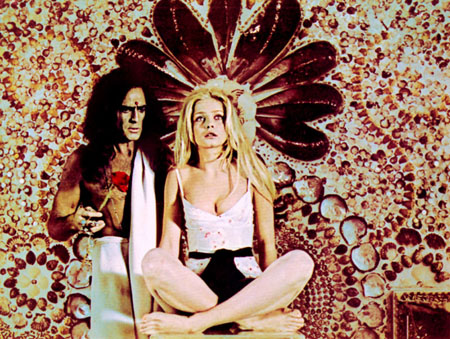
Still from Candy (1968)

WHY IT WON’T MAKE THE LIST: Ah, the late 1960s all-star wacky counter-culture cash-in flop. I have a personal affection for this suspect subgenre, which includes Casino Royale and Myra Breckinridge among other campy disasters. The whole mini-movement was inspired equally by “Laugh-In,” screenwriters with LSD connections, and Hollywood execs’ hopes of wringing the spare cash that hadn’t been blown on grass from out of hippies’ pockets. Sadly, as the number of available remaining slots on the List of the 366 Best Weird Movies grows ever smaller, we have to be ever more selective, and Candy has neither the balls-to-the-walls weirdness nor the cinematic competence to challenge for a spot among the very strangest films. Having the even more stunning and misconceived Skidoo on the List to represent this movement takes some of the sting out of reluctantly passing on this wild and wooly folly.

COMMENTS: , fresh off an Oscar for The Graduate, wrote Candy‘s script. Douglas Trumbull (the man responsible for 2001: A Space Odyssey‘s “cosmic gate” scenes) did the opening and closing effects. The Byrds, Steppenwolf and Dave Grusin appear on the impressive soundtrack. With that lineup of talent, along with a cast sporting multiple Oscar winners, it’s a shock how awful Candy can be at times. The blame can go to none other than director Christian Marquand (a successful French actor), whose second and final turn at the helm of a major motion picture was this financial shipwreck. Fortunately, at its best (er, worst), Candy is laughably awful, with enough “WTF?” moments (both intentional and unintentional) to keep your eyes glues to the tube.

The plot is a series of nearly-satirical vignettes in which a cross-section of American manhood attempts to grope, seduce, and violate the naïve Candy, who only wants to find her missing father. It is, as the kids today say, kind of rapey; but the menaces the nubile Ewa Auin faces are so silly and absurd that it’s hard to take offense. Candy appears confused rather than frightened by the men’s advances, and whenever someone does score, she enjoys it, in the free love spirit of the times. Her molesters are, in turn, a drunken poet (Burton, as a teen idol version of Dylan Thomas); a Mexican gardener (Ringo Starr, who makes look like a Guadalajara native by comparison); an air force commander (Walter Matthau); her father’s twin brother; two medical professionals (Coburn and Huston); an underground filmmaker; a hunchback (Azvanour); a self-appointed guru traveling the country in a big rig (Brando); and a mysterious cloaked figure. Among the male cast, opinions are divided on who comes off best and worst, but even if their performances are halfway decent (Coburn), the actor’s star is tarnished just by appearing in this mess.

If you’re looking for weird bits beyond the spectacle of big names embarrassing themselves, we only need to point to the opening and closing, which imply that Candy is some sort of star child sex messiah. Then there’s the scene in a glass-bottomed limousine, shot from below; a drunken Burton making love to a mannequin; a wall-scaling hunchback; and every moment of Brando’s politically incorrect brownface performance as an Indian guru who teaches Candy both levitation and the advanced spine-warping version of the Kama Sutra. Individually, some of the sequences work, but the movie never gets a comic rhythm going, and even the horrible acting rarely elicits a chuckle. It does, however, get weirder as it goes on, coming to resemble a softcore “Alice in Wonderland” more than its original inspiration, Voltaire’s “Candide.” It’s one of those fabulous extravagances that could only have emerged out from behind of a cloud of smoke in the psychedelic era.

The eclectic cast and crew of the film adaptation fits Candy’s curious history. It started life in 1958 as a satirical pornographic novel by Terry Southern and Mason Hoffenberg, which was originally banned but became a succès de scandale when it was republished in the 1960s. “Candy” helped launch Southern’s career: he went on to write or contribute to screenplays for Dr. Strangelove, Barbarella, Easy Rider, and the adaptation of his own novel The Magic Christian. (Reportedly, Southern was not a fan of this 1968 adaptation). Candy was remade twice in 1978 (without authorization, with just enough changes to avoid lawsuits), as dueling hardcore sex films: The Erotic Adventures of Candy and Pretty Peaches. Pretty Peaches, at least, was quite accomplished for an adult film, with bubbleheaded Desiree Cousteau arguably outperforming debuting Ewa Aulin, and has probably been seen far more often than this official studio-backed adaptation. Long neglected, in 2016 Kino Lorber re-released Candy on DVD and Blu-ray, with interviews with Buck Henry and film critic Kim Morgan (‘s wife) among the extras.

WHAT THE CRITICS SAY:

“…a trippy, candy colored comedy with sci-fi and fantastic overtones, complete with a mindblowing cosmic finale. There really hasn’t been another movie quite like it, and for those who can handle cinematic head trips laced with chuckles and gorgeous visuals, this Candy is dandy indeed.”–Mondo Digital (DVD)

(This movie was nominated for review by “kengo,” who rhapsodized “Cheesy sleazy patchy fun, with a bit of hit and miss satire and no discernible plot, but it does have McPhisto! – Richard Burton at his best. Hollywood was good in the sixties.” Suggest a weird movie of your own here.)

256. AMARCORD (1973)

“The natural was not an opportunity for Fellini, material to be recorded or rearranged, but rather a constraint, like rationality, defined order, and logic were—a limit on his creativity—and that is why the natural, the narrativized, and the realistic began to disappear from Fellini’s work, at first imperceptibly, before 1960, and then markedly afterward.”–Sam Rohdie, “Amarcord: Federico of the Spirits”

Recommended

DIRECTED BY:

FEATURING: Bruno Zanin, Magali Noël, Armando Brancia, Pupella Maggio, Luigi Rossi, Josiane Tanzilli, Maria Antonietta Beluzzi

PLOT: Amarcord documents a year in the lives of residents of an Italian coastal town (based on Fellini’s own hometown, Rimini) in the 1930s under Mussolini’s Fascist party. Titta, an adolescent boy, is the character with the most screen time, and he spends it mostly with his friends engaging in mischief and lusting after unobtainable older women. The most unobtainable of these is Gradisca, the dreamy, red-maned village beauty and the second most important character, whose eventual marriage marks the end of a chapter in the town’s history.

Still from Amarcord (1973)

BACKGROUND:

  • Won the 1975 Academy Award for Best Foreign Language Film; the film was also nominated (in 1976) for Best Original Screenplay and Best Director.
  • Depending on what source you believe, “amarcord” is either a Fellini neologism, or an unusual slang word from the Romagnolo dialect of Italian meaning “I remember.” Per Damian Pettigrew, it possibly derives from “amare” (“love”) + “ricordo” (“memory”) (=”fond memory”), perhaps with a touch of “amaro” (=”bitter”, for “bittersweet memory”). Or, it might be just a slurred pronunciation of the Italian phrase “io mi ricordo” (“I remember”).

INDELIBLE IMAGE: Most mainstream movie fans remember the peacock in the blizzard, or the massive S.S. Rex passing by in the night (over, as it turns out, a sea made of cellophane). The weird-minded are more thrilled by the sight of the imaginary wedding ministered by the giant Facscist talking head made from red and white blossoms, with the girls holding up hula hoops on one side of the aisle while the boys raise their rifles on the other.

THREE WEIRD THINGS: Flowery Mussolini wedding; bean vendor in a harem; dwarf nun

WHAT MAKES IT WEIRD: Amarcord finds Federico Fellini fondly remembering, or deliberately misremembering, his own youth in a series of sketches that alternate between burlesque comedy, light absurdism, and total fantasy. Mainstream movie lovers sometimes see Amarcord as too flamboyant, while Fellini’s more surrealist-oriented fans often miss the delirium of Satyricon, seeing this one as too nostalgic and accessible. Amarcord admittedly isn’t Fellini’s weirdest, but as one of the most beloved works by one of the weird genre’s key directors, it’s worth your time. It skates onto the List of the 366 Best Weird Movies on the sliding-scale rule: the better the movie, the less weird it has to be to be honored.


Original U.S. release trailer for Amarcord

COMMENTS: It sounds like an outtake from “Arabian Nights” by Continue reading 256. AMARCORD (1973) →

CAPSULE: FRANCOFONIA (2015)

DIRECTED BY:

FEATURING: Louis-Do de Lencquesaing, Benjamin Utzerath, Vincent Nemeth, Johanna Korthals Altes, Aleksandr Sokurov

PLOT: An experimental documentary on the Louvre, with dramatic recreations of the Nazi takeover and Napoleon showing up in the museum after hours.

Srill from Fancofonia (2015)

WHY IT WON’T MAKE THE LIST: This stream-of-consciousness companion piece to Russian Ark, Aleksandr Sokurov‘s amazing one-shot exploration of St. Petersburg’s Hermitage, is too messy with too many wild hairs. Ultimately, it seems to be more about Sokurov’s own artistic whims and impulses than it is about the Louvre.

COMMENTS: As the opening credits scroll, we hear director Sokurov take (scripted) phone calls regarding post-production work on his latest movie (presumably Francofonia itself). The second caller (“Captain Dirk,” who we’ll meet again later) asks about the director’s progress and he confesses “I don’t think the film is successful.”

I generally agree, although any movie that spotlights so many masterpieces from the Louvre can’t be a complete failure. Sokurov is a true connoisseur of European art (as seen in Russian Ark) and has a legitimate love for the Louvre, but this documentary/narrative hybrid piece shows no real organization or purpose. It’s like a spur-of-the-moment whirlwind trip to a museum. Partly, Sokurov wants to give an account of how deputy Louvre director Jacques Joujard hid the museum’s treasures from the Nazis ahead of the occupation of Paris in 1940, with the silent blessing of Count Franz Wolff-Metternich, the cultured professor Hitler had appointed as “caretaker” of French cultural treasures. This potentially interesting story is told with both archival footage and recreations using actors. But Sokurov masks his straightforward tale with multiple digressions: his own poeticized musings on European culture; a mysterious character who runs around the darkened Louvre in a gown saying “liberté, égalité, fraternité”; the ghost of Napoleon (who shows up to point out his own portraits); Sokurov’s fanciful Skype discussions with the aforementioned Captain Dirk, who’s carrying a load of museum-bound historical treasures on a freighter imperiled by rough seas; and so on.

Francofonia suffers by comparison with Russian Ark, whose one-take, two-character gimmick imposed structure and discipline on the film while still allowing Sokurov to indulge his imagination. Sokurov is intelligent, and his a love for museums and for the preservation of European high culture comes across, but Francofonia is so scattershot that his passion is dissipated. A conventional documentary would hit at least as hard: indeed, moments when the camera merely pans over the straining figures of “The Raft of the Medusa,” or passes each curl in an Assyrian lamassu’s beard, or zooms in so we can see the intimate cracks in the “Mona Lisa”‘s aging canvas, are the film’s strongest sights.

Sokurov says he wants to create cinematic tributes to Madrid’s Prado and London’s British Museum next. I hope he finds a more interesting angle from which to film these projects than he did for his Louvre piece.

The Music Box Francofonia DVD or Blu-ray includes two substantial extras, each about an hour long: the making of documentary “Visitors to the Louvre” and “The Man Who Saved the Louvre,” a conventional documentary (which the DVD refers to as a “play”) on Jacques Joujard.

WHAT THE CRITICS SAY:

“Sometimes the bizarre can illuminate the poignant, sometimes it distracts. In ‘Francofonia’ it most definitely distracts… terribly over-directed and seems strange just for the sake of being strange.”–Tom Long, Detroit Free Press (contemporaneous)

255. RUBIN & ED (1991)

“People try to make me sound a lot… weird… and just, strong, you know, I’m strong!”–Crispin Glover on “Late Night with David Letterman”

“Talk about el weirdo.”–Ed, on Rubin

Recommended

DIRECTED BY:

FEATURING: Howard Hessman, , , Michael Greene

PLOT: Ed is a recently-separated loser who joins “the Organization,” a cult-like real estate pyramid scheme. Rubin is a shut-in nerd whose mother takes away his boom box and refuses to return it until he makes a single  friend. When Ed tries to recruit Rubin to attend an Organization seminar, Rubin agrees to go, on the condition that Ed helps him find a place to bury his dead pet cat.

Still from Rubin and Ed (1991)

BACKGROUND:

  • Rubin & Ed was Utah-based director Trent Harris’ first feature film after making the three documentary/narrative hybrid shorts known as “The Beaver Trilogy” (the first installment is a documentary featuring an oddball kid who performs in drag as Olivia Newton-John, while the next two recreate the first using actors and Crispin Glover, respectively).
  • Glover created Rubin Farr for another role that never materialized. He convinced Harris, who was looking for a project for his feature film debut, to write a script around the character.
  • In 1987, three years before Rubin & Ed began filming, a stuttering, awkward Crispin Glover appeared in character as Rubin on “Late Night with David Letterman.” Letterman thought Glover was there to promote River’s Edge, and walked off his own set when Glover almost kicked him in the head while wearing Rubin’s giant platform shoes. The segment only lasted a little over four minutes. Many Americans who saw it live assumed Glover was wasted on psychedelic drugs.
  • Although it had a reasonable degree of star power and was produced by major independent Working Title Films (who released the Palme d’Or winning Barton Fink the same year), Rubin & Ed initially received terrible reviews made a mere $15,000 in its original theatrical run. The film flopped so badly that the studio pulled funding for another Trent Harris project that had already been greenlit. Rubin & Ed later found a small cult following on VHS.

INDELIBLE IMAGE: Rubin’s happy hallucination, which features his previously-dead cat alive and waterskiing while its owner relaxes in a floating inner-tube wearing shoes with two foot heels, on which the bikini babe motoring the speedboat compliments him.

THREE WEIRD THINGS: Weaponized platform shoes; waterskiing cat; insole slurping

WHAT MAKES IT WEIRD: Though structured as a quirky comedy, not too different from the usual outing of the period, Rubin and Ed has a gaggle of weird points in its favor, including a hallucination scene with a water skiing cat and a lunatic Crispin Glover playing something very near the Crispin Glover-iest character ever written. Its sense of humor is so eccentric that it’s been forced off-road to become strictly a cult curiosity.


Trailer for Rubin & Ed

COMMENTS: “It’s going to get weird now, isn’t it?,” frets Ed, after Continue reading 255. RUBIN & ED (1991) →

CAPSULE: RETURN OF THE LIVING DEAD (1985)

366 Weird Movies may earn commissions from purchases made through product links.

Recommended

DIRECTED BY: Dan O’Bannon

FEATURING: Clu Gulager, Don Calfa, James Karen, Thom Mathews,

PLOT: Workers at a cadaver warehouse accidentally release an experimental army chemical that reanimates the dead and, together with a band of punks, find themselves fighting hundreds of brain-eating zombies.

Still from Return of the Living Dead (1985)

WHY IT WON’T MAKE THE LIST: It’s essential cult movie viewing, but it’s not inside the perimeter of the weird.

COMMENTS: In the mid-1980s horror movies realized that, in a post-Leatherface/Michael Meyers/Jason/Dawn of the Dead world, it was fast becoming impossible to shock jaded horror audiences with escalating gore. The response was to embrace, and exaggerate, the campy aspects of the genre. By 1984, wisecracking Freddy Krueger and his groaner puns supplanted the silent masked killers of just a few years earlier. Along with 1985’s bloody-but-wacky Re-Animator and the increasingly cartoonish horrors of , Return of the Living Dead was in the vanguard of the new tongue-in-cheek horror movement, helping to start a cycle that reached an artistic apex with 1987’s Evil Dead II (verifying the trend towards black comedy, II was itself an outrageously campy sequel/remake of the earnestly grim 1981 original).

While took horror’s basement budget subgenre into ridiculous realms of farce with The Toxic Avenger and its ilk, Return got the tone just right, adding reassuring flecks of “you shouldn’t take this seriously” to the script in a way that didn’t mar its legitimately scary and thrilling aspects. Return‘s jokes range from the blatant and silly (a zombie grabs a walkie-talkie from an abandoned ambulance and advises the concerned dispatcher to “send more paramedics”) to the subtle and silly (a pair of the survivalists are named “Burt” and “Ernie”). But the gags are just opportunities to catch your breath as the zombies close in, not the entire point of the show. Return captures the siege mentality of its inspiration, ‘s Night of the Living Dead. The victory of the ghouls is inevitable, because the dead outnumber the living. The victims, funeral industry workers and a gang of “punks” trapped in the melee while partying in the cemetery, can’t hope to defeat the undead. These corpses are particularly resilient—if you chop them up into tiny pieces and throw them in a garbage bag, the dismembered parts continue squirming. They are, in fact, nearly indestructible. The living can only hope to hold out long enough for the National Guard to arrive. Along the way come some imaginatively freakish sights, such as quivering half-dog zombies (the FX are not great by today’s standard, but it’s the concept that chills you) and the interrogation of a female corpse who’s missing the lower half of her body. Add in proto-Goth Linnea Quigley’s full-frontal nude dance among the tombstones (which is about as much Eros as a teenage boy in the 1980s could take with his Thanatos without exploding) and you have a trashy but timeless horror spectacle.

Scream Factory released a 2-Blu-ray “Collector’s Edition” of Return in 2016, with four different commentary tracks (!), including contributions by director O’Bannon and a number of the cast members. The set also includes unused scenes taken from the work print and a definitive 2-hour documentary on the film (More Brains: A Return To The Living Dead) among its comprehensive encyclopedia of supplemental features.

Happy Halloween!

WHAT THE CRITICS SAY:

“It’s kind of a sensation-machine, made out of the usual ingredients, and the real question is whether it’s done with style. It is.”–Roger Ebert, Chicago Sun-Times (contemporaneous)

(This movie was nominated for review by “Brad.” Suggest a weird movie of your own here).