All posts by Gregory J. Smalley (366weirdmovies)

Gregory J. Smalley founded 366 Weird Movies in 2008 and has served as editor-in-chief since that time. He is a member of the Online Film Critics Society, and his film writing has appeared online in Pop Matters and The Spool.

CAPSULE: CEMETERY OF SPLENDOR (2015)

DIRECTED BY:

FEATURING: , Banlop Lomnoi, Jarinpattra Rueangram

PLOT: Soldiers struck with an inexplicable sleeping sickness are housed at an old school, and a housewife volunteer develops an empathic bond with one young victim, which may involve entering his dreams.

Still from Cemetery of Splendor (2015)

WHY IT WON’T MAKE THE LIST: Fans of Apichatpong Weerasethakul (who mercifully nicknamed himself “Joe” for the benefit of Western audiences) know exactly what to expect from his latest experiment in dream cinema: long takes, quiet moods, the blurring of the line between the real and unreal, and mundane dramatics that subtly slip into the surreal. Cemetery will please those he’s already won over, but his Palme d’Or winning breakthrough Uncle Boonmee Who Can Recall His Past Lives makes for a better representative of his sleepy, spiritually weird style. We wouldn’t rule out adding another of Joe’s movies to the List of the 366 Best Weird Movies down the road, but it will need to venture farther into the bizarre than Cemetery does.

COMMENTS: With four minutes of nearly silent establishing shots—showing sleeping soldiers being shipped by the truckload to the makeshift hospital, and our limping protagonist making her way up the wooden planks of the porch on her way to volunteer duty—Weerasethakul throws down the gauntlet to viewers’s attention spans. This introduction is followed by an initial half-hour that seems composed mostly of long and medium shots of young men sleeping, with middle-aged women quietly sitting by their bedsides watching over them, and a lunch break to introduce the fact that one of them has psychic abilities. (We also, for reasons only Joe could explain, watch a man poop in the woods).

The movie, set in a leafy Thai jungle and scored to the hum of insects and distant rumbling backhoes, lulls us into a peaceful mood. We might be forgiven for wondering if we have fallen asleep ourselves and are dreaming when things start to change. Does the soldier Jen watches over, Itt, briefly wake up and take a meal with her? Maybe, maybe not, but surely two dead princess don’t visit her at a picnic table at the dinosaur park to share fruit and explain a possible origin of the sleeping sickness. And we might doubt that the psychic licks Jen’s deformed leg as a form of therapy. And when amoebas appear drifting among the clouds in the sky, you can be absolutely sure it’s a dream.

Cemetery of Splendor never goes anywhere, so there’s nothing to wrap up. The soldiers, and their caretakers, simply sleep and dream on, and at some point Weerasethakul decides to turn the camera off. A paradoxical offering from a Valium-toned auteur, Cemetery of Splendor is simultaneously minor and profound, inconclusive and whole. It’s a film you’re proud to have seen, but in no rush to watch again.

For those not yet ready to wake up, the 2016 Strand DVD includes a “making of” featurette and deleted scenes.

WHAT THE CRITICS SAY:

“…[Weerasethakul’a] movies work best when they’re washing over you, even when — in fact, especially when — things get weird.”–Matt Prigge, Metro

253. IF…. (1968)

“What child has ever been silly enough to ask, when Cinderella’s pumpkin turns into a golden coach, where reality ends and fantasy begins?”–Lindsay Anderson

Recommended

DIRECTED BY:

FEATURING: , David Wood, Richard Warwick, Robert Swann, Hugh Thomas, Peter Jeffrey, Christine Noonan

PLOT: Mick Travis is a rebellious teenage boy at a British boarding school. Because of “general attitude,” he and two friends are persecuted and beaten by the “whips,” older students given privileges to enforce discipline. During military exercises, Mick and his friends discover a cache of automatic weapons and make plans to disrupt the school’s Founders’s Day celebration.

Still from If.... (1968)

BACKGROUND:

  • In England if…. was controversial due to its unflattering portrayal of English boarding schools (particularly, one suspects, of the depiction of pervasive homosexuality) and, by extension, of English traditions in general. When David Sherwin and John Howlett brought their original screenplay to one producer, he called it “the most evil and perverted script he’s ever read.”
  • The film was inspired by ‘s 1933 Certified Weird anarchist screed Zéro de conduite, relocated from 1930s France to then-contemporary Britain.
  • if… was filmed mostly on location at Cheltenham College, director Lindsay Anderson’s alma mater. Many of the boys who appear in smaller roles were students there at the time. A doctored script, missing the final scenes, was given to the college, since the school never would have granted permission to shoot if they had known if…’s climax beforehand.
  • This was Malcolm McDowell’s film debut.
  • Look for portraits of famous revolutionaries and icons of rebellion like Che Guevara, Geronimo, Vladimir Lenin, James Dean and others hanging on the boys’s walls.
  • There is a legend that the film shifted from black and white to color because the producers ran out of money for color stock. Lindsay Anderson contradicted these rumors, saying that they decided to shoot the first chapel scene in black and white due to lighting considerations. He liked the effect so much that he inserted black and white scenes at random to disorient the viewer and to hint at the fantasy elements to come later.  Anderson insists there is no symbolic “code” or reasoning for why some scenes are monochrome and some in color.
  • Distributor Paramount was horrified by the film and certain it would bomb in Britain. They wanted to bury it, but at the last minute they needed a movie to screen in London to replace their current flop: Barbarella. if… went on to be a hit.
  • if…. won the Palme d’Or at Cannes, although in the commentary Malcolm McDowell recalls that he was told that the film actually came in third in the voting, but was chosen as a compromise because the jury could not break a deadlock between supporters of Costa-Gavras’s Z and Bo Widerberg’s Adalen 31.
  • Lindsay Anderson and Malcolm McDowell made three films together, in three different decades. In each of them McDowell plays a character named “Mick Travis,” although based on their varying personalities it’s unlikely that they are intended to be the same person. The other two “Mick Travis” films are 1973’s O Lucky Man! and 1982’s Britannia Hospital.
  • Anderson actually wrote a proper sequel for if…, which was to take place at a class reunion, which was unfilmed at the time of his death in 1993.

INDELIBLE IMAGE: The final shootout, as a whole; it’s both a troubling massacre and an immensely satisfying revenge. Early posters of if… favored shots of star McDowell or the photogenic Girl; we prefer the brief image of a dowager who grabs a machine gun and pitches in for the defense of the school.

THREE WEIRD THINGS: Tiger mating ritual; chaplain in a drawer; granny with a machine gun

WHAT MAKES IT WEIRD: Throughout most of its run time if… is a viciously realistic boarding school drama. But when the Headmaster sternly tells the boys “I take this seriously… very seriously indeed” after Mick shoots a chaplain and bayonets a teacher during the school’s campus war games, we suddenly realize the line between realism and fantasy has been thinner than we thought.


Original U.S. release trailer for if….

COMMENTS: if…‘s theme is the conflict between tradition and rebellion, age and youth, especially resonant concerns in the tumultuous year of 1968, when the firebrand film was fortuitously released a few months after the student riots in Paris. Structurally, if… Continue reading 253. IF…. (1968) →

CAPSULE: PERFUME OF THE LADY IN BLACK (1974)

DIRECTED BY: Francesco Barilli

FEATURING: Mimsy Farmer, Maurizio Bonuglia, Mario Scaccia, Jo Jenkins, Daniela Barnes, Orazio Orlando

PLOT: A wealthy, workaholic bachelorette chemist begins seeing visions of a lady in black, and a young blond girl; is she going mad or being tricked (or both)?

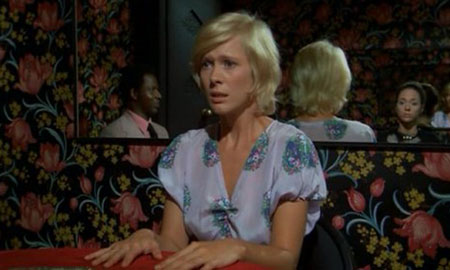
Still from The Perfume of the Lady in Black (1974)

WHY IT WON’T MAKE THE LIST: With its hysterical hallucinations and hints of witchcraft, plus a grisly surprise ending, a case could be made for certifying this quality offbeat occult giallo; but ultimately, it falls into the category of “you gotta draw the line somewhere.”

COMMENTS: In his interview comments accompanying the Raro Video release, writer/director Francesco Barilli acknowledges The Perfume of the Lady in Black’s debt to , but you’d probably sniff the lingering scent of Repulsion early on even without that admission (not to mention a whiff of Rosemary’s Baby, too). Perfume is part of a line of 60s and 70s horrors playing on the anxieties of young single working women. Thanks to sexual liberation, a class of working women living on their own without a live-in male protector was a relatively new phenomenon, and for all the necessary freedom, the fact is that it can be scary to be a woman in a man’s world. Lone females have more to fear than solo males: they fear all the same things men do, plus, they have to fear men. Silvia is competent enough to manage a chemistry lab, but she can’t trust her surroundings, her neighbors, strangers who stare at her on the street, or her even own senses in the dead of night. Whenever she’s alone, she’s endangered, and returns to sanity only when her boyfriend rushes to her side.

Perfume takes place in that lush giallo world, an existence full of tennis dates, elegant silk robes, and apartment courtyard’s with Roman fountains. The art direction is sumptuous, and at times a little outrageous, such as the jungle mural that hovers above Silvia’s friend’s bedpost. Surely such bourgeois elegance can only be there to cover up the stench of decadence. Mimsy Farmer, while not star material, is a treat in this role, constantly frightened and almost reluctantly sexy. The plot seems to be being made up as it goes along. It turns out that there are really two storylines, one of which involves oblique divulged secrets from Silvia’s childhood. The dual plots are mashed together, which produces extra confusion, but less satisfaction, since there’s not a single resolution, and nothing in particular to tie them together. Highlights include a ghostly little girl, “Alice in Wonderland” references, and a séance with a blind psychic (which may be the most giallo scenario ever). The ending is a genuine shock surprise, leaving a strong enough impression to make you forget the somewhat tedious early moments.

Raro Video upgraded Perfume to Blu-ray in 2016. The disc includes an interview with writer/director Barilli (which might be cut down from a longer one included on the DVD release) and a bonus short film, the 23-minute “The Knight Errant,” a shot-on-video variation on Death Takes a Holiday with a couple of surreal surprises that’s well worth a watch.

WHAT THE CRITICS SAY:

“The Perfume of the Lady in Black piles on the weird, somewhat to its detriment.”–Jamie S. Rich, DVD Talk (2011 DVD)

CAPSULE: THE LADY IN THE CAR WITH GLASSES AND A GUN (2015)

DIRECTED BY:

FEATURING: Freya Mavor, Benjamin Biolay, Elio Germano,

PLOT: When he’s away on business, a Parisian secretary who has never seen the ocean takes her boss’s Thunderbird on a road trip, but everywhere she goes people swear they’ve seen her before—is she going crazy?

Still from The Lady in the Car with Glasses and a Gun (2015)

WHY IT WON’T MAKE THE LIST: For a while, the Lady seems to be driving her borrowed car into French territory, but she ultimately crashes it into mere implausibility.

COMMENTS: Forget the car, glasses and gun: the Lady, portrayed by Freya Mavor, is something to see. Freya was the Norse goddess of love and sex, and with her red hair, willowy build and tempting freckles, Mavor could pass for Scandinavian love goddess (she’s actually Scottish). It’s the Lady (not the plot) that is Lady‘s chief asset, and the way he shoots Mavor, I think director Johann Sfar knows it. He begins the film with her dancing madly at the sea shore, flaming hair flying around her head and bare feet pattering on the sea-soaked concrete of the pier, then cuts to an earlier scene where the model/actress is shot in unflattering light to actually make her look kind of ugly (a remarkable feat of cinematography). But as her confidence increases throughout the story, her hemline rises. Mavor’s girlish looks and waifish figure lend her an air of forbidden innocence that makes her future behavior seem all the more shocking.

As the pseudo-doppelanger plot synopsis might suggest, mirrors will provide key imagery here, and an early scene where the Lady’s reflection disobeys her provides one of the first hints of an ever-increasing subjectivity that leads us to suspect that she’s headed for madness. The plot kicks into gear after the Lady has borrowed the car, and keeps running into people who insist they’ve seen her recently; for example, eating breakfast that morning in a country café when she was actually in Paris at the time. On her road trip, she’s also assaulted at random, and starts making poor decisions re: picking up sleazy drifters at roadside motels. Our attention is diverted by Sfar’s style (cool music, cool cars, sexy chicks, impossible occurrences); and the Lady seems to be turning schizophrenic, until fifteen minutes of closing exposition explain what’s really been going on all along. Many people criticized the climax as a clunky dénouement device, but I was more disappointed in the solution to the mystery, which relies too much on crazy coincidence for my satisfaction.

Johann Sfar has been hanging around on the fringes of weird films for a while now, starting with the mildly hallucinatory biopic Gainsbourg: A Heroic Life, and continuing with The Rabbi’s Cat, his arcane adaptation of his own graphic novel about a snarky, sacrilegious pet. In Lady‘s second act the thick, nearly surrealistic atmosphere makes this remake of the seldom-seen 1970 shocker of the same title seem like it’s going to be Sfar’s weirdest film; ultimately, however, it ends up as his most conventional. Sfar remains an unpredictable force with the potential to unleash something fantastically weird in the future, although each near-miss diminishes our enthusiasm for his work just a little.

WHAT THE CRITICS SAY:

“Sfar creates the eerie impression of being trapped in someone else’s dream. Relying on hallucinatory tricks in which time seems to roll back on itself, or else lurch forward to some possible future, the helmer makes everything feel surreal enough that we hardly stop to consider the only logical explanation, delivered in stultifying detail over a tedious, low-tension climax.”–Peter Debruge, Variety (contemporaneous)

250. THE CREMATOR (1969)

Spalovac Mrtvol

366 Weird Movies may earn commissions from purchases made through product links.

“The Lord arranged it very well when he told people: ‘Remember, dust thou art and to dust thou returnest.’ A crematorium, dear friends, is clearly a God-pleasing object, because it helps God to speed up the transformation of people into dust.”–Kopfrkingl, The Cremator

Recommended

DIRECTED BY:

FEATURING: , Ilja Prachar, Milos Vognic, Jana Stehnová, Jirí Lír

PLOT: Kopfrkingl is a crematorium operator in Czechoslovakia in the late 1930s who holds odd opinions about the liberating nature of death, based largely on his self-study of the Tibetan Book of the Dead. Because he has German blood, an old army buddy recruits him into the Czech branch of the Nazi party. His beloved wife’s half-Jewish parentage, however, soon becomes an issue that threatens his advancement both in the party, and in his chosen profession.

Still from The Cremator (1969)

BACKGROUND:

  • The movie is based on a novel by Ladislav Fuks, a Czech who had been a forced laborer (arbeitseinsatz) during the Nazi occupation. Fuks collaborated with director Juraj Herz on the screenplay.
  • Although he was their contemporary, Herz did not consider himself part of the In school he studied puppetry (in the same class as ) rather than film, and had few friends in the New Wave clique. (One exception was director , who plays the small role of Dvorák in The Cremator). He did sneak in to film screenings at FAMU (the national film school that incubated the New Wave movement) and filmed a segment for the 1966 anthology Pearls of the Deep, which was rejected because of its length (30 minutes).
  • The Cremator began filming during the Prague Spring, but was interrupted by the Soviet invasion in 1968, which made completing it a challenge. The film was released and screened but removed from circulation soon after.
  • Czechoslovakia submitted The Cremator to the Oscars as Best Foreign Film, but the Academy did not grant it an official nomination.
  • The Cremator won best film, actor (Rudolf Hrusínský) and cinematography (Stanislav Milota) at the Sitges Film Festival, but not until 1972, three years after its initial release.

INDELIBLE IMAGE: Most likely it’s frequently tuxedoed cremator-in-chief Rudolf Hrusínský’s round face, the subject of so many closeups, that will stick with you the most. We chose to highlight the moment when he is invited into the rear tent at the freaskshow to gaze at the embalmed two-headed specimens and faces ravaged by syphilis, in which he shows a strange fascination.

THREE WEIRD THINGS: Buddhist Nazism; the throne in Lhasa; girl in black

WHAT MAKES IT WEIRD: A WWII drama soaked in an atmosphere of Gothic psychological horror, The Cremator seems like a screenplay might have written if he’d lived to see the Holocaust. Distorted lenses and madcap montages track the cremator’s bent descent from eccentric mortician to megalomaniacal tool of ultimate evil.


Second Run DVD trailer for The Cremator

COMMENTS: The IMDB categorizes The Cremator as, among other Continue reading 250. THE CREMATOR (1969) →