Tag Archives: Sexual repression

90. BLACK SWAN (2010)

“It’s a Polanski movie, and then it becomes a Dario Argento movie. And maybe a little bit of David Cronenberg too.”–Vincent Cassell

Must See

DIRECTED BY: Darren Aronofsky

FEATURING: Natalie Portman, Mila Kunis, , Barbara Hershey, Winona Ryder

PLOT: Nina, a goody two-shoes ballerina, wants to dance the lead role in a production of “Swan Lake,” but although she’s perfect for the role of the White Swan, she lacks the seductiveness to portray the Black Swan. Lily, a sexy, irresponsible dancer newly arrived from a San Francisco troupe, becomes her primary competition for the part, but also helps her loosen up by talking her out on the town for a night of drinking and meeting guys. Nina starts physically break down and hallucinate as the stress of preparing for the role takes its toll; by opening night, she can’t distinguish reality from the story she dances of the princess trapped in the body of a swan who takes her own life.
Still from Black Swan (2010)

BACKGROUND:

  • Natalie Portman danced many of her own parts, and actually dislocated a rib while dancing during the shoot. More difficult moves were performed by professional ballerinas, and for two sequences Portman’s face was digitally superimposed on dancer Sarah Lane’s body. There was a minor controversy over how much of the dancing Portman actually did herself and how much was performed by doubles; Aronofsky estimated that the actress executed more than 80% of the dance moves that appear onscreen.
  • Portman won the 2010 Best Actress Oscar for her role as Nina. The film was also nominated for Best Picture, Director, Cinematography and Editing.
  • Aronofsky received “The Understudy,” the original script that became Black Swan, while he was making Requiem for a Dream (2000). He described the script as Dostoevsky’s “The Double” meets All About Eve. Aronofsky combined that script, which was set in an off-Broadway production, with an idea he had to shoot a movie in the New York ballet world to create Black Swan.
  • Aronofsky and Portman had discussed doing a ballet movie together 8 years prior to shooting.
  • Made on a relatively small budget of about $12 million, Black Swan has grossed more than $300 million worldwide as of this writing.

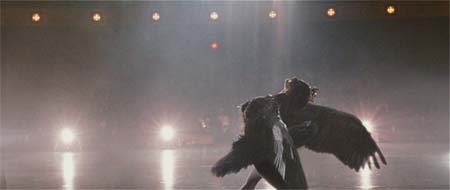
INDELIBLE IMAGE: Nina’s “triumphant” onstage transformation into the Black Swan: as she pirouettes, feathers sprout from her arms, thickening with every swirl, until her limbs have been replaced by wings.

WHAT MAKES IT WEIRD:  Up until opening night, Black Swan is a backstage melodrama about backstabbing ballerinas, with an exaggerated, lurid psychopathology that’s thrust even further over-the-top by lesbian love scenes, hints of horror, and mirrors, mirrors, mirrors.  When the curtain rises on the big night, we experience the performance through the subjective perspective of an overworked, paranoid, demented dancer, whose psychology has been shattered by the film’s sledgehammer symbolism.  No avant-grade choreographer could stage as disorienting a “Swan Lake” as the one she hallucinates for us through her obsessed eyes.

Promotional Music Video for Black Swan

COMMENTS: Black Swan is the weirdest movie ever to win a major Academy Award (Natalie Continue reading 90. BLACK SWAN (2010)

60. ELEVATOR MOVIE (2004)

“I think it was from taking the elevator to my dorm room every day in college.  I developed this weird thing with elevators.  It wasn’t fetishistic or anything, I was just always thinking about the elevator, and you know how you feel your stomach move a bit when an elevator first starts or stops?  I would feel that at random times in the day when I wasn’t in an elevator, and I would feel like the ground was just a rising elevator platform.  I was also very shy at the time and I started to look forward to taking the elevator every day because it was the rare time I might be forced into a social situation with someone.”–Zeb Haradon on the origins of Elevator Movie

DIRECTED BY:

FEATURING: Zeb Haradon, Robin Ballard

PLOT:  A woman carrying groceries is trapped in an elevator with a socially inept graduate student. Oddly, no one answers when they push the call button, and no one comes for days and weeks on end; even more oddly, her grocery bag is refilled each morning. As the weeks stretch into months, the mismatched pair—an adult virgin obsessed with anal sex and a reformed slut turned Jesus freak—form a sick symbiotic bond, until the girl undergoes a weird metamorphosis.

Still from Elevator Movie (2004)

BACKGROUND:

  • Per director Haradon, the budget for the film was between twenty-five and thirty thousand dollars.
  • According to a statement on the official website the main influences on the story were Samuel Beckett’s “Waiting for Godot,” the films of Luis Buñuel (particularly That Obscure Object of Desire and The Exterminating Angel), and Eraserhead.
  • Although the mouse-stomping scene was faked, the end of the film shows a joke disclaimer that proclaims, “No animals were harmed in the making of this film except for lobsters and mice.”  Haradon received angry mails from animal rights advocates who believed that a mouse was actually killed onscreen.
  • Hardon’s followup film was the documentary Waiting for NESARA (2005), about a bizarre UFO cult composed of ex-Mormons.
  • The 2008 Romanian film Elevator features a similar dramatic scenario of a young man and woman trapped together in a cargo elevator, but without any surrealistic elements.

INDELIBLE IMAGE: Lana, after she inexplicably transforms into a metal/human hybrid.

WHAT MAKES IT WEIRD:  By mixing Sartre’s “No Exit” with an ultra-minimalist riff on Buñuel’s The Exterminating Angel, garnished with large dollops of fantastical sexual depravity and a pinch of body horror, writer/director/star Zeb Haradon created one of the weirder underground movies of recent years. The absurdist script is exemplary, and the simplicity of the one-set scenario means that the movie’s technical deficiencies don’t stick out, and could even add to the oddness.


Original trailer for Elevator Movie (WARNING: trailer contains profanity and sexual situations)

COMMENTS: I have to start this review of with a confession/apology: when I first Continue reading 60. ELEVATOR MOVIE (2004)

57. GOZU (2003)

366 Weird Movies may earn commissions from purchases made through product links.

AKA Gokudô kyôfu dai-gekijô: Gozu (full Japanese title)

INDIEWIRE INTERVIEWER: Are there any themes or images you find too upsetting or disturbing to show?

MIIKE: Normal things.”

RecommendedWeirdest!

DIRECTED BY: Takashi Miike

FEATURING: Yûta Sone, , Kimika Yoshino

PLOT:  Minami is a journeyman yakuza whose boss Ozaki is going insane, and who has been ordered by higher-ups to see to it that he is killed.  Since Ozaki once saved his life, Minami is conflicted about the assignment; but fortunately, an accident seems to take care of the problem for him.  That is, until the presumptive corpse disappears while he is stopped in a strange town outside of Nagoya, and Minami launches a desperate search for his boss that leads him into a surreal labyrinth of malleable identities.

Still from Gozu (2003)
BACKGROUND:

  • Gozu was one of five movies the prolific Miike made in 2003.
  • “Gozu” means cow’s head, and the full Japanese title translates literally as Grand Theatre of Perversion and Fear: Cow’s Head (sometimes translated as Yakuza Horror Theater).
  • Like many of Miike’s films, Gozu was originally intended as a direct-to-video release.  A successful Cannes screening got the movie noticed, and it was able to get wider theatrical distribution.
  • Harumi Sone, who plays the small role of the Inkeepers Brother, is the father of star Yûta Sone, and the executive producer of the film.  He brought the idea of casting his son in a yakuza film to Miike, though it’s reasonable to suspect he had a more traditional film in mind.

INDELIBLE IMAGE: In a film full of shocking imagery, the obscenely drooling cow-headed man who slowly approaches Minami to lick his face stands out.

WHAT MAKES IT WEIRDGozu may be the culmination of Miike’s “weird and perverted” phase, loaded with his particular fetishes and combining the two genres he works best in: horror and the yakuza (mobster) film. With its Eraserhead-like aura of personal alienation and fearsome psycho-sexual nightmares, bizarre identity shifts, and a cow-headed man as a mascot, Gozu‘s weirdness is never in doubt.

Japanese trailer for Gozu

COMMENTS:  Sexual repression always makes a good base for a weird movie.  Our libidos Continue reading 57. GOZU (2003)

BORDERLINE WEIRD: MEATBALL MACHINE (2005)

DIRECTED BY: Yûdai Yamaguchi and Jun’ichi Yamamoto

FEATURING: Issei Takahashi, Aoba Kawai

PLOT:  Alien parasites infect human hosts, morphing their bodies into bio-combat machines who then fight each other to the death; shy factory worker Yôji and Sachiko, the lonely girl he fancies, soon find themselves caught up in the struggle.

Still from Meatball Machine (2005)


WHY IT’S ON THE BORDERLINEMeatball Machine‘s alien gladiator-parasite setup is bizarre, but the movie never really tries to top its strangeness.  Rather, the weirdness pretty much stops at the premise, as the producers instead spend their energy indulging their true loves: gore and special effects.  The result is a movie that’s well within the weird genre, but not an outstanding example of it. (NOTE: upon further reflection, Meatball Machine was upgraded to “Borderline Weird” on 7/5/2010).

COMMENTS: To say that Meatball Machine‘s storyline is thin would be an insult to the relatively dense scripts of Michael Bay. In fact, the entire last half hour of the movie is nothing but an extended melee that persists long after the dual directors have run out of combat hooks.  To keep us emotionally involved in between (and during) the fight scenes, the plot takes a perfunctory stab at a touching love story between two losers; viewers will have to buy into this romance on their own, as neither the script nor the actors sell it.  But though Meatball Machine might be light on depth, what the movie does have going for it is unforgettable costume design and a few endearing oddnesses; and, of course, buckets of gore, for those who consider that a plus.  The alien parasites who populate this film thrive by inserting themselves inside humans and mutating the host body to create an ever-evolving arsenal of extremely implausible organic weapons, among which are biochainsaws, bioflamethrowers, and, for the necroborg who has everything, a visor complete with a windshield wiper to keep blood from splashing into his Continue reading BORDERLINE WEIRD: MEATBALL MACHINE (2005)

16. CARNIVAL OF SOULS (1962)

“We hoped for the look of a Bergman film and the feel of Cocteau.”–variously attributed to screenwriter John Clifford or director Herk Harvey

Must See

DIRECTED BY: Herk Harvey

FEATURING: Candace Hilligoss, Sidney Berger

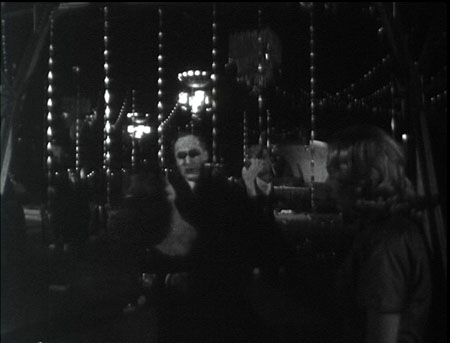
PLOT:  Mary Henry, a church organist, is the lone survivor of an accident when the car she’s riding in plunges over the side of an old wooden bridge.  Looking to start over, she takes a job as an organist at a new church in a town where she knows no one.  She finds herself haunted by the sight of a pale grinning man who appears to her when she is alone, and fascinated by an old abandoned carnival pavilion visible from the window of her boarding house that she senses hold a mysterious significance.

carnival_of_souls
BACKGROUND:

  • Carnival of Souls was made in three weeks for less than $100,000 (figures on the budget vary, but some place it as low as $33,000).  The film was a flop on its initial release, but gained a cult following through late night television showings.  The film was restored and re-released in 1989 to overwhelmingly positive reviews.
  • Director Herk Harvey, screenwriter John Clifford and composer Gene Moore worked together at Centron Corporation, an industrial film company, creating short safety documentaries such as Shake Hands with Danger and high-school propaganda/hygiene films such as What About Juvenile Delinquency? None were ever involved with a feature film again.
  • Mesmerizing star Candace Hilligoss acted in only one other feature film, 1964’s The Curse of the Living Corpse, before retiring to raise a family.
  • The movie has been very influential on other films, particularly low-budget horror films.  Director George Romero has said that the ghostly figures in Carnival of Souls inspired the look and feel of the zombies in The Night of the Living Dead (1968).  Other writers see a Carnival of Souls influence on films such as Eraserhead (in regards to its ability to evoke the nightmarish quality of everyday objects), Repulsion (disintegration of the mind of a sexually repressed woman), and even Apocalypse Now (the shot of Martin Sheen rising from the water mimics a similar scene involving The Man–thanks to Matthew Dessem of “The Criterion Collection” for the catch).
  • Carnival of Souls was “remade” in 1998, although the plot (about a clown killer and rapist) shared nothing with the original except the name and the final twist.  Wes Craven produced.  The remake went direct to DVD and was savaged by critics and audiences alike.

INDELIBLE IMAGE: What else, but the titular carnival? Ghostly figures waltz to an eerie, deranged organ score on what appears to be an old merry-go-round at the abandoned amusement park. The tableau recurs twice in the film: once clearly in a dream, and once near the end as a scene that may also be a dream, but may be another state of being entirely.

WHAT MAKES IT WEIRDCarnival of Souls is set in the ordinary, everyday world, but as seen through the eyes of an alienated, frightened woman. The world the film depicts is familiar, but made maddeningly strange, and its the subtle, grubby touches rather than ghostly apparitions that allow this creepy low-budget wonder to seep deep under your skin.


Trailer for Carnival of Souls

COMMENTS: Carnival of Souls is a minor film miracle. There was little reason to suspect Continue reading 16. CARNIVAL OF SOULS (1962)