Tag Archives: Expressionism

BORDERLINE WEIRD: THE NIGHTMARE BEFORE CHRISTMAS (1993)

AKA Tim Burton’s The Nightmare Before Christmas

Recommended

DIRECTED BY: Henry Selick

FEATURING: Voices of Chris Sarandon, Danny Elfman, , Ken Page

PLOT: Jack Skellington, the Pumpkin King of Halloweentown, discovers Christmas and tries to recreate it, with ghoulish results.

Still from The Nightmare Before Christmas (1993)

WHY IT’S ON THE BORDERLINE: As a children’s film, The Nightmare Before Christmas has a high hurdle to overcome. Since it’s aimed at kids, the movie is permitted to indulge in imagination and fantasy, so long as it uses a conventional story framework and takes a stab at conveying a useful moral lesson. Nightmare has a great, morbid motivating idea and is a triumph of macabre art design, but at heart it doesn’t stray very far from the childrens’ film format. If it’s eventually to be counted amongst the weird, it will be solely for its incidentals and visuals.

COMMENTS: The opening song introduces us to the ghastly denizens of Halloweentown, including the expected assortment of witches, vampires and ghosts, but also a creature with black and white striped snakes for fingers, the “clown with the tearaway face,” and a two-faced mayor with a spinning top for a head and a freakishly phallic stovepipe hat. This legion of scary weirdos are ruled over by Jack Skellington, an elegant but spindly skeleton in a pinstripe suit. A grim gray pallor hangs over the town, which features an Expressionist pumpkin patch/boneyard with slanted tombstones and a curlicue hill permanently posed before a giant yellow moon. Bored with the repetitive routine of  Halloween, Skellington seeks new vistas and finds one when he stumbles onto Christmastown, an eye-popping festival of lights and toys set among blinding white snowbanks ruled over by a jolly fat man; the town provides the perfect visual and spiritual contrast to gloomy Halloweentown. A holiday architect looking for a new challenge, Jack decides to “take over” Christmas (incidentally kidnapping Santa Claus). After futile attempts to ferret out the meaning of Christmas by dissecting teddy bears and placing crushed ornaments in boiling beakers, Skellington hatches a plan to pose as Kris Kringle and deliver toys himself, which leads to the film’s keystone sequence: a horrific Christmas Eve sleigh ride through a doomed village, where the Santa-suited skeleton leaves ghoulishly inappropriate gifts for Christmastown’s tots, including a severed head and a tannenbaum-swallowing snake. It all ends in disaster, as Jack, who began with the best of intentions, realizes that his amateur staging of Christmas was a Nightmare and that he has to set things right and reaffirm his devotion to the Satanic rites of All Hallow’s Eve. The moral seems to be, attempts to understand other cultures are doomed to failure; stick to your own kind.

The character designs and intricate, almost hidden gruesome details (like the skeletal Halloween cock that crows the dawn) are the triumph of Nightmare. With a couple of exceptions—the bubbly, Broadwayesque “What’s This?” when bemused Jack first discovers Christmastown (“There’s children throwing snowballs instead of throwing heads/They’re busy building toys and absolutely no one’s dead!”) and a deviant number sung by three mischievous trick or treaters who plan to kidnap “Sandy Claws” (“Kidnap the Sandy Claws, throw him in a box/Bury him for ninety years, then see if he talks”)—Danny Elfman’s songs are flat and unmemorable, advancing the plot but not thrilling the ear. The story is also exceedingly thin, even at its trim running time of under 80 minutes. The original concept came from a Burton parody of Clement Moore’s “Twas the Night Before Christmas;” to pad out the running time, a romantic subplot and an antagonist were added. The love interest is Sally, a stitched-together female Frankenstein forever losing her limbs.  She’s constantly scheming to escape her creator, a duck-billed mad scientist with a detachable brainpan who wants to keep her locked in his castle, and she acts as a cautionary voice for Jack, trying to warn him off his insane Yuletide scheme. There’s no spark to their relationship, though, and though their romantic ending is pretty, it’s also pretty meaningless in story terms. The villain, Oogie Boogie the Boogeyman, is another wonderful character in search of a plot function. A burlap sack stuffed with creepy crawlies, gruff Ken Page gives him a 1920s boogie-woogie singer’s voice, and he makes a hell of a hellish impression. But he’s introduced late and has no real motivation: it’s unclear why he thinks that bumping off Santa Claus will help him unseat Skellington as king of Halloweentown. He pads the film, but his main purposes are to set up an unnecessary, anticlimactic action sequence for the finale, and (more importantly) to provide Selick the opportunity to build another magical set. And Oogie’s lair is it’s own freaky, fun world: his hideout is casino themed, with living gunfighter slot machines and worms crawling through the pips of dice, and it’s bathed UV lights to give the puppets an eerie glow. Though the script could have done much more to make him a meaningful antagonist, the awesome visuals this boogeyman inspires are reason enough for him to take up space in Nightmare‘s world. The entire story takes a back seat to the cute, Gothic animation, so why should Sally and Oogie Boogie be any different?

The idea for Nightmare was originally sketched out by Tim Burton at Disney Studios, before they fired him for “wasting company resources” by making Frankenweenie. After the director found success outside the Magic Kingdom, Disney was willing to work with him again, and he served as Nightmare‘s producer and even got his name in the title. In a case of history repeating itself, the studio again found the finished work too morbid and were afraid it would frighten young children, so they released it under their Touchstone subsidiary. Despite rave reviews, Nightmare was not an immediate success, but it has found a cult audience on video. Disney has since fully re-embraced the movie, removing all traces of the old Touchstone logos and prominently slapping the Disney name back on the prints, just as if they had been 100% behind it before it became a hit.

Related: Alfred Eaker’s A Few Odd Yuletide Favs.

WHAT THE CRITICS SAY:

“[Burton] pulls adult minds down to the surreal darkness of childish imagination — where the real nightmares are. But through Burton’s eyes, these dark dreamscapes aren’t bad places at all. In fact, they’re quite wonderful.”–Desson Howe, The Washington Post (contemporaneous)

SHORT: VINCENT (1982)

Recommended

DIRECTED BY: Tim Burton

FEATURING: Vincent Price

PLOT: A seven year old boy wishes he could be just like the Vincent Price he sees in old movies.

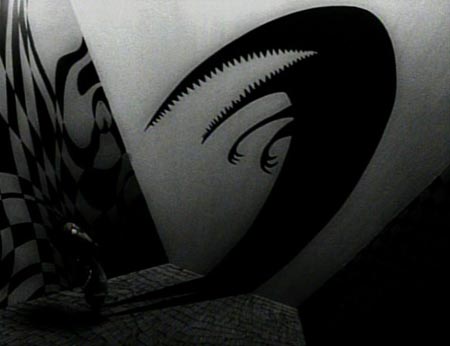
Still from Vincent (1982)

WHAT MAKES IT WEIRD:  It’s not quite weird; more mildly macabre.  But it sure is cool.

COMMENTSVincent is a 5 minute poem, narrated by the mellifluous Vincent Price, about a morbid boy (also named Vincent) obsessed with emulating the horror icon’s tormented screen persona.  It’s told in a singsong, storybook cadence and given a superlative reading by Price (who was so flattered by the tribute that he proclaimed it a greater honor than a star on Hollywood Boulevard).  There are some specific references to Price’s work for the actor’s fans, though the short prefers to evoke their general atmosphere than to cite specific movies. Young Vincent’s daydreams involve dipping his aunt in wax, turning his dog into a zombie, and slowly being driven mad by his guilt over his unspeakable crimes.  A representative stanza: “Such horrible news he could not survive/For his beautiful wife had been buried alive!/He dug out her grave to make sure she was dead/Unaware that her grave was his mother’s flower bed.”  Vincent is visually impressive, deliberately shot in luminous black and white and drawing on the gloomy Gothic style of the old Universal horror movies with a powerful dose of German Expressionism.  (Burton denied being directly influenced by The Cabinet of Dr. Caligari, but he’s the only one who doesn’t notice the similarity to the silent psychological horror classic in the geometrically warped sets).  The look and childishly ghastly tone bring to mind a lighter version of the macabre black and white lithographs of Edward Gorey (who once created a primer where each letter illustrates the death of a tot).  Burton’s visual sensibility is already fully formed here, and the elements of his classic style—his comic, cathartic synthesis of fresh childhood innocence and the must of the grave—are already in evidence.  In fact, there may be no better example in the director’s entire body of work of than this crisp five minute exhibition of his talent for mixing the chuckle with the shudder.

Disney has traditionally made Vincent and Burton’s other pre-fame short Frankenweenie as extras on all their editions of The Nightmare Before Christmas.  The film is also included on the anthology Cinema 16: American Short Films (buy) alongside  Maya Deren‘s “Meshes of the Afternoon” and works by Andy Warhol, Todd Solondz and Gus Van Sant, among others.

WHAT THE CRITICS SAY:

“…a pastiche of styles lifted from the writings of Dr. Seuss and Edgar Allen Poe, and a range of movies from B-horror films, German expressionist works and the films of Vincent Price.”–Michael Frierson, Animation World Magazine (DVD)

[(This movie was nominated for review by reader “Maxwell Stewart.” Suggest a weird movie of your own here.)]

61. KWAIDAN (1964)

AKA Kaidan; Ghost Stories

“A hundred thoughts suggested by the book might be written down, but most of them would begin and end with this fact of strangeness… many of the stories are about women and children,–the lovely materials from which the best fairy tales of the world have been woven. They too are strange, these Japanese maidens and wives and keen-eyed, dark-haired girls and boys; they are like us and yet not like us; and the sky and the hills and the flowers are all different from ours… in these delicate, transparent, ghostly sketches of a world unreal to us, there is a haunting sense of spiritual reality.”–from the original introduction to the folk tale collection “Kwaidan”

Must See

DIRECTED BY: Masaki Kobayashi

FEATURING: Rentarô Mikuni, Michiyo Aratama, Keiko Kishi, , , Kan’emon Nakamura

PLOT: An anthology film telling four Japanese folk tales centered around ghosts or nature spirits.  An ambitious samurai leaves his faithful but poor wife for a rich new one, and finds himself haunted by regret over his desertion.  A winter spirit spares the life of a young woodcutter, on one condition.  A clan of ghosts demand a blind minstrel play the tale of their tragedy for them night after night.  The final story tells of a guard who sees an apparition in a bowl of water.

Still from Kwaidan (1964)

BACKGROUND:

  • The four episodes were adapted from Lafciado Hearn’s collections of Japanese folk tales (the two middle pieces are from his 1903 volume entitled “Kwaidan: Stories and Studies of Strange Things”).  Hearn was born Greek, educated in Ireland, and spent time as a journalist in the United States (causing a scandal by marrying a black woman in Cincinnati, which was a crime at the time).  He later became a foreign correspondent in Japan and was naturalized as a Japanese citizen, taking the name Koizumi Yakumo.
  • Hearn offered “Weird Tales” as one possible translation of the Japanese word Kwaidan.
  • Kwaidan won the Special Jury Prize at Cannes (at that time, the second most prestigious prize after the Palme D’Or).  It was nominated for a Best Foreign Film Oscar, but lost to the Czech war drama The Shop on Main Street [Obchod na korze].
  • The episode “The Woman of the Snow” was (unwisely) trimmed from the original American theatrical release in order to cut the runtime from three hours to just over two hours.

INDELIBLE IMAGE: Although it’s hard to top the image of the minstrel Hoichi covered (almost) from head to toe in holy Buddhist characters or the ghostly court of samurai, it’s the expressionistic set of “The Woman in the Snow”—with its constellations of warped watching eyeballs set in a deep blue sky—that makes the eeriest impression.

WHAT MAKES IT WEIRD: Kwaidan illustrates the rule that, the better the movie, the less weird it has to be to make the List. Although on the surface it’s just a collection of bare-bones ghost stories, in telling these tales director Kobayashi wisely jettisons reality in favor of a stylized, expressionistic, visually poetic aesthetic that gently detaches the viewer from everyday life and floats him into an ancient spirit world that seems simultaneously to have never and always existed.


Original Trailer for Kwaidan

COMMENTS: In Kwaidan‘s opening credits black, blue, red and purple inks swirl around in Continue reading 61. KWAIDAN (1964)

EDGAR G. ULMER’S THE BLACK CAT (1934)

The Black Cat has been promoted onto the List of the 366 Best Weird Movies ever made. Please make comments general comments about the film on the official Certified Weird entry.

Edgar G. Ulmer has a cult reputation, particularly in France. The late British film critic, Leslie Halliwell, believed that reputation to be wholly undeserved, since most of Ulmer’s films ranged from B to Z status. Ulmer did not begin that way when, in 1934, he was handed “complete freedom” in an A (A-) production, teaming, for the first time, Universal Studio’s reigning horror stars Bela Lugosi and in the Edgar Allan Poe-inspired The Black Cat. The resulting film, and Ulmer’s affair with his employer’s wife, quickly ended a promising top-notch studio career almost as quickly as it began.

This first Karloff/Lugosi teaming was also their best. That is because of their eight collaborations this was their only joint-starring project directed by a visionary auteur. In The Black Cat Lugosi was cast as protagonist Dr. Vitus Werdegast, and Karloff as antagonist Hjalmer Poelzig. In the original, uncut film, Lugosi’s hero does some less than heroic things. Enough of Vitus’ sinister quality remains that Lugosi gives us a hero we are never quite comfortable with. Under Ulmer’s direction, Lugosi’s performance is superb, an extreme rarity for this actor. As good as Lugosi is, Karloff is even better and, as unpopular as it may be to say now, Karloff was always a far better actor than his co-star.

Ulmer’s “complete freedom” came to a screeching halt when universal execs saw the filmed footage and script. Lugosi’s hero rapes the heroine, the heroine occasionally turns into a black cat, and Karloff’s Poelzig is skinned alive and last seen crawling on the floor with his skin hanging from his body as Lugosi’s mad hero laughs hysterically. All of these scenes were cut from the film and, par the course at that time, were destroyed. There are conflicting accounts as to whether the scenes were shot and then burned, or merely scripted and axed.
Still from The Black Cat (1934)
Regardless, what remains of The Black Cat is a flawed, baroque masterpiece, intoxicating to watch and simultaneously frustrating, especially in light of Ulmer’s original intent. Lugosi’s Hungarian psychiatrist Vitus is traveling by train, and he is on a journey of revenge and retaliation. Vitus meets two newlyweds—American novelist Peter Alison and his wife Joan (played by David Manners and Jaqueline Wells)—who are as bland a 30s couple as one is likely to find. Lugosi sees something in the young woman Joan and touches her hair as she sleeps. The Hays Code be damned, it’s an erotic, Continue reading EDGAR G. ULMER’S THE BLACK CAT (1934)

DREYER’S CINEMATIC PASSION (OF JOAN OF ARC)

Every time a prestigious film institute puts together an official, stamped with authority list of “The Greatest Films of All Time” their number one pick is going to be Citizen Kane. No surprises there. Such lists might as well be packaged and sold as a 1.2.3 paint-by-numbers set. Ironically, it was the granddaddy of all film institutes that treated Kane’s creator as a heretic, refused to give him due recognition, banished him to Europe and excommunicated him for life.

Taking absolutely nothing from that film, nor Orson Welles, Citizen Kane is not the greatest film ever made.  That honor probably goes to Carl Theodor Dreyer’s 1928 Passion of Joan of Arc.

Rarely do classic films live up to the hype. Throughout the 1970s numerous books whispered about this lost film. It was very common to read its being compared to a fugue. Several veteran critics lamented its loss, something akin to losing a sacred relic. Only the loss of Von Stroheim’s uncut Greed inspired as much passion.

Then, in the early 1980’s a near mint condition print was found in the closet of an Italian mental institute.  When it was finally made available, many, myself included, bristled with excitement, wondering if this film was everything it was said to be.

Regardless of how much you’ve read about The Passion of Joan of Arc, nothing prepares you for it.  By the time the credits roll, the viewer feels emptied, literally drained. It is that devastating, as an emotional, spiritual, ecstatic, and aesthetic experience.

Dreyer’s The Passion of Joan of Arc is an essential, time-defying, inimitable cinematic experience of (German) Expressionism and (French) avant-garde.  The producers had wanted something else altogether, but Dreyer’s film was taken directly from Joan’s trial transcripts.  This is not Joan the warrior, but a young, frightened uneducated girl, absorbed in an ecstatic religious experience and a terrifying, inevitable martyrdom.

Still from The Passion of Joan of Arc (1928)The performance of this Joan of Arc, as portrayed by Maria Falconetti, is the single greatest acting that has ever been imprinted, seared, burned, into celluloid.  But, this could hardly be called acting in any traditional sense.  Rumor has it that, in certain scenes, Dreyer made Falconetti kneel on hot coals to obtain the right expression of suffering, and Falconetti certainly was in abject misery for the hair cutting sequence (Dreyer’s reputation as a tyrannical dictator, ironically a bit like Joan’s judges, was well earned, but he made the Continue reading DREYER’S CINEMATIC PASSION (OF JOAN OF ARC)