Tag Archives: 1968

232. HOUR OF THE WOLF [VARGTIMMEN] (1968)

“Directors always say—and I think they mean it—that they’re telling a story. They tell a story and they don’t want to have an interpretation of what it ‘means,’ symbols… I think, for example, Hour of the Wolf, it can look like it was a lot of symbols. I don’t think it is. It’s a scary story, narrated very simply, even if the persons are very surreal.”–actor Erland Josephson (Baron von Merkins)

Recommendeds

DIRECTED BY:

FEATURING: ,

PLOT: The prologue explains that the artist Johan Borg disappeared from his home on the Frisian islands, and that this film is a recreation of events from his diary and the recollections of his wife. Borg has disturbing dreams, and the characters from the dream, along with an old flame, appear before him in real life. As the days wear on, the hallucinations become so intense that his wife seems to share in them, and the ghostly party invites the couple to visit them at the local castle.

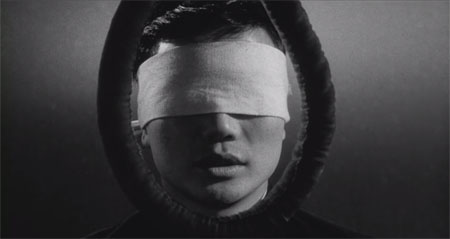
Still from Hour of the Wolf (1968)

BACKGROUND:

  • According to the film, “the hour of the wolf” is the time between midnight and dawn when most people die and most babies are born.
  • The film began life as a screenplay entitled “The Cannibals.” After Bergman was hospitalized with pneumonia, he stopped working on the script and instead produced Persona.
  • Ingmar Bergman and Liv Ullmann had an affair during the making of Persona, and Ullmann became pregnant with Bergman’s child. The actress did not want to relocate to Fårö to live with Bergman (who was still married to concert pianist Käbi Laretei at the time), and stayed in Oslo until Bergman sent her the script for Vargtimmen and convinced her to come to Fårö to make the film. She gave birth to the child before the movie was completed.

INDELIBLE IMAGE: When describing the figures that appear to him in his nightmares, Johan Borg mentions “the old lady, the one always threatening to take off her hat. Do you know what happens if she does? Her face comes off along with it, you see.” That’s not just a tease; although we never see Borg’s sketch of the character,  Bergman later comes through with the literal vision of the old woman removing her face along with her hat.

THREE WEIRD THINGS: Boy at the beach; walking on the ceiling; face-off hag

WHAT MAKES IT WEIRD: Themes of creative frustration, infidelity, humiliation, forbidden sexual impulses, and existential angst manifest as a court of demonic aristocrats who lure the artist and his love into a web of madness and self-destruction in Hour of the Wolf. Gothic imagery fits Ingmar Bergman like a comfortable shadow, and his only outright horror movie is every bit as philosophical, eerie and inscrutable as you could hope.


Clip from Hour of the Wolf

COMMENTS: According to Liv Ullmann, when, pregnant, she fled Ingmar Bergman’s arms after completing Persona, he convinced her to Continue reading 232. HOUR OF THE WOLF [VARGTIMMEN] (1968)

LIST CANDIDATE: FANDO Y LIS (1968)

Weirdest!

DIRECTED BY: Alejandro Jodorowsky

FEATURING: Sergio Kleiner, Diana Mariscal

PLOT: Fando carts and carries his paralyzed lover Lis across a ravaged landscape searching for the legendary city Tar.

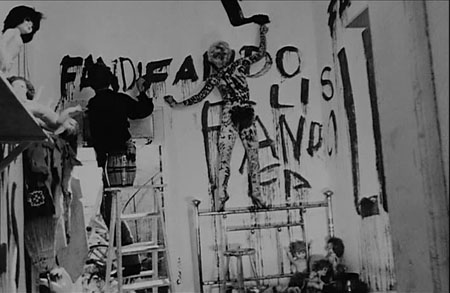
Still from Fando y Lis (1968)

WHY IT MIGHT MAKE THE LIST: If you’ve ever seen a Jodorowsky movie before, you know what to expect. Fando y Lis is a parade of fantastical, shocking imagery, including snakes that penetrate a baby doll and a man who begs for blood (he extracts a donation with a syringe and drinks it from a brandy snifter). That said, Fando & Lis is one of the least of Jodorwosky’s works, an early curiosity that is thoroughly weird, but not strongly conceived enough to make the List on the first ballot. (Plus, Jodo’s so well-represented here already we don’t feel at all bad about the possibility of leaving one movie off).

COMMENTS: Fando y Lis begins with a woman eating flowers while a siren wails. Later we will learn she is the paraplegic Lis, whose lover Fando will cart her across a bizarre post-apocalyptic landscape searching for the mystical city of Tar. Along the way they encounter a man playing a burning piano, mud zombies, a transvestite parade, and a gang of female bowlers led by a dominatrix, among other absurdities. There will also be flashbacks to both Fando and Lis’ childhoods, and unrelated fantasy sequences of the actors goofing around (posing in a graveyard, and painting their characters’ names on each other). And there’s quite a few more transgressions, both beautiful and clumsy, to be found in this rambling, overstuffed avant-garde experiment. Although Jodorowsky comes from an older bohemian tradition, at times Fando y Lis plays like something made by Mexican hippies, improvising scenes with random props in between hashish tokes.

The “spiritual journey” structure makes for an episodic film, but the ideas aren’t as stunningly realized or obsessively detailed as The Holy Mountain. Here, Jodorowsky has found, but not perfected, his unique voice: it’s as if he’s working with individual sentences, rather than complete paragraphs. It would have helped the movie feel more coherent and unified if the relationship between Fando and Lis was better done, but their dynamic is unpleasant. They unconvincingly profess eternal love for each other, but Fando is much better at conveying his irritation and annoyance at having to carry Lis everywhere, while her character is reduced to desperate, pathetic whining for most of the film.

In 1962 Jodorowsky, Fernando Arrabal and , feeling that Andre Breton and the old guard Surrealists had lost their edge and were no longer extreme enough in their embrace of absurdity, founded the Panic movement, which was mostly an experimental theater group. Fando & Lis was originally a play from this school, written by Arrabal and staged by Jodorowsky. This movie adaptation is not intended to be faithful; Jodorowsky instead described it as based on his memories of the play. When Fando y Lis premiered at the Acapulco Film Festival in 1968 it caused a riot (presumably due to its abundant nudity and mildly sacrilegious content) and was subsequently banned in Mexico. The film basically disappeared for years. Discovering Jodorowsky in the early 90s, when his films were only available in bootleg VHS versions, I was unaware that he had made a movie before El Topo; Fando wasn’t even a filmography entry. It wasn’t until 2003 that a DVD of this early work suddenly popped up.

WHAT THE CRITICS SAY:

“… pothead vaudeville all the way… A tumultuous cause celebre at festivals, it paved the way for the director’s rise from small-time poseur to big-time poseur with El Topo a few years later.”–Fernando F. Croce, Cinepassion

(This movie was nominated for review by “Zelenc” who called it a “must see film.” Suggest a weird movie of your own here.)

READER RECOMMENDATION: “TOBY DAMMIT” (1968)

Reader recommendation from Steven Ryder

Note: ‘Toby Dammit’ is a segment filmed as part of Spirits of the Dead, an anthology based on ’s short stories. The other entries were “William Wilson,” directed by , and “Metzengerstein” by .

DIRECTED BY:

FEATURING: , , Antonia Pietrosi

PLOT: During a trip to Rome to film a Catholic Spaghetti Western, Toby Dammit, an alcoholic, drug-addled Shakespearean actor, falls deeper and deeper into uncertainty, pursued by a devilish young phantom.

Still from Toby Dammit (1968)

WHY IT SHOULD MAKE THE LIST: Any number of Fellini’s films could be given the “weird” seal of approval due to his preoccupation with dream imagery and Jungian psychoanalysis, but few are as quite deeply rooted in the surreal as “Toby Dammit.” Oktay Ege Kozak described “Dammit” as “8 ½ in Hell,” and seeing as how Fellini’s magnum opus does make the List, it would come as no real surprise to see this shorter, more blatant genre offering creep its way on as well.

COMMENTS: Spirits of the Dead, the anthology that includes “Toby Dammit,” isn’t particularly fascinating, and it is painfully obvious that Roger Vadim and Louis Malle, the directors of the other two segments, either care little about or did not know how to approach the subject matter. These are directors later made made campy science fiction flicks or serious wartime dramas, and neither of these genres reflect Edgar Allen Poe’s Gothic roots as well as Fellini’s style does. Now, if producer Alberto Grimaldi had managed to get on board, as he originally intended, then we may have been looking at a late-sixties masterpiece of horror cinema, but instead we get two forgettable entries and one incredibly weird, incredibly original Poe adaptation from one of the giants of Italian film, fresh off the critical hits 8 1/2 and Juliet of the Spirits. Fellini confessed to never actually read the story he was supposed to be filming, which may have assisted him in bringing his own enduring cinematic style to the table. Aside from the title and the decapitation finale, nothing else remains from Poe’s original tale.

The film opens with disheveled Shakespearean actor Toby, played with a distinct charisma and style by Terence Stamp, drunk on a plane, preparing to meet the producer of his next film in Rome. There is no mistake that Fellini wanted Toby, already a frazzled mess of a man, to be driven further and further into madness, and it wouldn’t be glib to speculate that the red mist his plane descends into is a symbol for the Hell that is to follow—even if the jaunty, instantly recognizable score from frequent Fellini collaborator Nino Rota says otherwise. We follow Toby on his first trip to Rome and Continue reading READER RECOMMENDATION: “TOBY DAMMIT” (1968)

218. HEAD (1968)

“Quite frankly, there was a bit of acid involved.”–Bob Rafelson on the genesis of Head

DIRECTED BY:

FEATURING: Micky Dolenz, Davy Jones, Michael Nesmith, Peter Tork, Victor Mature

PLOT: An official is cutting a ribbon on a bridge when the ceremony is interrupted by four young men (the Monkees) who leap off the bridge and into the water. We then see a number of sketches that find the Monkees in the trenches fighting a war, performing live concerts, enjoying hookahs in a harem, fighting boxer Sonny Liston in the ring, trapped in a giant metal box, and acting out other absurd vignettes that blend into each other. Throughout the film they find themselves pursued by a giant man played by Victor Mature, and the movie ends where it began as the entire cast is seen chasing the Monkees onto the same bridge, off which they once again leap.

Still from Head (1968)

BACKGROUND:

  • The Monkees were formed in 1965 for a TV sitcom about a band “that wanted to be the Beatles.” Although Micky Dolenz, Davy Jones, Michael Nesmith and Peter Tork were cast for their acting abilities and presumed appeal to teenage girls rather than their musical chops, they developed into a tight band and had several hits. Their self-titled debut album reached #1 on the Billboard charts.
  • Despite the band’s financial success, the actors were dissatisfied with the goofy television scripts, which featured stories like the band spending a night in a haunted house. “The Monkees” TV series lasted for only two seasons before cancellation.
  • Head was the feature directing debut of Bob Rafelson, who had originally pitched the concept for the TV show and directed several episodes.
  • The script was co-written by , in his “acid” period. (One source says Nicholson directed at least one scene, uncredited). Nicholson also produced the soundtrack album, including assembling the sound collages.
  • The Monkees themselves contributed to the original brainstorming sessions, but were denied screen writing credits; they staged a mini-protest, but were placated when the producers offered more money.
  • With its surreal imagery and drug references, Head seems to be intended to destroy the Monkees wholesome image. The ad campaigns avoided mentioning the Monkees altogether.
  • Head‘s notable cameos and bit parts include Rafelson, Nicholson, , Victor Mature, , Annette Funicello, (in his final role), Timothy Carey, Green Bay Packers linebacker Ray Nitschke, boxer Sonny Liston, and celebrity stripper Carol Doda. A pre-fame Terri Garr and Toni Basil can also be seen in the film. Furthermore, is featured prominently in clips from The Black Cat.
  • Rafelson’s next project as director was Five Easy Pieces (1970), starring Nicholson as an underachieving piano prodigy. It was nominated for four Oscars.
  • Tork left the band soon after Head was released, and Nesmith resigned soon thereafter. The Monkees broke up by 1970, although Dolenz and Jones later recorded under the name with substitute musicians.

INDELIBLE IMAGE: The Monkees posing as dandruff in “the Big Victor”‘s hair. (In fact, a surprising number of Head‘s most memorable images involve the giant version of Victor Mature, especially if we assume that oversized eyeball Davy Jones finds staring at him from out of the medicine cabinet also belongs to Vic).

THREE WEIRD THINGS: Psychedelic mermaids; eye in a cabinet; “the Big Victor”

WHAT MAKES IT WEIRD: It is tempting to describe Head as what might happen if a young Jack Nicholson were hired to write a treatment for a bubblegum boy band, then dropped acid and wrote a script that reimagined the boys as psychedelic tricksters wandering through a surreal series of cynical, self-aware scenarios set everywhere from the old West to a dandruff commercial, sprinkling in the most bizarrely eclectic assortment of pop-culture cameos imaginable. Actually, that’s pretty much the true story of how Head came to be, meaning reality scoops metaphor once again.


Theatrical trailer for Head

COMMENTS: In 1964, A Hard Days Night turned a little band from Continue reading 218. HEAD (1968)

CAPSULE: PSYCH-OUT (1968)

DIRECTED BY: Richard Rush

FEATURING: , , , Max Julien, Adam Roarke, 

PLOT: A deaf runaway goes to Haight-Ashbury in search of her burnout brother, who has sent her a postcard reading “God is alive and well in a sugar cube.”

Still from Psych_Out (1968)

WHY IT WON’T MAKE THE LIST: A few hallucination scenes supply a bit of weirdness, but essentially this is just an earnest pro-hippie exploitation film.

COMMENTS: I like the vintage newspaper ad copy for Psych-Out—“listen to the sound of purple!”, “they’ll ask for a dime with hungry eyes… but they’ll give you love—for NOTHING!”—much better than the actual film. The movie is a 1968 rush job tossed into the market to exploit the audience’s salacious interest in the drugs, sex and rock n’ roll ethos of San Francisco’s flower children. The story of young Jenny’s search for her acid-casualty brother takes a back seat to a tour of Haight-Ashbury locales and culture. You get love beads, pot smoking, freakouts, happenings, chaste orgies, bead-stringing, bogus zen philosophy (“everything is part of everything else”) delivered by a guy in a Navajo headband, concerts at the Filmore East, the Strawberry Alarm Clock providing a fairly groovy soundtrack, and more pink and yellow paisley than you’d see in binge-watching session of “Laugh In.” Strasberg plays the wide-eyed ingenue lost in the den of friendly sin, Nicholson is musician/love interest aptly named “Stoney,” Max Julien (the future pimp of The Mack) is a drummer who hallucinates that he’s a knight, Dean Stockwell is Nicholson’s hippie conscience (he warns Stoney that success is “all just one big plastic hassle”), and Bruce Dern is the mad messiah of Haight Street. There are a few fun psychedelic scenes—one guy sees his friends as zombies and tries to cut off his own hand with a power saw, while Strasberg’s final fiery crash-and-burn STP trip is almost worth the wait—but mostly the film makes unfettered freedom and hedonism look kind of tedious, like a drug trip that starts off fun but just won’t end.

The script details are sloppy. Lots of plot points don’t make sense, like why a gang of straits is so eager to devote their time hunting down “the Seeker” when he’s no more offensive than any other street freak preacher. Strasberg’s Jenny has the most perfect diction you’ve ever heard from a deaf person. Jenny is also underage—otherwise her mother wouldn’t be able to send cops after her as a runaway—a fact whose moral implications the script ignores when throwing her in bed with various unshowered hippies. Overall, Psych-Out fails as standard entertainment, and delivers little in the way of weirdness or overt exploitation (the film has some blurry, blissed-out  suggested sex, but is nudity-free). At the time, it was a novel look at a subculture that was weird to outsiders, but today its only value is as a curiosity of hippie kitsch. It will come over either as camp or nostalgia, depending on your age. High on kaleidoscope lenses but low on plotting, this psychedelic capsule has lost most of its potency over the past five decades.

Jack Nicholson’s original script for Psych-Out was deemed too experimental, and Richard Rush had it re-written by a team of screenwriters; Nicholson kept the lead role of Stoney, which he wrote for himself. The great Lazslo Kovacs (who got his start in low-budget exploitation films like this one) oversaw the cinematography. Psych-Out was produced by clean-cut American Bandstand/New Year’s Rockin’ Eve impresario Dick Clark (!) It was re-released on Blu-ray (to better appreciate the pretty colors) in 2015.

WHAT THE CRITICS SAY:

“…an above average programmer about San Francisco hippies. Thin story line – girl seeking lost brother – is sufficient as the medium for a series of incidents, including drug-induced hallucinations, all directed in excellent fashion by Richard Rush.”–Variety (contemporaneous)