Tag Archives: 1968

THE PRISONER (1967-1968), PART THREE

This is Part 3 of a 3 part survey of “The Prisoner.” Part 1 can be found here, Part 2 is here.

“A Change Of Mind,” (directed by Patrick McGoohan) opens with the Prisoner confronted by thugs from the gymnasium (which is fairly typical for workout fundies). Seeing that No. 6 would rather exercise in the woods, they accuse him of being “unmutual” (not status quo) and ferociously pick a fight with him. The Prisoner reacts by beating the hell out of them. Then, like all bullies who get whupped, they go and tattle. Of course, No. 2 (played by John Sharp this week) and his gang threaten a spanking,  in the form of a lobotomy for No. 6—a literal change of mind. Unfortunately, they haven’t found out yet what they need from No. 6: why the Prisoner resigned as an agent. The solution? Make the Prisoner believe he has been lobotomized. The episode uses Rod Serling circularity, with another confrontation in the woods and a table-turning that leads to the charge of “unumutuality” going much higher.

“Do Not Forsake Me, Oh My Darling,” (directed by Pat Jackson) is a genuine oddity in a genuinely odd series. Its contrasting textures are off-colored, with the presence of “star” McGoohan kept to a minimum. He’s hardly even in it, as he was busy filming Ice Station Zebra (1968). Of course, the production team could have simply waited for McGoohan’s return. Instead they found an opportunity for a change of pace. Whether they succeeded or not is intensely debated.

On paper, the plot sounds fatigued. Yet another mind-swapping thriller, the type that “one idea” Universal hack Curt Siodmack wrote repeatedly.  When the Colonel (Nigel Stock) arrives in the Village, he is informed by No. 2 (Clifford Evans) that a professor Seltzman (Hugo Schuster) has invented a mind-swapping machine. Unfortunately, Seltzman is missing and, apparently, once done, the process cannot be reversed, which is hardly going to stop No. 2, if it means obtaining information from the Prisoner.

Yet again, the Prisoner is abducted and drugged, only to awaken in the body of the Colonel. It doesn’t take him to long to do the math and go looking for Seltzman. Along the way, No. 6 has his only love scene in the entire series, played by Stock (because the hyper-Catholic McGoohan refused to ever do a love scene). Stock plays the Prisoner throughout most of the episode without resorting to impersonation. His performance is an effective one, matched by Evans’s charismatic No. 2.

Apparently, the script was loathed by almost everyone, and many “Prisoner” fans rank it as the low ebb of the series. There’s no denying that it doesn’t quite come together, but it is a compelling effort.

The Prisoner, "Living in Harmony"“Living in Harmony” (directed by David Tomblin) is another episode which sounds wretched and could be dubbed “the Prisoner goes west.” However, as when the original “Star Trek” crew relived the gunfight at the OK Corral (in “Spectre of the Gun,” also from 1968), the end result is among the most refreshingly ludicrous in the show’s run.

The Prisoner finds himself in the guise of a recently resigned sheriff Continue reading THE PRISONER (1967-1968), PART THREE

THE PRISONER (1967-1968), PART TWO

This is Part 2 of a 3 part survey of “The Prisoner.” Part 1 can be found here.

Does 6 plus 6 really equal 12? So asks the aptly titled “The Schizoid Man” (directed by Pat Jackson). After a seemingly innocuous trifle about bonding with a psychic villager and a bruised thumb, the Prisoner lies down for a good night’s sleep, but it appears that the room night light has a faulty bulb.

Drugged once more, the Prisoner is taken by men in white coats who wheel him into the hospital, turn him into a southpaw (via electroshock, in a moment of karma for all us lefties who were at the mercy of brainwashing status quo teachers with rulers back in first grade), throw away his razors, and give him a new do.  After an indeterminate amount of time on the gurney, the Prisoner awakens with a new look in a new surrounding, as pawn of an elaborate scheme composed by the new No. 2 (Anton Rodgers), a surprisingly young administrator.

“You are Number 12,” the Prisoner is told at the Green Dome, “and you are to break Number 6.” “But I am Number 6.” And so he is, or at least his double is. And if you think that in addition to being an attempt at uncovering the reason for the Prisoner’s resignation, this is also a ploy to get him to own his number, you would be right.  See Number 12 fence with Number 6. See them box. See them duel with pistols.

Now actually, Number 6 is Number 12 , Number 12 is Number 6, and Number 12 is in cahoots with Number 2. Of course, No. 6 (12) knows this is a feeble scheme hatched by No. 2. Of course, No. 2 knows that No. 12 (6) knows that No. 6 (12) knows. But, what if No. 12 pretends to be No. 6? Perhaps then he could escape. And the helicopter circles back, as it always does. And the psychic is remorseful over having cooperated with No. 2, but neither she nor No. 2 counted on a bruised thumb. Ah!

The script for “The Schizoid Man” so impressed McGoohan  that he hired its writer, Terence Freely, to join the production company’s board of directors. In contrast, for years director Pat Jackson claimed to have been utterly confused by the script, but simply directed it as written. His confusion was an honest one and shows in one of the series most legendary episodes. McGoohan responds with a tour de force performance.

Director Peter Graham Scott was reported to have been equally confused by the script for “The General.” Again, that turns out to be a plus (and undoubtedly an astute choice by McGoohan and company).

The Prisoner cannot even enjoy his coffee without Village trauma drama when he hears an announcement ordering history students to immediately return to their dwellings, which is followed by his witnessing the Professor being caught and manhandled (by his students) while attempting to escape.

The Village is obsessed with a new fad, Speed Learning: “Learn a three-year course in three minutes.” “It’s not impossible,” says No. 12. The Prisoner finds the Professor’s tape recorder, which has “information” that may prove damaging to the General and No. 2 (Colin Continue reading THE PRISONER (1967-1968), PART TWO

THE PRISONER (1967-1968), PART ONE

The British series “The Prisoner” (1967-1968), starring and co-created by , is the model for cult television. It is an indirect sequel to a previous series, “Secret Agent” (AKA “Danger Man,” 1960-1962), which also starred McGoohan. By general consensus, “The Prisoner” ranks as one of the best, if not the best, example of science fiction as a television genre. The consensus, for once, is probably accurate, because “The Prisoner” is far more than science fiction, dispensing with genre expectations. We could also describe it as being psychological, surreal, allegorical, existential, countercultural, satirical, Kafkaesque, psychedelic, nightmarish, absurdist, comic bookish, supernatural, born from the spy genre (in a far more interesting breed than 007), and enigmatic. It’s still enigmatic today, with enthusiasts and critics compelled to attempt to express its mystification in the absence of creator McGoohan, who steadfastly refused to ever explain it. Even its reputation is aptly enigmatic; it’s heard about more than actually seen. “The Prisoner” often causes polemical arguments among many who have seen it and debate the chronological order of its seventeen episodes. It was created smartly and contrary to our priorities and agendas regarding television. To many of us, the series should be ongoing. In its blueprint stage, the goal of “The Prisoner” was always to end, and yet in its (for us) brief run, McGoohan crafts a saga that feels narratively and aesthetically accomplished. Comparatively, many series, after being cancelled prematurely, will feel unfinished, cheating its dangling audience. At the other end of the spectrum, many ongoing series have trekked on well past the point of what should have been a well-developed beginning, middle, and satisfying climax. “The Prisoner” was originally intended to be even briefer, but was extended in order to ensure an American market. In hindsight, “The Prisoner” might even be seen as an advance metaphorical commentary on that puerile abomination known as reality television: elastically taunting and playing with our concepts of reality, daily humdrum, juxtapositional narrative, and cryptic completion.

What we do know is the idea for “The Prisoner” sprang from McGoohan’s exhaustive workload on “Secret Agent.” In “The Arrival” (directed by Don Chaffey), its unnamed protagonist (McGoohan) quits the British Secret Service with no reason cited; but as we know, departing an intelligence position is hardly a done deal. Drugged and abducted by arcane forces, he  awakens …

Where Am I?

In the Village.

What Do You Want?

Information.

Still from The Prisoner (1967-1968)Whose Side Are You On?

That Would Be Telling. We Want Information.

You Won’t Get It.

By Hook, or By Crook, We Will.

Who Are You?

The New No. 2.

Who Is No. 1?

Continue reading THE PRISONER (1967-1968), PART ONE

THE ACID EATERS (1968)

Plot-spoiler police beware!

The Acid Eaters (1968)…

Tick Tock, Tick Tock, Tick Tock…

up the pyramid of white blotter.

Tick Tock, Tick Tock, Tick Tock goes the white clock and…

a man climbs down a tree and then climbs up another tree.

Tick Tock… telephone operators at work, Tick Tock…man stamps checks, Tick Tock… man paints pictures, Tick Tock…man pours booze for shaking, hungry awaiting hands, Tick Tock…

Whistle blows… man eats sandwich with mouth open, Whistle blows…toilet flushes…woman eats McFries with mouth open, toilet flushes, 60s chicks do … well, something, toilet flushes…Whistle blows…  TickTockTickTockTickTockTickTockTickTockTickTockTickTockTickTockTickTockTickTockTockTickTockTickTockTickTockTickTock

Lather, rinse, repeat.

the_acid_eaters_1Peopledowalk. Carsdodrive. Therebeawhitepyramidofacid…People dowalk. Carsdodrive…Therebeawhitepyramidofacid…People dowalk. Carsdodrive… boomchickaboom, boomchickaboom, boomchickaboomboomchickaboomboomchickaboomboomchickaboomboomchicksintightminiskirtshuggingbuttsboomchickaboomguysintightjeanshuggingbuttsboomchickaboomboomchickaboom…wahwahwah…rusty trumpet….wahwahwah…dudes and chicks on harleys…adoo ado dodo… sniffle, sniffle…awah…dowah…do d…d…rahdowah…acid eaters skinny dip…

“Mumblemumble…I’m ready for another crash drive.”

“Take a deep breath Ally baby, I got 4 packets full!!!”

“You ready to fly?”

“Let’s crash drive once more.”

“SAVE IT FOR LATER SAILOR.”

Splishsplashboobsa’flashin’.

“Have I got the colors ! I’ll make a masterpiece. What’s your pleasure, treasure?”

“reD, RedHot.”

W…wwwwwwahwwwwah

runredpaintdownflabbyside… Wwwwwahhh. Gasp.

Chinkachongtototototototwahboomsplashsplishsplashtakinabathwahwahawahahramatamtam…

Plane flies.

GO LSD. See your travel agent.

splishsplash.

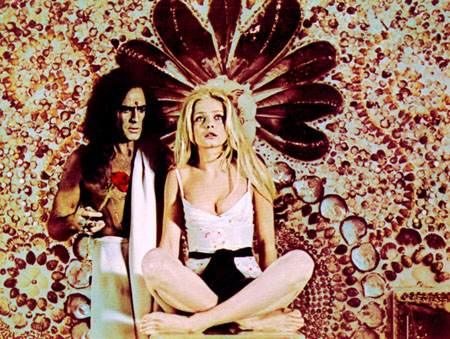
Still from The Acid Eaters (1968)Primary colors. Smokin’ ceegarettes  before da Lawd invents boob jobs.

Vince Guaraldi’s white blotter pyramid.

Theblondebabedoeshaveboobs. Yellowstripe. Bluecircle. Continue reading THE ACID EATERS (1968)

233. DEATH BY HANGING (1968)

Koshikei

“You mustn’t think our film is just labored theorizing. The officials’ attempts to convince R that he is R are amusing and bizarre. I think it’s a spot-on depiction of all us Japanese in all our amusing bizarreness.”–Nagisa Ôshima

Recommended

DIRECTED BY:

FEATURING: Yung-Do Yun, Fumio Watanabe, , Akiko Koyama

PLOT: After the failed execution of a Japanese-Korean double murderer, various state functionaries are at a loss as how to proceed when the criminal’s body refuses to die. Going to increasingly outlandish lengths to remind the convict of why he is there and condemned, the prison’s officials inadvertently explore the nature of crime, nationality, and culpability. Eventually a young woman is introduced to the group, and the captors decide to get drunk.

Still from Death by Hanging (1968)

BACKGROUND:

  • The criminal in Death By Hanging is based on Ri Chin’u, who also murdered two Japanese school girls. In addition to his crimes, Ri Chin’u gained a degree of fame for his extensive writings while in prison.
  • Much of the dialogue between R and his “sister” is taken from actual correspondences between Ri Chin’u and a Korean journalist.
  • Death by Hanging came during Ôshima‘s most experimental period, made back-to-back with the Certified Weird satire Japanese Summer: Double Suicide. Like most of Ôshima‘s mid-to-late 1960s work, Hanging was initially ignored in America, not even screening for the first time until 1974 and not officially reaching home video until 2016.

INDELIBLE IMAGE: The movie is stuffed to the gills with claustrophobic shots of slapstick fused with philosophy, none more so than the penultimate scene: an unlikely combination of prison officials getting hammered around a “table” while the convict “R” and his (probably imaginary) sister consider the nature of guilt. The drinkers take turns discussing how they came to this kind of work while R, reclining with the young woman beneath a Japanese flag, comes to the conclusion that though he committed his crimes, he is not responsible for them.

THREE WEIRD THINGS: Stubborn corpse; rape re-enactment; hallucination participation

WHAT MAKES IT WEIRD: Death By Hanging starts with a very traditional documentary approach, including narration reeling off statistics and some expository shots of a nondescript execution facility in a prison compound. Quickly, however, the aura of formality disintegrates as the hapless officials endeavor in vain to make sense of the film’s central conceit: a young convict refusing to die. Their efforts to restore his memory and edge him toward accountability grow desperate and extreme until a point is reached where everyone involved in the process begins to believe in the unreal.


Original trailer for Death by Hanging

COMMENTS: While most leftist directors merely point a shotgun at Continue reading 233. DEATH BY HANGING (1968)