CAPSULE: LUTHER THE GEEK (1989)

366 Weird Movies may earn commissions from purchases made through product links.

DIRECTED BY: Carlton J. Albright

FEATURING: Edward Terry, Joan Roth, Stacy Haiduk

PLOT: Imprisoned as a juvenile for a murder spree, Luther is released on parole and terrorizes a family in a remote Illinois farmhouse.

Still from Luther the Geek (1989)


COMMENTS: What is the goal of imprisonment? Some argue deterrence. Others rehabilitation. A few would make the case for vengeance. Or perhaps it’s some combination of these. Carlton J. Albright and his team put these socio-philosophical concerns aside in their chronicle of Luther the Geek: a madman who began as a mad lad, murdering three people after a formative encounter with a circus performer who ripped open the necks of chickens for the amusement of the crowds (and to earn his much-needed liquor).

Amongst that crowd, Young Luther is thrown to the floor in a scuffle—smashing out his front teeth in the process. Fast-forward twenty years (all of them in prison), and his parole is reviewed by five prison officials, among them a “bleeding-heart” female who notes Luther’s commendable behavior prison, his lack of speech notwithstanding. Luther, you see, merely clucks. By a vote of three-to-two, he’s set loose, and the inevitable ensues.

Albright lucked out finding a performer like Edward Terry, since to whatever degree it may be argued that Luther the Geek works, it could not work without Terry’s all-in performance. His Luther is not fit for society, and quickly murders again. An hour or so of this eighty-minute movie takes place in an out of the way farm, during which—through a series of commendably paced, shot, and edited chase, scuffle & violence set-pieces—various victims are bloodily dispatched by the titular geek.

Why are we here, though? The pay-offs will interest slasher fans. Titillation seekers get their thrills from the buxom daughter. The rest of us may find Luther the Geek an oddity (if not a weird-ity) worth checking out. Through much of the dialogue-free performance from Terry, I was reminded of 183’s Angst. Luther the Geek sort of plays out like that German film’s American hick cousin. Indeed, one weakness I found in Angst is not present in Luther: there is no inner monologue. We have no real idea why this nut is doing what he’s doing; and Luther is all the more terrible and, perhaps, sympathetic for this lack of elucidation. As a violence picture that goes for the throat, there’s a strange undercurrent of pathos—and a remarkable finale that doesn’t chicken out.

WHAT THE CRITICS SAY:
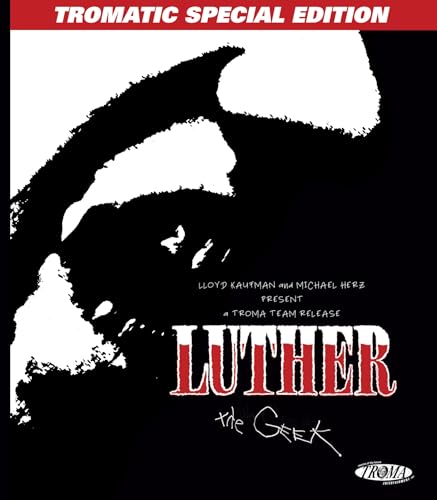
“What happens when a horror film refuses to dampen its premise with humor, even when the premise itself borders on the absurd? LUTHER THE GEEK answers that question by committing, sometimes uncomfortably, to a nightmare that never pauses to reassure the audience it’s in on the joke. This is not a standard slasher, nor a self-aware cult oddity; it’s a blunt, regional exploitation film that believes in its monster completely, for better and for worse.” — Chris Jones, Overly Honest Reviews

Luther The Geek (Tromatic Special Edition)

  • A young country boy is plunged into the depths of homicidal madness after witnessing the strange exploits of a carnival “geek.”

List Price : 19.95 $

Offer: 9.99 $

Go to Amazon

APOCRYPHA CANDIDATE: PASSAGES FROM JAMES JOYCE’S FINNEGAN’S WAKE (1966)

AKA Finnegan’s Wake

Recommended

366 Weird Movies may earn commissions from purchases made through product links.

DIRECTED BY: Mary Ellen Bute

FEATURING: Martin J. Kelley, Jane Reilly, Peter Haskell, Page Johnson

PLOT: In a series of disconnected scenes, memories, and dreams, the passing of Finnegan, AKA Humphrey Chimpden Earwicker, AKA HCE (and there may be many other names not yet known) is the occasion of a wake, an event which the deceased keeps attempting to attend despite his survivors’ reluctance for him to participate—or perhaps none of that happens.

WHY IT MIGHT MAKE THE APOCRYPHA: The next time you hear someone complain that their favorite book was adapted for the cinema and the filmmakers weren’t “faithful to the original text,” just plop them down and make them watch this ridiculously successful effort to burnish the original medium through adaptation into a new one. Passages never claims to be a literalization of Joyce’s book, instead recognizing that its greatest advantage is the power of its twisted language and putting that front and center.

Still from Passages from James Joyce's Finnegan's Wake (1966)

COMMENTS: “When is a pun not a pun?” the jolly bartender asks. It’s an unexpectedly galling question, considering that he’s inside a story that consists almost entirely of plays-on-words, that exists solely to celebrate the flexibility and incomprehensibility of language. The nerve of this guy.

James Joyce’s Finnegan’s Wake, the novel he spent 15 of the last 17 years of his life composing, is enshrined in history as, according to the Encyclopedia Britannica, “arguably one of the most complex works of 20th-century English-language fiction.” It makes pretensions to having a narrative, but if it is about anything, it’s about words, words, words, and their notorious malleability. Joyce gives nearly every sentence at least two meanings, exploiting meter and importing similar words from other languages and playing with time to such a degree that the last words of the book form a complete sentence with the first words of the book. It’s a 628-page fairground ride of a novel, and it regularly tops lists like “The 10 Most Difficult Books to Read” and features in stories like “This book club finally finished ‘Finnegans Wake.’ It only took them 28 years.” It’s a monument to inaccessibility. I haven’t read the whole thing. Have you?

So there is enormous praise to be extended to Mary Ellen Bute’s ambitiously foolhardy decision to actually try and visualize Joyce’s wandering scenarios, because it makes the effort of reading the book seem both achievable and desirable. Her film uses an adaptation created by Mary Manning in 1955 staged by the Poets’ Theatre in Cambridge, Massachusetts, but while all the language comes directly from Joyce’s text, she makes two key innovations that neither book nor stage could offer. The first is the use of tools of cinema; framing, closeups, and editing keep the language moving and prevent the focus from wandering away, while visuals can create a level of surrealism commensurate with the text. A film that looks like it will be stuck in the hall of the titular funeral party can transform unexpectedly into a burlesque show, while what has been a stagebound production through the halfway point suddenly steps out into nature.

Bute’s second contribution may be even more important: most of the film is subtitled with Joyce’s text, giving the viewer a unique opportunity to both hear and read the language and appreciate the multiple meanings and sneaky substitutions that Joyce has peppered throughout the book. (Here, “throughout” should be taken to mean “in every damn sentence.”) You know who would agree? Joyce’s countryman Samuel Beckett, who said of the original book, “You complain that this stuff is not written in English. It is not written at all. It is not to be read—or rather it is not only to be read. It is to be looked at and listened to. His writing is not about something; it is that something itself.” The film version honors this fact, dramatizing Joyce’s maddening doggerel and giving sound and shape to the words so that you cannot miss his fantastical leaps of rhyme and oronym.

It’s nice of Beckett to show up, because in reviewing a pair of films based on the works of this fellow son of the Emerald Isle, I twice made the observation that there was nothing weird about the films that wasn’t already weird in the original plays. One might expect the same to be true of these excerpts from Joyce’s novel, given that scenes have been adapted as faithfully as possible. However, the transition from prose to moving image puts the absurdism into a wholly new context. Film doesn’t just repeat the weirdness of the original; it highlights it. By the end, as HCE marches off into the sun to the strains of composer Elliot Kaplan’s oddly emotion-drenched score, I don’t have any more of an idea of what’s going on than I did at the start, but the urge to explore the puzzle further is invigorating.

WHAT THE CRITICS SAY:

“The movie creates literal visuals to go with the flowing imagery of the book that rapidly moves and shifts between scenes as in a dream… probably best taken in smaller doses. .” – Zev Toledano, The Worldwide Celluloid Massacre

(This movie was nominated for review, in a small bit of wordplay, by “Finnegans Cake”. Suggest a weird movie of your own here.)   

CAPSULE: THE BLOODY LADY (1980)

Krvavá pani

366 Weird Movies may earn commissions from purchases made through product links.

Recommended

DIRECTED BY: Viktor Kubal

FEATURING: Voice of Jela Lukesová

PLOT: A young maiden transforms into a sadistic lady after a short affair leaves her heartbroken, and the myth of Erzsébet Báthory, the Blood Countess, is born.

Still from The Bloody Lady (1980)

COMMENTS: It starts innocently, with vivid and warm color palettes, visual gags, and a young princess dancing and playing with the forest animals, like something out of a Disney movie. But do not be fooled; this lady is Elizabeth Bathory, and things will suddenly take a turn for the grim, the weird, and the macabre.

When the young girl falls sick while in the forest, a peasant takes her under his protection and care. Something akin to love blossoms. But this love is doomed to remain unrequited, as the princess will have to return to the palace eventually, leaving behind as a memento… her heart.

This slightly grotesque gesture is not  only a symbol of her love and devotion towards the peasant, it underlines the grief their separation brings. With the gift she becomes figuratively and literally heartless. She stops caring about others—people or animals—and her hardened feelings transform her gradually into a cruel beast, finding comfort and joy only in tormenting others.

The drawings, till this point vibrantly recalling 60s and 70s psychedelia, grow darker with and an ominous night color palette emerges.  Like the mythical Snow Queen, our heroine develops cruel instincts as a way to cope with her frustrations. She turns into what we would call “evil”, although she is never just a caricature, retaining her humanity even in the movie’s most WTF moments.

She turns a servant into a pawn for her evil doings. His job will be to seduce young virgins and lure them inside the castle, where the countess awaits ready to turn them into a bloodbath for her own pleasure and self-care. More murders and mayhem follow, climaxing in a suggestive scene combining nudity, seduction, and sharp nipples.

Although dialogue is mostly absent, the soundscape is a major part of the world-building. Orchestral music, often melancholic and with a slow tempo,  introduces us to the darkest moments of our tale. Psalms, resembling satanic calls, accompany the grotesqueries. And everything culminates in a deeply lyrical ending.

This is not a sensationalist portrait of the legend of Bathory, but one that strives to find her humanity. Humans are revealed as deeply flawed creatures, but with a prospect of salvation sometimes—but not always. The story can be considered as a parable, an allegorical commentary on the perpetual fight of good vs evil inside our psyche. The Countess’ young servant, a dirty-looking dark-haired man, is a symbol of impure evil. The blond, angelic peasant Elizabeth fell in love with at the first place is a vessel of light, a messenger of bliss and pure good—even when he fails to make a difference.

WHAT THE CRITICS SAY:

“[Kubal’s] trademark style involving very simple lines, shapes, and colors was first put to use in commercials and child-friendly short subjects, but here he lends it to something much stranger and darker that feels like a Saturday morning cartoon splashed with nudity and blood.”–Nathaniel Thompson, Mondo Digital (Blu-ray)

The Bloody Lady [Blu-ray]

  • A collection of feature and short films by the influential Slovak animator, Viktor Kubal.

List Price : 19.99 $

Offer: 19.98 $

Go to Amazon

POD 366, EP. 153: SATAN HATES THE THING WITH CHEEKS SYNDROME 2

366 Weird Movies may earn commissions from purchases made through product links.

Audio link (Spotify)

YouTube link

Discussed in this episode:

Satan Hates You (2009): Read Eric Young’s review. The indie parody from 2009 gets its first Blu-ray release; the included “Creepy Christmas” shorts should be a nice bonus. Buy Satan Hates You.

The Stendahl Syndrome (1996): Read Gregory J. Smalley’s review. ‘s late giallo, premised around a dubious condition that causes people to hallucinate when viewing artwork, gets a 4K UHD upgrade from Vinegar Syndrome. Buy The Stendahl Syndrome.

The Thing with Feathers (2025): Read Michael Diamades’ review. Despite ‘s relative star power, Thing with Fearhers did not fly at the box office, and now receives a no-frills Blu-ray from Universal. Buy The Thing with Feathers.

Troll 2 (1990): Read Ryan Aarset’s review. Despite the fact that Troll is—by comparison—the better movie, there’s always been more interest in its disastrous sequel-in-name-only, Troll 2, which is widely considered one of the most laughably inept movies ever made. So much so that Vinegar Syndrome decided to upgrade 2 in a 4K UHD special edition, leaving the original in the dustbin. Buy Troll 2.

Twin Cheeks (1994): AKA Twin Cheeks: Who Killed the Homecoming King? A college student goes undercover as a male stripper to investigate his brother’s disappearance—think a parody as done by at his queerest and most transgressive. The VHShitfest edition of ‘ microbudget “” spoof includes director’s commentary, odds and ends, and an entire underground bonus feature, It’s Not the House, It’s My Mother (2023?), about which little information is available.  Buy Twin Cheeks.

WHAT’S IN THE PIPELINE:

No guest is currently scheduled for next week’s Pod 366 (although and of Haunters of the Silence will appear the following week.) Greg and Giles will run down the week’s weird news and releases, as always. In written content, Micheal Diamades bathes in the animated Slovak origin story of Erzsébet Báthory, The Bloody Lady (1980); Shane Wilson attempts to translate Passages from Finnegans’s Wake (1966), the almost literal adaptation of James Joyce’s famously difficult novel; Gregory J. Smalley warns you not to Return to Silent Hill; and Giles Edwards refuses to chicken out in facing Luther the Geek (1989). Onward and weirdward!

Celebrating the cinematically surreal, bizarre, cult, oddball, fantastique, strange, psychedelic, and the just plain WEIRD!