All posts by Gregory J. Smalley (366weirdmovies)

Gregory J. Smalley founded 366 Weird Movies in 2008 and has served as editor-in-chief since that time. He is a member of the Online Film Critics Society, and his film writing has appeared online in Pop Matters and The Spool.

19*. MIRROR (1975)

Zerkalo

366 Weird Movies may earn commissions from purchases made through product links.

“For Proust the concept of time is more important than time itself. For Russians that’s not an issue. We Russians have to plead our case against time. With authors who wrote prose based on childhood memories, like Tolstoy, Garshin, and many others, it’s always an attempt to atone for the past, always a form of repentance.” –Andrei Tarkovsky

DIRECTED BY:

FEATURING: Margarita Terekhova, Ignat Daniltsev, Filipp Yankovskiy, voices of Innokentiy Smoktunovskiy and Arseny Tarkovsky

PLOT: Alexei’s life story is told through jumbled flashbacks and dreams that mainly involve his mother. Abandoned by his father, he spent his youth in a remote cabin with his mother and siblings. He grows up to have a child of his own, but his relationship with the boy’s mother is only cordial, and he’s grown apart from his own mother.

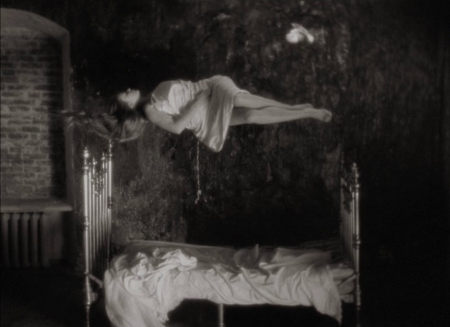
Still from Mirror [Zerkalo] (1975)

BACKGROUND:

  • Originally conceiving the film as a memoir about his own childhood memories of WWII, but gradually adding in elements from his later life, Tarkovsky began work on this story as early as 1964.
  • The poetry heard in the film is written and read by Arseny Tarkovsky, Andrei’s father. Andrei’s mother appears as herself in the film.
  • Tarkovsky reportedly made 32 edits of the film, complaining that none of them worked, before settling on this as the definitive version.
  • The Soviet authorities refused to allow Mirror to screen at Cannes.
  • Mirror ranked #19 in Sight & Sound‘s Critics’ Poll and #9 in the Director’s Poll in 2012.

INDELIBLE IMAGE: Maria floating in a dream while a dove flutters above her.

TWO WEIRD THINGS: Apparition history lesson; levitating mom

WHAT MAKES IT WEIRD: Mirror is an intensely personal, extremely diffused meditation on the meaning of life from one of cinema’s greatest artists. Although insanely difficult, many cinephiles find it intensely moving as an accumulation of individual images that flow like finely crafted verses of surrealistic poetry.


Restoration trailer for Mirror [Zerkalo]

COMMENTS: If you enjoy being confused, jump into Mirror with no Continue reading 19*. MIRROR (1975) →

APOCRYPHA CANDIDATE: EVANGELION: 3.0 + 1.0 THRICE UPON A TIME (2021)

366 Weird Movies may earn commissions from purchases made through product links.

Recommended

DIRECTED BY:

FEATURING: Voices of , Fumihiko Tachiki, , , Yuriko Yamaguchi; , John Swaney, , , Mary Faber (English dub)

PLOT: Angsty teenage Eva pilot Shinji must cope with his guilt over inadvertently causing the Third Impact, and regroup to face NERV and his own father in a final apocalyptic battle.

Stiill from Evangelion 3.0 + 1.0 Thrice Upon a Time (2021)

WHY IT MIGHT JOIN THE APOCRYPHA: The movie garners significant weird credentials by being only the second anime ever made about emo teenagers piloting giant robots to stave off a psychedelic apocalypse that ends by blasting its protagonist into a surreal purgatory where he wrestles with the nature of reality that’s actually a metaphor for mental illness. In this case, it’s more of a question of what might keep Thrice Upon a Time out of the Apocrypha. The answer there is more difficult, but this alternate take on a story already enshrined in the canon of weird movies does come equipped with one big negative: just to follow the basics—which is a far cry from “understanding” the film—requires you to watch (at a minimum) the three previous movies in the “rebuild series” on top of this 3.5 hour epic.

COMMENTS: Evangelion: 3.0 + 1.0 Thrice Upon a Time concludes a one-of-a-kind epic anime journey with one of the unwieldiest titles ever slapped upon a major release. The “thrice” probably refers to the series’ three different alternate endings—the TV finale, 1997’s End of Evangelion, and this one.

Is this the definitive conclusion to the story, or merely the final one? That will be a matter of taste, but 3.0 + 1.0 boasts some advantages over previous finales. For one thing, it gives more closure to the supporting characters. In previous versions, the story arcs of Eva pilot Asuka and, to some extent, antagonist Gendo were suddenly abandoned to focus on Shinji’s solipsistic hallucinations. Here, these characters play a larger role—Gendo’s motivations are explored in much greater detail—which is, in a conventional narrative sense, more satisfying. The mysterious clone Rei also follows a completely new plotline, resulting in a deeper catharsis than before, when she functioned mostly as a plot device.

Structurally, 3.0 + 1.0 is an odd duck, as Anno tries to keep his many balls juggling with one hand while tying up loose ends with the other. It starts with a four-minute rebuild recap, too brief to orient newcomers but effectively refreshing the memories of series’ followers who waited nine years between the release of 3.0 and 3.0 + 1.0. This is followed by an extended action scene where the renegades of the Wille organization, assisted by Eva pilot Mari, liberate Paris from NERV; it’s superfluous, but supplies an opportunity for an big action sequence up front, and helps to re-establish the good guys and the bad guys.

After this prologue, the movie unexpectedly turns into a post-apocalyptic drama as Shinji, Asuka and Rei shelter in a small village of survivors of the Third Impact. This hour-long, character-based story detour is unexpected, but not as disruptive as you might think. It’s a space for Anno to enact the major change to his story. Shinji still suffers from catatonic melancholia, as in previous iterations; but here, he works his way through his guilt and grief and recovers, resolving to fight against NERV by the conclusion of his stay. This revision allows him to be a vital and active participant heading into the final showdown, which in previous installments had been about the sullen teen working through the nadir of his depression. Since the protagonist’s self-loathing whininess had always been one of the major obstacles to enjoying Evangelion, this alteration will be viewed as an improvement for many. (The out-of-story explanation for this change is that Anno, who recovered from his own bout of depression decades ago, no longer identifies with the whiny, paralytic Shinji, and in fact now has more in common with Gendo, who is a far more sympathetic villain this time around.)

The last hour and a half of the movie gives fans what they came for: robot/spaceship battles, bizarre sciento-mystical musings, and eye-popping visual fireworks (and even a touch of fanservice). The Wille crew, with the three surviving Eva pilots, plunge into the bowels of NERV headquarters in a hellish descent into a bottomless red burrow, with Evas fighting off hordes of enemies as they fall. As always, Anno’s dialogue is thick with poetic-sounding nonsense. “Gendo Ikari–you used the Key of Nebuchadnezzar and willingly abandoned your humanity?,” Maya accuses. “I merely appended upon my body information that transcends the Logos of our realm,” answers the villain in a robotic deadpan. Half the dialogue here sounds like Philip K. Dick was hired to do a rewrite of the Revelation of St. John. The final action sequences are pure visual mayhem, decidedly NSFE (not safe for epileptics), with cascading pixels in a constant chaotic dance. Every space within the NERV netherworld is constantly exploding into some kind of cosmic kaleidoscope, mandala, or fractal geometry. The film does end up exploring the same surreal psychological spaces as End of Evangelion, but spends less time there, and more in a more conventional conflict between Shinjii and his father (who at one point face off in mirror-image Evas battling across imaginary landscapes).

Overall, I preferred the way End of Evangelion launched straight into the crazy from the get-go, and the peculiarity of its fascination with the unappealing Shinji. But I didn’t feel cheated by this version, and I can see how many fans might find this to be the more satisfying—and indeed ultimate—conclusion to the tale. Not for newcomers, since a four-movie commitment is almost a necessity, but for anyone who’s dipped their toes into Anno’s deranged opus before, this will rate as must see anime. It’s the true End of Evangelion, and the end of an era.

WHAT THE CRITICS SAY:

“Anno opens the film with crowd-pleasing action, delves into the psychological stuff, shifts to a skirmish set beyond all planes of reality and finds yet another psychological plane beyond those planes, and it’s all bedecked by wondrously detailed and tirelessly creative psychedelic imagery. Theoretically, one could ignore the almost impenetrably dense plotting and objectively watch the film for its visuals alone, from the elegant, Ghibli-esque simplicity of its Tokyo-3 scenes to the second half’s parade of hallucinatory sequences, each one crazier than the previous.”–John Serba, Decider (contemporaneous)

CAPSULE: TICKLES THE CLOWN (2021)

366 Weird Movies may earn commissions from purchases made through product links.

DIRECTED BY: BC Fourteen

FEATURING: Voices of , Jennifer Fourteen, Marco Guzman

PLOT: 2000 years in the future, the alien Illuminati have taken over Earth, and the key to defeating them lies in the DNA of an imprisoned sociopathic clown super-criminal.

Still from Tickles the Clown (2021)

COMMENTS: Tickles the Clown is notable simply because, by all rational criteria, it shouldn’t exist. A spoofy science fiction saga mocking conspiracy theories done in the style of an extremely cheap video game, it appears to come solely from the obsessive mind of one “B.C. Fourteen,” a prolific (111 writing credits) director/screenwriter who also produces work under the names “B.C. Furtney” and “Christopher Maitland.” It’s the latest installment in a four-movie-and-counting series that includes Bigfoot vs. the Illuminati, Trump vs the Illuminati, and Bigfoot vs Megalodon.

Besides the unaccountable fact that there were three previous movies in the series, two things stand out about Tickles. The first is the animation, which appears to use some video game engine modeling technology like Unreal Engine together with a stock library of motion captures. It’s clearly not hand animated; characters’ faces never change expression (for that reason, several of them are almost always depicted in helmeted spacesuits), and backgrounds are completely static. In place of expressive movements, characters sway slightly or gesticulate at random, like video game avatars awaiting entry into conversation with a player. The effect is slightly uncanny, but, at feature length, mostly tedious. One of the movie’s biggest shocks come in the credits, when you discover it took a team of eleven individuals to create this animation.

The second notable feature is the movie’s insane world-building (much of which we gather from the explanation on the back of the DVD, along with a lengthy exposition drop or two). The series is set two millennia in the future, and the Illuminati antagonists are stereotypical “grey” aliens led by a clone of , who is building some kind of Death Star and also has black magick rituals up his sleeve. Meanwhile, Big Foot—a jive-talkin’ Big Foot, no less—has joined the Rebel Alliance; a conversation with a werewolf who appears on his spaceship’s viewscreen divulges some backstory that is likely familiar to longtime viewers of the series (aw, who am I kidding?)

As for the movie… it’s mostly dull and talky, but every now and then it sparkles with some demented absurdity. The main plot has heroine Princess Kali repeatedly returning to criminal mastermind Tickles’ maximum security cell to try to convince or bribe him into giving up a blood sample (for ludicrously contrived reasons, they can’t get the genetic markers they need if the blood is taken involuntarily). Thus, most of the movie is just a drawn-out conversation between Kali and the recalcitrant-but-horny Tickles, who taunts her with his super-genius insights into her character and background (and tries to get her to show him her boobs). In other words, it’s a Silence of the Lambs rip-off plot in a Star Wars rip-off setting. But those odd touches! It starts off with a quote from Nietzsche, which is not a promising opening for an indie comedy. Every now and then, a bit of live-action stock footage—a mushroom cloud, a cup of tea, an elephant penis (!)—appears to punctuate the script’s point. There’s the relative star power of Bill Oberst, Jr., who injects a surprising malevolent life force into the perpetually grinning Tickles, laughing maniacally and generally playing the role like a potty-mouthed Saturday morning cartoon villain hopped up on too much sugary cereal. Big Foot is cringily voiced as an African American (he even says “word!” at one point). There are numerous plot holes, including the fact that Tickles’ big escape from a maximum security galactic jail is completely unexplained in-movie (the box cover clarifies the situation, albeit with a typo, although to be fair it also describes a completely different plot than the one in the movie).

Tickles the Clown is intended as a comedy, although it’s not very funny. It often plays as a comedy of errors, though one not funny enough for the so-bad-it’s-good crowd. By all accounts, it’s not any better or worse than the previous three entries in the series. Even as cheaply produced as these movies are, given the spotty distribution—Tickles is only available on DVD, one of the previous three movies is on Amazon Prime, but not the rest— it’s hard to believe they are making enough money to justify hiring Bill Oberst for voiceover.  Forget the question of whether the psychopathic clown and the alien Aleister Crowley clone will team up to defeat Big Foot and the generic space rebels, the big mystery posed by the Illuminati series is: how are these obscure movies continuing to get made, in the face of the world’s utter indifference?

WHAT THE CRITICS SAY:

“The series is pretty wild for the most part but what could be something very fun and memorable has been a tough chore to finish…  It’s one of the most difficult films [in the series] to watch and I was not a fan. Skip it.”–“Blacktooth,” Horror Society (contemporaneous)

CAPSULE: THE BEST OF DORIS WISHMAN (2021)

366 Weird Movies may earn commissions from purchases made through product links.

DIRECTED BY: Anonymous

FEATURING: Archival footage

PLOT: This odd little disc is a collection of segments and trailers from Doris Wishman movies, along with edited footage from other psychotronic films set to swinging vintage catalog music.

Still from The Best of Doris Wishman (2021)

COMMENTS: If you’re anything like me, you’ve been searching for a compilation of the sleazy strip-club jazz music featured in little-old-lady-cum-disreputable-pornographer Doris Wishman’s offbeat 1960s and 1970s exploitation movies for years. Having actually looked at that sentence typed out, it occurs to me that you are almost certainly nothing like me. But please read on anyway.

Something Weird’s “The Best of Doris Wishman” advertises itself as a soundtrack (your choice of CD or vintage vinyl) with an accompanying DVD “filled with Doris’ outrageous oeuvre!” Since this is a movie site, we won’t be delving deeply into the aesthetic qualities Wishman’s music. The original songs commissioned especially for her early nudist movies are pure kitsch (“I’m moonin’ over you, my little moon doll,” croons Ralph Young in the theme to Nude on the Moon.) The library music  selected to accompany Wishman’s roughies are often surprisingly competent, if not always germane to the onscreen action—as if the director were picking at random from a stack of nearby 45s. But again, we’re not here for the music.

The ad copy doesn’t really explain what part of “Doris’ outrageous oeuvre” is on the DVD. If you guessed “trailers,” you’re mostly correct. The video content is synced to the accompanying soundtrack, to the point where you are offered a countdown so you can drop your needle on your record at the appropriate start point (I believe only the LP syncs up, as with bonus tracks the CD has a slightly longer running time). Although the content is mostly trailers, for several segments—mostly the early naturalist films—the original tunes play over scenes of nudists frolicking in the nudie pool, using beach balls to carefully cover up their pubic hair. Sprinkled throughout the assembly you’ll find audio cues of Wishman caught on tape, usually to embarrassing effect (she forgets which partner was on top when blocking a love scene; her cameraman yells at her to get out of the shot). Nineteen of Wishman’s thirty-one movies are represented here in some form, including both Indecent Desires and Bad Girls Go to Hell (in trailer form only, although the soundtrack has an additional cut for each). For a fan, it’s a fine trip down memory lane, and it’s unlikely that any but the most dedicated Wishmanites will have seen all these movies.

But that’s not all! The real surprise, and an unexpected treat, is a collection of bonus content that’s almost as long as the feature. You see, the soundtrack music was remastered by an outre audophile company called Modern Harmonic, in collaboration with Something Weird (who own Wishman’s movie catalog). After the feature presentation ends, Modern Harmonic throws in an additional 25 minutes of musical highlights—ranging from early soul to jazz to rock n roll—scored to edits of various other Something Weird titles. These are taken from other LP/CD releases, either “Something Weird Greatest Hits” or individual soundtrack releases. Some of them are just clips or trailers, but others are edited experimentally: action sequences from Doll Squad are rejiggered to make the actors dance to a funky bongo-riffic groove; a cute-but-spiteful 50s brunette from Fuzz Box gets trapped in a loop enviously checking out a blonde rival, serenaded by a psychedelic band who wouldn’t rock out in their garage for another decade and a half. And a crapsetrpiece like Dracula (The Dirty Old Man) doesn’t require fancy tricks to hold its own: just show an abridged version of the film, with Dracula and his press-on goatee spying on and abducting swinging sixties maidens with the help of his werewolf companion while a sax and organ combo vamps for five minutes.

The Wishmania was welcome, but Modern Harmonic’s bonus material makes this an unexpected, if minor and very particular, pleasure. Try serving this campy retro buffet at your pad for your next psychedelic sex party, and you might be surprised at how well you get on. If nothing else, you’ll be one step closer to being like me.

CAPSULE: RETURN TO OZ (1985)

366 Weird Movies may earn commissions from purchases made through product links.

DIRECTED BY:

FEATURING: , Nicol Williamson, Jean Marsh

PLOT: After being sent for experimental shock therapy, Dorothy Gale returns to Oz, where she meets new magical friends and enemies as she tries to save the Scarecrow from the clutches of the Nome King.

Still from Return to Oz (1985)

COMMENTS: Few people today realize that, after the smash success of “The Wonderful Wizard of Oz” in 1900, L. Frank Baum wrote thirteen sequels (and other writers continued the official Oz legacy for a couple dozen additional volumes). With so much material available, it’s a surprise that it took Hollywood almost fifty years to create a live-action[efn_note]An animated sequel, Journey Back to Oz, was released in 1974.[/efn_note] sequel to 1939’s Oz blockbuster; had the original been made in today’s entertainment climate, we would be seeing a new Oz movie every year—at least.

The reasons for the delay had partly to do with rights to the originals being divided up between rival studios (MGM optioned the first book, Disney all the rest). By the 1980s, Disney’s rights to Baum’s works were about to lapse, so in 1985 they handed respected sound-editor-turned-first-time director Walter Murch the opportunity to create a sequel, based mainly on Baum’s third book, “Ozma of Oz,” but also incorporating parts of the immediate sequel “The Marvelous Land of Oz” and original ideas. The resulting movie was a box office flop, often criticized for being too “dark.” But children who saw it in theaters remembered it more fondly than their parents or contemporary critics did, turning Return into a minor cult film on video.

Encouraged by Murch’s own characterization of his work, the accepted wisdom that Return is “dark” is repeated like a mantra every time the film is brought up: often as a criticism or warning, but sometimes as a compliment or lure, depending on who is doing the reviewing. But, while Return is indisputably scary, “dark” implies some kind of inappropriate moral perversity found nowhere in Oz. In the original Wizard of Oz, Dorothy faced a green-faced hag bent on revenge-killing both her and her lapdog, a magical best friend who’s nearly incinerated, and pursuit from nightmarish flying monkeys dressed as bellhops. These vintage horrors compare quite favorably to those found in Return—but just because no one periodically breaks out in lighthearted songs about missing vital organs, the later movie is forever branded as “dark,” while the earlier one is a beloved childhood classic. Return to Oz‘s half-rock Nome king is eerily brought to life through uncanny claymation, but he’s no darker than Margaret Hamilton’s cackling harridan. Return features bizarre creatures called the Wheelers, who dress like New Wave punks who would have been at home as extras in Liquid Sky but for the wheels grafted onto their hands and feet, who a slink about the ruins of a post-apocalyptic Emerald City. Scary, but then again, they’re not freaking flying monkeys.

The darkest element in Return is purely subtextual, and will go right over young ones’ heads: the primitive turn-of-the-century electroshock therapy to which Dorothy’s aunt and uncle subject the girl hoping to cure her of her yearnings for Oz (a procedure that ironically sparks her return to the fantasyland). The reference to barbaric mental health practices of olden times is indeed dark, but few kids would get why in 1985 (and even fewer in 2021). There is an even darker undercurrent, though. This plot device could be read as implying that Dorothy Gale isn’t just an innocent dreamer; in fact, she’s deeply mentally ill, and the land of Oz is her schizoid hallucination. But again, this twist just disturbs the older folks: kids accept Dorothy’s adventures at face value, and remain blissfully ignorant of the suggestion of juvenile insanity.

Return to Oz could never live up to the original movie; wisely, it doesn’t try to. It ditches the musical numbers, which would have inevitably disappointed. 9-year-old Fairuza Balk seems chosen as lead based solely on her jewel-like eyes; she’s no Judy Garland (and she’s confusingly younger than the Dorothy of Wizard), but she’ll do. When we finally see the updated Scarecrow, beloved Ray Bolger has been transformed into an animated puppet, and he’s… a little off. But Dorothy’s new cast of allies are mostly delightful: a talking chicken, roly-poly mechanical soldier Tik-Tok, childlike Jack Pumpkinhead, a moose head attached to a flying couch. So are the villains: evil Queen Mombi with her detachable heads, the severe and mostly-animated grey Nome King. After a slow start, in a full color Kansas, the movie morphs into a well-paced 80s children’s adventure tale, with thrilling escapes and despicable (if not quite “dark”) acts of villainy. It has that magical “Oz” spirit—minus the songs, which obviously wasn’t part of Baum’s original work—and it’s easy to see why those who first saw it as kids fell in love with it. A good fantasy for first time viewers, and great nostalgia for grown-ups.

Also, be sure to read Jesse Miksic‘s detailed analysis for this site, “The Three Fetishes: Transformation and Ethical Engagement in Walter Murch’s Return to Oz.”

WHAT THE CRITICS SAY:

“Dorothy’s friends are as weird as her enemies, which is faithful to the original Oz books but turns out not to be a virtue on film, where the eerie has a tendency to remain eerie no matter how often we’re told it’s not.”–Jay Scott, The Globe and Mail (contemporaneous)

(This movie was first nominated for review by “ubik,” who said that it “was probably the movie that first gave me a taste for weird movies way back in the day.” Suggest a weird movie of your own here.)