Tag Archives: Tinted footage

LIST CANDIDATE: OF FREAKS AND MEN (1998)

Pro urodov i lyudey

Recommended

DIRECTED BY: Aleksey Balabanov

FEATURING: Sergey Makovetskiy, Dinar Drukarova, Viktor Sukhorukov

PLOT: The lives of two bourgeois families and a crew of pornographers cross paths in pre-revolutionary Russia.

Stil from Of Freaks and Men (1998)

WHY IT MIGHT MAKE THE LIST: With its sepia-tinted, silent movie feel and its clutch of strange denizens—conspiring maids, conjoined twins, and eerie criminals—Of Freaks and Men straddles the line between black comedy and social commentary with a combination of non sequiturs and S&M photography.

COMMENTS: The tone is set early and thoroughly as a series of sepia bondage photos are projected beneath the opening credits. The story begins in a style that would not be unfamiliar to the first movie-goers, as a brief montage displaying the primary characters plays through in black and white (accompanied by the background crackle of a scratchy film projector on the soundtrack). The film switches to sepia, and the theme of connivance is introduced when we see a young woman, obviously a maid, furtively whispering in Johann’s ear. What follows is an unlikely but believable tale of plots, peril, and pornography (known, of course, as “the 3 P’s of cinema”). Through underhanded means Johann, a purveyor of obscene photographs, manages to infiltrate the household of a bourgeois engineer and his daughter. Meanwhile his assistant and hatchet-man, Victor, comes across a surgeon who is the adoptive father of conjoined twins.

Their combined efforts allow them to move their “studio” from the basement of a nearly derelict building (that seems to be more than half a dozen floors underground) to an upscale flat in the heart of the town. The engineer’s daughter Leeza is immediately coerced into posing for their wares, stripping on demand to be lightly whipped by Johann’s grandmother who is carted out of a nearby cupboard for the purpose. The criminal’s cameraman, Putilov, is hopelessly smitten by Leeza, as is one half of the set of conjoined twins.

Things go on this way for “months” (according to a title card), with repetitive photos thrown together, sometimes taken in front of a paying audience. Henchman Victor eploits the twins more benignly, as they both sing and play the piano (and, most amusingly, the accordion, each half held by one of them as they perform a song). All good things must come to an end, though. Nana passes away, prompting Johann to break down and experience a seizure. The captives take this chance to get outta there and try and make it on their own—with limited success.

One could well argue that storyline alone is enough to plant this film firmly on the “weird” side of things, and as you would hope for from a movie given space at this site, it cements its position—and then some. While certainly not the first modern movie to pose as a throwback to silent pictures and sepia tinting, Of Freaks and Men does so with off-key humor and an appreciable lack of pretension. An out-of-the-blue the title card appears reading “Johann readied himself to make a wedding proposal,” and we see the stone-faced criminal, dressed as best as he knows how, on the prow of a small steam boat. His expression then is of a in need of exorcism. When Leeza is first photographed in the nude and when she sleeps with one of the two conjoined twins, the title cards announce, “And so, Leeza became a woman for the first time”, and “And so, Leeza became a woman for the second time”, respectively.

Russians widely viewed the movie as allegorical. The conjoined twins, Kolya and Tolya, symbolize Russia. Kolya, on the right, is intelligent, talented, and spurns the offers of liquor from the various ill-intentioned adults. His twin Tolya, on the left, is buffoonish— talented, yes, but quick to fall under the spell of a licentious maid who shows him some of the Johann’s photos, and then happy to adopt the regimen of alcohol his overseers foist upon him. Kolya represents the Russia that could be; Tolya represents what Russia so often has been (and is likely to continue being). Not knowing their father has been murdered, in the end they head to his hometown, in the East. Pursuing this path, the twins rush toward tragedy.

There is sadness in Of Freaks and Men, but it is coupled with wonderfully black humor. Its weirdness is best seen in its self-assured tone. The world this movie creates is believable, while at the same time flying in the face of expectation. I haven’t even mentioned its other weird accessories: the blind wife of the doctor who “[falls] in love for the first time” with Victor when he forces her to expose herself to him, the recurring train yard scenes, the sinister quality of the two antagonists, and the nebulous ending with its beautiful ice flows. Now that I’ve mentioned them, I can promise the curious amongst you that there are plenty others to be found.

WHAT THE CRITICS SAY:

“When I first saw Alexei Balabanov’s Of Freaks and Men at the Edinburgh Film Festival in 1998, I thought it was touch and go whether a film quite so original, provocative, perverse and calculatedly offensive – not to mention weird in the extreme – would get British distribution at all… fans of Borowczyk, Peter Greenaway, Guy Maddin, early David Lynch and Jan Svankmajer’s Conspirators of Pleasure will have a field day, as will broadminded devotees of the more fantastical Russian novelists…”–Michael Brooke, The Digital Fix (DVD)

CAPSULE: WILD AND WEIRD (ALLOY ORCHESTRA SILENT FILM COMPILATION)

The Alloy Orchestra Plays Wild and Weird: Short Film Favorites with New Music

Must See

DIRECTED BY: D.W. Griffith, , , Segundo de Chomón,  F. Percy Smith, , Ernest Servaès, Ladislas Starevich, Winsor McKay, , Eddie Cline, Hans Richter

FEATURING: Jack Brawn, Paul Panzer, Ernest Servaès, Buster Keaton

PLOT: A compilation of twelve strange, fantastic, and experimental films from the dawn of cinema (spanning the years 1902 to 1926) with new scores for each composed by the Boston-based silent film ensemble “the Alloy Orchestra.”

Still from The Red Spectre (1907)
WHY IT WON’T MAKE THE LIST: This presentation won’t make the List solely on formal grounds, because it’s a compilation. You could make a case for several of the individual shorts, however, on the basis of their historical significance, especially “A Trip to the Moon,” “Dream of the Rarebit Fiend,” “Play House,” or “Filmstudie.”

COMMENTS: Hidden off in a corner of the Movie and Music Network‘s catalog, far away from the exploitation films in a quiet place only the cool kids know about, is an obscure little collection of classic cinema. For the most part the Alloy Orchestra’s selections in this compilation aren’t especially rare, at least to silent cinephiles, but wild and weird they certainly are. From trippy nickelodeon snippets to epic hallucinations, these films hail from a thrilling era when cinema was fresh and every new movie was an adventure in invention.

The Orchestra’s musical accompaniment is excellent and appropriate to the material. It’s mostly classical-ish, with a little bit of tasteful electronic ornamentation, and very rarely does it get avant-garde or dissonant enough to threaten the casual listener’s delicate ears. At times it’s electronic-Baroque, often it’s vibraphone and percussion heavy, with a welcome cameos by musical saws and theremins in some dream sequences. Unfortunately, the digitization used here captured some analog rumbling and distortion when the volume got too high, but in general the music is a pleasant accompaniment to the main attraction.

A brief rundown of each slice of weirdness:

CAPSULE: SIN CITY: A DAME TO KILL FOR (2014)

366 Weird Movies may earn commissions from purchases made through product links.

DIRECTED BY: ,

FEATURING: , , , , , , ,

PLOT: Three stories involving gamblers, thugs, private detectives, strippers, corrupt senators, and femme fatales, and other disreputable denizens of the mythical Sin City.

Still from Sin City: A Dame to Kill For

WHY IT WON’T MAKE THE LIST: It doesn’t do anything new or better to distinguish itself from its Certified Weird predecessor; not that that’s necessarily a bad thing, entertainment wise, but the original represents the Sin City franchise on the List of the 366 Best Weird Movies well enough.

COMMENTS: First, the good (or bad) news: this 2014 followup does such a good job recreating the look and feel of the surprise 2005 hit, right down to renovating the rapidly aging faces of Mickey Rourke and Bruce Willis to the point where they’re indistinguishable from their decade-younger selves, that you could edit the stories from A Dame to Kill For into the original Sin City and never notice the difference. The tangled timeline—some of the stories here take place before any of the events in the first movie, while others are roughly contemporaneous with it—helps with that sense that Dame is not so much a sequel (or prequel) as it is an organic extension of the original, almost as if we were viewing deleted scenes. Returning from the first film is Rourke’s Marv, that slab of grizzled muscle with a vertical nose and a horizontal chin, who unites the stories and plays a supporting role in two out of three tales; Willis’ romantic cop Hartigan, in what is basically a cameo; and Jessica Alba’s diva stripper Nancy, now an alcoholic wreck. Josh Brolin tackles a younger (yet somehow more bitter and jaded) version of the role played by Clive Owen in the original, while Powers Boothe’s corrupt politico has a greatly expanded part as the new principal antagonist for two of the three characters. There are numerous callbacks to the previous films (e.g., a portrait of Nick Stahl’s Yellow Bastard on his fathers’ wall) and origin stories (we learn how Manute got his stylish gold eye). The real stars here are the new characters, though: Joseph Gordon-Levitt’s Johnny, a gambler with a golden touch whose boyish looks are a welcome contrast to the craggy male miens that otherwise populate the city, and especially Eva Green’s seductress Ava. Green is frequently nude—in fact, her first appearance naked, on a diving board in front of a digital moon, is itself justification for the movie’s existence—but she is also the first female character in the Sin City universe who is a worthy adversary for a male. Her femme fatale performance is campy, but riveting, and with ruby red lips and turquoise eyes accentuating her classical black and white beauty, she’s a breathtaking update of the archetype. The digital cinematography is as crisp and beautiful as the original film: the whites of characters’ eyes sometimes appear to glow, as does their spurting blood, and there are wonderfully evocative effects like tendrils of steam that hang in midair without dissipating. There are scattered weird visual touches, the most impressive of which is a giant poker hand (you’ll know it when you see it). Overall, fans who loved their first visit should find plenty of reason to go slumming again in this City, while those who had their misgivings about the trip may find themselves depressed by the burg’s seedier aspects, now that it’s really showing its age.

Given that the new Sin City is pretty much of a piece with its predecessor, its lackluster performance with critics and box office patrons requires explanation. The core fanbase seems appeased, based on a decent 7.2 IMDB rating, so we assume that the movie failed to put casual fans’ butts in theater seats. The lesson is that nine years between installments is not exactly striking while the iron is hot, no matter how faithful to the original you make the followup.  On the critical side, Dame bashing may be partly a chance to reappraise the original, which caught reviewers by surprise with its technique. (Nathan Rabin candidly takes this tack in his review for The Dissolve). In 2005 nothing else quite leapt off the screen the way Sin City did, and the glowing visuals, star power and cinematic energy caught critics by surprise and allowed them to overlook the film’s many flaws: its painful faux-Chandler dialogue, pornographic brutality, and adolescent understanding of both masculinity and femininity. Since the visuals are no longer original, today’s reviewers appear to be looking past the screen’s gilded surface and letting their misgivings about the movie’s lack of any worldview beyond appreciation of the awesomeness of violence dictate their opinions.

WHAT THE CRITICS SAY:

“…it was easy to imagine that A Dame to Kill For would try to one-up the original, to push the envelope of perversity in some fresh and jarring (if likely unsuccessful) way. Instead, Rodriguez and Miller have erred in the opposite direction, offering up a movie that feels timid, half-hearted, eager to play it safe. The former path might have been a mistake. This one feels almost like a betrayal.”–Christopher Orr, The Atlantic (contemporaneous)


171. SIN CITY (2005)

366 Weird Movies may earn commissions from purchases made through product links.

“It’s pretty damn weird to eat people.”–Marv, Sin City

Recommended

DIRECTED BY: , , (“special guest director”)

FEATURING: , , , , Nick Stahl, Jaime King, , , , ,

PLOT: The movie tells three stories (with some common characters) set in the mythical Basin City: in one, a police detective risks his life to stop a child-killer. In a second, a brutal, mentally ill criminal hunts down the men he believes killed the only woman who ever showed kindness to him. A final strand tells of a suave assassin who attempts to prevent someone else’s accidental killing from turning into an all-out war between the cops, the mafia, and the self-governing prostitutes of Old Town.

Still from Sin City (2005)
BACKGROUND:

  • A fan of Frank Miller’s original series of Sin City comics, Robert Rodriguez wanted to make the movie as true to the book as possible: “a translation, not an adaptation.” The actual comics were used as the storyboards. The stories selected were “The Hard Goodbye,” “The Big Fat Kill,” and “That Yellow Bastard” as well as the short “The Customer is Always Right.”
  • Rodriguez shot the opening segment, “The Customer is Always Right,” in one day as a proof-of-concept to convince Miller that he could do justice to the art style. He then used that clip to convince actors such as Bruce Willis and Benicio Del Toro to sign on to the project.
  • Rodriguez insisted that Miller receive a co-director credit on the film, but the Directors Guild of America objected to the credit (they do not allow co-directing). He then decided to give Miller full credit, but Miller refused. Rodriguez then resigned from the Guild so the co-directing credit could remain.
  • Quentin Tarantino directed a single scene in the movie (a segment from “The Big Fat Kill” involving a conversation between the severed head of Del Toro’s “Jackie-Boy” and Clive Owen’s “Dwight”). Tarantino directed for a salary of $1 as a way to repay Rodriguez for composing music for Kill Bill: Vol. 2 for $1.
  • The movie was entirely shot on Rodriguez’s “digital backlot” (green screen studio) near his home in Austin, Texas.
  • Sin City screened in competition at Cannes and won the Technical Grand Prize.
  • Plans for a sequel (based on Miller’s “A Dame to Kill For“) were announced immediately after the film was completed; the followup feature was delayed until 2014, however.
INDELIBLE IMAGE: From the very first frame—a woman in a blood-red backless cocktail dress on a balcony staring out over a steel-grey city—Sin City‘s pulp Expressionism is consistently startling and poetic. Since we’re fascinated by the weird, we’ll select the first sight of the Yellow Bastard, the bald, satellite dish-eared pedophile killer dyed the color of French’s mustard, as our unforgettable take-home image from the movie.

WHAT MAKES IT WEIRD: A marriage between the mythologies of film noir and violent comics, Sin City‘s bloody tales are set in an abstract urban hellscape inhabited by invulnerable tough guys and rough sexy dames. They play like the lost works of Raymond Chandler’s alternate universe grandson, written to scrape up a few bucks for a bottle of booze while he was down and out in Gotham City. With a cast of cannibal serial killers, jaundiced pedophiles and ninja hookers, the adventures of the hard-boiled demigods of Sin City are as fantastical as its random splotches of color in a monochrome landscape are visually unreal.


Original trailer for Sin City

COMMENTS: Sin City earns its “recommended” label almost solely on the basis of its visuals (bolstered by some finely weird touches), and not for its Continue reading 171. SIN CITY (2005)

THE ADVENTURES OF PRINCE ACHMED (1926)

Historians, film buffs, and Disney fanatics all cite Snow White and the Seven Dwarfs (1937) as the first animated feature. While it is the first animated feature as we Americans tend to think of animation, actually that “first” honor goes to a little known, innovative oddity from eleven years earlier. The Adventures Of Prince Achmed (1926) is a labor of love from the pioneering female German filmmaker Lotte Reiniger and her husband, Carl Koch.

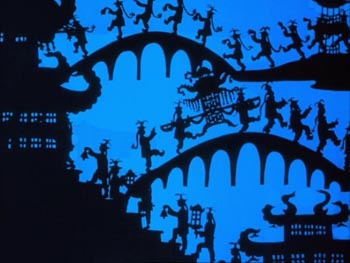
What makes Achmed still unique 88 years later is animation entirely composed of cutout silhouettes. The result  was one of the silent era’s most enchanting and captivating films. It is also a lucid reminder that the medium of film was at its most innovative in its infancy, before the rules were set and the mediums defined.

Reiniger lucked into a patron for her artistic efforts: Louis Hagen supplied her with enough film stock and financing to proceed with her project. Using scissors and black construction paper as her primary tools, Reiniger spent three years meticulously working in an attic on Achmed with a small crew that included her husband/cinematographer, Koch.

Influenced in part by Georges Méliès and Arabian Nights, Reiniger created a world of sensuous, exquisitely detailed beauty. The film has an almost surprisingly coherent and linear narrative, given that Reiniger was embraced by the European avant-garde. Unfortunately, the director had difficulty booking Achmed, and with the exception of Dr. Doolittle And His Animals (1928), the rest of her career was relegated to short films. There was work on a third feature, to be based on Maurice Ravel’s enchanting opera, “L’Enfant et les Sortilèges”; unfortunately, rights to the music could not be secured and the film was abandoned. The Adventures Of Prince Achmed is the only one of Reiniger’s films to date that has seen a home video release. Some of her shorts occasionally appear on television, but often in truncated versions. One such example is Doolittle, which has aired with added (and intrusive) voice over narration, coupled with woefully inadequate projection speeds. Fortunately, YouTube has been more respectful. The Star of Bethlehem (1921), Cinderella (1922), The Adventures of Prince AchmedPapageno (from Mozart’s “The Magic Flute”) (1935), The Magic Horse (1953), and Jack and The Beanstalk (1955) along with a short documentary of her work can all be found there. The documentary shows her storyboarding techniques and the almost rapid-fired speed at which she crafted her baroque figures.

Still from The Adventures of Prince Achmed (1926)There is a noticeable gap of activity in Reiniger’s filmography from 1938 to the early 1950s. With the rise of Fascism, Reiniger and Koch struggled to flee Germany. Although not Jewish, politically they leaned left, which marked them as subversives. Jean Renoir was among those who aided the couple, but they lived in abject poverty until finally being able to settle in England in 1949. Despite the initial financial failure of Achmed, Reiniger and Koch were respected in film circles and were able to be relatively prolific.

Achmed is of its time in its portrayal of the good guys as completely good, bad guys as completely bad, and the pretty girl as in need of saving (Reiniger’s later films frequently had biblical, Victorian, fairy tale, and operatic themes). Still, it’s put over so beautifully, even the most hardened cynics will hardly care. The color tinting renders the film a phantasmagoric smorgasbord of gemstones. Achmed is awash in emeralds, sapphires, rubies, garnets, aquamarines, amethyst, topaz, citrine, tanzanite, and fire opal.

The Adventures of Prince Achmed weaves interrelated narratives involving our protagonist, his princess sister, their Caliph father, an erotic heroine (who Achmed voyeuristically spies on while she is bathing), a flying horse, a malevolent shape shifting African magician, the Witch of the Fiery Mountain, dancing harlequins, sphinxes, terrifying demons, Aladdin, and the genie of the magic lamp. Locales include an exotic island, a majestic palace, Peru, and China.

Reiniger was  master of her medium and an innovator. Every step through her unique world is an enchanting one.