Tag Archives: Satire

CAPSULE: W THE MOVIE (2008)

twostar

DIRECTED BY: Alfred Eaker & Ross St. Just

FEATURING: Alfred Eaker, PinkFreud

PLOT: “W” appears in a meteorite in the Arizona desert, steals the election for

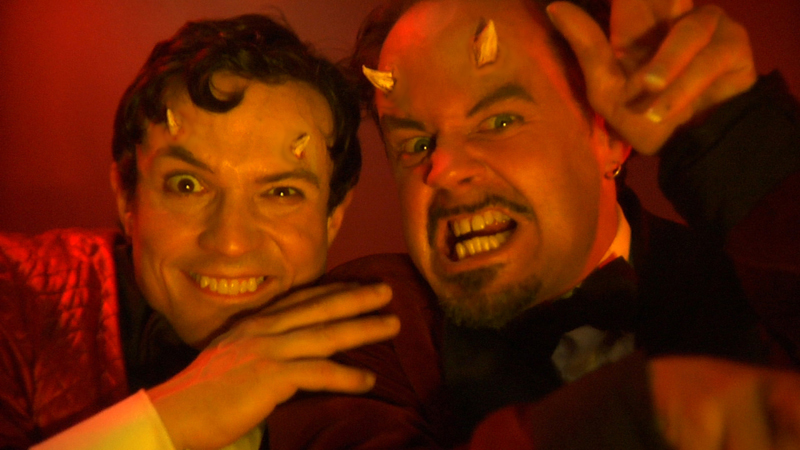
Still from W: The Movie (2008)

the party of No, and becomes a tyrant opposed by liberal reporter BlueMahler.

WHY IT WON’T MAKE THE LIST:  With half the characters distinguished by facepaint that makes them look like either World Wrestling Federation rejects or members of a failed 70s revival glam band, acting in front of shifting psychedelic computer-generated backdrops, this surrealist satire of George W. Bush’s presidency is definitely weird enough to make the list.  The problem is that, as a polemic against the 43rd President of the United States, it comes with an expiration date.  It’s too particular and too parochial, both in terms of subject matter and target audience, to earn a final place on a list of 366 representative weird movies.

COMMENTS:  Because it is a vehemently partisan mockery of a former President, as opposed to a generic political satire, W the Movie is difficult to review.  Your reaction may depend on your politics; the far left might applaud it as a hilarious send-up of a dangerous political hack, those on the right may be outraged (and personally insulted), or simply dismiss it as liberal piffle.  Moderates and fence-sitters are unlikely to be swayed.  All sides will recognize it as deliberately unfair; Bush’s foibles are exaggerated past the point of absurdity.  W is cruel, crude and stupid, and at his most decisive when he demands his pancakes with “lots of syrup”; his foil, BlueMahler, is brave and righteous, and his only character flaw is neglecting his wife and son as he devotes his life to exposing the truth about the alien demagogue and his infernal war.  W the Movie makes the work of Michael Moore (who himself makes as appearance as a ghostlike, babbling puppet) look fair and balanced.  There’s a place in the film world for narrowly political art and clever character assassination, and in this sense the producers are to be commended for not fearing to enter the fray, take sides, and name names.

But, polarizing political content aside, there’s quite a bit to be admired in the low-budget production.  It’s an excellent example of how a unique, almost mesmerizing visual style can be forged through CGI on the cheap, when artistic effect and atmosphere is placed above the fetish for strict realism.  About 90% of the film was shot in front of a green-screen, and memorable virtual sets include W riding on a missile against a cloudscape (a la Dr. Strangelove), W worshipping at an altar of giant gold coins, and an amusing black and white parody sequence with W in Ford’s Theater.  The effect is a bit like the old studio-bound pictures of the 30s and 40s, where the backgrounds were matte paintings, but modern technology combined with a hallucinogenic vision makes these brightly colored living mattes slip, morph and shift before the viewer’s eye.  Therefore, the film is constantly interesting to the eye, even when the plot gets difficult to follow. Furthermore, Eaker does quite well in multiple roles, including both W and his nemesis BlueMahler. Actors cast in smaller roles range from adequate to distracting.  The humor is also uneven, ranging from the highly effective (the Ford’s Theater scene) to the painfully embarrassing (the 9/11 tragedy is used as an excuse for cheap jokes about W’s pro-life stance and lack of geographical acumen).  More genuine funny and fewer pointed potshots would have made it a happier movie experience.  All in all, W‘s well worth checking out, but if you’re to the right of Obama politically, you may want to check your party of No pin at the door.

WHAT THE CRITICS SAY:

“…this is one seriously messed up flick and… I mean that in the best possible way… wild and wonderful, weird and whacked out.”–Richard Propes, The Independent Critic

4/23/09 UPDATE: W the Movie won the “Best Experimental Feature” award at the New York International Independent Film and Video Festival.

7/22/10 UPDATE: For a limited time, we are screening “W” for free on YouTube. Enjoy!

CAPSULE: ADAPTATION (2002)

Recommended

DIRECTED BY: Spike Jonze

FEATURING: , , Chris Columbus

PLOTAdaptation tells two stories: in one, a “New Yorker” journalist (Meryl Streep) becomes obsessed with the subject of her nonfiction book, a trashy but passionate collector of orchids (Chris Cooper); in the other, a depressed screenwriter (Nicolas Cage) struggles to adapt her book “The Orchid Thief” into a movie, while fending off his chipper and vapid twin brother (also played by Cage), himself an ersatz screenwriter.

adaptation

WHY IT’S ON THE BORDERLINEAdaptation is a metamovie, the filmed equivalent of metafiction (a literary style where the real subject of the work is not the ostensible plot, but the process of creating of the work itself).  In Adaptation, screenwriter Charlie Kaufman (Being John Malkovich) inserts a fictionalized version of himself into the script, writing and rewriting the story as the movie progresses.  Adaptation may appear unusual, and even weird to those who aren’t used to this kind of recursive style, but it’s a purely intellectual exercise about the creative process, and the mysteries presented in the movie have a purely logical explanation when considered in their literary context.

COMMENTSAdaptation sports perhaps the smartest script written in this young millennium, a story which twists and turns back upon itself with sly wit and playful intelligence.  (The screenplay was nominated by the Academy for “Best Adapted Screenplay”; maybe it would have won if it had been properly nominated in the “Best Original Screenplay” category).  In addition, the acting by the three principals—toothless and trashy Chris Cooper as the orchid thief, Meryl Streep as a jaded, intellectual journalist drained of passion, and Nick Cage as the twins, Charlie and Donald Kaufman—shows three veterans at the very peak of their games.   All three were nominated for Oscars, and Cooper won for “Best Supporting Actor.”   As good as Cooper was, it’s Cage’s magical performance as the writer paralyzed by artistic ambition and self-doubt, and also as his clueless doppelganger with a maddening Midas touch, that carries the film.  This is easily Cage’s best performance in an uneven career.

Despite the superlative script and performances, Adaptation falls just short of being an unqualified classic.  The problem is that the secondary plot—despite such welcome spectacles as Meryl Streep trying to imitate a dial tone while tripping balls—pales beside the more intriguing internal struggle of poor Charlie Kaufman.  When Streep and Cooper are on screen, we are always anxious to get back to Cage throwing barbs at himself.  Adaptation is geared towards a specialized audience—mainly writers, movie reviewers and other highly creative types—but will also appeal to fanatical film fans and industry insiders and would-be insiders who want to have a good wicked laugh at the cutthroat compromises required to bring a screenplay to life in Hollywood.

WHAT THE CRITICS SAY:

“…an occasionally maddening and sometimes brilliant motion picture that varies between being insightfully sharp and insufferably self-indulgent…  I can’t imagine Adaptation having much mainstream appeal, but, for those who look for something genuinely off-the-wall in a motion picture, this will unquestionably strike a nerve.”  -James Berardinelli, Reel Views