Tag Archives: Satire

CAPSULE: COLD SOULS (2009)

DIRECTED BY: Sophie Barthes

FEATURING: , Dina Korzun, David Strathairn

PLOT: Paul Giamatti (playing himself) feels burdened by his soul, so he utilizes the services of a company that specializes in soul removal and storage; when he decides to reclaim it from its safe deposit box, he finds there’s a problem…

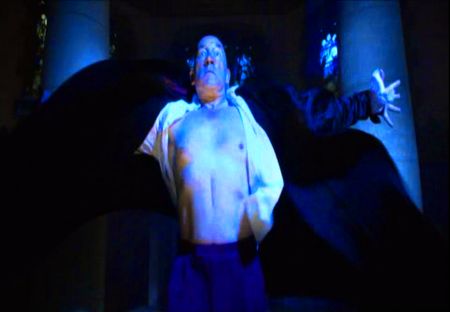
Still from Cold Souls (2009)

WHY IT WON’T MAKE THE LISTCold Souls is an excellent little movie, but it pitches its tent a few yards outside the boundaries of Weird City.  It posits its impossible philosophic premise as a scientific fact, and develops a strangely believable set of consequences from it.  It’s magical realism that’s heavy on the realism but light on the magic; a perfectly reasonable artistic choice, and one that works well here, but a choice that should prevent it from making the List. A brief peek inside the (rather blurry) corridors of Giamatti’s soul isn’t enough to smuggle it across the weird border.

COMMENTSCold Souls has three things going for it: an intriguing concept, a great sense of humor, and Paul Giamatti. Writer/director Barthes doesn’t have anything new or profound to say about the human soul—her theme is limited to the idea that it has something to do with suffering, and the fact that we’re less human if we lose it—but what new or profound is likely to be said about the nebulous, millennia old concept of soul? Instead, she wisely focuses on creating an elaborate medical mythology of the soulectomy, and builds a fascinating plot by exploring those soul mechanics. We get such concepts as soul residues, the black market soul trade (dominated by those masters of soul, the Russians, natch), and soul mules, people who implant the souls of others inside themselves to smuggle them across international borders. The jokes arise naturally from the set of rules Barthes devises: human essences manifest themselves physically in a variety of shapes, including jellybeans and chickpeas, sometimes to their owners’ dismay.  It’s gratifying to find laugh-out-loud funny lines in this film, since the intellectual concept could easily have limited the humor to being merely sly, witty, and clever.

Deadpan David Strathairn, as a satirically practical plastic surgeon of the psyche, sets up some of the best gags, such as the idea that removed souls can be warehoused in New Jersey to save on state sales tax. But most of the humor and pathos come from the performance of Giamatti, who plays both a soulful and a soulless role; he’s funny when troubled, and troubling once his cares are removed. Giamatti puts his own twist on the smart, neurotic Woody Allen type, but conveys plenty of genuine existential melancholy as well. As an actor playing an actor (his painful emotional over-involvement in playing the title role in Chekhov’s “Uncle Vanya” sets the plot in motion), he truly tests his range. It’s quite a challenge for a polished actor to portray a bad thespian, and Giamatti gets to showcase two failed Vanyas: one that’s subtly off because he’s too depressed, and one that is a complete, farcical burlesque. With the range he shows here, Giamatti merits Oscar notice. On the negative side, one could criticize the flat ending, which is not ambiguous so much as inconclusive, and the fact that the obvious similarities to Being John Malkovich tempt unflattering comparisons. Cold Souls is still a rewarding watch, a smart movie that avoids pretension and delivers solid chuckles.

Eric Young‘s alternate take: it should be borderline weird, at leastCold Souls is a weird movie in the same way that Southland Tales is weird, except that it’s not horrible. It has that paranoid misgiving about the future that begs to be analyzed like a cinematic psychological disorder. There’s something definitely weird about the world that surrounds Paul Giamatti here: it’s foreign, it’s vaguely (and at times obviously) threatening, and it fuels a very strong, underlying neurosis in Paul. Sophie Barthes’ odd cinematic landscape was not the best place for him to go and get something as emotionally and philosophically ponderous as a soul removal, I believe.

Cold Souls is one of the weirder films I’ve seen in 2009, a year soundly devoid of anything resembling true weirdness a la (or , if you’re feeling frisky). It seems the indie circuit has taken the ideas brought forth by the cinematic pioneers of oddities from yesteryear and used them to fit their own kitschy agenda. This new breed write bizarre movies without really bringing much attention to the deformed elephant they’ve written into the room: see Growing Out, as well as flicks like ‘s Fur and, to a lesser extent, Wristcutters. Their efforts have been of dubious quality, for the most part, as most indie directors are a little too insistent on navel gazing to examine the strangeness in their midst, but Cold Souls has something different about it. It’s a well-made movie with a star in his prime that has its priorities lined up, and while existential ponderings by resident schlub Giamatti are priority numero uno, introducing us to the fascinatingly bizarre world of illegal Russian soul trafficking and all the unusual characters involved is pretty high on the list, much to the delight of anyone who’s willing to try something different and new.

WHAT THE CRITICS SAY:

“It’s the kind of thing that could easily be played as zany, cockeyed weirdness – but Barthes… wisely keeps the temperature pretty cool throughout. Exploring bizarre concepts, characters and situations with a deadpan matter-of-factness results in a likeably offbeat affair that’s frequently funny and occasionally hilarious, thankfully avoiding the self-consciousness and clever-clever, overcooked feel that marred Charlie Kaufman’s recent, not-so-dissimilar Synecdoche, New York.”–Neil Young, Neil Young’s Film Lounge (contemporaneous)

42. JOHNNY GOT HIS GUN (1971)

“How can you tell what is a dream and what’s real when you can’t even tell when you’re awake and when you’re asleep?”–line from Joe’s internal monologue in Johnny Got His Gun

DIRECTED BY: Dalton Trumbo

FEATURING: Timothy Bottoms, Jason Robards, Donald Sutherland

PLOT:  Joe is an ordinary young man with a sweetheart back home who goes to Europe to fight World War I and is blown apart by an enemy shell. The accident leaves him limbless, deaf, and blind; the doctors assume he is brain dead, but keep him alive in hopes of learning how to cure similar brain injuries in the future. Left alone in a hospital bed with only his own thoughts for company for years on end, Joe drifts in and out of memories and dreams, while during his lucid moments he struggles to find a way to communicate with the outside world.

Sill from Johnny Got His Gun (1971)

BACKGROUND:

  • Dalton Trumbo wrote the novel “Johnny Got His Gun” in 1938; it won that year’s National Book Award for “Most Original Novel.”
  • Trumbo became a sought after screenwriter in Hollywood in the 1930s and 1940s. He joined the American Communist Party, and in 1947 he was brought before the House Un-American Activities Committee (the “McCarthy hearings”). Along with 9 others (the “Hollywood 10”), Trumbo was held in contempt of Congress for refusing to testify on the grounds that he believed the First Amendment protected his right to political association. Trumbo served several months in prison and was later blacklisted by Hollywood. While the blacklist was in effect he wrote the script for The Brave One; the screenplay won an Academy Award, but no one showed up to the Oscars to claim it. The person credited for the screenplay was actually a producer’s nephew.
  • Luis Buñuel, whom Trumbo had met while in a self-imposed exile in Mexico, was originally set to direct the adaptation of the novel. The two men went so far as to collaborate on a screenplay. When the deal fell through, Trumbo decided to direct the film himself. The image of Christ driving the locomotive was one typically Buñuelian touch that made it into the final product.
  • Johnny Got His Gun tied for the Jury Prize (second place) at Cannes.
  • The movie inspired the popular Metallica song “One,” and footage from the film features heavily in music video (included on the DVD).
  • There is also a 2008 version of Johnny Got His Gun available on DVD, which is actually a film version of the stage play.

INDELIBLE IMAGE: Jesus Christ howling out the window of a locomotive engine as he drives doomed doughboys to the front.

WHAT MAKES IT WEIRD: The bizarre flashbacks and fantasies Joe endures for years on end as he lies in a nightmarish paralysis. His dreamlike reveries—including conversations with Jesus and imagining himself as a freakshow exhibit in a carnival traveling though a barren desert—are never gratuitously weird, but always relate tightly to his psychology and to the antiwar theme.


DVD trailer for Johnny Got His Gun (1971)

COMMENTS:  It’s difficult to imagine a more nightmarish scenario—to be paralyzed in a Continue reading 42. JOHNNY GOT HIS GUN (1971)

RECOMMENDED AS WEIRD: VISIONEERS (2008)

Recommended

DIRECTED BY: Jared Drake

FEATURING: Zach Galifianakis, , Mía Maestro, Missi Pyle, Chris Coppola

PLOT: Repressed corporate employees the world over are literally bursting apart from frustration. Innocuous worker George Winsterhammerman must deal with his huge corporate employer’s misguided and demeaning attempts to remedy the malady. But could the source of the problem be the perpetual brain-numbing proselytizing of the very corporations themselves?

Still from Visioneers (2008)


WHY IT SHOULD MAKE THE LIST: Visioneers is an unconventional metaphor about the illogic of artificial business and social constructs.

COMMENTS: Set in the not so distant future, Visioneers is a satirical black comedy about the absurdity of corporate culture, futile optimism, and the ridiculous nature of self-help schemes. George Washington Winsterhammerman works for the fictitious Jeffers Corporation, a giant corporate bureaucracy. His mid-level workaday job is mundane and unfulfilling. The PA system bombards him hourly with optimistic corporate pep talk encouraging productivity.

Everything is business as usual until George and his personal office staff are made aware that around the world, people are spontaneously exploding—literally. The root of the problem stems from lives of quiet desperation and repression. It seems that everywhere, people are being forced to pay lip service to falsely optimistic corporate culture and to suppress human emotion and rational thought.

The constant denial of emotions, the enforced phony business visages, and the frustration of coping with senseless bureaucracies takes its toll. The pent-up stress and officially-enforced anal-retentiveness is causing employees everywhere to literally burst apart into a spray of atomized blood and body parts as surely as if a fuse had been lit to a rectally embedded stick of dynamite. The Jeffers Corporation frantically imposes an endless series of misguided remedies, accompanying them with futile reassurances and encouragement not to explode.

Meanwhile, George has his own worries to deal with. He and his wife are unhappy, he struggles with impotence, his ex-convict, whackjob brother founds a freedom-of-expression movement in George’s backyard, and George worries that he too will explode under all of the confusion and pressure. His employer and physician instruct him to relieve stress via a cascade of absurd quack remedies and bizarre devices, such as a “happiness hat” that comes equipped with a mobile of the solar system. Try as he might, George cannot make any of these remedies reduce his anxiety.  Finally, George has to confront the question of whether or not a lifestyle of mindless productivity, absurd Orwellian bureaucracy, and smiley-faced denial actually provides a positive, substantially meaningful conduit to reality and the human condition.

In the way it addresses the effect of irrational propaganda on the human psyche, Visioneers is reminiscent of Eugene Ionesco’s “Rhinoceros,” with human explosions stemming from modern workplace dogma replacing rhino metamorphosis from political indoctrination.

Visioneers furnishes an effective metaphor for the artificial constructs of the modern world. The film is very funny until it misses its chance to top its premise near the end, when it changes into a personal triumph of self-actualization for the protagonist. With great irony, Visioneers becomes the very thing that it condemns and satirizes; a sort of inspirational icon, akin to the posters on your bosses’ walls with the motivational messages printed at the bottom.

WHAT THE CRITICS SAY:

“…gently absurdist… quirky satire wears its influences on its dystopian sleeve, but an amiable cast and some surprising poignancy add up to Orwell that ends well.”–Michael Rechtshaffen, The Hollywood Reporter (contemporaneous)

30. A CLOCKWORK ORANGE (1971)

“The story functions, of course, on several levels, political, sociological, philosophical and, what’s most important, on a dreamlike psychological-symbolic level.”–Stanley Kubrick

Must See

DIRECTED BY:

FEATURING: Malcolm McDowell, Patrick Magee

PLOT:  Alex is the leader of a small gang of violent, thrill-seeking youths in England sometime in the indefinite near future.  After a home invasion goes bad, his “droogs” betray him and his victim dies, and he is sent to prison.  The government selects him to undergo experimental Pavlovian conditioning that makes him violently ill when he becomes aggressive, then releases him onto the streets as a “reformed” criminal, only to find he is helpless to defend himself when he encounters his vengeful former victims.

Still from A Clockwork Orange (1971)

BACKGROUND:

  • A Clockwork Orange is an adaptation of the critically acclaimed 1962 novel by Anthony Burgess.  Burgess was ultimately unhappy with this treatment of his novel, because in his intended ending for the story, Alex voluntarily reformed.  This final chapter of redemption had been excluded from American prints of the novel—the version Kubrick worked worked from—at the request of the American publisher.  Kubrick’s version ends with evil triumphant.  Although Kubrick had not read the final chapter of the novel before beginning the film, he later stated in interviews that he would not have included the happy ending anyway because he thought it rang false.
  • The title—which is not explained in the movie, only glimpsed briefly as a line of text on a typewritten page—comes from an expression Burgess overheard in a bar, “as queer as a clockwork orange.”
  • Burgess created the elaborate fictional jargon Alex uses by mixing elements of Russian and Slavic languages with Cockney slang.  Much of his original dialogue found its way into the movie.
  • A Clockwork Orange was Stanley Kubrick’s next project after his previous weird masterpiece, 2001: A Space Odyssey (1968).  It was also young star Malcolm McDowell’s first feature role after starring in a 1968 weird film, Lindsay Anderson’s If…
  • A Clockwork Orange was the first movie to use Dolby sound.
  • The movie was released in the United States with an “X” rating, and was later cut slightly and re-released in 1973 with an “R” rating.
  • The film was blamed for several copycat crimes in Britain and Europe, notably, a gang rape in which the rapists sang “Singin’ in the Rain” during the assualt.  Kubrick, an American who lived in the United Kingdom, was also reportedly stalked by some deranged fans of the film.  For these reasons, Kubrick withdrew A Clockwork Orange from distribution in Britain, both from live screenings and on video.  The self-imposed ban lasted until Kubrick’s death.

INDELIBLE IMAGEA Clockwork Orange filled with as many iconic images as any film of the last fifty years.  Scenes like the one where Alex and his costumed droogs walk cockily through a deserted city in slow motion have consciously or unconsciously been copied many times (compare the similar slo-mo shot of the uniformed gangsters emerging from their breakfast meeting in Quentin Tarantino’s Reservoir Dogs).  Probably the most instantly recognizable image is the opening closeup of Alex’s sneering face, wearing a huge false eyelash one one eye only.  I selected another memorable Malcolm McDowell closeup, the one of Alex as he’s undergoing the Ludovico technique, with wires and transistors attached to his head and metal clamps forcibly holding his eyes open so he cannot look away from the violent images on the screen, because it works as a perfect ironic metaphor for a film we cannot tear our eyes away from.

WHAT MAKES IT WEIRD:  Although the plot is simple, and realistic in its own speculative way, Kubrick’s A Clockwork Orange is so hyper-stylized with its bizarre poetic language, sets, costumes, music, broadly exaggerated performances, and the improbable karmic symmetry of the plot that it seems to take place in a dream world or a subconscious realm.  The action, which takes the form of an ambiguous moral fable, occurs in an urban landscape that’s familiar, but fabulously twisted just beyond our expectations.


Original trailer for A Clockwork Orange

COMMENTSA Clockwork Orange did not have to be weird.  The story could have been Continue reading 30. A CLOCKWORK ORANGE (1971)

CAPSULE: MAN BITES DOG [C’est arrivé près de chez vous] (1992)

AKA It Happened in Your Neighborhood

DIRECTED BY: Rémy Belvaux, André Bonzel, Benoît Poelvoorde

FEATURING: Benoît Poelvoorde, Rémy Belvaux

PLOT:  A documentary crew follows a serial killer around on his daily rounds, becoming more and more complicit in his crimes as he slowly charms them, and eventually finances completion of the film with the money he steals from his victims.

man_bites_dog

WHY IT WON’T MAKE THE LISTMan Bites Dog starts with an absurd premise, that a camera crew would follow a serial killer around nonjudgmentally documenting his crimes, and follows that bizarre idea to its illogical conclusion. Once the concept is established, however, the film goes about its business with a stark realism that only rarely strays into absurd territory. The movie’s black humor and ironic celebration of violence don’t set out to give us a weird feeling; they are an intellectual attempt to disturb us, morally.

COMMENTS: Even though Man Bites Dog ultimately misses its satirical target, there is a lot to admire in the craft behind this experimental expedition from three Belgian student filmmakers.  Chief among them is the performance of Benoît Poelvoorde as the killer (also named Benoît). Poelvoorde inhabits the role with a cocky, credible naturalism that suggests he is playing himself, if only he made his living by killing old ladies and postmen for a handful of francs at a time.  As the subject of the documentary, the character of Benoît is fascinating, even when he’s not pumping bullets into a body.  He has the soul of a bad poet; a would be philosopher, he takes time to notice and pontificate on the finer things in life.   He’s capable of pausing in the middle of stalking a victim to notice some amorous doves, and discourse to the camera in hushed but knowledgeable tones about avian mating habits before resuming his hunt.  He’s also casually racist and homophobic, kind to his parents and girlfriend, constantly aware of the camera’s location and visibly anxious to make sure that it is always pointed in his direction.  He’s shamelessly unafraid to be captured on film, either killing or vomiting up a mix of wine and bad mussels, so long as he’s the center of attention.  Without such a strong, guiltily charming characterization centering the film, the extreme violence and cruelty of  Benoît’s rape and killing sprees would be unpardonable.

The film, ostensibly a black comedy, also has some very funny moments: Benoît is ambushed by a rival killer, only to find, after he dispatches him in a shootout, that his latest victim also had a camera crew following him around.  The juxtaposition between Benoît’s amiable public personality, exemplified in a conversation with his grandpa about the time the old man sold a sucker a department store-bought pair of panties claiming they belonged to Brigitte Bardot, and scenes where he discourses in a drolly businesslike manner about the various ballast ratios needed to sink bodies of adults, children and midgets, also provides an undercurrent of fun.  But unfortunately, although there are a few gems, most of the way the gags fail badly to find the correct balance between darkness and comedy, leaning much too far towards the former.  Most people find the child snuffing and gang rape/murder scene particularly, and needlessly, vile, but the Continue reading CAPSULE: MAN BITES DOG [C’est arrivé près de chez vous] (1992)