Tag Archives: Recommended

272. CITY OF WOMEN (1980)

La città delle donne

Recommended

“It’s the viewpoint of a man who has always looked at woman as a total mystery.… Through the ages, from the beginning of time, I’m certain man has covered woman’s face with masks. They are, however, his masks, not hers.”–Federico Fellini defending City of Women

DIRECTED BY:

FEATURING: , , Ettore Manni, Bernice Stegers, Donatella Damiani

PLOT: Waking on a train across from a seductive woman, Snàporaz pursues her into the carriage’s wash-room. Abruptly, the train stops and the woman de-embarks, heading across a field with Snàporaz in close pursuit. During his long journey he explores an hotel teeming with Feminists, hitches a ride with a crew of drugged-out teenage motorists, and meets a doctor whose “manly” villa contravenes local law.
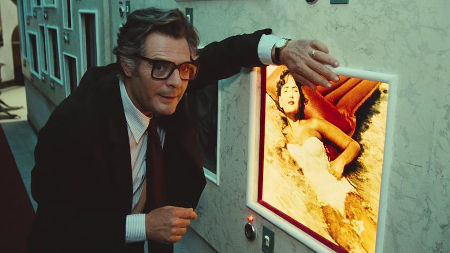
Still from City of Women (1980)

BACKGROUND:

  • A massive re-work of the story was required when the second male lead (Ettore Manni, who played “Dr. Katzone”) died from a fatal, self-inflicted gunshot wound to the groin.
  • Before returning to his reliable proxy Marcello Mastroianni, Fellini offered the role to Dustin Hoffman. Hoffman declined, as he was concerned about the post-dubbing process being detrimental to his performance.
  • Though it received largely positive reviews on its general release, it fared poorly at Cannes. , in Rome at the time working on Nostalghia, dismissed City of Women in his diary, saying “…it’s true, his film is worthless.”
  • Production designer Dante Ferretti was kept on his toes while making of the film, as Fellini would constantly request that new, elaborate sets be whipped up in a small amount of time. Farretti invariably obliged the director’s requests, and his success allowed him sole billing as “Production Designer,” a title usually nabbed by Fellini himself in the movie’s credits.

INDELIBLE IMAGE: After the brief introduction of the train ride turning into a romp across a field, virtually everything that follows in Fellini’s City of Women starts globbing on to the memory. From a long list of choices (addled Feminists fomenting in an hotel, drugged-out [?] minors driving the middle-aged protagonist to a haunting techno-pop tune, and an aged Lothario blowing out 10,000 candles among them), perhaps the best choice is the joy-filled sequence in the museum of women at Katzone’s villa. Snàporaz darts back and forth with an innocently lecherous glee as he flicks on the photographs’ illumination and hears a snippet from that woman’s sexual history. The visual and sonic overload goes up to eleven when Snàporaz’s ex-wife appears at the end of the corridor and turns on all of the displays. Women, women everywhere—in sound and vision.

THREE WEIRD THINGS: The hall of sexual conquests; memory lane slide; ideal woman escape balloon

WHAT MAKES IT WEIRD: Traipsing along for two and one-half hours, City of Women somehow combines the sugary charm of a light-weight musical with the non-stop adventure of an epic film. Beginning with a tone bordering on the mundane (the tediousness of travel), Fellini quickly pushes things from believable, to somewhat believable (the feminist convention), then onwards and upwards to a literal and metaphorical peak of disbelief as our hero escapes an arena full of spectators by clinging to a hot-air balloon. Between the jostling in the train car and the flight into the unknown, it would be faster to answer the question, what isn’t weird about it?


Original Italian trailer for City of Women

COMMENTS: Obsession can be a dangerous thing, but it can also be Continue reading 272. CITY OF WOMEN (1980)

271. THE HOURGLASS SANATORIUM (1973)

Sanatorium pod Klepsydra; AKA The Sandglass

“For in that sleep of death what dreams may come
When we have shuffled off this mortal coil,
Must give us pause. “–Hamlet, Act III, Sc. 1

Recommended

Weirdest!

DIRECTED BY:

FEATURING:

PLOT: As the film opens, Józef is on a train headed to a sanatorium where his dead father is being kept. When he arrives, the grounds are deserted and decrepit, but eventually he finds a doctor who leads him to his now-sleeping father’s room and explains the patient’s comatose-but-alive status: “the trick is that we moved back time… we reactivate past time with all its possibilities.” Józef then wanders through the sanatorium’s grounds, meeting his mother, a collector of automatons, a parade of men dressed in bird costumes, the Three Wise Men, and other strange characters.

Still from The Hourglass Sanatorium (1973)

BACKGROUND:

  • The film was primarily based on Polish Surrealist author Bruno Schultz’s short-story collection “Sanatorium Under the Sign of the Hourglass,” although it included ideas from some of the author’s other short stories. (A Schulz story was also the inspiration for the ‘ stop-animation nightmare “The Street of Crocodiles“).
  • Wojciech Has worked on this project for five years.
  • The Hourglass Sanatorium did not receive the blessing of the Polish censors and was banned. Has had copies smuggled to the Cannes Film Festival, where it tied for the jury prize (at that time, essentially third place). In apparent retaliation for his insubordination, the Communist Party did not approve any of Has’ new film projects for the next ten years.
  • In Poland, an hourglass is a symbol of death.

INDELIBLE IMAGE: Oddly enough, especially given how visually sumptuous The Hourglass Sanatorium is, the image which best evokes the movie isn’t even in it. I speak of the famous theatrical release poster by Polish artist Franciszek Starowieyski, which depicts a giant orange eyeball perched on a jawbone, with a grill of teeth through which a worm crawls (a limbless woman’s torso is also stuck between its molars), while numbers and arrows illustrate features of bone anatomy like occult footnotes. The poster seizes upon the film’s major theme of death; Starowieyski was also picking up on the repeated motif of eyeballs which occurs throughout the Sanatorium, from the train conductor’s blind stare to the cobweb-covered eyeball collection Józef finds under the bed. To illustrate the film, we ultimately chose the image of a toppled wax automaton with his eye-socket popped open to reveal the gears inside—but when I think of The Hourglass Sanatorium, I always think of that poster first.

THREE WEIRD THINGS: Crow frozen in flight; Józef spying on Józef; eyeballs under the bed

WHAT MAKES IT WEIRD: The Hourglass Sanatorium is a rare work of genuine Surrealism. Seldom has any film ever captured the free-falling feeling of being lost in a dream so well: the portentous but inexplicable visions; the tenuous, tantalizing connections between ideas; the smooth and continuous shifting of realities. Let a blind conductor be your guide inside a crumbling hospital whose rooms hold wonder after wonder.


Brief clip from The Hourglass Sanatorium

COMMENTS: Sanatorium pod Klepsydra opens on the silhouette of a Continue reading 271. THE HOURGLASS SANATORIUM (1973)

CAPSULE: NIGHT HAS A THOUSAND DESIRES (1984)

Recommended

DIRECTED BY:

FEATURING: Lina Romay, Daniel Katz, Carmen Carrion, Albino Graziani, Jose Llamas, Mauro Rivera

PLOT: Irina, a psychic who performs a nightclub act with her lover Fabian, is plagued by nightmares that she believes to be real.

Still from Night Has a Thousand Desires (1984)

WHY IT WON’T MAKE THE LIST: Some of the visuals are surreal and the film has a trippy feel; this is achieved with music and creative camera work that do not equate to weirdness.

COMMENTS: A few years ago I started a (NSFW) feature on Tumblr called Franco Friday. It was part of an ongoing project to see every film Jess Franco has directed. IMDB lists 203 Franco films; according to Wikipedia ((The number of films directed by Jess Franco according to Wikipedia is “about 160”.)), that number is inaccurate. Apparently there are several films listed under more than one title. I noted in my June 2015 Vampyros Lesbos review that I had viewed some 40-plus Franco films at that time. Night Has a Thousand Desires marks my 70th Franco flick. It is already becoming difficult to find Franco films I have not seen, and I have yet to reach the halfway mark of his library.

Never missing an opportunity to make the most of a budget, Franco would often make two or three films all using the same cast, wardrobe and locations. Night Has a Thousand Desires was obviously filmed just before or after the inferior The Sexual Story of O, which I by chance had watched the week before. I have enjoyed a lot of  Franco’s output from the early 1980s, and I think Night Has a Thousand Desires is his best of the period.

The film takes place in the Grand Canary Islands; the scenery is really beautiful. Both the natural shots and the interior locations are well chosen. The building where much of the story takes place has lovely stained glass windows that Franco uses repeatedly; it lends a great deal to both films vibe. The garden setting where one of Irina’s nightmares occur is superb. The copious zoom shots Franco is so fond of effectively relay a feeling of hypnosis. Everything about this film visually is on point. The soundtrack complements it perfectly: a mix of music borrowed from previous Franco films, including Female Vampire and Devil Hunter, combined with all manner of groaning, grunting, echos and plenty of chanting. Irina’s name is repeated over and over throughout. In one scene, the film’s best, Irina shares a joint with a man and two women who had attended her night club act. I felt like I was getting stoned along with the quartet.

It wouldn’t be a Franco film without sex and violence. Rest assured there are healthy helpings of sex and nudity, and most of these scenes have a bloody ending. The story is straightforward and there is certainly no mystery to solve; plotwise, the cat is let out of the bag early. This does not make the film any less captivating to watch. Lina Romay is outstanding! Whether under a trance, screaming and howling, crying, laughing, giving or receiving sexual pleasure, her character is empathetic and very watchable. Night Has a Thousand Desires is an entertaining and visually impressive Franco effort with a fabulous soundtrack and a great performance by Romay that should delight his fans.

Mondo Macabro’s package offers a really nice Blu-ray transfer with concise, easy to read subtitles and crisp and clear sound. I had to turn down the volume several times (I’m pretty sure my neighbors already think I’m a pervert, so I don’t know why I bother). The extras are a bit thin. There is solid Eurotika documentary on Franco that I had actually already seen before (I believe on another Mondo Macabro release) and an interview with Stephen Thrower, author of “Murderous Passions: The Delirious Cinema of Jesus Franco.” The art work on the DVD cover by Justin Coffee is superb! If you are a fan of Jess Franco you need this in your collection.

268. DEAD ALIVE [BRAINDEAD] (1992)

Known as Dead Alive in North America, Braindead elsewhere

“You know what they are saying about you don’t you? You’ve got funny in the head! A real bloody weirdo!”–Roger, Dead Alive

Recommended

DIRECTED BY:

FEATURING: Timothy Balme, Diana Peñalver, Elizabeth Moody, Ian Watkin, Stuart Devenie

PLOT: An explorer discovers a Sumatran “Rat-Monkey” on Skull Island; the creature is safely housed in a Wellington zoo. The animal escapes and bites Lionel’s overbearing mother, who becomes a zombie and infects anyone she comes across. Lionel then juggles the advances of the local shop owner’s daughter Paquita and the machinations of his blackmailing uncle with the zombies mounting in his basement.

Still from Dead Alive (Braindead) (1992)

BACKGROUND:

  • Written before the controversial puppet black comedy Meet the Feebles, but filmed afterward. This was the first script co-written with longtime Jackson collaborator and partner Frances Walsh. The story originated with the third credited co-writer, Stephen Sinclair, who originally conceived of it as a stage play satirizing New Zealand society.
  • Partly funded by taxpayer dollars through the New Zealand Film Commission.
  • The film won Best Screenplay at the New Zealand Film and Television Awards in 1993. It won Best Film (and Best Special Effects) at the 1993 edition of the Fantasporto Film Festival for genre pictures.
  • Released as Braindead in New Zealand, Australia, and other countries, but as Dead Alive in North America to avoid confusion with the practically identically titled 1990 horror film Brain Dead (directed by Adam Simon).
  • The uncut version was banned for extreme violence in several countries, including Finland, Singapore, and South Korea.
  • Came in it #91 on Time Out’s 2016 poll of the greatest horror movies.

INDELIBLE IMAGE: The Grand Guignol finale where Lionel cuts down a horde of zombies with a lawnmower. Three hundred liters of fake blood were used in this scene.

THREE WEIRD THINGS: Sumatran Rat-Monkey; zombie baby; the Lord’s ass-kicker

WHAT MAKES IT WEIRD: From the seemingly benign and placid surface of 1950’s New Zealand society, director Peter Jackson spews forth undead geriatrics consuming German Shepherds, amorous zombies who impregnate each other, sentient viscera, oedipal vaginal imagery on an epic scale, and an inexplicable excursion to the local park with a zombie baby. The invention and gory slapstick of this film are comparable to a Looney Tunes episode where Wyle E. Coyote falls into a spool of razor wire. Or perhaps the antics of and the Keystone Cops defending themselves from an undead invasion after ingesting speed-balls.


Original trailer for Dead Alive

COMMENTS: I fondly remember Braindead from my 1990’s adolescence, days of VHS and weekends spent with friends, trying to outdo Continue reading 268. DEAD ALIVE [BRAINDEAD] (1992)

CAPSULE: OUT 1: NOLI ME TANGERE (1971)/OUT 1: SPECTRE (1972)

Recommended

DIRECTED BY: Jacques Rivette

FEATURING: Jean-Pierre Leaud, , Michele Moretti, , Bernadette Lafont, , Francoise Fabien, Hermoine Karagheuz, Eric Rohmer

PLOT: Two theatrical troupes: one amateur and one professional, with different artistic approaches, rehearse plays by Aeschylus. Two loners: one male and one female, both scam artists, operate independently of each other. All these players are seemingly connected via a loose conspiracy of “13,” inspired by the work of Honoré de Balzac and .

WHY IT WON’T MAKE THE LIST: The improvisational framework is experimental, but it’s more conventional in its overall form. Rivette’s follow-up feature, Celine and Julie Go Boating, which is indebted to Out 1 in its production and concept, is closer to “weird.”

COMMENTS: Out 1 was long hyped as “the Holy Grail of modern French cinema,” and that was not mere hyperbole. After French television turned the project down, a four-and-a-half-hour cut, Spectre, was edited to screen in theaters (with an intermission). The original version thirteen-hour version, Noli Me Tangere (Don’t Touch Me) was screened only once in workprint form in the early 70’s. A re-edited version followed in the late 80’s, and a “finished” version turned up on German and French television in the early 90’s.

At first, watching the complete, restored Out 1 may seem a daunting enterprise, but in a world of binge viewing, it seems very contemporary, while simultaneously presenting a time capsule of France in the early 70’s. Out 1 explores the role of art (specifically theater) in society, interpersonal relationships, and secret societies/conspiracies, all in a way that is very entertaining—much more than the words “experimental feature” would suggest.

Looking at it 45 years later, one thing that helps give Out 1 some perspective are the events of May ’68, which is the hub from which the story revolves around. After a brief period of revolution and the hope of all things possible, we pick up two years later; and while the revolutionary spirit is still alive in the efforts of the troupes, everyone involved is disillusioned with their current reality to some degree. The passing of a note to Colin (Leaud) by an unknown woman—seen as one of the actors in one of the troupes—stirs him to investigate the concept of the “13,” and its effect ripples out among the characters. Is there indeed a conspiracy? Or is the conspiracy merely an abstract concept of a fleeting ideal that may never be obtained, but should always be pursued?

The Noli Me Tangere version, presented over eight episodes, anticipates such shows as “Lost” with its canvas of characters and a central mystery at the core. However, while that mystery provides dramatic momentum, it is not the primary focus; in fact, it isn’t until Episode 5 that it begins to coalesce. A substantial portion of each episode focused on the exercises and rehearsals of both troupes, and their succeeding analyses. It’s a detailed look at theatrical process, and while some may find these sections maddening, they’re an important part of the whole: “acting”  and “performance” are the main subjects, after all. The characters’ interactions with each other at many points are performances, especially the outsiders Colin and Frederique (Berto), whose scams are another form of improvisation. And the entire enterprise is a performance by everyone involved. The Spectre version keeps this basic frame intact, yet at four hours, much is condensed. Scenes are rearranged, some tangents are dropped, and the “Conspiracy of 13” aspect is center stage.

BLU-RAY/DVD INFO: In 2016, Carlotta released a region free box set in North America of both versions of Out 1 on Blu-ray and DVD, featuring a 2K restoration. Also included in the set is a documentary, The Mysteries of Paris: Jacques Rivette’s OUT 1 Revisited, which is extremely informative, and a 120 page booklet with essays and notes. For those in the UK or with region free players, Arrow UK issued the box set “The Jacques Rivette Collection” which includes Out 1, and the additional Rivette features Duelle, Noroit and Merry-Go-Round.

LINKS OF INTEREST:

Order of the Exile – Jacques Rivette website

Introduction to Rivette – Jonathan Rosenblum essay on Rivetter

Out 1 And Its Double – Jonathan Rosenblum’s essay from the box set release

WHAT THE CRITICS SAY:

“Uniquely ambitious, Rivette’s film (technically a serial) spends nearly 13 hours stitching paranoia, loneliness, comedy, and mystical symbolism into a crazy quilt big enough to cover a generation.”–Ignatiy Vishnevetsky, The A.V. Club (Blu-ray)