
When pictures surface of people having their facial features stolen, a woman seeks the help of a detective to track down the mysterious force behind it.
Tag Archives: Psychological
175. L’IMMORTELLE (1963)

“-Do you know the poems of Sultan Selim?
‘They are full of flowers and perfumes,
greenery, cool fountains, and slim jets of water.’
-Which Sultan Selim?
-I don’t know. Whichever. They were all named Selim and they all wrote the same poems with the same cliched imagery that recurs like fetishes. Or passwords you utter to pass through the garden gate and enter the palace of your sleepless nights.”- L’Immortelle
DIRECTED BY: Alain Robbe-Grillet
FEATURING: Françoise Brion, Jacques Doniol-Valcroze, Catherine Robbe-Grillet
PLOT: A professor vacationing in Istanbul comes across a mysterious, vivacious woman who weaves in and out of his life during a fateful summer. The impenetrability of the woman ignites an obsession in the professor, one that leads him into the shadowy, knotted heart of the city and the underbelly of his own desire.

BACKGROUND:
- Already a staple in French New Wave as a successful screenwriter (Last Year in Marienbad), Alain Robbe-Grillet was trying to break into motion pictures as a director, but was unable to find the funding. A Belgian producer agreed to fund his first feature on the condition that he use funds legally tied up in Turkey (due to an inability to convert the Turkish pound, which had left a wool-trading friend of the producer’s unable to use his profit anywhere else in the world). Robbe-Grillet shot the film there and used the location as a central narrative device, in the vein of a cinematic arabesque.
- Robbe-Grillet’s own wife Catherine plays the oft-mentioned Catherine Sarayon (or Carayon). Robbe-Grillet met her in Turkey, which is similar to the way the protagonist meets the woman he falls for in L’Immortelle. Catherine wrote several novels of sadomasochistic erotica, sometimes under the pseudonym “Jean de Berg.”
- During filming, Turkey erupted into a violent revolution in which the heads of government were all hanged. Robbe-Grillet, whose production company had made deals with the ousted government, had to get out hastily and wait in France for the volatile situation to die down before returning to complete the film.
- Although it was reasonably well-regarded at the time of its release, screening at the Berlin Film Festival, L’Immortelle since fell between the cracks and was not released on home video in any form until 2014.
INDELIBLE IMAGE: This film is rife with iconic, spellbinding imagery, but chief among them is the mystical and sacred moment in the mosque as the professor, already deeply entranced by the woman of his waking dreams, searches for her in the darkness. He shambles around a corner with desperation in his gait (slowly, though, as if no wait was long enough), and spies the woman kneeling on the ground kneeling in prayer, perfect and impregnable. She rises to meet him like a goddess of torturous pleasure; her grace and beauty combined with his love-struck agony in the shadows is a moment of understated, haunting beauty.
WHAT MAKES IT WEIRD: L’Immortelle operates less like a film and more like a state of mind, using baffling, at times purposely repetitive shots to create something that transcends the world of the nominal. It is a movie based in philosophy, emotion, and spirituality, not plot and structure. It does not want to entertain or make sense, it wants to touch below the surface, and it does through the tried-and-true tactic of not explaining a single thing, compounding each image placed on screen into an enigma that never diminishes as time rolls on.
Original French language trailer for L’Immortelle
COMMENTS: The narrative tradition is a lie. From our earliest fables to the towering epics of our own time, we tell stories in the way that is the most Continue reading 175. L’IMMORTELLE (1963)
174. VERTIGO (1958)
“If Vertigo remains, unchallengeably, Hitchcock’s masterpiece, this is surely because there the attitude to the unknown and mysterious is not simply one of terror but retains, implicitly, a profound and disturbing ambivalence.”–Robin Wood, “Hitchcock’s Films
“Only one film had been capable of portraying insane memory, impossible memory: Alfred Hitchcock’s Vertigo.”—Chris Marker, Sans Soleil

DIRECTED BY: Alfred Hitchcock
FEATURING: James Stewart, Kim Novak, Barbara Bel Geddes
PLOT: During a rooftop pursuit of a fleeing suspect, John “Scottie” Ferguson finds himself hanging from a drainpipe; the uniformed cop who tries to save him slips and falls to his death. Suffering from debilitating acrophobia and vertigo, as well as survivor’s guilt, Scottie quits the police force. An old college acquaintance offers him a job tailing his wife, and Scottie becomes obsessed with the beautiful and mysterious woman who believes she is possessed by the spirit of a suicidal ancestor.
BACKGROUND:
- The source of Vertigo was the novel “D’Entre Les Morts” (translated in English as “The Living and the Dead”), by the French writing team of Pierre Boileau and Thomas Narcejac. Hitchcock had wanted to adapt the pair’s first novel, “Celle qui n’était plus,” but the rights were sold to a French company and it was made as Les Diaboliques by Henri-Georges Clouzot. Boileau-Narcejac would later write the screenplay for Les Yeux Sans Visage [Eyes Without a Face] (1960).
- Hitchcock bought the rights to Vertigo back from Paramount (along with four other 1950s-era films), then willed them to his daughter. The film went out of circulation for many years. The rights eventually ended up with rival studio Universal, who restored and re-released the film theatrically (in 1983 and again, after a major restoration, in 1996) to great acclaim.
- The dizzying “vertigo” effect (sometimes known as the “dolly zoom” or “trombone shot”) is the film’s most famous technical innovation: the camera tracks backwards on a dolly while simultaneously zooming the lens, resulting in a disorienting visual experience of moving backwards and forwards simultaneously.
- Abstract Expressionist painter John Ferren designed the dream sequence.
- A controversial flashback scene reveals the “twist ending” about two-thirds of the way through the movie. Before the film’s release Hitchcock decided to remove this sequence, over the strenuous objections of his producer, Herbert Coleman. After preview audiences were unimpressed by the flashback-free cut, the studio ordered Hitchcock to return the film to the way it was originally shot.
- Vertigo, which was exceedingly dark compared to the average Jimmy Stewart vehicle, was not as successful as Hitchcock’s previous hits such as 1954’s Rear Window, and barely broke even at the box office. The scale of its initial failure is often exaggerated, however, for the sake of a good story: it qualified more as a minor disappointment than a flop. The contemporaneous reviews were also mixed (leaning towards positive with reservations about plausibility and pacing), rather than universally negative, as is sometimes implied.
- In the 2012 Sight & Sound critics poll, Vertigo replaced Citizen Kane, the top vote getter every year since the poll’s inception in 1962, as the greatest movie of all time. (It ranked #7 on the director’s poll, where Tokyo Story took the top spot).
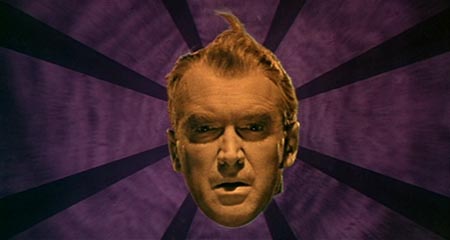
INDELIBLE IMAGE: It has to come from the dream sequence. Although we chose Jimmy Stewart’s head floating against a shifting kaleidoscope background to illustrate this review, the most thematically significant image is the male shadow falling, first onto a terracotta rooftop and then through a white void (this figure is incorporated into the original Saul Bass-designed poster, where it combines with the movie’s other significant motif, the spiral).
WHAT MAKES IT WEIRD: Vertigo may be one of the most subtly strange movies out there. It’s entirely possible to watch it and see it as no more than a conventionally (if implausibly) plotted mystery. But peer into its vortex closer and you’ll see why this brightly lit but oddly dreamlike tragedy has fascinated generations of moviegoers: in its depths hides madness, illusion, necrophilia, sexual domination, a perverse longing for death, guilt, and the grinding gears of merciless fate. There’s a reason Vertigo is a cult movie. It doesn’t give up its secrets easily. Watch it again, with your weird eyes.
Re-release trailer for Vertigo
COMMENTS: Did any movie produced under the Hollywood studio system ever torture its protagonist as mercilessly as Vertigo torments Scottie Continue reading 174. VERTIGO (1958)
170. GLEN OR GLENDA (1953)
“Some argue that this kind of thing puts Ed Wood into the company of Luis Buñuel and Salvador Dalí.
Should we buy this argument? Pull the string!”–IMDB Glen or Glenda FAQ
DIRECTED BY: Ed Wood, Jr.
FEATURING: Bela Lugosi, Ed Wood, Jr. (as Daniel Davis), Dolores Fuller, Timothy Farrell, Lyle Talbot
PLOT: A transvestite is found dead, a suicide. Seeking to understand more about this phenomenon, a police inspector visits a psychiatrist who explains transvestism to him using the example of Glen, a heterosexual man who is tormented by the question of whether he should reveal his passion for cross-dressing to his fiancée. Meanwhile, a sinister, omniscient “scientist” (played by Bela Lugosi) occasionally appears to cryptically comment on the action (“pull the string!”)

BACKGROUND:
- Producer George Weiss wanted to make a film to exploit the then-current case of Christine Jorgensen (born George William Jorgensen), one of the first men to have successful sex-reassignment surgery. According to legend, Ed Wood convinced Weiss that he was the right man to direct the picture because he was a transvestite in his private life and understood gender confusion. The resulting film, shot in just four days, ended up being more about transvestism than sex-change surgery.
- Against Wood’s wishes, Weiss inserted bondage-themed imagery into the dream sequence to give the film a dash more sex.
- Wood himself plays the transvestite Glen (and Glenda) under the pseudonym Daniel Davis.
- In his own life, Wood did not take the advice he gave his character in Glen or Glenda to honestly discuss his desire to wear women’s clothes with his betrothed. Wood’s first wife had their marriage annulled in 1955, after Ed surprised her by wearing ladies’ undergarments to their honeymoon.
- This is the first of three collaborations between Wood and then down-on-his-luck and opiate-addicted Bela Lugosi. Three of Lugosi’s final four credits were Wood films.
- Some reviews of Glen or Glenda refer to Lugosi’s character as “the Spirit” rather than “the Scientist”; were there two separate sets of credits, each with a different name for the character?
- Wood’s 1963 novel “Killer in Drag” features a transvestite character named Glen whose alter-ego is named Glenda.
INDELIBLE IMAGE: Such a wealth of possibilities! What about the hairy Satan who inexplicably shows up at Glen and Barbara’s dream wedding? And who can forget Bela Lugosi, yelling nonsense at the viewer while his angry face is superimposed over a herd of stampeding buffalo? The iconic image, however, is Wood’s intended emotional climax: in a ridiculously touching gesture of unconditional acceptance, Glen’s girlfriend Barbara strips off her angora sweater and hands it to the wide-eyed transvestite.
WHAT MAKES IT WEIRD: A narratively-knotted 1950s pro-transvestite pseudo-documentary, told in naively earnest rhetoric via a wandering structure that includes flashbacks inside of flashbacks, would have made for a worthwhile oddity in itself. But throw in Bela Lugosi as a one-man Greek chorus reciting fractured fairy tales, and include a fourteen-minute dream sequence mixing Freudian symbolism, bargain-basement Expressionism, bondage, and a guest appearance by the Devil and you achieve incomparable weirdness, the way only Ed Wood could serve it up—on a bed of angora.
Clip from Glen or Glenda
COMMENTS: Ed Wood had a secret, and it’s not just that he liked the feel of silk panties under his rough trousers. Transvestism, in a way, was the Continue reading 170. GLEN OR GLENDA (1953)
CAPSULE: BAD MILO (2013)
366 Weird Movies may earn commissions from purchases made through product links.
DIRECTED BY: Jacob Vaughan
FEATURING: Ken Marino, Peter Stormare, Gillian Jacobs, Stephen Root, Patrick Warburton, Mary Kay Place, Toby Huss
PLOT: An accountant finds that his searing intestinal pains come from a monster that lives in his lower digestive tract, who emerges from his bowels to kill whatever is causing him undue stress in his life.

WHY IT WON’T MAKE THE LIST: Playing like a cross between a Frank Henenlotter splatter goof and The Brood remade as a comedy, Milo has minor midnight movie aspirations, but lacks the gut impact to become one of the top weird movies of all time.
COMMENTS: For a movie about a demon that lives in an accountant’s colon and emerges to slay his enemies, Bad Milo isn’t nearly as much of an exercise in bad taste as you might think. There’s only one scene of spraying fecal matter, and it’s rather light, almost a mist. There’s more blood than poop, but Milo isn’t a gorefest by horror movie standards, either. The movie’s grossest moments are all left up to your imagination, suggested only by Ken Marino’s labored grunts. Whether this modicum of restraint constitutes a relief or a disappointment is up to you, but the odd fact is that Milo the movie ends as surprisingly good-natured as Milo the killer puppet is disarmingly cute. Ray Romano-lookalike Marino plays accountant Duncan as a put-upon pushover who gradually grows a pair when forced to defend his family from his own intestinal impulses. Marino is ably supported by a familiar cast of character actors whose presence give the movie a polished and professional feel (again, whether “polished and professional” is what you want from your butt-monster movie may be a matter of personal taste). Peter Stormare, as a disheveled, New Age-y hypnotherapist (“witch doctor!,” accuses his parrot) is the movie’s quirkiest creation. Mary Kay Place amuses as Duncan’s cradle-robbing mom who gives her son T.M.I. about her S&M lifestyle. Stephen Root plays a pothead whose laid back attitude proves a constant struggle for him, while Patrick Warburton proves a natural as a genially sociopathic middle manager. For the most part, the script’s humor emerges easily from the absurd premise and capable performances, and rarely feels strained.
Milo‘s unexpectedly layered psychology involves learning to cope with buried neuroses rather than letting them become impacted, paternal abandonment issues, and, most importantly, a fear of parenthood angle. Duncan may explicitly deny that the monster up his butt is a metaphor, but the movie begs to differ. And that very fact may hurt Milo with its target audience: by being more thoughtful and probing than the usual movie about butt-monsters, it passes up a lot of scatological opportunities, which may explain why it failed to wow the midnight movie crowds. This is a case where the movie might benefit from a less tasteful approach.
WHAT THE CRITICS SAY: