Tag Archives: Obscure/Out of Print

IT CAME FROM THE READER-SUGGESTED QUEUE: UN PERRO LLAMADO DOLOR [A DOG CALLED PAIN] (2001)

AKA El artista y su modelo [The Artist and His Model]

DIRECTED BY: Luis Eduardo Aute

PLOT: A series of vignettes about seven legendary Spanish-speaking painters and their relationships with their models, united by a dog which shares a name with Frida Kahlo’s beloved pet.
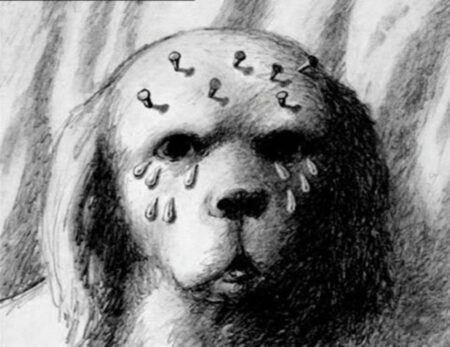
Imaged from "A Dog Called Pain" (2001)

COMMENTS: No doubt you’re all familiar with the Barbershop Harmony Society and the annual international barbershop quartet competition it hosts. Well, have I got news for you: just this past week, video of the 2023 finalists’ performances in Louisville earlier this year was posted online, so you now have the chance to see what the coolest kids in a capella close harmony are up to. In particular, you might want to check out the work of this year’s champion Midtown, who clinched the crown with a 12-minute mashup of “Old MacDonald Had a Farm” and the old “Spider-Man” cartoon theme, a performance which turns out to consist entirely of inside jokes. It’s so deep down the barbershop rabbit hole that the explanation merits its own playlist. And if the crowd’s response is any indication, the aficionados are eating it up with a spoon.

Now, why am I subjecting you to this bizarre-even-by-our-standards digression about an arcane and nearly forgotten musical subgenre? Because for weeks, I have been reckoning with what I think of Un perro llamado dolor, Luis Eduardo Aute’s hand-crafted fantasia on the lives and artistic stylings of some of the most famous painters who ever lived, and hearing this professional and utterly impenetrable barbershop performance proved to be a fitting analogue: it’s exceedingly skilled, breathtakingly beautiful in moments, and so far up its own ass that it threatens to cross dimensions.

Aute possessed a variety of talents, from composing chart-topping songs to headlining art shows across Europe to not only writing successful poetry but inventing new forms to increase the challenge. After a while, he began to combine his talents, uniting his artwork, songs, and poems around joint themes and even expanding into film, a medium he encountered early through a job he landed as a second A.D. on ’s Cleopatra. So here is a chance for all of his skills to come together.

It’s a mammoth undertaking. Aute created over 4,000 drawings in pencil and charcoal, often aping the styles of the greats he intends to honor. His assembly is barely animation (save for a couple computer-assisted shots late in the film, Un perro unfolds at a rate of about 3 seconds per drawing), but it flows smoothly through seven different portraits united only by the subjects’ profession and the titular dog. The dog is a curious companion. Named Pain (supposedly like one of Frida Kahlo’s actual dogs, although hers were Xoloitzcuintli and not the generic hound seen here), his presence hints at the constant agony all artists seemingly feel, but he is a loyal friend, protecting his masters and their models against all sorts of villains who would do them harm.

The dangers of both the making of art and the judgment of others seem to be foremost in Aute’s mind. We watch as crowds of celebrities (especially comic filmmakers) look on at Picasso’s Guernica like a Hollywood legend, but the artist himself needs reassurance from Man Ray that he’s done something worthwhile. is portrayed as unusually vulnerable, and his model even chops off one of his hands. Francisco Goya is attacked first by flying demons, then firing squads. Aute suggests that to be an artist is to endure trauma.

But maybe not. Divining Aute’s point is purely a guessing game. If you’re not an art historian, Un perro is a baffling collection of surreal images that convey the hauntings of a troubled soul but offer little interpretation. Even if you recognize Goya and his Maja desnuda, or intuit that it’s Leon Trotsky whom Diego Rivera stabs in the head with a Soviet sickle, there’s nothing to tell you why Aute brings them together. And those are just the artists I recognized. I found myself stopping the film frequently to peruse quick biographies of the subjects of Aute’s portraits in hopes of gleaning more insight into what was going on. (I have to confess that I was not familiar with Joaquín Sorolla at all, and his story in the film remains lost on me.) It’s the purest artist’s trope: let the work speak for itself. But what the work seems to be saying here is that it’s too smart for you.

My best hope for understanding comes from the title cards, which describe Un perro llamado dolor as a “libertarian fantasy based on the work and events of the lives of the artists portrayed.” It’s a curious label, given that the main characters in the film are in no way free. They are trapped by their obsessions, helpless in the face of fantastical fears, and able to defend themselves only with pencil or paintbrush. Aute may intend his film as a celebration of their persistence and fortitude, or he may seek to make them seem smaller, more human and fragile. It’s hard to know.

The obtuse nature of the film makes it a strange viewing experience, because it feels like it’s trying hard to push you away. Aute crafts something beautiful, but the experience locks you out, rather than inviting you in. Watching it in a room full of Spanish art historians would make for a very unusual experience. Much like being in an audience of barbershop quartet enthusiasts who laugh uproariously to drive home the point that they get all the jokes… and you don’t.

WHAT THE CRITICS SAY:

“The seven ‘portraits’ of assorted artists and their (usually nude) muses, starting with Goya and ending with Velasquez in no apparent chronological order, bear enigmatic titles like ‘There are no witches, but they do exist’ and proceed with a loopy, angst-filled dream logic that defies exposition.  A difficult, arcane film… will prove a hard sell outside the fest circuit, particularly since some of its profiled Spanish artists are virtually unknown here.” – Ronnie Scheib, Variety (contemporaneous)

(This movie was nominated for review by Wormhead. Suggest a weird movie of your own here.)

IT CAME FROM THE READER-SUGGESTED QUEUE: ROLLER BLADE (1986)

366 Weird Movies may earn commissions from purchases made through product links.

DIRECTED BY: Donald G. Jackson

FEATURING: Suzanne Solari, Jeff Hutchinson, Shaun Michelle, Katina Garner, Sam Mann

PLOT: During the Second Dark Age in the City of Lost Angels, a holy order of avenging roller-skating nuns battle evil mutants.

Still from Roller Blade (1986)

COMMENTS: It’s extremely important not to overthink Roller Blade, because Donald G. Jackson, the Z-movie legend who thought up the thing, absolutely did not overthink it. This is, after all, the man who dreamed up “Zen Filmmaking,” a commitment to scriptless, why-the-hell-not productions that make everyone else look as obsessive as . So let’s try and embrace the spirit of Roller Blade and just get to the heart of the matter.

This is a film that is made up almost entirely of lunatic choices. Placing the fate of humanity in the hands of a group of nuns on roller skates who wield switchblades that heal the wounded should clue you in, but Jackson happily goes further. The forces of good all speak in faux Shakespearean patois, even the highway patrolman who is the sisters’ only ally. The villains, meanwhile, consist of a man in a steampunk luchador mask and his mini-me, a wrinkly puppet that looks and acts like a bleached Triumph the Insult Comic Dog. (Speaking of which, one of the nuns is an actual dog.) The voice of wisdom is the order’s mother superior, a wheelchair-bound sage with a Latka Gravas accent and a propensity for astounding cosmic aphorisms like “The Cosmic Order of Roller Blade is the only force on Earth where all weapons and battle techniques are converted into tools of love” and “My visions have shown me a new world where it will one day be easy to trust every beast.”

The nuttiness extends to the filmmaking as well. The opening credits intercut incomprehensible images of women dressed like garden gnomes, a writhing woman enduring a restless slumber, and a group of hooligans on the attack, all to the tune of bombastic music cues that crescendo long before the list of names is complete, meaning the score has to keep restarting. With no natural sound, everyone is dubbed in the fashion of a Japanese monster movie, and the filmmakers are so committed to not showing moving lips that one character manages to play harmonica through a bandana.

And let’s not overlook Jackson’s commitment to crowd-pleasing nudity. Early on, three of the sisters are kidnapped and forced to engage in a naked catfight. When they are later rescued, they are brought back to the sanctuary to step naked into a recuperative hot tub and rub each other back to health. A character quickly peels off her bodysuit after being splashed with acid, and later kneels before a dying man to bless him with her uncovered body. Jackson has an audience in mind, and he’s prepared to fulfill their expectations.

It’s fun to list all that is quite nuts about Roller Blade, but the movie is actually less than the sum of its parts. It’s very slow, nobody’s motivations are entirely clear, and the tone is wildly inconsistent, swinging from broad comedy to awkward earnestness at random. So there’s no argument that there’s a lot of crazy stuff going on, but it never really coheres into anything watchable. It’s just Jackson coming up with ideas and immediately finding ways to film them. An impressive accomplishment, but an iffy product.

Creatively, it might be a mess, but Roller Blade was a financial smash, grossing $1 million off its $20,000 budget and earning Jackson the right to make the iconic Hell Comes to Frogtown. But his heart never strayed far from his humble beginning chronicling the adventures of bodacious babes in roller skates. Although he didn’t make good on the promise of the closing title card (advertising Roller Blade 2: Holy Thunder), he eventually helmed four sequels, each of which has a reputation for being strange. Donald G. Jackson wasn’t skilled, but he had audacity, and given how many times we’ve seen the reverse, his is a career to salute.

Roller Blade has never been released on DVD or Blu-ray and is available on vintage VHS only. At this writing, it can be found on Tubi, however.

A BRIEF HISTORICAL NOTE: Despite what the title might imply, no one in this movie who skates (and nearly everyone does) wears the inline skates of the title, but rather classic roller skates. That is because the product bearing the trademark “Rollerblade” was first commercially available in 1987, the year after this movie came out. I’m not saying that the movie inspired the mode of transport, but it does explain the confusing lack of Rollerblades in Roller Blade. 366 Weird Movies: out here doing the hard work so you don’t have to.

WHAT THE CRITICS SAY:

“…embraces its cheesy, campy, exploitative and bad qualities to produce something bizarre, like a cheap Mad Max made while on acid and horny.”–Zev Toledano, The Worldwide Celluloid Massacre

(This movie was nominated for review by Phoenix. Suggest a weird movie of your own here.)

CAPSULE: TWELVE HOURS WITH MARIA [AS HORAS DE MARIA] (1977)

DIRECTED BY: António de Macedo

FEATURING: Eugénia Bettencourt, João D’Ávila, Cecília Guimarães

PLOT: After purportedly being raped by her stepfather and expelled from home by her mother, blind 23-year old Maria is interned in the ruined remains of an old psychiatric ward by her aunt, Sister Ângela, who entrusts her to the care of Doctor Firmino.

Still from Twelve Hours with Maria [As Horos de Maria] (1977)

COMMENTS: António de Macedo is one of Portugal’s most unjustly treated directors. One of the pioneers of the “Novo Cinema” movement (Portugal’s version of the “New Wave”) and the country’s only consistent representative of genre filmmaking, he abandoned the craft in the early 1990’s out of frustration with the open ostracism to which he was subject, including the government’s refusal to finance his movies. He nevertheless left behind an important, although little noticed, body of work including the relatively successful A Promessa (The Vows) (the first Portuguese film to be selected for the Cannes Film Festival) and lesser-known works that delved explicitly in fantastical territory. His retirement from cinema saw him focus on other interests: he was also a playwright, novelist, and an explorer of religion and esotericism.

Twelve Hours with Maria, which could be described as a Gothic psychodrama, proved controversial at the time of release, denounced as blasphemous by the Catholic Church and inciting the ire of conservative activists who sabotaged screenings with violence and protests.

Set entirely within the austere confines of the abandoned ward to which Maria is committed, the film’s tone is accordingly solitary and cold; when not focused on the main character, shots are of the bleak edifice’s broken windows and unruly surrounding vegetation. Maria’s only interactions are with her visiting aunt and the calm and professional Dr. Firmino.

The film opts for a structure based on mystery. The way Maria’s inner world, and the complete account of what brought her to her current situation, is gradually unveiled through dialogue and confessions, as well as the subtler hints given by her occasionally erratic behavior, generate the suspense. Besides the broken state in which she finds herself, Maria’s mystical sense of faith is her principal character trait and the apparent source of her strength. Believing that her blindness will eventually be cured by the grace of the Virgin, and demonstrating an unshakable trust in fate, Maria’s faith is consistently challenged (as well as paradoxically strengthened) by a world that continuously subjects her to suffering and isolation. Dr. Firmino’s rationalist and historicist tirades, including commentary on scripture that is brought to life in vivid reenactments, clashes with the aunt’s dogmatic beliefs.

Besides the caricatured nun, the main source of controversy at the time were scenes where the atheist doctor presents an alternative version of the Gospel story, outrageously extrapolating from apocryphal sources to include a twin brother of Jesus, a son taken as hostage by Roman authorities, and reducing Christ’s movement to a merely political affair, depicting him as a guerrilla leader. These sections, with the bright colors of the desert, Roman troops, and bloodshed, provide a much welcome visual and tonal counterpoint to the rest of the film’s stark presentation; they are almost reminiscent of s theological explorations in The Milky Way. The film firmly avoids a satirical or ironical posture, however, adopting instead a sober approach to the dilemma of faith as it haunts the protagonist. Bettencourt’s convincing performance greatly aids this portrayal, capturing the varied inflections of a mistreated and troubled soul.

Although the story and the problems it raises don’t exactly build to a grand conclusion, the pervasive sense of mystery and the careful unfolding of new details through each new interaction or piece of dialogue will certainly provide an intriguing treat for fans of films dealing with similar themes and moods.

IT CAME FROM THE READER-SUGGESTED QUEUE: LA CICATRICE INTÉRIEURE [THE INNER SCAR] (1972)

DIRECTED BY: Philippe Garrel

FEATURING: Nico, Pierre Clémenti, Philippe Garrel, Christian Aaron Boulogne

PLOT: A man leads a woman through the desert;  abandons her as she pleads for help;  a nude archer arrives; the woman travels with him as well, until she again cries out in despair.

Still from La Cicatrice Interieur [The Inner Scar] (1972)

COMMENTS: The woman sits alone in a desolate landscape. A man approaches, wearing a burnt umber suit that is somehow both 70s and Victorian. He pulls the woman to her feet. They walk, heading toward the horizon as we fade to black. Before we’ve had a chance to fade in on the new scene, we can hear her, sobbing and wailing that she can’t breathe. She keens like a toddler who has been denied dessert, and the silent man finally abandons her, trudging off… in what turns out to be a circle, ending up right back with his bereft traveling companion. She shrieks “I don’t need you!” and staggers off into the distance. 

So passes the first ten minutes of La cicatrice intérieure. There isn’t going to be all that much variation on the theme. A first-time viewer should gird their loins for a lot of walking, a lot of screaming, occasional appearances by fire, and several dramatic songs that might be at home in a Ren Faire, courtesy of Nico. It’s the kind of film that will devote five minutes to despairing cries of“There is no justice!” followed immediately by an extended tracking shot of sheep being herded down a dirt road.

The temptation is to view La cicatrice intérieure as some kind of allegory. No one has a name, no one engages in dialogue, none of this should be taken literally. The locations in Egypt, Iceland, and New Mexico are stunning, but the people are barely even characters, and there are almost no situations to speak of. (The film even starts to parody itself, as more than one lengthy pan across a dramatic vista suddenly reveals Nico, once more shattering the peace with her vocal despair like an inescapable buzzkill.) But it doesn’t really say much in an abstract sense, either. The fire, the sword, the giddy nude toddler lying on a fur amidst a field of ice… they’re metaphorical, but without actually representing anything. 

So what is the goal? The film seems to function in part as a kind of proto-music video for Nico, the German chanteuse best known for her collaboration with the Velvet Underground. This makes it all the more curious that she doesn’t get top billing. Here she is, the actor with the most screen time, the only one to make the journey from the beginning of the film to the end, the ostensible reason the film exists at all, and she’s listed second. Although in fairness, perhaps the top spot is meant as a reward for Clémenti, who shows up as the new male lead roughly halfway through the film and who spends the duration completely naked save for a quiver and bow (which go unused). Clémenti is mostly impassive, although he impressively does things unclothed like ride a horse or sail a boat off an icy coast, inspiring the thought, “That looks really uncomfortable.”

The few moments of speech may be a clue as to the directorial intent. Nico alternates between German and English, while Clémenti and an adolescent boy speak French. Garrel reportedly refused to permit subtitles, meaning the literal incomprehensibility of some of the dialogue is a feature, not a bug. Being opaque is the point. That seems to be an overriding philosophy in La cicatrice intérieure; if you’re going to complain about things not making sense, you’re not the right audience. In that case, you might want to take a walk.

WHAT THE CRITICS SAY:

“… pretentious artsy indulgence at its worst.” – Zev Toledano, The Worldwide Celluloid Massacre

(This movie was nominated for review by NGboo, who dubbed it one of “the most surreal and weirdest movies I’ve seen this year” back in 2011. Suggest a weird movie of your own here.)

IT CAME FROM THE READER-SUGGESTED QUEUE: HANSEL AND GRETEL (1983)

366 Weird Movies may earn commissions from purchases made through product links.

DIRECTED BY: Tim Burton

FEATURING: Michael Yama, Alison Hong, Andy Lee, Jim Ishida

PLOT: A young brother and sister lost in the woods find sanctuary in a candy-covered house deep in the forest, but the witchy proprietor proves equally dangerous.

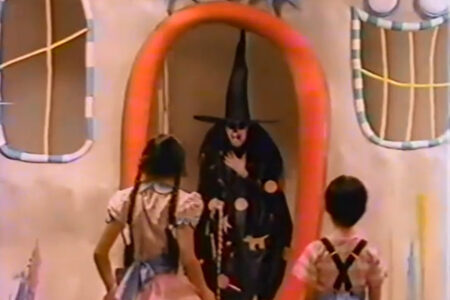
Still from Hansel and Gretel (1983)

COMMENTS: Several years ago, the 366 Weird Movies staff joined forces to debate the relative weirdness of the oeuvre of one Timothy Walter Burton. If one of his kooky gothic fairy tales might be inducted into the canon that had thus far eluded him, then perhaps one of us could make a compelling case for the film most worthy of the honor. (It should come as no surprise: Alfred Eaker’s pick won the day.) But in all that talk, not one of us even mentioned the very first live-action film ever crafted under Burton’s watchful eye. This turns out to be a significant oversight, because this small-scale retelling of a classic fairy tale is a true oddball by just about any yardstick. 

One reason “Hansel and Gretel” escaped our critical eye is because the film hardly had any eyes on it at all. It debuted on Halloween night in 1983, airing in the 10:30 p.m. slot on the Disney Channel as part of a special double feature hosted by Vincent Price, paired with Burton’s short animation “Vincent.” After being hidden in this near-invisible time slot, it was then buried even deeper, consigned to the Disney vault to never be seen again, eventually becoming the subject of rumors and doubt as to whether it was even real. Only when it resurfaced as part of a retrospective at New York’s Museum of Modern Art in 2009 were true believers rewarded with proof of its strange existence.

So now we have it—and while the story itself is pretty faithful to the version of the tale made famous by the Brothers Grimm (it’s number 327A on the Aarne-Thompson-Uther index of folklore), a handful of adjustments and adornments make Burton’s retelling unusual. For one thing, the director hired an all-Asian cast, an affectation which is progressive from a cultural-diversity standpoint but suggests a greater purpose that isn’t really explicated in the text. There’s also a stark emptiness to the set, with minimal decor and a hollow sound that suggests a vast soundstage mic’d up with a single boom. Where there is decor, however, it’s very Burton-esque, with toys that appear to have escaped from his animations and curlicue mountains straight out of The Nightmare Before Christmas. The confectionary house of the witch is especially bizarre, with walls and chairs that spurt colorful liquids when touched, and beds with cream-filled comforters that sprout hideous hands in the middle of the night.

Two performances are so eccentric that they make the case for weirdness all by themselves. Michael Yama’s dual-drag turn as both the wicked stepmother and the wicked witch leaves nothing on the table. (Any suggestion that they are one and the same character will only be met with vehement agreement.) Seriously, it’s the kind of performance that might make the contestants on “RuPaul’s Drag Race” tell him to take it down a notch. His stepmother is strictly bitchy, complaining about everything in an angry-Paul-Lynde cadence, greedily devouring hideous-looking food, and punishing the children just because she can. But it’s as the witch that he can really let his freak flag fly, with a candy-cane nose, an arsenal of sweet weapons, and a devilish affect that recalls Looney Tunes’ Witch Hazel. The other notably strange performance is Bam Bam, a misshapen, toothy gingerbread creature (puppeteered by future Pixar scribe Joe Ranft) who sings a parody of “Do Ya Think I’m Sexy” in an effort to persuade Hansel to eat him.

Hansel and Gretel suffers from a split tonal personality: the hideousness of the villains and Burton’s fondness for grotesque stylings, countered by good-natured innocence in the form of the blandly decent children and especially by Johnny Costa’s score, which feels exactly like his most famous work, the soothing tinkly piano stylings that underscored nearly three decades of “Mister Rogers’ Neighborhood.” As a fairy tale adaptation, it’s just okay. It works far better as a historical curiosity, a piece of juvenilia that Burton had to get past in order to realize his vision on a bigger scale. But it’s instructive to see his technique before the edges started to get sanded away, when skill and budget were the only things limiting his creativity. 

WHAT THE CRITICS SAY:

“I understand why Disney canned this thing after one airing. It’s not even so much that it’s too scary, but it’s just weird. Everything after Hansel and Gretel enter the witch’s house is just one strange creative decision after another… I have no clue if Burton wasn’t given enough money to work with, or was under the influence of some very strong hallucinogens, but this is truly bizarre and unprofessional. It’s easily the weirdest thing I’ve seen yet.”–Collin, Movie Match-Up

(This movie was nominated for review by Ari Srabstein, who dubbed it “a very strange and fascinating film in my opinion and truly unique.” Suggest a weird movie of your own here.)