Tag Archives: International cast and crew

CAPSULE: TETSUO: THE BULLET MAN (2009)

DIRECTED BY:

FEATURING: Eric Bossick, Akiko Monô,

PLOT:  A salaryman with “android DNA” turns into a metal monster when he gets angry.

Still from Tetsuo: The Bullet Man (2009)

WHY IT WON’T MAKE THE LIST: Tetsuo: The Bullet Man (2009) is a virtual English language remake of the same auteur’s original (Certified Weird) Tetsuo: The Iron Man (1985) that’s inferior in every respect except for budget.  See the original instead.

COMMENTS: Besides the basic man-becomes-mineral motif, Tetsuo: The Bullet Man contains several explicit nods to Tetsuo: The Iron Man.  The salaryman’s spastic dance over the opening title is recreated.  The metal transformation is once again set in motion by a hit-and-run accident, although the implications are quite different this time.  And Tsukamoto’s trademark high-speed zoom effect, where he edits a series of stills together at breakneck speed to take the viewer on a roller-coaster ride, is again in play.  But whereas in Iron Man the technique was used to create the cheesy but effectively unreal illusion of the Salaryman and the Fetishist racing through deserted city streets, here the rapid-fire cuts don’t lead us on a journey, but reveal only random, unconnected shots of skyscrapers skewed at various angles.  The editing creates movement and pace, but it doesn’t go anywhere.  Therein lies your metaphor for comparing the two films.  Tsukamoto tries to endow this 21st century Tetsuo with more plot sense, but the movie ends up making less artistic sense.  There is a basic (though logically unsatisfactory) b-movie schema to “explain” things this time out.  Half-Japanese Anthony (the archetypal Salaryman is given a name for this outing, as part of the half-hearted attempt to relocate Tetsuo in our reality) has the misfortune of having inherited “android DNA” that will cause him to mutate into a man/killer machine hybrid if he gets angry enough.  A paramilitary group is intent on assassinating him before he can learn to harness his power, while director Tsukamoto plays a mysterious figure whose goal is to goad Anthony into transforming into a human arsenal, both by threatening his family and by calling him “cowboy.”  The result is many confusing, dimly lit battle scenes; missing, sadly, is the Continue reading CAPSULE: TETSUO: THE BULLET MAN (2009)

88. THE PILLOW BOOK (1996)

“I am certain that there are two things in life which are dependable: the delights of the flesh, and the delights of literature.  I have had the good fortune to enjoy them both equally.”–Sei Shōnagon, “The Pillow Book,” Section 172.

DIRECTED BY: Peter Greenaway

FEATURING: Vivian Wu, Ewan McGregor, Yoshi Oida

PLOT: Every birthday, Nagiko’s father draws calligraphic figures on her face while ritualistically reciting the story of creation. Nagiko grows into a beautiful young fashion model obsessed with the intersection of calligraphy and sex, seeking lovers who will use her naked body as a canvas on which to write. She meets and falls in love with a bisexual British translator who convinces her to write on others’ bodies, and together they conspire for revenge against the publisher who wronged her father.

Still from The Pillow Book (1996)

BACKGROUND:

  • The “Pillow Book” from which the movie takes its title is “The Pillow Book of Sei Shōnagon,” the diaristic collection of anecdotes, observations, poetry and lists by a lady-in-waiting to Empress Sadako of Japan in the Heian era (the book was composed around 1000 AD).  Shōnagon’s work, though probably never intended for others’ eyes, became one of the classics of Japanese literature and a tremendous source of historical data about the Japanese imperial court.  Greenaway was inspired by “The Pillow Book,” but the film is not an adaptation of Shōnagon.  In an interview he explains: “I took some of [the book’s] sensitivities, primarily where Sei Shōnagon said, ‘Wouldn’t the world be desperately impoverished if we didn’t have literature and we didn’t acknowledge our own physicality?’ And the movie’s just about that.”
  • Occasionally, the spoken Japanese dialogue is not translated into subtitles. This is deliberate.
  • Venerable cinematographer Sacha Vierny had shot Greenaway’s previous six feature films and had previously worked with Resnais (Hiroshima Mon Amour, Last Year at Marienbad), Buñuel (Belle de Jour) and Raoul Ruiz (The Hypothesis of the Stolen Painting, Three Crowns of the Sailor), among other notable (and weird) directors.

INDELIBLE IMAGE: There are a bewildering number of nominees to choose from, especially since Greenaway frequently places two or three images on the screen at once, picture-in-picture style.  The overwhelming repeated image is that of writing inked on nude bodies, however, and so the shot of glowing letters cast on Vivian Wu’s darkened, reclining body as she writes in her diary in bed best captures The Pillow Book‘s visual fetish.

WHAT MAKES IT WEIRD: The Pillow Book is a movie about a fetishistic, eccentric, obsessed


Trailer for The Pillow Book

character, brought to us by an auteur with firsthand knowledge of those qualities.  Greenaway splashes the screen with visual extravagances, with pictures framed inside of other pictures, and images layered on top of one another, melding one into the next.  Full of obscure musings about the nature of art and sex, The Pillow Book tells a story of lust and revenge, but subjugates the text to the image, the narrative to the cinematic.  The result is visually hypnotic, frequently frustrating, and all Greenaway.

COMMENTS: A man and woman make love.  The entwining limbs are spectral, as their Continue reading 88. THE PILLOW BOOK (1996)

81. ENTER THE VOID (2009)

“Q: How would you define the film’s genre?
A: Psychedelic Melodrama.”–Gaspar Noé, Enter the Void Cannes pressbook

Recommended

DIRECTED BY: Gaspar Noé

FEATURING: Nathaniel Brown, Paz de la Huerta

PLOT: Oscar is a drug-dealer living in Tokyo with his stripper sister.  One day he is shot and killed during a deal inside a bar called “The Void.”  He spends the rest of the movie as a silent ghost, floating around Tokyo and observing his sister and friends, while simultaneously hallucinating and remembering the details of his life.

Still from Enter the Void

BACKGROUND:

  • Noé wrote preliminary scripts for Enter the Void as early as 1994; the screenplay was consider to expensive to produce until the director’s 2002 success with Irréversible made it appear commercially viable.
  • Star Nathaniel Brown, a non-actor, was chosen because of his physical resemblance to lead Paz de la Huerta and because he was interested in directing.  As someone with no acting ambitions, Noé presumed Brown would not be upset by the fact that his face is only seen once in the film, briefly in a mirror.
  • Visual perfectionist Marc Caro supervised the set designs.
  • The 100 page script indicated the action and described the visual effects, but very little dialogue was scripted; the actors improvised most of their lines.
  • The paintings Alex is shown working on in the film were actually painted by Luis Felipe Noé, the director’s father.
  • The original run time of the film at its Cannes debut was 163 minutes.  Post production and editing continued after this debut, and, as completed in 2010, the final run time of the film (which premiered at the Sundance Film Festival in January, 2010) as screened in the U.S. is about 140 minutes.  There is a longer version of the film, however, including a 17 minute sequence where Oscar believes he has woken up in the morgue; this segment occupies reel 7 of 9 reels, and for American screenings the film was simply shown with reel 7 omitted.  The extended cut is available on French DVD releases.
  • Noe instructed theaters that the film should be run at 25 frames per second rather than the usual 24 frames (this fact accounts for some of the discrepancies in listed running times).
  • At the Cannes premier there were no opening or closing credits.  The film began on a closeup of the none sign reading “enter” and ended with the words “the void.”
  • Noé got the idea for the film form watching Robert Montgomery’s noir The Lady in the Lake while on a magic mushroom trip.  Like Enter the Void, Lady in the Lake is filmed entirely from a first-person point of view (actually, in Void the POV is usually from about a foot behind Oscar’s head, though at other times we see events through his eyes).
  • Tokyo was chosen as the location of the film partly because Japan’s strong ant-drug laws would make the actions of the police more believable, partly because Noé believed the city, with its abundance of neon, had a “druggy mood.”
  • Pioneering acid guru Timothy Leary used to read “The Tibetan Book of the Dead” to voyagers undergoing LSD trips in an attempt to steer the experience in a spiritual direction.

INDELIBLE IMAGE: The opening DMT trip, with it’s multicolored mandalas, floating planetoids, and neon tentacles seems hard to top, but it merely sets the mood.  It’s the pornographic “Love Hotel” scene, with its parade of rutting couples with mystically glowing genitalia, that really impresses itself on the mind’s eye.

WHAT MAKES IT WEIRD: As the most impressive and eye-splintering acid trip movie of the decade (by a wide margin), Enter the Void gets an automatic pass onto the List of the 366 Best Weird Movies of All Time. The fact that the protagonist is dead throughout most of the movie doesn’t hurt its chances one bit.  But the clincher, the sure sign that the movie is weird, is the walkouts.  Less than halfway through the screening I saw, the sexagenarian couple who had stumbled into the film by accident (probably thanks to ad copy suggesting the movie was a sentimental ghost story about brotherly love that transcends death) walked out of the theater, leaving me alone with two same-sex couples with facial piercings and hair that glowed in the dark.


Original trailer for Enter the Void

COMMENTSEnter the Void is an exploitation piece masquerading as an art installation, Continue reading 81. ENTER THE VOID (2009)

72. ANTICHRIST (2009)

“If Ingmar Bergman had committed suicide, gone to hell, and come back to earth to direct an exploitation/art film for drive-ins, [Antichrist] is the movie he would have made.”–John Waters, “Artforum Magazine”

Must See

DIRECTED BY:

FEATURING: William Dafoe, Charlotte Gainsbourg

PLOT: He and She (the characters are nameless) are making love when their child tumbles to his death out of a window. She falls into inconsolable grief, and He, a therapist, unwisely decides to take her under his personal care. When He discovers the root of She’s anxiety and irrational fears centers around a woodland retreat they call Eden, He forces her to go there to face her fears; but when they arrive, nature itself seems determined to drive them both mad.

Still from Antichrist (2009)

BACKGROUND:

  • Von Trier says that he was suffering from extreme depression when he made Antichrist and that working on the script and the film was a form of self-therapy. Von Trier was still depressed at the time of screening and sometimes had to excuse himself from the set.
  • In the title card and much of the promotional art, the “t” in “antichrist” is suggested by a figure combining the Christian cross and the symbol for “woman.”
  • The therapy He employs in the film is called “exposure therapy” (where an anxiety-ridden patient is gradually exposed to the source of their irrational fear); von Trier had undergone this treatment for his own anxiety problems, and thought little of the practice.
  • The idea for the fox came from a shamanic journey taken by von Trier.
  • Besides this film, British cinematographer Anthony Dod Mantle also shot Slumdog Millionaire, for which he received the 2009 Academy Award, in the same year. Of the two, Antichrist, with its extreme slow-motion photography, was the more difficult and magnificently shot film.
  • Von Trier dedicated Antichrist to Andrei Tarkovsky, which caused jeers at Cannes and gave critical wags the opportunity to take deserved, if obvious, potshots (Jason Anderson’s “we now know what it would’ve been like if Tarkovsky had lived to make a torture-porn movie” was a typical dig).
  • The film’s Cannes reception was tumultuous, with audience members reportedly fainting, and hostility between the press and von Trier (who proclaimed himself “the world’s greatest director.”) Charlotte Gainsbourg won “Best Actress” for her brave and revealing performance. The film received a special “anti-humanitarian” prize from the ecumenical jury (a Cannes sub-jury with a Christian focus), who called Antichrist “the most misogynist movie from the self-proclaimed biggest director in the world.”

INDELIBLE IMAGE: Without doubt, the searing image is of the encounter between Charlotte Gainsbourg’s intimate prosthetic and a pair of rusty scissors. However indelibly gruesome this scene may be, however, it comes out of von Trier’s shock toolbox rather than from his weird shed. For an image with a power to make us do more than squirm, we turn to the scene where He and She are copulating in the woods, with her head resting on a bed of roots from a massive oak tree. The camera slowly pulls back to reveal a number of disembodied human hands sticking out at various places from between the oak limbs.

WHAT MAKES IT WEIRD: Though the graphic torture-porn (and plain old-fashioned porn) elements have stolen the headlines and alienated viewers, at bottom this is von Trier’s spookiest and most mysterious film, a trip deep into the heart of darkness, and one the viewer may have as difficult a time returning home from intact as the characters do. The irrational horror of von Trier’s vision is only magnified by the sense that you aren’t so much watching a story of madness as watching a director going insane in real time, before your very eyes: he seems to lose control of his story as it progresses, turning the climax over to his internal demons for script-doctoring, before reasserting some measure of control of his material in a surreal epilogue.


Trailer for Antichrist (WARNING: contains non-explicit sexual content)

COMMENTS: Lars von Trier deserves to be roundly criticized for burdening Antichrist with four Continue reading 72. ANTICHRIST (2009)

67. SUSPIRIA (1977)

“For Suspiria I was inspired by… everything that German Expressionism means: dreams, provocations, unreality, and psychoanalysis.”–Dario Argento

Recommended

DIRECTED BY: Dario Argento

FEATURING: , Joan Bennet, Allida Valli, Stefania Casini

PLOT: Suzy, an American ballet student, is accepted to a German dance academy, but when she arrives there one stormy night she is denied entrance and watches as a young woman flees the school and runs into the forest. The next day she returns and is admitted to the academy with apologies, but she soon falls ill and becomes too weak to practice with the other students. After a series of bizarre occurrences and disappearances, Suzy becomes convinced that the faculty and staff of the academy are not who they pretend to be.

Still from Suspiria (1977)

BACKGROUND:

  • Suspiria (concerning the “Mother of Sighs”) is the first and most notable of Argento’s “Three Mothers” trilogy. Subsequent installments are Inferno (1980, about the “Mother of Darkness”) and Mother of Tears (2007). The idea of the Three Mothers came from opium-addicted English writer Thomas de Quincey, who invented a myth of three witches analogous to the three Fates in his collection of fantastical essays Suspiria de Profundis (“suspiria” is Latin for “sighs”).
  • Argento originally wanted the story to feature a school of girls in the 8-10 year age range, but producers balked at the idea of showing gruesome murders of children. Although he cast adults to play the roles, Argento left in some childlike dialogue, and actually raised the doorknobs on the set so that the actress’ would have to reach up to turn them, as if they were children.
  • Argento has said that the color scheme for Suspiria was inspired by Walt Disney’s Snow White and the Seven Dwarfs (1937).
  • In an early scene in the taxicab Argento’s scowling face can be seen momentarily reflected in the glass that separates the driver and the passenger; the effect is nearly subliminal.
  • Suspiria was one of the last films made using the Technicolor process.
  • Argento co-composed the remarkable soundtrack, performed by the Italian progressive rock group Goblin.
  • Rumors of a remake have been circulating for years. A project entitled Suspiria is (at the time of this writing) listed as “in development” on the IMDB, scheduled for a 2012 release. There are reports that Italian producer Marco Morabito has confirmed that David Gordon Green (Pineapple Express) will direct. Earlier rumors speculated that Natalie Portman would play the lead. (UPDATE: the remake is here, and it was almost none of what was predicted).

INDELIBLE IMAGE: Isolating a single indelible image in the movie is an impossible task; Suspiria shapes its surreality from the play of supersaturated colors on the baroque walls of the dance academy, and from its impossible, unnatural lighting schemes. The colors as a whole are indelible; there are perhaps a dozen impossibly lit individual shots (scenes that look as if they were inked by a demented gnome) that together form an impression of a world gone luminescently awry. The image of Suzy posed in front on a neon peacock as she enters the witch’s chamber, with a background column glowing an improbable scarlet from an unseen light source, is as a representative an image as any.

WHAT MAKES IT WEIRD: Although there are plenty of “weird” (in the sense of “uncanny” or“ occult”) occurrences in Suspiria—such as the rain of maggots—it’s the stylized sensual elements, the brilliantly unreal cinematography and the relentless unnerving score, that catapult the movie out of the realm of ordinary supernatural horror and land it in its own unique fairy tale nightmare realm.

Edgar Wright’s commentary for Suspiria trailer for “Trailers from Hell”

COMMENTS: Suspiria is more an assault on the senses than a narrative; it’s Gothic horror Continue reading 67. SUSPIRIA (1977)

66. THE SCIENCE OF SLEEP [La science des rêves] (2006)

Mrs. Miroux: “So, what did you think?”

Stephanie: “I adore it!”

Mrs. Miroux: “Really? I’ve always found it rather strange.”

Stephanie: “That’s what’s good.”

DIRECTED BY: Michel Gondry

FEATURING: Gael García Bernal, Charlotte Gainsbourg,

PLOT: Stephane is a young artist and inventor from Mexico, a man who has always had trouble distinguishing dreams from waking life; he is lured to Paris by his mother with the promise of a “creative” job that turns out to be a position as a typesetter at  a company that makes nudie calendars. He slowly falls in love with his next door neighbor Stephanie, who is also a creative type, an amateur composer and toy designer. Their developing relationship becomes complicated and eventually melancholy because Stephane can’t tell if Stephanie returns his affections; whenever he meets her, he can’t even be sure if it’s in a dream or reality.

Still from The Science of Sleep (2006)

BACKGROUND:

  • The Science of Sleep was Michel Gondry’s feature fiction followup to 2004’s Certified Weird Eternal Sunshine of the Spotless Mind.  It was Gondry’s first feature screenplay.
  • Gondry stated that the character of Stephane was about 80% based on himself (the other 20% coming from Gael García Bernal’s interpretation of the character). Many of the dreams depicted in the film came from Gondry’s own dreams; the scene where Stephane has giant, cartoon-like hands came from a recurring nightmare the director had as a child. In the commentary on the DVD Gondry also implies that the romantic trauma Stephane goes through in the script was inspired by a real life unrequited love. Gondry also filmed the picture in the house he grew up in a s a child.
  • The director said in an interview that he got some of the inspiration for the film’s look from Communist propaganda films aimed at children.

INDELIBLE IMAGE: The two would-be lovers on a gray felt horse with button eyes in a white boat with a forest inside, sailing off on a cellophane sea.

WHAT MAKES IT WEIRD: The Science of Sleep is nearly a straight shot of surrealism masquerading as a romantic comedy, under the cover of dreams. In this movie, it’s the reality-sequences that interrupt and inform the dream narrative, not the other way around.


Original trailer for The Science of Sleep

COMMENTS: In the very first scene of The Science of Sleep, Stephane’s subconscious,  Continue reading 66. THE SCIENCE OF SLEEP [La science des rêves] (2006)

CAPSULE: PARIS, JE T’AIME (2006)

Recommended

DIRECTED BY: Christopher Doyle, Oliver Schmitz, The Coen Brothers, , Wes Craven, , and others

FEATURING: Steve Buscemi, Miranda Richardson, Juliette Binoche, Willem Dafoe, , , Seydou Boro, Aïssa Maïga, , Elijah Wood, Olga Kurlyenko, Gena Rowlands, Ben Gazarra, , Li Xin, and many, many more

PLOT: Eighteen short films (averaging about six minutes each), each set in a different Paris neighborhood and each focusing loosely on the theme of amour.

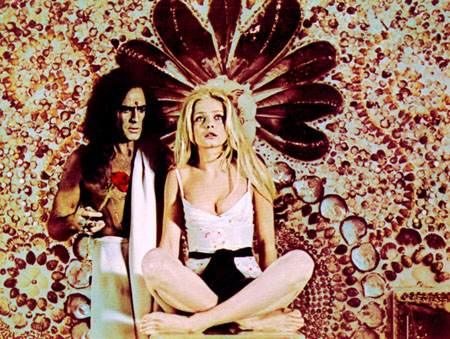
Still from Paris Je T'aime (Christopher Doyle's "Porte de Choisy" segment) (2006)

WHY IT WON’T MAKE THE LIST: Of the eighteen shorts, only Christopher Doyle’s offering is actually weird (although a few others have some mildly weird elements).

COMMENTS: Like any anthology film, Paris, Je T’aime is a box of chocolates, with some bittersweet bon-bons, a few of the dreaded coconuts, and one oddly shaped piece with a taste you can’t quite place.  Putting the most curious confection aside for last, there are a few novel flavors in this box of sweets.  The Coen brothers serve up an absurdly paranoid—and laugh-out-loud funny—sketch.  A bemused and horrified Steve Buscemi stars as an American tourist who unwisely forgets his guidebook’s advice not to look Parisians in the eye in the subway, with strange, unfortunate, and hilarious results.  Impossible teleportations and lusty Gallic vindictiveness remove this one from the realm of reality.  Climbing a rung down the weirdness ladder brings us to Vincent (Cube) Natali’s offering, a stylized, silent eroto-vampire number starring Elijah Wood and luminous Bond girl Olga Kurlyenko; shot in faux black-and-white with hyperreal pools of red blood, it’s a mood piece tapping elegant cinematic myths.  Further down, Juliette Binoche is a grieving mother who dreams of cowboys in “Place des Victories”; and Sylvian (The Triplets of Bellville) Chomet brings us a slapstick story of love among mimes that won’t change your view of those despicable creatures, but offers respite from the reality of the surrounding tales.

The most memorable segment of all, it should be mentioned, isn’t one bit weird: Oliver Schmitz’ “Places des Fêtes” is the account of an injured Nigerian immigrant who wants to share a cup of coffee with the cute paramedic who comes to his aid.  His story is told in flashback, and the piece ends on a quiet but shattering image.  Compressing a lifetime’s heartbreak into five minutes of film is an amazing achievement.

The one fully weird sequence comes courtesy of respected cinematographer Christopher Continue reading CAPSULE: PARIS, JE T’AIME (2006)