
A reckless boy with a gun is disciplined by the leader of his tribe in this dialogue-free short.
Tag Archives: French
278. I WILL WALK LIKE A CRAZY HORSE (1973)
J’irai Comme un Cheval Fou
“…where you go look for the grotesque, the dirty, you find God, happiness, beauty…”–Fernando Arrabal

DIRECTED BY: Fernando Arrabal
FEATURING: George Shannon, Hachemi Marzouk, Emmanuelle Riva
PLOT: Accused of killing his mother and stealing her jewels, Aden Rey flees to the desert. There, he discovers a mystical dwarf shepherd named Marvel who offers him refuge. They develop a friendship verging on romance, and Aden decides to take the innocent nature boy (and his favorite goat) to see the big city.

BACKGROUND:
- Together with Alejandro Jodorowsky and Roland Topor, Fernando Arrabal founded the Panic movement (named after the Greek satyr god Pan). Starting in 1962 in Paris, the Panic movement staged disruptive live public “happenings” and plays that included (reportedly) live animal sacrifices, Jodorowsky being stripped and whipped, nude women covered in honey, and a replica of a giant vagina. The movement was inspired by the idea that Surrealism had become too mainstream and lost its power to shock the viewer; Jodorowsky officially dissolved it in 1973, after the three principals had already gone their own ways.
- I Will Walk Like a Crazy Horse was Arrabal’s second film as director (after 1971’s surreal fascism satire Viva la Muerte). He may be best known to 366 readers as the screenwriter for Jodorowsky‘s 1968 debut Fando y Lis, which he adapted from his own play.
INDELIBLE IMAGE: The most unforgettable image in I Will Walk Like a Crazy Horse is one I actually wish I could forget: Aden and Marvel silhouetted in the sunset, squatting back to back, defecating. If you need something less repulsive (and we do, for illustrative purposes), go with the dwarf making out with a skull so fresh that bits of meat still cling to it.
THREE WEIRD THINGS: Synchronized pooping; cross-dressing skull-birthing; butt-flower eating
WHAT MAKES IT WEIRD: With its sharply dressed, on-the-lam hero wandering the streets of Paris as the cops close in, I Will Walk Like a Crazy Horse plays at times like an exceptionally strange nouvelle vague crime flick—as if Jean-Luc Godard failed to show up on set and Alejandro Jodorowsky seized control of the project, firing Anna Karina and installing a dwarf as the love interest. Oedipal, mystical, scatological, blasphemous, surreal, and still shocking even today, Crazy Horse is crazy indeed.
DVD release trailer for I Will Walk Like a Crazy Horse
COMMENTS: Fernando Arrabal’s sophomore feature I Will Walk Like Continue reading 278. I WILL WALK LIKE A CRAZY HORSE (1973)
CAPSULE: OUT 1: NOLI ME TANGERE (1971)/OUT 1: SPECTRE (1972)

DIRECTED BY: Jacques Rivette
FEATURING: Jean-Pierre Leaud, Juliet Berto, Michele Moretti, Michael Lonsdale, Bernadette Lafont, Bulle Ogier, Francoise Fabien, Hermoine Karagheuz, Eric Rohmer
PLOT: Two theatrical troupes: one amateur and one professional, with different artistic approaches, rehearse plays by Aeschylus. Two loners: one male and one female, both scam artists, operate independently of each other. All these players are seemingly connected via a loose conspiracy of “13,” inspired by the work of Honoré de Balzac and Lewis Carroll.

WHY IT WON’T MAKE THE LIST: The improvisational framework is experimental, but it’s more conventional in its overall form. Rivette’s follow-up feature, Celine and Julie Go Boating, which is indebted to Out 1 in its production and concept, is closer to “weird.”
COMMENTS: Out 1 was long hyped as “the Holy Grail of modern French cinema,” and that was not mere hyperbole. After French television turned the project down, a four-and-a-half-hour cut, Spectre, was edited to screen in theaters (with an intermission). The original version thirteen-hour version, Noli Me Tangere (Don’t Touch Me) was screened only once in workprint form in the early 70’s. A re-edited version followed in the late 80’s, and a “finished” version turned up on German and French television in the early 90’s.
At first, watching the complete, restored Out 1 may seem a daunting enterprise, but in a world of binge viewing, it seems very contemporary, while simultaneously presenting a time capsule of France in the early 70’s. Out 1 explores the role of art (specifically theater) in society, interpersonal relationships, and secret societies/conspiracies, all in a way that is very entertaining—much more than the words “experimental feature” would suggest.
Looking at it 45 years later, one thing that helps give Out 1 some perspective are the events of May ’68, which is the hub from which the story revolves around. After a brief period of revolution and the hope of all things possible, we pick up two years later; and while the revolutionary spirit is still alive in the efforts of the troupes, everyone involved is disillusioned with their current reality to some degree. The passing of a note to Colin (Leaud) by an unknown woman—seen as one of the actors in one of the troupes—stirs him to investigate the concept of the “13,” and its effect ripples out among the characters. Is there indeed a conspiracy? Or is the conspiracy merely an abstract concept of a fleeting ideal that may never be obtained, but should always be pursued?
The Noli Me Tangere version, presented over eight episodes, anticipates such shows as “Lost” with its canvas of characters and a central mystery at the core. However, while that mystery provides dramatic momentum, it is not the primary focus; in fact, it isn’t until Episode 5 that it begins to coalesce. A substantial portion of each episode focused on the exercises and rehearsals of both troupes, and their succeeding analyses. It’s a detailed look at theatrical process, and while some may find these sections maddening, they’re an important part of the whole: “acting” and “performance” are the main subjects, after all. The characters’ interactions with each other at many points are performances, especially the outsiders Colin and Frederique (Berto), whose scams are another form of improvisation. And the entire enterprise is a performance by everyone involved. The Spectre version keeps this basic frame intact, yet at four hours, much is condensed. Scenes are rearranged, some tangents are dropped, and the “Conspiracy of 13” aspect is center stage.
BLU-RAY/DVD INFO: In 2016, Carlotta released a region free box set in North America of both versions of Out 1 on Blu-ray and DVD, featuring a 2K restoration. Also included in the set is a documentary, The Mysteries of Paris: Jacques Rivette’s OUT 1 Revisited, which is extremely informative, and a 120 page booklet with essays and notes. For those in the UK or with region free players, Arrow UK issued the box set “The Jacques Rivette Collection
LINKS OF INTEREST:
Order of the Exile – Jacques Rivette website
Introduction to Rivette – Jonathan Rosenblum essay on Rivetter
Out 1 And Its Double – Jonathan Rosenblum’s essay from the box set release
WHAT THE CRITICS SAY:
LIST CANDIDATE: L’INHUMAINE (1924)
L’Inhumaine has been promoted to the List of the 366 Weirdest Movies Ever Made. Please visit the official Certified Weird entry. Comments are closed on this review.
The Inhuman Woman
DIRECTED BY: Marcel L’Herbier
FEATURING: Georgette Leblanc, Jaque Catelain, Philippe Hériat
PLOT: A celebrity singer feels responsible for the suicide of a young suitor.

WHY IT MIGHT MAKE THE LIST: Too weird for 1924, when screenings reportedly prompted fistfights between its few admirers and its numerous detractors, this interbellum mashup of silent melodrama, heedlessly optimistic science fiction, and bizarre set design is even more singular when viewed through contemporary eyes. This is a case where a film’s advanced age enhances its weirdness—but when watching it you’ll think that it came from not just another time, but another planet.
COMMENTS: L’inhumaine is a riot of Futurist preoccupations, with sets and themes evoking then-current Euro-chic: Cubism, Art Deco, German Expressionism (filtered through French Impressionism), and even a bit of Surrealism. Director Marcel L’Herbier’s intent was partly to showcase all the new movements in the art world for 1925’s Exposition des Arts Décoratifs. To this end he invited artists like painter Fernand Léger and architect Robert Mallet-Stevens to put their individual stamps on the various sets. The extrerior of singer Claire Lescot’s mansion is Cubist, and model cars pull up in front to drop off attendees for her soirees. She takes her meals in a grand geometric hall; the dinner table is on an interior peninsula surrounded by a pool in with swimming swans, and butlers in eerie smiling masks serve hors d’oeuvres. Claire has an indoor “winter garden” with giant ferns, and Einar’s laboratory, lined with neon and filled with strange machinery, makes Dr. Frankenstein’s digs look subtle and restrained. Every detail is so heavily artificed that even the real sets look like painted cardboard backdrops.
L’Herbier uses every camera trick in the silent arsenal: irises, tinted footage to denote different moods and locales, double images, words appearing in mid-air, lightning-fast Soviet-style montage (which reaches a fevered peak in the still-awesome final “resurrection” sequence with its spinning dials and rocking pendulums overlaid on a veering camera and certain-to-cause-seizures strobe effects). Watching this, you’ll understand why Guy Maddin fell in love with the 1920s (I wonder if “The Heart of the World“‘s competing suitors explicitly nod to L’Inhumaine). The acting is theatrical and possibly old-fashioned even for 1924 (watch as the evil maharajah narrows his eyes when introduced to signal his untrustworthiness), but still appropriate for melodrama. But the film’s biggest detriment, and the thing that holds it back from unqualified classic status, is the miscasting of matronly opera star Georgette Leblanc as the fabulous beauty who enchants the hearts of the world’s most eminent men. Leblanc put up half the money for the production, essentially buying the role; but I don’t care how well she sings or how glittery the tiara, no man is going to commit suicide for a woman who compares only slightly favorably to your Aunt Martha. Imagine how effective L’Inhumaine might have been if they’d cast an actress who looked more like Maria in Metropolis!
The Blu-ray, a co-production between France’s Lobster Films and the United States’ Flicker Alley, offers the viewer the choice of either French or English subtitles, as well as a choice of music. The Alloy Orchestra’s percussion-heavy, mechanistic performance is perhaps closer to the score’s original intent—you can hear a touch of George Anthiel in it—but drummer Aidje Tafial’s progressive jazz accompaniment is superior. He leads an ensemble featuring percussion, accordion, vibes and trumpet, and the abstract spaces the group explores suggest an agreeable affinity between the old and new avant-gardes. Sadly, composer Darius Milhaud’s original score is thought to be lost.
WHAT THE CRITICS SAY:
251. PLAYTIME (1967)
(G. Smalley contributed additional commentary and background to this article.)
Play Time
“Playtime is a film that comes from another planet, where they make films differently.”–attributed to Francois Truffaut
DIRECTED BY: Jacques Tati
FEATURING: Jacques Tati, Barbara Dennek
PLOT: A nearly plotless “day in the life” of 1967 Paris: a group of American tourists arrive in the city, but instead of visiting the monuments they are taken to a complex of skyscrapers to shop. Meanwhile, Monsieur Hulot is trying to keep an appointment, but gets lost in a mazelike building in the same downtown complex. After business hours, everyone converges on a restaurant on its opening night for a chaotic celebration as the building falls apart around them.
BACKGROUND:
- The third of four features in which Jacques Tati played the affable, bumbling Monsieur Hulot.
- Playtime was in production for three years; the downtown sets were constructed by hundreds of workers and were nicknamed “Tativille” among the crew.
- The film was incredibly expensive to make and Tati took out personal loans to finance it; it was a disappointment at the box office and he went into bankruptcy, giving away Playtime‘s rights in the process.
- Tati shot the film in 70mm (which was capable of a 2.20:1 aspect ratio, one of the widest formats), and initially insisted the film be screened only in that format in venues with stereophonic sound, despite the fact that very few theaters could meet these specifications. (Partially for this reason, the movie was not screened at all in the United States until 1972). He later relented and allowed 35mm prints to be struck.
- Humorist and newspaper columnist Art Buchwald wrote the English dialogue for Tati.
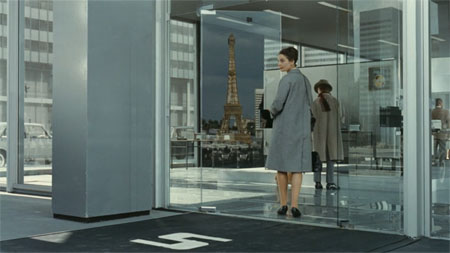
INDELIBLE IMAGE: Many people will best remember Hulot’s view from the second-floor view of a factory-like job site composed of a maze of cubicles—a workplace prophecy that’s come true. We chose a scene—one of three in the film—where straggling Barbara opens a door to one of her tour’s commercialized sightseeing destinations, only to see the Eiffel Tower (or the Arc de Triomphe, or the Sacré Coeur) perfectly reflected in the plate glass. These shots express Tati’s theme of the disappearance of culture under the ugliness of modernity, while retaining the wistful hopefulness that is characteristic of his work.
THREE WEIRD THINGS: Faux Hulots; cubicle labyrinth; doorman with no door
WHAT MAKES IT WEIRD: Playtime is about the alienating, isolating influence technology has on human beings. It’s not the standard elements of plot, narrative, character development or dialogue that pulls an equally alienated audience into this unfurling drama, but the careful choreography of hapless humans navigating a barely recognizable hypermodern Paris. Play Time is a sort of anti-Brazil.
Short Clip from Playtime
COMMENTS: Do you remember when watching “Tom and Jerry” on Continue reading 251. PLAYTIME (1967)