Tag Archives: Fantasy

168. MR. NOBODY (2009)

366 Weird Movies may earn commissions from purchases made through product links.

“Oh, my God, and when you got up in the morning, there was the sun in the same position you saw it the day before—beginning to rise from the graveyard back of the street, as though its nightly custodians were the fleshless dead—seen through the town’s invariable smoke haze, it was a ruddy biscuit, round and red, when it just might as well have been square or shaped like a worm—anything might have been anything else and had just as much meaning to it…”–Tennessee Williams, The Malediction

Must See

DIRECTED BY:

FEATURING: , Toby Regbo, Sarah Polley, Natasha Little, , , , Linh Dan Pham

PLOT: In 2092, after all disease has been conquered through cellular regeneration technology, 119-year old Nemo Nobody is the last mortal man left in the world. He recounts his life story to a psychiatrist and a reporter, but his memories are wildly inconsistent and incompatible, and at times fantastic and impossible. In his confused recollections he is married to three different women, with multiple outcomes depending on choices that he makes in the course of his life; but which is his real story?

Still from Mr. Nobody (2009)

BACKGROUND:

  • The genesis of this story came from Jaco Van Dormael’s 1982 short film “È pericoloso sporgersi,” about a boy who must make an “impossible” choice between living with his mother or with his father.
  • According to Van Dormael the script took seven years to write, working about five and a half hours a day, every day.
  • Van Dormael published the Mr. Nobodoy screenplay (in French) in 2006, one year before production began and three years before the film was completed.
  • Despite being made in 2009, the movie was not released in the U.S. until 2013, and then only in an attempt to capitalize on the Oscar buzz surrounding Jared Leto’s performance in Dallas Buyers Club.
  • Leto temporarily retired from acting after Mr. Nobody, spending the next four years focusing on his band Thirty Seconds to Mars.
  • Mr. Nobody’s first name, Nemo, means “nobody” in Latin.
  • The movie is full of visual tricks and illusions, some of which are so subtle that they’re easy to miss. For example, watch for a scene where Nemo enters a bathroom then focuses on his own image in a mirror. When he turns around and the camera follows him back out of the room, we now see the perspective as if we had passed through the mirror; the reflection seamlessly swaps places with the real world.

INDELIBLE IMAGE: Mr. Nobody‘s essential image is of branching, criss-crossing railroad tracks; if you want something with a little more surreal zip, however, check out the scenes of a fleet of helicopters delivering slices of ocean, slowly lowering them into place on the horizon.

WHAT MAKES IT WEIRD: Essentially an experimental narrative film disguised as a big-budget science fiction extravaganza, Mr. Nobody, an epic fantasia in which the protagonist lives a dozen different lives and a dozen different realities, was doomed to be a cult film from its inception. Even with a healthy dose of romantic sentimentality and whimsy a la , it is far too rare and peculiar a dish for mainstream tastes. The opening is confusing, the moral ambiguous, and reality won’t sit still; it’s got unicorns, godlike children, helicopters delivering the ocean, a future world where everyone has their own genetic pig and psychiatrists are known by their facial tattoos, and a malformed sub-reality where everyone wears argyle sweaters. It’s unique, unforgettable, and utterly marvelous.


Original trailer for Mr Nobody

COMMENTS: One of the enigmatic Nemo Nobody’s many possible past identities is a TV science lecturer who explains such esoteric concepts as Continue reading 168. MR. NOBODY (2009)

CAPSULE: THE DUNGEONMASTER (1984)

AKA Ragewar

DIRECTED BY: Charles Band, Rosemarie Turko, John Carl Buechler, David Allen, Jeffrey Byron, Peter Manoogian, Ted Nicolaou

FEATURING: Jeffrey Byron, , Leslie Wing

PLOT: A demon sucks a computer expert into a dream world where he puts him through a series of tests, each directed in a different genre style.

Still from The Dungeonmaster (1984)
WHY IT WON’T MAKE THE LIST: With its bespectacled hero with a laser-blasting artificial intelligence best buddy who defeats Satan in hand-to-hand combat to save his super-hot aerobicized girlfriend from demonic bondage, The Dungeonmaster may be the apotheosis of 1980s nerd camp. Objectively speaking, however, it’s no more than a guilty pleasure.

COMMENTS: The Dungeonmaster starts out in medias R.E.M., with a dream in which the hero chases a red-robed woman through a misty corridor; he catches her, she drops her dress for a full frontal shot, they start to make love, and then a bunch of aliens break in and abduct her kicking nude body. This has absolutely nothing to do with anything that follows, but it does earn the movie that super-cool R-rating all the awesomest B-flicks get (besides this pre-credits sequence, The Dungeonmaster is strictly a PG affair).

Actually, in a funny Zen koan sort of way, the fact that this preliminary fantasy sequence has nothing to do with anything that follows has everything to do with everything that follows, because the rest of the movie is made up of strung-together fantasy sequences with no real logical connection between them. Paul is a computer scientist with an early prototype version of Google glasses that allows him to hack the traffic light cycles as he’s jogging and take money out of his ATM without entering his PIN number. Gwen, his aerobics-instructor girlfriend, is jealous of Paul’s relationship with a female artificial intelligence named CAL (short for her serial number, X-CALBR8), but when the Devil abducts her and chains her to a concrete boulder on a studio back lot, she learns to appreciate what she’s got.

You see, Old Scratch is impressed by Paul’s skill with computers, which he regards as some form of arcane wizardry, and so has devised seven tests (each directed by a different one of Charles Band’s pals) for Paul to conquer in order to win Gwen back. One representative quest involves Paul finding Einstein’s ice grenade to throw at the figures in a frozen wax museum. Other challenges include facing zombies and their puppet king in the Land of the Dead, defeating a stop-motion animated jungle statue, and solving a neo-noir mystery. In the most terrifying trial of all, Paul finds himself in a W.A.S.P. video directed by Charles Band, and must fight his way past a bunch of leather clad groupies with big hair to stop an Alice Cooper wannabe from sacrificing his fair maiden on a pointy stage prop.

Paul defeats almost every challenge simply by zapping the boss baddie with CAL, whom Satan has helpfully transformed into a wristband laser. He also utters the immortal line, beloved of “Mythbusters” and teenage solipsists alike, “I reject your reality and substitute my own!” The art direction, while admittedly cheap, is actually pretty good throughout, colorful in that bright 1980s way with plenty of sub-Industrial Light and Magic glowing laser beams and electrical arcs turning up everywhere. The Dungeonmaster zips from one underdeveloped adolescent fantasy to the next, with zero logic and seven layers of cheesy spectacle. It’s kind of great! If I had my way, I would totally reject this reality and substitute The Dungeonmaster‘s.

Remembered fondly by few, The Dungeonmaster was a very late arrival in the DVD format, only showing up in 2013 on Scream Factory’s “All Night Horror Marathon Vol. 2” set alongside inferior but equally unloved Charles Band productions Cellar Dweller (1988), Catacombs (1993), and Contamination .7 (1993).

WHAT THE CRITICS SAY:

“If this really was a D&D adventure I’d venture that the Dungeon Master desperately needs new medication. Or much less medication. I haven’t seen anything this weird and stupid since I read the Castle Greyhawk module.”–Noah Antwiler, The Spoony Experiment

161. THE 5,000 FINGERS OF DR. T (1953)

366 Weird Movies may earn commissions from purchases made through product links.

“As to who was most responsible for this debaculous fiasco, I will have nothing more to say until all the participants have passed away, including myself.” –Theodore Geisel on The 5,000 Fingers of Dr. T

Recommended

DIRECTED BY: Roy Rowland

FEATURING: Tommy Rettig, Hans Conried, Peter Lind Hayes, Mary Healy

PLOT: Fatherless Bart’s well-meaning mother forces him to practice the piano when he would rather be playing outside like a normal boy. He falls asleep and dreams of an institute ruled over by the dictatorial piano teacher Dr. Terwilliger, who keeps his mother in a hypnotic bondage and plans to enslave 500 boys to play his massive piano. With the help of a plumber, Bart must thwart the evil Dr. T and his henchmen and bring his mom back to her senses. Still from The 5,000 Fingers of Dr. T (1953)

BACKGROUND:

  • The script and lyrics were written by Theodor Geisel (better known as Dr. Seuss). The first draft he submitted reportedly weighed in at 1,200 pages (100 pages would be an average script length).
  • Geisel disowned the film after it bombed at the box office, and refused to mention it in his biography.
  • Hans Conried said that eleven musical numbers were cut before the final release.
  • In “The Elevator Song,” the stanza referring to the “Third Floor Dungeon” was cut out of the film after the initial screenings (and does not appear on television screening or home video versions). The original lyrics read “Third floor dungeon: Household appliances. Spike beds, electric chairs, gas chambers, roasting pots, and snapping devices.” It’s speculated that the reference to “gas chambers” was deemed inappropriate in a movie released so soon after the Holocaust.
  • Producer Stanley Kramer is rumored to have directed some of the sequences himself.
  • Frederick Hollander’s compositions were nominated for a “Best Scoring of a Musical Picture” Oscar.

INDELIBLE IMAGE: The 5,000 Fingers of Dr. T is saturated with surreal Seussian imagery, from roller skating Siamese twins linked by their beards to an elevator operator with no nipples and no face. Even the uniform Dr. Terwilliger requires Bart and the boys to wear—a simple blue beanie with five yellow fingers pointing skyward—is a candidate for most bizarrely memorable image. Throwing up our hands in despair, we’ll go with the obvious choice: the mile-long, two-tiered winding keyboard that the diabolical doctor plans to make his 500 charges play.

THREE WEIRD THINGS: Hypnotic whammy battle, underground musical cacophony, executioner elevator operator [selections provided by reader “Gargus” as part of a 2016 contest]

WHAT MAKES IT WEIRD: In books like “Horton Hears a Who” and “The Cat in the Hat,” Dr. Seuss’ fuzzy characters speaking singsong nonsense and cavorting across landscapes with implausible fauna make for children’s classics. But imagery that’s merely whimsical on paper in ink turns positively weird when fleshed out in Technicolor, with live actors singing and dancing. The backdrop of Cold War paranoia, before which flits a fey villain with a fabulous wardrobe, only adds to the oddness.

Joe Dante on the reissue trailer for The 5,000 Fingers of Dr. T

COMMENTS: Theodore Geisel, the Philistine, notably hated The 5,000 Fingers of Dr. T, considering it an embarrassment and a low point in his Continue reading 161. THE 5,000 FINGERS OF DR. T (1953)

LIST CANDIDATE: 7 FACES OF DR. LAO (1964)

DIRECTED BY: George Pal

FEATURING: Tony Randall, Arthur O’Connell, Barbara Eden

PLOT: A mysterious “Chinaman fakir” rides into a small western town of Abalone and shows the cartoonish townspeople a variety of colorful wonders to teach them that life is a mystery and a marvel. Still from 7 Faces of Dr. Lao (1964) WHY IT MIGHT MAKE THE LIST: Although a sappy message-movie about the power of imagination, any film that shows you a faun in cutoff shorts drawing out the lust in a priggish school teacher, and then minutes later unveils a mustachioed serpent telling his human likeness that the man is the most imperfect creature he’s ever seen, at least deserves some consideration for the List of the 366 best weird movies.

COMMENTS: “Ye ever see a catfish ridin’ on a yellow jackass before?”

Although at first glance 7 Faces of Dr. Lao is a contrived, tedious “Charlie and the Chocolate Factory”-esque story of the purity and wonder of a young boy befriended by a whimsical fantasy-lander among the hee-hawing bumpkins and self-absorbed dowagers, that message gets lost in the excessive phantasmagoria that suffuses the film. We see a bunch of campy characters in western attire living contentedly in the realm of stereotype: there’s the domineering husband and wife (“No no, dear. I don’t mean to give you the jitters”); there are the bigoted goons (“only good Injun’s a dead Injun!”); then there’s tight-lipped prude of a librarian, Angela Benedict (“the section on courtesy and good manner is over there”), destined to fall in love with the blockheaded newspaperman, Ed Cunningham, who’s found a home among the plastic cacti and tumbleweeds. The solution to shake up these trite archetypes appears to be another one: a comedic white man playing a Chinese mystic, with a painful vehemence lacking in Sidney Toler’s Charlie Chan or ’s Fu Manchu. The sound of Chinese bells and Pipa strings replace the music of banjos and harmonicas. Dr. Lao shows up to awe and confound the Abalonians with a variety of disguises, including an organ-grinding yeti and a Medusa in a stop-motion-animated wig. Inside his circus tent (that’s much bigger on the inside, naturally) Dr. Lao turns women to stone and tells the sad futures of blithering widows. He opens his show with a stock footage barrage of fireworks that represents the colorful but tame cabinet of wonders. A wavering-voiced Merlin makes flowers grow instantly and an inch-long sea serpent swims in fishbowl. But then things get crazy: behind one curtain a seductive faun beguiles the librarian with a dizzying tune on the pan pipes, and behind another, the evil real estate mogul encounters a serpent with his face. After yokels pause their “What in Tom Thunder?!” astonishment or skepticism, we return to the strained message movie when Dr. Lao befriends a torturously acted little boy, Mike, in whom he sees an active imagination and appreciation for life. That sickeningly artificial message encapsulates the film, and dismisses the genuine weirdness of Lao’s creations.  However, stop-motion animator turned director George Pal seems far more interested in the lavish set pieces than teaching kids life lessons. The film most drastically diverges from kiddie-matinee flick with the sexual awakening of the librarian love interest who unbuttons her shirt, panting while the well-oiled faun twirls lasciviously. The film further ignores the corny confines of the message with a climax that includes a rocket-powered rain making machine and some drunk bumpkins fighting an ever-growing Lochness monster in the desert, all underscored by a soundtrack of anarchic bagpipes. When Lao leaves in a plume of smoke, much to the dismay of Mike, we’re left stranded with the Abalone bumpkins wondering: “What in the heck was that all about?”

But who is Doctor Lao anyway? Is he a whimsical Chinese guru capable of transforming into six circus entertainers, or is his “Chinaman” persona a role like all the others? At times he drops the “velly solly” accent when speaking to Mike, explaining that he talks in “whatever dialect the mood requires.” This statement explains his divine talent for manifesting himself in a form specifically attuned to whoever’s observing. It is only to Mike that he drops his cadre of disguises, because he sees no need for artifice in the presence of a boy fertile with imagination. His role as master of deception to the dull-minded Abalonians explains his need for fantastical disguises, but the reason for Dr. Lao’s brief stay in the middle-of-nowhere burg remains a mystery left unsolved, due to his seeming lack of effect on the town. Instead of leaving the Abalonians blessed with ability to see life as a circus despite their mundane lives, he leaves the desert ruffians dazed and spouting the same tiresome exposition as always. The only changes Dr. Lao makes in Abalone are galvanizing the townspeople to vote against selling their land to Stark, and chemically developing a romance between Ed and Angela. Lao has the power to catch fish in dry rivers and render the local bigots senseless (with the help of some twinkling music), so obviously he has some ulterior plan beyond running a fabulous circus. Why did he come? Why does he care about Abalone? Why does a man with supreme power charge five cents for fortune telling? Dr. Lao, false god or just brilliant entertainer, leaves us with only a phony moral and the memory of a phantasmagorical circus.

WHAT THE CRITICS SAY:

“…a curious concoction of superb effects and makeup (William Tuttle won the first ever Oscar for makeup design for his work here) and a schmaltzy, moralising tone that doesn’t immediately speak to all audiences.–Graeme Clark, “The Spinning Image” (DVD)

(This movie was nominated for review by kengo, who said that the movie “has a lot of weirdness in it.” Suggest a weird movie of your own here.)

7 Faces of Dr. Lao [Blu-ray]

  • Blu-ray

New starting from: 27.99 $

Go to Amazon

THE ADVENTURES OF PRINCE ACHMED (1926)

Historians, film buffs, and Disney fanatics all cite Snow White and the Seven Dwarfs (1937) as the first animated feature. While it is the first animated feature as we Americans tend to think of animation, actually that “first” honor goes to a little known, innovative oddity from eleven years earlier. The Adventures Of Prince Achmed (1926) is a labor of love from the pioneering female German filmmaker Lotte Reiniger and her husband, Carl Koch.

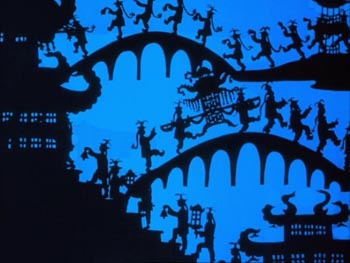
What makes Achmed still unique 88 years later is animation entirely composed of cutout silhouettes. The result  was one of the silent era’s most enchanting and captivating films. It is also a lucid reminder that the medium of film was at its most innovative in its infancy, before the rules were set and the mediums defined.

Reiniger lucked into a patron for her artistic efforts: Louis Hagen supplied her with enough film stock and financing to proceed with her project. Using scissors and black construction paper as her primary tools, Reiniger spent three years meticulously working in an attic on Achmed with a small crew that included her husband/cinematographer, Koch.

Influenced in part by Georges Méliès and Arabian Nights, Reiniger created a world of sensuous, exquisitely detailed beauty. The film has an almost surprisingly coherent and linear narrative, given that Reiniger was embraced by the European avant-garde. Unfortunately, the director had difficulty booking Achmed, and with the exception of Dr. Doolittle And His Animals (1928), the rest of her career was relegated to short films. There was work on a third feature, to be based on Maurice Ravel’s enchanting opera, “L’Enfant et les Sortilèges”; unfortunately, rights to the music could not be secured and the film was abandoned. The Adventures Of Prince Achmed is the only one of Reiniger’s films to date that has seen a home video release. Some of her shorts occasionally appear on television, but often in truncated versions. One such example is Doolittle, which has aired with added (and intrusive) voice over narration, coupled with woefully inadequate projection speeds. Fortunately, YouTube has been more respectful. The Star of Bethlehem (1921), Cinderella (1922), The Adventures of Prince AchmedPapageno (from Mozart’s “The Magic Flute”) (1935), The Magic Horse (1953), and Jack and The Beanstalk (1955) along with a short documentary of her work can all be found there. The documentary shows her storyboarding techniques and the almost rapid-fired speed at which she crafted her baroque figures.

Still from The Adventures of Prince Achmed (1926)There is a noticeable gap of activity in Reiniger’s filmography from 1938 to the early 1950s. With the rise of Fascism, Reiniger and Koch struggled to flee Germany. Although not Jewish, politically they leaned left, which marked them as subversives. Jean Renoir was among those who aided the couple, but they lived in abject poverty until finally being able to settle in England in 1949. Despite the initial financial failure of Achmed, Reiniger and Koch were respected in film circles and were able to be relatively prolific.

Achmed is of its time in its portrayal of the good guys as completely good, bad guys as completely bad, and the pretty girl as in need of saving (Reiniger’s later films frequently had biblical, Victorian, fairy tale, and operatic themes). Still, it’s put over so beautifully, even the most hardened cynics will hardly care. The color tinting renders the film a phantasmagoric smorgasbord of gemstones. Achmed is awash in emeralds, sapphires, rubies, garnets, aquamarines, amethyst, topaz, citrine, tanzanite, and fire opal.

The Adventures of Prince Achmed weaves interrelated narratives involving our protagonist, his princess sister, their Caliph father, an erotic heroine (who Achmed voyeuristically spies on while she is bathing), a flying horse, a malevolent shape shifting African magician, the Witch of the Fiery Mountain, dancing harlequins, sphinxes, terrifying demons, Aladdin, and the genie of the magic lamp. Locales include an exotic island, a majestic palace, Peru, and China.

Reiniger was  master of her medium and an innovator. Every step through her unique world is an enchanting one.