Tag Archives: Comedy

LATTIE (2016, KEVIN L. CHENAULT)

There is always the risk of sentimentality for a writer, actor, director in depicting a terminally ill, or potentially terminal ill, character. The risk is even greater if none of the above have experienced the process.

Picasso once listed nostalgia and sentimentality as enemies of art, and reportedly walked out on the premiere screening of ‘s valentine to himself, the embarrassingly saccharine Limelight (1952). The younger Chaplin, unfettered by dialogue, is one of the few artists who could actually get away with overt pathos. An older, talking Chaplin could not.

As written, directed by and starring , Lattie (2016) does not entirely escape or transcend that inherent risk. Like Chaplin, Lattie succeeds most when relying on visuals to interpret his narrative. Even then, the film is uneven. At times, Chenault is almost in an experimental mode, but there are just as many vignettes that hold back and play it safe. Striking a James-Dean-lying-alone-on-the-floor posture, contemplating his condition, Lattie smokes his cigarette down to the butt, accompanied by angsty indie alt music that sounds like it cut its teeth on post-Syd Barret Pink Floyd (AKA “lesser Floyd”). Lattie receives a voice message of concern, talks to family and shrink, gets hugged.  Here, it’s paint-by-numbers filmmaking, a rudimentary sketch hampered by arthritic acting, with the exception of Chenault himself as the title character.

Still from Lattie (2016)Once done with the obligatory disease-of-the-week bullet points, Chenault trusts himself, and us, venturing into quirkier, more refreshing terrain. Lattie is catapulted into an absurdist murder mystery combining offbeat humor and visual cues: a Christmas tree, a pre-adolescent drawing on a face, an ominous Bible as a facade for a cash-stashed phone book. When overly-serious family members prod him about his impending drama, Lattie is too preoccupied to invest much time in shoulder-patting. He has a mystery to solve. Damn right. And, of course, there are the little hassles, like an uncooperative truck and stooge-like adversaries who attempt to derail the murder investigation.

Lattie is episodic in the best way, its surreal qualities conveyed in under-the-breath pacing. When it gets right to the meat of it, Lattie confirms that, for death to be interesting, there has to be a bit of funny business. The unexpected finale is welcome and queerly memorable.

Chenault’s body of work is an interesting one, with his strengths being in sublime restraint (seen at its most effective in 2011’s The Strangers). As in Chenault’s previous efforts, Lattie is well-filmed and shows a filmmaker concerned about craftsmanship, commendably unhampered by budget restraints.

More information on Lattie is available at the official home page.

241. PIERROT LE FOU (1965)

“Velazquez, past the age of 50, no longer painted specific objects. He drifted around things like the air, like twilight, catching unawares in the shimmering shadows the nuances of color that he transformed into the invisible core of his silent symphony. Henceforth, he captured only those mysterious interpenetrations that united shape and tone by means of a secret but unceasing progression that no convulsion or cataclysm could interrupt or impede. Space reigns supreme. It’s as if some ethereal wave skimming over surfaces soaked up their visible emanations to shape them and give them form and then spread them like a perfume, like an echo of themselves, like some imperceptible dust, over every surrounding surface.”–opening lines of Pierrot le Fou, supposedly from the book on modern painters Ferdinand reads throughout the film

Recommended

DIRECTED BY:

FEATURING: ,

PLOT: Ferdinand, who is married to a wealthy Italian woman and has recently lost his television job, leaves a bourgeois cocktail party early and skips town with babysitter Marianne, with whom he had coincidentally had an affair years before. After knocking out an intruder, the two go on a crime spree and end up living on a remote island, but Marianne grows bored and wants to return to city life. Things get complicated when Marianne, who claims her brother is a gun runner, kills a man in her apartment, and the lovers are separated.

Still from Pierrot le Fou (1965)

BACKGROUND:

  • Pierrot le Fou is a (very) loose adaptation of Leonard White’s pulp novel “Obsession.” In the novel, the babysitter is much younger than the man she runs away with, creating a “Lolita” dynamic; when Godard decided to cast Belmondo and Karina, the nature of their relationship had to change.
  • “Pierrot” means “sad clown,” a stock character from commedia del arte. Pierrot is archetypically foolish, in love, and betrayed by his lover.
  • Two days before the film was to shoot, Godard still had no script. Some of the film was therefore improvised, although, according to Anna Karina, the extent to which the film was made up as it went along was later exaggerated.
  • Godard and Karina were married in 1961; by the time Pierrot was released, they were already divorced.
  • The film was booed at its debut at the Venice Film Festival, yet went on to do well at international box offices.
  • Director has a cameo as himself in the cocktail party scene, where he gives his theory of the essence of cinema.

INDELIBLE IMAGE: The despondent Ferdinand, speaking on the phone, grabs a paintbrush and begins daubing his face blue. Once finished, he goes out into the Mediterranean sun, carelessly swinging two bundles of dynamite—one red, one yellow—around his body. He’s off to end the movie.

THREE WEIRD THINGS: Topless cocktail party; scissored dwarf; Pierrot is blue

WHAT MAKES IT WEIRD: Inspired by a film noir plot, but shot in a sunny primary-color pop art style that banishes all shadows, Pierrot le Fou is a bittersweet contradiction, and a story that refuses to sit still: it’s a road movie, a romance, a comedy, an adventure, a musical, a satire, a meditation, a surreal fantasy, and a postmodern lark (sometimes, it’s all of these in a single scene). Godard’s personality holds it all together with a lighthanded unity that he would seldom pull off.


Video review of Pierrot le Fou from Lewis Senpai (MoviesEveryday)

COMMENTS: “Fou” means “crazy” in French. Ferdinand’s lover, Marianne, calls him “Pierrot” throughout the film, although he constantly Continue reading 241. PIERROT LE FOU (1965) →

LIST CANDIDATE: LI’L QUINQUIN (2014)

P’tit Quinquin

Recommended

DIRECTED BY: Bruno Dumont

FEATURING: Alane Delhaye, Bernard Pruvost, Philippe Jore, Lucy Caron

PLOT: A big city detective with facial tic disorder comes to a remote French beach village to investigate a bizarre double murder: parts of the victims were found inside the bodies of cows.

Still from Li'l Quinquin (2014)

WHY IT MIGHT MAKE THE LIST: Bruno Dumont’s sprawling (206 minute) longform Gallic mystery is quirky and ominous in about equal measure, with an ambiguous non-conclusion that adds to the weirdness while also making the entire enterprise feel strangely incomplete.

COMMENTS: Because of its quirky dark humor and strange-outsider-in-a-stranger-town mystery plot, L’il Quinquin almost always dubbed “the French ‘Twin Peaks.'” Indeed, it shares many of that series’ strengths and weaknesses: absurd, dark humor; meandering subplots that can become more interesting than the main thread; fascinating rural eccentrics; a hint of the supernatural; and an unsatisfactory resolution.

That last part bears keeping in mind. Although L’il Quinquin is presented as a mystery, beginning with the macabre discovery of human body parts inside of cows, the murders are, most frustratingly, not solved at the end. This fact is in accord with the director’s wishes—he presents a world where evil is allowed to triumph, even to the extent of remaining anonymous—but, after such an amazing buildup, the anticlimax inevitably leaves a bit of an unpleasant aftertaste.

That disappointment won’t arrive until the very end, however, and there is much to savor up until then. We’ll start with the performance of Bernard Pruvost as Commandant Van der Weyden, a detective who looks like Albert Einstein with uncontrollable facial tics—his expression changes an average of two times per second. Pruvost projects a weird sort of competence, and serves as the film’s disapproving moral center, but shares the limelight with Alane Delhaye as the titular Quinquin, a mischievous “bad kid” who absorbs the town’s unreflective racism, but is redeemed by his innocence and his genuine love for a neighbor girl (Lucy Caron, whose penetrating stare recalls the blank intensity of Kara Hayward in Moonrise Kingdom). There’s also an African Muslim boy who snaps when a popular white girl rejects him; a beautiful and talented young chanteuse who seems bound for the big city; Carpentier, Van der Weyden’s dim and nearly toothless second-in-command; Quinquin’s uncle, a speechless, nearly catatonic wreck just back from the institution, given to wandering around in circles; and dozens of other weirdos in brief bits (like the developmentally-disabled English man who throws dishes in a restaurant while the detective is giving a status report to his superior officer). Offbeat comic touches, often quite absurd, break up the serious dramatic sections: a pair of priests preside over an awkward funeral and giggle inappropriately; Quinquin is bedeviled by a costumed younger boy calling himself “Speedyman!” who shows up on his doorstep without explanation; a car careens down the street on two wheels. But in the midst of all this everyday madness, things grow ever darker, as secrets are uncovered and more and more bodies are found, leading the detective to his eventual, apparently final, conclusion: “l’enfer, ici” (“this is Hell, here”).

But for all L’il Quinquin‘s assets, it ends on little more than that involuntary eyebrow shrug by our detached detective. I appreciate an ambiguous ending, when well done, but the idea of a mystery that is never resolved, yet is wrapped up in a way that the audience will find emotionally satisfying, remains cinema’s elusive white whale.

WHAT THE CRITICS SAY:

“…a wonderfully weird and unexpectedly hilarious murder mystery.”–Scott Foundas, Variety (festival screening)

LIST CANDIDATE: SYMBOL (2009)

Shinboru

DIRECTED BY:

FEATURING: Hitoshi Matsumoto, David Quintero, Luis Accinelli

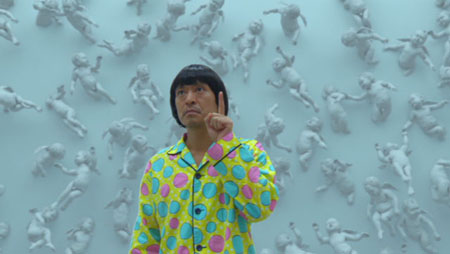
PLOT: A Japanese man wakes up in an enormous white chamber whose walls and floor are littered with cherubic phalluses; meanwhile a Mexican luchador, “Escargot Man,” prepares for a wrestling match.

Still from Symbol (2009)

WHY IT MIGHT MAKE THE LIST: The main narrative, following the action in the white room, is so absolutely removed from reality it demands a place on the List, while the Mexican wrestling scenes remain incongruous and weirdly exotic throughout.

COMMENTS: It’s difficult to talk about why Symbol is so arresting and oddly rewarding without spoiling details of the story or the reveals near the film’s end. Suffice to say the two seemingly unrelated narratives come together in a most unexpected and ridiculous way, and the torture experienced by the Japanese protagonist in the white room leads to a truly transcendent revelation by the film’s end.

The film is structured under three headings: “Learning, Practice and Future.” Learning refers to the rough education the Japanese man receives in the white room from the mischievous owners of the Cherubic phalluses, while the particulars of Practice and Future I’ll leave viewers to discover on their own.

Much of the early joy of the film involves watching Matsumoto interact with the white room and the objects released therein, seeing his mounting frustration at the “bait and switch” as the Cherubs deliver alternately helpful or useless items. They give him an endless stream of sushi rolls, but no soy sauce until after he’s eaten the very last one; 3D glasses direct him to press a particular button, only to have an enormous Cherub behind break wind on him. Another scene sees him releasing an endless pile of chopsticks before he finally presses a different phallus, sending an office trolley careening into his shin. This comedic torment in the vein of silent film comics like or Harold Lloyd continues until Matsumoto recognizes a means of escape…only to be led to earth-shattering alternatives.

There is very little to fault in this film; from its production values to its execution it is equally unique, vibrant and visually arresting. The pacing is surprisingly jaunty for an episodic film, and it actually rewards a re-watch to see how all the various threads build towards the film’s close. Some viewers may find the ridiculous payoffs a little too surreal to be satisfying; to them I can only recommend the consolation to be found in the philosophical treatise “In Praise of Silly,” the book never written by comedian Mike Myers’s father, who believed silliness “was our natural state, and we only get serious to get to silly.” Symbol contains moments of textbook Japanese cinematic weirdness.

A possible weak element of the film (other than two unnecessary moments of flatulence humor) could be identified in Matsumoto’s performance; while his timing is excellent and he works as a hapless, unassuming everyman, his constant screaming is often irritating. A more skilled slapstick performer like , Lee Evans or Rowan Atkinson could have made the physical comedy transcendent and ballet-like rather than merely solid and amusing. This is a rare case where I would not mind a U.S. remake.

I know little about director and star Matsumoto, other than he is one half of a comic duo—the boke or “funny man” of a team called “Downtown”—on Japanese television, just like his contemporary Takeshi “Beat” Kitano (Hana-bi, Violent Cop) was at the beginning of his career. The comparison to Kitano is apt due to the similar career trajectory the two men have followed, although Matsumoto only has four feature film directorial credits to his name and none of the Kitano’s international recognition—at least for the time being. Also, from a cursory YouTube glance, Matsumoto’s TV persona appears to be that of a histrionic, put-upon weed (the character he develops here follows a similar vein) whereas Kitano’s comedy always came from his role as bully.

WHAT THE CRITICS SAY:

“…one of the most bizarre, impenetrable films of the year. That doesn’t mean it is not funny, intriguing and visually impressive, just don’t expect to come out being anything less than baffled.”–Owen Van Spall, “Eye for Film” (contemporaneous)

(This movie was nominated for review by many people, but “Roy” was first when he advised us in 2010 “You gotta check out this flick ‘Symbol’ by the director of Big Man Japan.” Suggest a weird movie of your own here.)

CAPSULE: CUTIE HONEY (2004)

AKA Cutie Honey: Live Action

DIRECTED BY:

FEATURING: Eriko Satô, Mikako Ichikawa, Jun Murakami, Eisuke Sakai; voices of Carrie Keranen, Eva Kaminsky, Vinnie Penna, Madeleine Blaustein (English dub)

PLOT: A naive, upbeat female superhero battles the alien organization “Panther Claw” after they abduct her professor uncle, while simultaneously trying to keep her temp job and find a true friend.

Still from Cutie Honey (2004)

WHY IT WON’T MAKE THE LIST: It is weird, in that Japanese pop way, but it’s also extremely lightweight, and we have to draw the line somewhere.

COMMENTS: “She’s that trendy girl/The one with the teeny butt… She’s that popular girl, the one with the bouncy boobs.” So goes Cutie Honey‘s theme song, which omits any reference to her crimefighting abilities. Our first view of Honey is of her soapy legs and feet in the bubble bath. She gets a phone call in the tub, learns her uncle is abducted, and has to rush to the scene of the crime—only she has no clothes available, so she runs through the street in her underwear, partially covered by a trash bag that doesn’t conceal much. Her regular crimefighting costume features skintight black pants and a heart-shaped cutout for her cleavage; during her off hours she favors midriff-baring mini-skirts and stiletto heels. Somehow, the camera always finds that the upskirt angle best captures the energy of the fight sequences. But, even though Cutie’s body is relentlessly sexualized—virtually fetishized—the story never compromises the innocence of her character. Cutie herself has no sexuality; she seeks only harmless friendship, and any impure thoughts others might have about her stem strictly from their own corruption. (The bosses clearly get an erotic charge out of battling her, especially Cobalt Claw, the vampire dominatrix Honey defeats with a searing embrace). Japanese movies have a way of pulling off this innocent fanservice without making it seem too skeevy, and director Hideaki Anno’s background in anime clearly served him well in the endeavor.

Former swimsuit model Eriko Satô’s considerable physical appeal aside—and to be fair, she does do a nice job rounding out her character between all the cheesecake shots, locating Honey’s legitimate grrl power—Cutie Honey is a wild, electric affair, one of the best live-action translations of anime style. Anno even splices in some brief, stylized animation at times, such as when Honey dodges Gold Claw’s missiles in the sky or hurls Scarlet Calw’s energy beam back at the villainous supergeisha. Of course, reality is a distant cousin to the characters of this world, and they’re not really on speaking terms. Panther Claw’s human henchmen dress in snazzy black Zorro-inspired uniforms, carry golden guns, and generally act like disposable buffoons from Adam West’s “Batman.”  The big baddie—Sister Jill—is some sort of tree goddess who eats virgins, and her tuxedo-clad butler wears eyeliner and a very fake mustache. There’s also a giant holographic uncle. And what would a weird Asian movie be without out-of-place musical numbers, including some drunken karaoke from the three principals, plus a quartet of henchmen playing violins as Black Claw croons a jazzy mid-tempo challenge (your toe will tap as he sings “for the sake of my own happiness, please wither away beautifully, baby.”) Cutie Honey is like an extended sugar-rush episode of “Power Rangers,” if the solo Ranger was played by a teenage pop star who dresses like a hooker.

The “Cutie Honey” franchise began life as an ecchi manga, then became a more innocent animated children’s TV series in the 1970s, followed by various video and television revivals of varying degrees of naughtiness. This feature version was followed by a live-action TV series, with a new live-action feature film scheduled for release in October 2016. Hideaki Anno, of course, is best known around here for directing two separate “Evangelion” anime series; we’re still awaiting the final installment of the second series, which seems to have stalled since Evangelion 3.0: You Can (Not) Redo rolled out in 2012.

WHAT THE CRITICS SAY:

“…those who like their films with a distinctly Western sensibility should be warned – Cutie Honey is loaded with trademark Japanese kookiness, and is at times just plain weird.”–Craig Villinger, “Digital Retribution” (DVD)

(This movie was nominated for review by a reader whose comment was lost in a server crash years ago. Suggest a weird movie of your own here.)