Tag Archives: Arthouse

APOCRYPHA CANDIDATE: BERLIN ALEXANDERPLATZ (1980)

DIRECTED BY:

FEATURING: Günter Lamprecht, , ,

PLOT: After four years in prison, wife-murderer Franz Bieberkopf is released into Weimar Germany; he tries to go straight, but with no means of employment, he soon returns to the criminal underworld, with tragic results.

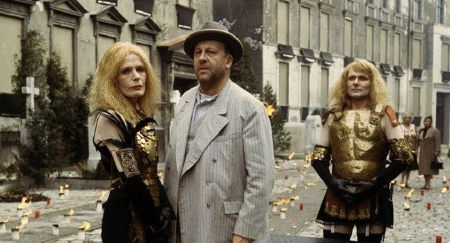
Still from Berlin Alexanderplatz (epilogue) (1980)

WHY IT MIGHT MAKE THE LIST: We’ve toyed with the idea of considering self-contained TV miniseries as “movies” for classification purposes before; Berlin Alexanderplatz, a celebrated masterpiece of world cinema from an auteur with eccentric tendencies but nothing on the List, makes perhaps the best case for loosening our criteria—especially since the result would be classified as “apocrypha” rather than canon. A miniseries adapting Alfred Döblin’s modernist novel, first broadcast on German television, Alexanderplatz is a fifteen hour dive into an enigmatic character told through a fluid mix of straight drama, melodrama, poetic monologue, and surrealism. The two-hour capstone installment, a frenzied passage dubbed “My Dream of the Dream of Franz Biberkopf by Alfred Döblin, An Epilogue,” could well stand alone as a weird movie classic—but it can’t be appreciated without first seeing the thirteen hours that came before.

COMMENTS: Oddly, it was the second episode that sold me on Berlin Alexanderplatz. The first introduced our protagonist, Franz, newly released from prison after a four year stay, briefly suffering from disabling agoraphobia until a friendly Jew tells him an obscure parable, visiting—and raping—an old acquaintance, and finally swearing an oath to go strait. It was strange stuff, setting up intriguing possibilities, but I was not all-in just yet.

That second episode was, in a way, comparatively ordinary. Desperate for a job, with legitimate employment in 1920s Berlin rare in even for non-felons, Franz agrees to put on a swastika armband—reluctantly—and sell newspapers for the newly-formed Nazi party. This decision causes him trouble when a fellow vendor, who happens to be Jewish, confronts him, followed by an old friend who’s now a dedicated Marxist. Franz, who is proud to be German but has nothing against the Jews (or anyone), eventually quits the job, but not before the gang of Communists accost him in a bar. He almost smooth talks his way out of the confrontation, but can’t resist responding to their taunts by singing a Nationalist song as a response to their chorus of the “Internationale.” Angered, they back him into a corner. In a frightened fury, one man against a gang, he is forced to raise a chair to defend himself.

It was at this point that I realized that I’d gone from simply following Franz’s story to rooting for the poor reprobate. Fassbinder brought me, slowly, to sympathize with a killer, a rapist, a pimp, and a Nazi Continue reading APOCRYPHA CANDIDATE: BERLIN ALEXANDERPLATZ (1980) →

2*. CÉLINE AND JULIE GO BOATING (1974)

Céline et Julie vont en bateau

366 Weird Movies may earn commissions from purchases made through product links.

“Each of us is the other half of our divided and ambiguous selves. The art of acting implies a dual personality and between the two of us we were able to create an organic whole.” –Juliet Berto

DIRECTED BY: Jacques Rivette

FEATURING: , Dominique Labourier, , , Barbet Schroeder

PLOT: Céline is in a hurry and drops a number of props as she passes Julie on a park bench, who picks them up and follows her, picking up more dropped accessories on the way. Their friendship thus established, Céline relates an odd tale about a dreamy encounter in a suburban mansion. The two friends find themselves investigating their memories in an attempt to solve a long-dead mystery and prevent a tragedy.

BACKGROUND:

  • Winner of the “Special Prize of the Jury” at the Locarno International Film Festival as well as being an “Official Selection” at the New York Film Festival on the year of its release.
  • Despite its light-hearted tone, shooting Céline and Julie was a comparatively tense affair. It was the cameraman’s (Jacques Renard) first movie, and shooting had to be completed in 20 working days over a four week period.
  • The “film-within-a-film” idea was built in from the beginning of development, even though writer/director Rivette didn’t know what the inner “film” was going to turn out to be at the time of inception.
  • Henry James’ story “The Other House” ultimately became the inspiration for the dream narrative shared by Céline and Julie.
  • An alternate title for the film, Phantom Ladies Over Paris, became something of a joke with the crew during production, having been suggested as what the movie would be titled if it had been American.
  • “Vont en bateaux” (“going boating”) has an idiomatic meaning in French, suggesting that one is following an outlandish narrative—the equivalent of a “shaggy-dog story”.
  • Celine and Julie provided the inspiration for Susan Seidelman’s 1985 comedy, Desperately Seeking Susan.
  • Celine and Julie go Boating was one of the top three vote getters in 366 Weird Movies first Apocryphally Weird movie poll, making it one of the most popular weird movies left off the 366 Weird Movies canon.

INDELIBLE IMAGE: The whimsical double scene in the library is probably the most important for establishing the titular characters. Julie sits at her desk, doing clerical work that her coworker interrupts for a Tarot reading. In the background, Céline sifts through children’s books in a nearby room. In one volume, Céline uses a bright red marker to outline her hand while Julie sits at her desk playing with her red ink pad, making random markings on a sheet of paper with her fingertips. Tying the two together with this imagery handily conveys the connection between these two mysterious women.

TWO WEIRD THINGS: Roller-skate library break-in; memory candies

WHAT MAKES IT WEIRD: Jacques Rivette has made a usual movie-within-a-movie, but goes extra steps beyond that “norm” with additional flourishes. The ghostliness of the inner narrative fuses oddly with the surrounding light-heartedness, rendering it almost a “horror-comedy.” Slippery memories give Céline and Julie Go Boating a feeling akin to Resnais‘ Je T’aime, Je T’aime and Last Year at Marienbad, while other diversions bring to mind Truffaut’s nouvelle vague realism. And, of course, the candy-based memory inducement is weird in its own right.

Trailer for Céline and Julie Go Boating

COMMENTS: In the whimsical spirit of the movie, I shall begin by remarking, yes, my friend, don’t worry: Céline and Julie do indeed go Continue reading 2*. CÉLINE AND JULIE GO BOATING (1974) →

CAPSULE: BLUE MY MIND (2017)

DIRECTED BY: Lisa Brühlmann

FEATURING: Luna Wedler, Zoë Pastelle Holthuizen

PLOT: A teenage girl finds her body is going through a strange transformation.

Still Blue My Mind (2017)

WHY IT WON’T MAKE THE LIST: Although it’s explored fully, the puberty/body image metaphor here is too obvious to create a mood of mystery.

COMMENTS: Mia is basically a normal 15-year old girl, dealing with normal 15-year old girl problems: trying to make friends with the cool crowd at a new school, worrying that her parents understand her so little that she must be adopted, and stressing about the strange changes her body is going through.

And fighting her compulsion to snack on goldfish straight out of the tank, a habit which is constantly getting her grounded.

Aside from the movie’s fantasy element (an intended surprise that’s likely been spoiled for you already if you’ve seen any of the marketing surrounding the movie), there’s another mild issue which inhibits your suspension of disbelief. Mia is supposed to be 15 years old, which is a little late to be getting her first period—especially when she looks like a fully developed young woman (Wedler was 17 or 18 years old during filming). It seems like the script compresses and crams in the entire range of problems faced by girls from 12 to 18 into 90 minutes: Mia simultaneously deals with the hormonal stress of oncoming adolescence, and with the rebellious delinquency typical of older teens.

Nevertheless, if you can accept that Mia’s experiencing an uneven, delayed puberty—possibly related to her biological “specialness”—her travails are believable. Perhaps too believable, in fact: large stretches of segments dealing with unsatisfactory crushes and awkward sexual encounters, getting buzzed on Saturday night, experimenting with asphyxiation or shoplifting on a dare, girlfriends who are carelessly and causally mean to each other at one moment and fiercely loyal the next, and so forth all start to feel routine, like incidents we’ve seen in dozens of teen-development dramas.

When Mia’s slow-gestating transformation finally blossoms, however, it breaks through all of the sudden. In a hazy, dreamlike trance, she freshens up her makeup with a brighter shade of red, takes a swig of vodka, and wanders out to the party she just excused herself from to dance seductively for a group of college-age boys, who invite her into the back bedroom for an “erotic” encounter sure to make you squirm in your seat. This peak of teenage peril is followed by a disappointing reveal and an inevitable denouement.

Although Blue My Mind isn’t exceptional, as a low-budget debut feature from a director fresh out of film school, it is remarkably assured. Freckle-faced Luna Wedler’s on-key performance helps a lot, and the rest of the cast assists ably. Other than an attempt at a beyond-her-means special effect, the technical aspects are all professional, and writer/director Brühlmann handles her actors well. She has talent, and with a different script and a few more Euros she could make something that will really blow your mind.

WHAT THE CRITICS SAY:

“Up to a point, the central analogy works rather brilliantly. The menacing yet dreamlike tone grounds the film’s dark-fairytale transformation… But at some point the allegory slithers out of Brühlmann’s grasp, and grows too large for its tank.”–Jessica Kiang, Variety (festival screening)

(This movie was nominated for review by Kristina. Suggest a weird movie of your own here.)

CAPSULE: LETTERS TO PAUL MORRISSEY (2018)

DIRECTED BY: Armand Rovira

FEATURING: Xavi Sáez, , María Fajula, Saida Benzal, Almar G. Sato

PLOT: Five cinematic letters to Paul Morrissey are sent by various fans of the experimental director.

WHY IT WON’T MAKE THE LIST: This is an anthology film, and so the format isn’t really what we’re after. In addition, the films lean much more toward “art-house” than “weird”.

COMMENTS: Udo Strauss: This opening letter, appearing in a photographic slide-style frame like all the epistles, is angry and languid. The writer in question is a German who, dismayed at the triumph of a hollow capitalism in his home country, attempts to claw his way toward unquestioning faith in God and Jesus. He attempts to find peace in a Spanish monastery. His doubt in the Church is made manifest by an attractive woman in sunglasses who intellectually parries with him in split-screen philosophizing. His desperation grows until we see him stapling pages from his Bible to his naked body. An obvious stand-in for , whom Morrissey directed in Andy Warhol’s Dracula and Frankenstein, actor Xavi Sáez encapsulates the plight of a man whose new gods disappoint and whose old God has gone silent. Appropriately, this was the most meditative and trying of the bunch, as we watch Udo grind himself down mentally in an attempt to attain a faith that cannot be forced.

Joe Dallessandro: Channeling in a junkie monologue over the shots of some nameless city’s denizens scoring heroin and coping with life, this is the briefest of the five films. Dallessandro’s gravelly tone made me feel like I was watching a reel from the author’s own memories.

Olena Wood: A former Chelsea girl waxes nostalgic about working with and frets over her diminishing fame (“I feel dizzy as I grow old”). To boost her spirits, she responds to a television ad for “Man Connections” (just call 800-453-2800 to rent yourself the perfect man). Her perfect man is a “Steve”, whom she meets at a swinger-karaoke bar after he sings Françoise Hardy’s “Voilà.” After forty-eight hours, he melts—it was only a rental—and the girl gets a phone-call about a special screening of Chelsea Girls she should attend. Dual montages show a “then” and “now” woman dolling herself up. It’s an odd riff on the universal fear of aging (and being forgotten) with undertones of determined hope clawing against the unstoppable time.

Saida Benzal: We find out that she’s a vampire in the closing credits, and that goes great lengths to explain Saida Benzal’s rumination on eternal damnation-through-longing. A cycle of events: a dark hallway, a man drawing in breath—a woman drawing in breath, a man rising toward a doorway—a woman crawling to peer through the crack below. These few minutes capture the furtive desperation endured by lovers who can never meet.

Hiroko Tanaka: The final letter begins with blood and sonic pain but ends with a making of peace, handily wrapping up the entire exercise. Almar Sato plays the a young woman afflicted with “Hoissuru”, a sound in the range of 20 Hz and 20 kHz that is audible in Françoise Hardy’s “Voilà” (again), a song Hiroko Tanaka used to love. She meets a young Spanish woman who works as a sales clerk at a comic book shop, whose voice immediately relieves the pain. Together they enjoy talking to a looming aquarium shark (who could also double as Morrissey’s stand-in as a confessor).

I write this review to try to work out the basics of what has occupied my mind quite a bit since I watched it thirty hours ago. I know little about Paul Morrissey, but plan to use this film as a starting point in my investigation of the iconic filmmaker; and perhaps now you may want to do this, too.

WHAT THE CRITICS SAY:

“…a true pleasure to witness, slightly echoing Guy Maddin’s experiments with found footage and certainly his weird sense of humour.It may seem strange to describe a film like this as ‘fun’, and yet that’s precisely what it is, with philosophical questions smoothly interwoven with loving throwbacks to Warhol and Morrissey’s biggest hit, Chelsea Girls, and discussions about the importance of eyeliner.” -Marta Bałaga, Cineuropa (festival screening)

APOCRYPHA CANDIDATE: DECASIA (2002)

Also see Alfred Eaker’s take on Decasia

Recommended

DIRECTED BY:

FEATURING: Uncredited documentary subjects

PLOT: Scored to a disturbing minimalist composition, a parade of early 20th century images on decayed and damaged film stock march across the screen, forming hypnotic abstract landscapes.

Still from Decasia (2002)

WHY IT MIGHT MAKE THE LIST: We avoided the hypnotic experimental documentary subgenre on our first pass through the List of the Weirdest Movies ever made, because this peculiar corner of art films normally wed an unusual (weird) form to commonplace (not-weird) subject matter. When it comes to honoring movies as Apocrypha, however, it’s harder to argue that formally groundbreaking movies like Koyaanisqatsi—and this one—can be excluded from being considered among the strangest things the mind of man has come up with.

COMMENTS: A boxer punches an amoeba. A man in a fez prays at a mummy’s tomb, in negative image. A lone airplane flies through the sky, almost perfectly centered in a wavering iris puncturing the darkness. Nuns and schoolchildren strobe in and out of existence. The screen is filled with nothing more than a billowing cloud. Abstract patterns whir by, almost looking as if they were drawn by hand—a butterfly here, a flower petal there—and fade away to reveal a shy geisha.

Experimental filmmaker Bill Morrison scoured over what must have been thousands of hours of partially decayed stock footage to select the most wondrous and poetic images time accidentally created. A complete taxonomy of film damage is on display here. Images sometimes decay from the center outward, sometimes from the edges inward. Frequently, the film is warped so that abstract cracked lines obscure the underlying picture, but often the effects are more surprising. Individual stills might look like gibberish, but because each frame of film holds a slightly different piece of information about the whole, when the series is run through a projector, ghostly figures emerge. The visuals often resemble ‘s splatter-paint-on-the-celluloid experiments, except that the effects here have been created entirely by the natural degradation of cellulose.

Decasia‘s reliance on a minimalist classical music score obviously recalls ‘s time-lapse documentaries. But whereas Philip Glass’ work on the “Qatsi trilogy” of films was smooth and dreamy, Michael Gordon’s composition is dissonant and confrontational. Low strings create a ceaseless rhythm, while violins fall through microtonal scales in a long, slow decay. Horns enter the mix like distant alarms. Gordon specified that certain instruments in the Basel Sinfonetta be deliberately out of tune. In keeping with the theme of recycling, he used discarded car brake drums he found in a junkyard as an instrument, along with detuned pianos. His intent, he said, was to “make the orchestra sound like it was covered in cobwebs, with instruments that had been sitting for a hundred years, creaky and warped and deteriorated…” The uncomfortable but still beautiful sounds divert our thoughts to the darker implications of the pictures dancing and disintegrating before our eyes. The music and the images exist in such a perfect, unconscious  symbiosis that it’s meaningless to wonder which came first.

Decasia is an authentically Surrealist documentary. The startling images have all been generated via a random process, with the interpretation up to the individual viewer. Everyone in these film clips is long dead, and soon the damaged images themselves will fade away to nothing. And yet, the experience is marvelous, not depressing.

WHAT THE CRITICS SAY:

“The unexpected thing is that its dying, in this shower of black-and-white psychedelia, is quite beautiful.”–Anita Gates, The New York Times (contemporaneous)

(This movie was nominated for review by “Tadd.” Suggest a weird movie of your own here.)