Tag Archives: Arthouse

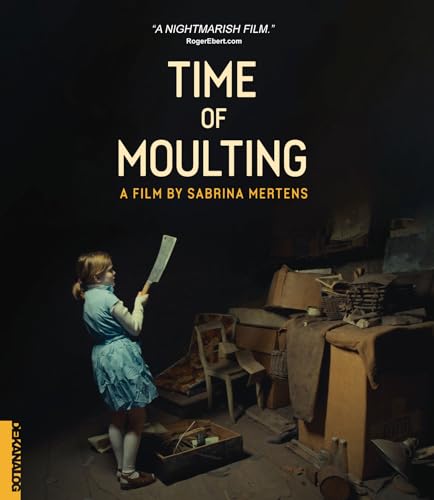
FANTASIA FILM FESTIVAL 2020: TIME OF MOULTING (2020)

Fellwechselzeit

366 Weird Movies may earn commissions from purchases made through product links.

Screening online for Canadians at 2020’s online Fantasia Film Festival

DIRECTED BY: Sabrina Mertens

FEATURING: Zelda Espenschied, Miriam Schiweck, Freya Kreutzkam

PLOT: Stephanie grows up with her eccentric, sickly mother and her “present-but-absent” father, becoming a troubled teenager.

WHY IT MIGHT MAKE THE APOCRYPHA LIST: Teutonic-degrees of mise-en-scène fastidious, tormentingly oblique dialogue, and an unflinching obsession with medium shots make Time of Moulting far too enigmatic and unnerving to fall into mere “arthouse”-levels of weirdness.

COMMENTS: The stifling warmth in this room and the ominous thunder and lightning outside is an appropriate environment for writing this review of Sabrina Mertens’ directorial debut. Time of Moulting is dark, oppressive, and ominous. It’s a slender movie, merely eighty minutes long, but every slice of it—dozens of fixed-camera, “photograph”-style cuts—drip a slow build of tension, like a viscous ooze that is gradually filling a dust-covered bottle. By the finish, I was torn between scratching my head in confusion and hugging myself in despair.

Stephanie (played by a charming Zelda Espenschied as a young child, and a surly Miriam Schiweck “tens years later”) is raised by two parents who have no business having children. The mother (Freya Kreutzkam, never far from despair-induced collapse) suffers from an unspecified medical condition—one both mental and physical, probably. The father makes it clear early on he has no patience for his daughter. Young Stephanie takes solace in exploring the mysteries hidden away in the increasingly untidy house, particularly the trunk full of her grandfather’s butcher’s equipment; older Stephanie takes far more sinister “comfort” in the tools found therein.

By IMDb’s count, there are 57 vignettes adding up to a cryptic whole. By my count, there are only two close-ups: one shot of false teeth creepily snapping shut, and one of liver curling while being fried upon a skillet. The recurrence of meat—always raw—is never a good sign in movies. In Time of Moulting it takes on a more abstract but equally sinister imagery. Young Stephanie arranges two slices of something almost origami-like on a plate; later in life she takes to drawing some truly grisly scenes of death, and even cannibalism.

But Time of Moulting’s horror elements take a back seat to the oppressive formalism of the whole affair, lingering in the many shadows with a quietly sadistic grin. I have never felt so unnerved by medium shots. You see everything going on in the scene, but that only makes the goings-on eerily detached. By this point in the review, I’ve realized that I am not communicating the movie’s aura as well as I would like; but that just reaffirms my position that Time of Moulting is a truly strange take on horror, art-house, and melodrama.

WHAT THE CRITICS SAY:
“The film is subtle to the point that we lose many of the narrative points that lead to the character feeling how she feels and doing what she does. It comes across as unqualified and strangely out of place as the film plods towards its underwhelming finale..” -Hunter Heilman, Elements of Madness (festival screening)

Time of Moulting [Blu-ray]
  • New interview with writer/director

APOCRYPHA CANDIDATE: PIGSTY (1969)

Porcile

366 Weird Movies may earn commissions from purchases made through product links.

DIRECTED BY: Pier Paolo Pasolini

FEATURING: , Jean-Pierre Léaud, Alberto Lionello, ,

PLOT: In contemporary Germany, a son of an industrialist discusses abstract social principles with his fiancée as his father plans a merger with an old, pre-war associate; in medieval Europe, a young cannibal forms a gang of bandits before eventually being trapped by the local militia.

Still from Pigsty (porcile) 1969

WHY IT MIGHT MAKE THE APOCRYPHA LIST: Pigsty qualifies not only for efficiency’s sake: as two narratives, it would be like getting two Apocrypha titles for the price of one. But each of the narrative strains is an oddity in its own right: one, an ambiguous morality tale stuffed with art-house flourishes; the other, an obvious morality tale stuffed with macabre social commentary.

COMMENTS: There is only one moment of near-tenderness in Pigsty, during an encounter between a young, unnamed scavenger and a young, unnamed militiaman on a blasted hillside in Medieval Europe. The militiaman has been straggling behind the main procession of armed soldiers, whistling as he idles. The two men awkwardly encounter each other, exchange glances, and for the briefest moment one might believe that something romantic might ensue—but almost immediately they fire their weapons, fight with their swords, and one kills, and eats, the other. Pigsty‘s true tenor is shown, not least when the cannibal throws the decapitated head of the guardsman into an steaming thermal vent on the mountainside that overlooks the lifeless clearing. Sacrifice.

Two parallel narratives intertwine as counterpoints, but each reinforces the other’s message. Modern life, with all its trappings (as emphasized by the fiancée character when she opens the contemporary story with the line, “We’re two, rich bourgeois, Julian”), turns out to be no less violent—and no less focused on survival—than life in the Dark Ages. While Pasolini uses wholly visual storytelling for the historical half, he dissects 1960s society via endless conversations between allegorical stereotypes. Julian, the scion of a major industrial concern, finds himself caught between two worlds: his fiancée’s conformist radicalism, and his father’s conformist classism; he retreats from what he sees as a mindless game of consumerist conquest by frequenting the pigsty on the family’s estate. What of love? His fiancée challenges him early on, “You kissed me!” He responds, “I also scratch myself.”

The focus quickly moves from the young man  to the father. Though wheelchair-bound, he derives plenty of joie de vivre from his business, his harp, and many, many conversations about the nature of class and society—finding the hilarity of it all from the side opposite his son. The patriarch is an ex-Nazi in the prosperous half of a divided Germany; his recollections of his political past consist exclusively of “humorous” anecdotes and memories. To illustrate this point—overtly, to the point of heavy-handedness—Pasolini presents this smirking cripple in a bedtime scene where he wishes he had been able to have his caricature drawn by George Grosz, with a Brechtian tune to back it up.

These characters without principle—or, at best, woefully misguided principles—are a direct contrast to the filmmaker. Pasolini was a complex man, but he was filled with disdain for the establishment (specifically, any of them). His views can be distilled as “anti-authoritarian”. There are countless references to parse: the allure of the pigsty, the undercurrent of homoeroticism in the historical narrative, and the nebulous confession of the scavenger (“I killed my father, I ate human flesh, and I quiver with joy”), with its religious overtones. But Pasolini isn’t a subtle filmmaker; even if any given piece of the story he’s telling is veiled in arcane symbolism, his message is always crystal clear.

WHAT THE CRITICS SAY:

“…an exquisitely revolting satire…”–Time Out

APOCRYPHA CANDIDATE: YUMEJI (1991)

366 Weird Movies may earn commissions from purchases made through product links.

Weirdest!

DIRECTED BY:

FEATURING: , Tomoko Mariya, , Masumi Miyazaki, Reona Hirota

PLOT: A bohemian poet and painter travels to Kanagawa to wait for his ailing girlfriend, only to fall for an alluring widow while he’s there.

WHY IT MIGHT MAKE THE LIST: Seijun Suzuki, a defiantly unconventional filmmaker with a career’s worth of bizarre films already under his belt, threw himself into Yumeji like he was making his magnum opus of weirdness. There’s blood painted on to the screen, life coming alive as art, and opaque references to slaughterhouses and blood—the last of which would seem to have little to do with the film’s subject. For an artfully bizarre take on an era filled with strange contradictions and perversions, who better than Seijun Suzuki to take you there?

COMMENTS: Takehisa Yumeji was a real-life painter, whose individualist lifestyle and era-defining paintings made him an icon of Japan’s Taisho era (1914-26). The name Yumeji contains the Japanese word for “dream,” so it’s fitting that Yumeji begins with a dream sequence in tribute to its namesake. But if you were expecting Seijun Suzuki to make a conventional biopic, think again. Suzuki used the names of some of the real women in Yumeji’s life, including Hikono (Masumi Miyazaki) and Oyo (Reona Hirota), who seem to have been portrayed in keeping with their real-life counterparts. Apart from these details, Suzuki paid more attention to Yumeji’s artistic side, imagining his romantic escapades and artistic concepts manifested as life.

As in Kagero-za, Suzuki centers the film on an adulterous love triangle, with a mysteriously powerful husband constantly plotting the protagonist’s murder, even though he never gets around to actually carrying it out. However, not one to repeat himself, Suzuki upped the ante here by adding a second adulterous love triangle, wherein the cuckolded husband is said to have killed his rival by throwing him down the drainage pipe at the local slaughterhouse. The killer then hides out in the mountains, evading a relentless police search and creeping around with a scythe in a none too subtle evocation of the Grim Reaper. 

Always one to dabble in surrealism, Suzuki gave in to his urges completely in Yumeji, throwing in enough hallucinatory imagery to eclipse any other film in his storied career. Paintings appear on wooden posts when tapped, a woman is cooked in a huge soup kettle by a group of singing women, and a blond madman proposes a duel while standing next to a hedge made of bloody animal carcasses, later emerging from a lake covered in blood himself. Yumeji (Kenji Sawada) also suffers from a clash of personalities which eventually lead to an identity crisis reminiscent of The Blood of a Poet: he is confronted by multiple versions of himself, all of whom accuse him of being a fraud. His morbid paranoia, his womanizing lust, his poetic thought process—all come together to inform the mood of the film and create something which feels much more like a waking dream than a biographical story.

The two previous films in Suzuki’s Taisho Trilogy (Zigeunerweisen and Kagero-za) each have their fair share of beautiful imagery, but Yumeji is overflowing with countless compositions that are framed to mimic Japanese paintings of the past. At numerous points throughout, paint is even overlaid onto the frame, including a notable scene in which a bright yellow boat nearly capsizes in a torrent of cow’s blood that is dabbed in red blobs along the bottom of the frame. Yumeji is also more erotically-charged than its predecessors, with an earthy sense of sexuality and framings that look like they could have been pin-ups from1920s Tokyo, together with levels of nudity and lewd behavior that contradict the popular image of historical films as stuffy and mannered visions of the past.

It’s fitting that as Seijun Suzuki’s career progressed, his work became more artistically-focused and surreal. His early films, with their painterly attention to color and visual design, bear the marks of an unconventional artist who just happened to be tasked with making B-movies about thugs and prostitutes. In the Taisho Trilogy, Suzuki finally had free reign to make movies that eschewed storytelling and audience expectations in favor of surreal imagery, irreverent reflections on Japanese culture and history, and fractured narratives that often featured elements of the supernatural. Curiously, Yumeji is the least supernatural of the three films, yet the weirdest overall. Like the pornographic kimono that features in its nightmarish finale, it’s a period piece that represents the culture of its era while also adding surrealism, eroticism and mystery into its historical framework. Thanks to Arrow Films, these three little known films by one of the great Japanese surrealist masters are now ripe to be rediscovered in all of their bizarre, experimental glory.

WHAT THE CRITICS SAY:

“By the time the film was completed, the gonzo filmmaker had so thoroughly dispensed with narrative sanity and even basic filmic grammar that whether or not the subtitles are on becomes irrelevant.” – Fernando F. Croce, Slant Magazine

7*. THE LIGHTHOUSE (2019)

366 Weird Movies may earn commissions from purchases made through product links.

“God help thee, old man, thy thoughts have created a creature in thee; and he whose intense thinking thus makes him a Prometheus; a vulture feeds upon that heart forever; the vulture the very creature he creates.”–Moby Dick

DIRECTED BY: Robert Eggers

FEATURING: Robert Pattinson, Willem Dafoe

PLOT: Ephraim Wilson attempts to escape his troubled past by seeking employ with the Maine Lighthouse Company. His four weeks of labor, under the supervision of the often tyrannical and always erratic Thomas Wake, stretch out indefinitely when the relief crew fails to retrieve them. Trapped on the lonely island, they both find each other to be increasingly vexing company.

Still from The Lighthouse (2019)

BACKGROUND:

  • Originally a ghost story (and, to a lesser extent, an adaptation of an unfinished Edgar Allan Poe tale), Robert Eggers and his brother Max, who co-wrote the screenplay, changed tack when Robert read a history of a pair of “wickie” Thomases trapped in a lighthouse off the coast of Wales in 1801.
  • The distinct visual texture was achieved through a combination of custom filters and the use of early 20-century lenses. Lighting was also a challenge, with so many lumens required for the exposure that the actors were practically blinded during shoots of some of the close-up scenes.
  • The Lighthouse‘s soundscape evolved from field recordings of actual weather and tidal events, later mixed in analog in the studio for a heightened, gritty effect.
  • To sexualize what otherwise would have been a prudish Victorian-style mermaid, Eggers and company drew design ideas by studying shark genitalia.
  • During production, there was no shortage of seagulls flitting and honking in the background—something appreciated by the filmmakers considerably more during the editing process than during the shoot.

INDELIBLE IMAGE: There are dozens of water-logged shots and scenes of mental deterioration, but the climax of The Lighthouse‘s frenzied, feverish collapse of sanity occurs in the penultimate scene, when the assistant wickie finally slays his demons and achieves his dream of witnessing, first-hand, the mysteries of the light atop the spiral tower.

TWO WEIRD THINGS: Vindictive one-eyed seagull; visions of Neptune

WHAT MAKES IT WEIRD: Eggers made his name with The Witch, exploring madness in an isolated community. With The Lighthouse he elevates the isolation and cranks up the corporeal unpleasantness in a story drained of color, drenched in water, and cramped by pared-down screen edges. The narrative perspective is unreliable, the psychology is toxic, and the obfuscation of water, liquor, sweat, urine, and more saturates both story and image. An ending that demands both a classical education and a willingness to shut up and run with it tops it all off.


Official trailer for The Lighthouse

COMMENTS: The Lighthouse is a considerable achievement in many Continue reading 7*. THE LIGHTHOUSE (2019) →

CAPSULE: JUBILEE (1978)

366 Weird Movies may earn commissions from purchases made through product links.

DIRECTED BY: Derek Jarman

FEATURING: Jenny Runacre, Jordan, , Nell Campbell (as Little Nell), Jack Birkett, Richard O’Brien

PLOT: Queen Elizabeth I requests her court sorcerer to summon the spirit Ariel to show her Britain’s future, and witnesses a bleak vision of apocalyptic decay.

Still from Jubilee (1978)

COMMENTS: An occasionally brilliant and often muddled mess of an artwork, Derek Jarman’s Jubilee lurks in a strange netherworld of identification. This is, admittedly, a typical “problem” for the movies that end up on the shores of this weird internet isle of ours, and it is a credit, in a way, to Jarman’s particular particularity that his movies tend to be both too weird to be arty while also being too arty to be weird. It’s a strange categorization, to be sure, and the call I made in not considering Jubilee Apocrypha-worthy was a tough one.

Jubilee is an Elizabethan period piece that flashes forward to then-contemporary 1970s London, which was in economic doldrums and still riddled with bombed-out, clapped-out, and otherwise derelict streets and homes. The narrative seems full of plot holes, but that fits nicely with the punk aesthetic that Jarman was, depending upon your perspective, either cynically celebrating or subtly satirizing. Clothes full of holes, ‘zine literature smashed together from ripped-up sources, and even punk’s musical style: all of it was intended to reflect decay, despair, and anger. These elements dovetail in Jubilee as we watch a loose gang of nihilistic young women spend their time breaking things and people, all while incongruously sucking up to the mysterious, flamboyant, and giggle-prone one-man superpower, “Borgia Ginz,” a music and media mogul.

The tone of Jubilee veers in as many directions as the scattershot narrative. There’s a heartwarming (if controversial) romance between two men (who are possibly brothers; the explanation is neither clear nor reliable), who eventually allow a young female artist into their relationship. But there’s also malignance. “Bod” and “Mad” (two of the girl gang members, possibly lovers) wantonly harass and then beat up a diner waitress early in the film, and then continue this cruel streak throughout. “Amyl Nitrate”, played by Punk-era icon Jordan, oscillates between petulant monologues (in the form of her world history she’s writing) and tender gestures with “Crabs” (Little Nell, whose status as the most convincing actor in the movie is saying something). And of course, what 1978 anarchic-socio-commentary-guerilla film would be complete without a young Adam Ant (then something of a nobody) as the latest protégé of Jack Birkett’s other-worldly, hyper-energized Borgia Ginz?

Derek Jarman was an artist of considerable talent: be it in the world of painting, production design, or direction. He was also someone to whom no friend or overseer (if there were any) could say “no.” While this allowed for a far more interesting oeuvre than might have existed otherwise, it was also to that oeuvre’s occasional detriment. What could have a tighter, tidier Jubilee looked like? I know, I know: I just lamented a lack of tightness and tidiness in a punk movie about the punk ethos, so perhaps I’m missing the point. But bearing that in mind, even I couldn’t help but be impressed with this glorious mess of style, pathos, music, and philosophy.

WHAT THE CRITICS SAY:

“Jubilee might be most appreciated by those who are able to embrace its cult movie aspects. Its enigmas and failings may not always be as compelling or as endearing as those found in the best-known cult films but some of Jubilee‘s idiosyncratic content does work to position the film squarely within the wild terrain of the cult film corpus.”–Lee Broughton, Pop Matters (Blu-ray)