Tag Archives: Arthouse

26. THE MILKY WAY [LA VOIE LACTEE] (1969)

“Think not that I am come to send peace on earth: I came not to send peace, but a sword.

For I am come to set a man at variance against his father, and the daughter against her mother, and the daughter in law against her mother in law.

And a man’s foes shall be they of his own household.”–Matthew 10:34-36

DIRECTED BY: Luis Buñuel

FEATURING: , Laurent Terzieff, Bernard Verley, Edith Scob, ,

PLOT:  Two tramps follow the ancient pilgrimage road leading from France to the Spanish city of Santiago de Compostela, where the bones of the apostle James are supposed to be interred.  Along the way they meet strange characters from various times who debate ancient Catholic heresies, a child with a stigmata, an angel of death, and a nun voluntarily undergoing a crucifixion.  Also scattered throughout the film are recreations of fictional and historical events, including dramatization of an Inquisition trial, a cameo by the Marquis de Sade, and scenes from the Gospels.

milky_way_coie_lactee

BACKGROUND:

  • In retrospect, director Luis Buñuel realized that The Milky Way formed the first part of a trilogy about “the search for truth” along with The Discreet Charm of the Bourgeoisie (1972) and The Phantom of Liberty (1974). The subsequent two films use the same fragmented, non-linear narrative style pioneered in The Milky Way.
  • The film is exhaustively researched, with many of the episodes composed of direct quotes from the Bible or the writings of heretics.
  • Released while the general strike and student protests of May 1968 were still fresh in France’s mind and a spirit of liberal revolution was in the air, some leftists were not happy that one of their own had chosen this moment to make a non-political film about the history of heresy in the Catholic church.  According to anecdote, Buñuel’s novelist friend Julio Cortazar accused the director of having completed the film with financing from the Vatican.
  • Although the film is often blasphemous on its surface, it was well-received by the Catholic Church, who even intervened with the Italian censors to reverse their decision to ban the film.  This was an unexpected reaction, as the Vatican had declared Buñuel’s 1961 film Viridiana “blasphemous”.
  • With its large, almost epic cast, it’s inevitable that several French actors with significant contributions in the weird movie arena appeared in cameo roles, including Delpine Seyrig (Last Year at Marienbad) as a prostitute, Julien Guiomar (Léolo) as a priest, and Michel Piccoli (La Grande Bouffe, Dillinger is Dead) as the Marquis de Sade.

INDELIBLE IMAGE:  The execution of a pope by a gang of anarchists, a scene that leads to the film’s funniest and most unexpected punchline.

WHAT MAKES IT WEIRD:  In The Milky Way two worldly pilgrims make their way through a strange, heresy-obsessed world in which every maître d’ is an expert theologian and Renaissance fops duel to the death over arcane philosophical doctrines, while any random stranger they meet may actually be God, an angel, or the fulfillment of a recent prophecy.

Hollywood-style VHS trailer for La Voie Lactée

COMMENTS:  Of all the great directors, Luis Buñuel was the greatest prankster.  His son, Continue reading 26. THE MILKY WAY [LA VOIE LACTEE] (1969)

25. NOSTALGHIA (1983)

366 Weird Movies may earn commissions from purchases made through product links.

“I wanted the film to be about the fatal attachment of Russians to their national roots, an attachment which they will carry with them for their entire lives, regardless of where destiny may fling them.  How could I have imagined as I was making Nostalghia that the stifling sense of longing that fills the screen space of that film was to become my lot for the rest of my life; that from now until the end of my days I would bear the painful malady within myself?” –Andrei Tarkovsky, Sculpting in Time

Recommended

DIRECTED BY: Andrei Tarkovsky

FEATURING: Oleg Yankovskiy, Domiziana Giordano, Erland Josephson

PLOT: Andrei is a Russian poet is traveling around Italy in the company of a fetching translator, researching a biography of a Russian composer who studied in Italy before returning to Russia only to drink and kill himself.  Andrei becomes homesick and bored with the project, and with life in general, until he becomes fascinated by a insane man living in a small town famous for its natural mineral baths.  The madman gives him a simple symbolic task to perform—which Andrei procrastinates in completing— then leaves for Rome on a mission of his own.

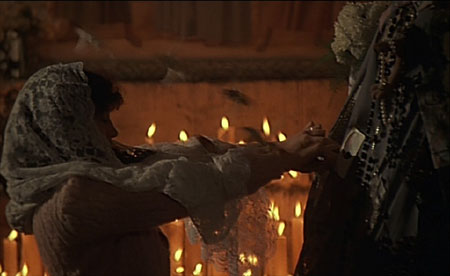
Still from Nostalghia (1983)
BACKGROUND:

  • Tarkovsky was considered one of the finest filmmakers in the Soviet Union; he frequently ran into difficulty with the Soviet censors, however, particularly for his Christian viewpoints.  Although his films won acclaim at international film festivals, they were often shown to limited audiences in edited versions in his own country.  Work on the historical epic Tarkovsky was helming prior to Nostalghia had been halted by the Soviet censorship board because of scenes seen as critical of the state’s policy of official atheism.
  • Nostalghia was the first film Tarkovsky made outside the Soviet Union.  Originally intended to be a Soviet/Italian co-production, the state-owned USSR film production Mosfilm withdrew financial support for the project without comment after filming had already begun.
  • The film competed for the Palme d’Or at Cannes, but was awarded a special jury prize instead.  Tarkovsky claimed that the Soviet contingent applied pressure to assure that the film would not be awarded the grand prize.
  • Tarkovsky defected to the West soon after Nostalghia was completed, leaving his wife and son behind.  They were eventually allowed to leave the country when he was diagnosed with lung cancer in 1986.  Rumors persist that Tarkovsky did not die of natural causes, but was actually poisoned by the KGB in retaliation for his defection.

INDELIBLE IMAGE:  There are many fine candidates.  The scene of Andrei attempting to carry a lit candle cupped in his hand across a drained spa may stick with the viewer, if not for its symbolism, then because it audaciously continues for over eight minutes.  But the final, static, picture postcard-like composition of a Russian homestead nestled inside an Italian cathedral perhaps captures Tarkovsky’s theme the best, and is shockingly beautiful, as well.

WHAT MAKES IT WEIRD:  The fluidity between the conscious and subconscious worlds. Although it’s almost always clear whether the events depicted actually occur or are imagined, Tarkovsky is much more interested in what is going on inside the heads of his alienated Russian poet and the Italian madman than in what is happening in the “real” world. He uses strong, sometimes obscure visual symbolism and dreams to convey an affecting mood of existential loneliness.


Trailer for Nostalghia

COMMENTSNostalghia can’t be approached without a word of warning: this movie is Continue reading 25. NOSTALGHIA (1983)