Category Archives: Canonically Weird (The List)

226. CONSPIRATORS OF PLEASURE (1996)

Spiklenci Slasti

366 Weird Movies may earn commissions from purchases made through product links.

“Conspirators is actually a film about liberation, and about gaining a freedom.”–Jan Svankmajer explaining why he considered Conspirators his most Surrealistic film up to that point

Recommended

DIRECTED BY: Jan Svankmajer

FEATURING: Petr Meissel, Gabriela Wilhelmová, Barbora Hrzánová, Anna Wetlinská, , Pavel Nový

PLOT: A man enters a newsstand and furtively buys a pornographic magazine as the owner nods conspiratorially at him. At home, he leafs through the pages but is interrupted by the postwoman, who has him sign for a letter that simply reads “on Sunday.” Over the next several days the man constructs an elaborate chicken costume; meanwhile, the postwoman, his next door neighbor, the newsstand owner, and another couple are all involved in their own strange, surreptitious projects.

Still from Conspirators of Pleasure (1996)

BACKGROUND:

  • Conspirators of Pleasure began life as a screenplay for a short written in 1970 but never filmed. That short would have told the parallel stories of the “chicken man” and his neighbor across the hall. Svankmajer resumed work on the project in 1996, thought of four more characters to include, and expanded the film to feature length.
  • In 1975 Svankmajer wrote a (satirical?) essay entitled “The Future Belongs to Masturbation Machines.”
  • Originally known for his stop-motion animated shorts, Conspirators was Svankmajer’s third feature film, and it continued a trend of having less and less animation in each successive film (there are only a few accent scenes here, which amount to about one minute of animation).
  • The end credits list Sacher-Masoch, the , Freud, , and Bohuslav Brouk (a Czech psychoanalyst who wrote up a series of case studies about masturbatory practices) as having provided “professional expertise.”
  • The , animators who paid tribute to the Czech director with the 1984 film “The Cabinet of Jan Svankmajer,” are listed in the credits as “musical collaborators” (although the soundtrack is prerecorded classical music).

INDELIBLE IMAGE: The man in a chicken suit doing a ritualistic (and sometimes literally animated) dance in front of a doll-like effigy tied to a chair.

THREE WEIRD THINGS: Stop-motion submissive; dough-snorting; carp shrimping

WHAT MAKES IT WEIRD: We follow six people engaged in complicated, intensely personal fetishistic rituals; adding to the odd, voyeuristic atmosphere, there is no dialogue, other than what’s overheard in the background on television. Each of the conspirators crosses the others’ paths, but continue to work on their own private obsessions, until all of them appear to receive their ultimate gratification. Then, Jan Svankmajer launches us into a new stratosphere of strangeness at the finale, when the chickens come home to roost (so to speak).


Short clip from Conspirators of Pleasure

COMMENTS: Case study: a man, Eastern European, balding but fit Continue reading 226. CONSPIRATORS OF PLEASURE (1996) →

225. ADAPTATION. (2002)

CHARLIE KAUFMAN: I’ve written myself into my screenplay.

DONALD KAUFMAN: That’s kind of weird, huh?

—Adaptation.

Must See

DIRECTED BY:

FEATURING: , , Chris Cooper, Brian Cox

PLOT: Screenwriter , fresh off the hit Being John Malkovich, is contractually and mentally trapped as he is forced to plow his way through an impossible project: “writing a movie about flowers.” Things go from bleak to bizarre as he finds himself competing with his endearingly oblivious twin brother, Donald, who also aspires to be a screenwriter. Charlie slips further and further past the deadline, until things come to a head in the film’s swampy denouement where he comes face-to-face with both the writer of and titular character from “The Orchid Thief,” the book he is adapting for the screen.
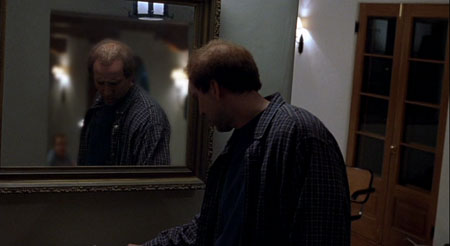
Still from Adaptation. (2002)

BACKGROUND:

  • The screenplay for Adaptation. was on Charlie Kaufman’s to-do list since the late ’90s. Tasked with adapting Susan Orlean’s novel-length essay “The Orchid Thief” and suffering the same problems as his doppelganger, he kept his progress secret from everyone other than Spike Jonze until 2000, when the movie was green-lit for production.
  • Screenwriting guru Robert McKee and his seminars are real. He personally suggested Brian Cox play him in the movie.
  • Adaptation. handily recouped the producers’ investment, with a return of $32.8 million worldwide on a $19 million outlay.
  • Nominated for four Oscars: best actor for Cage, supporting actor for Cooper, supporting actress for Streep, and adapted screenplay for Charlie and Donald Kaufman. Cooper was the only winner.
  • Though “Donald” Kaufman’s serial killer script The 3 was never shot, the idea may have inspired two subsequent movies, 2003’s Identity and 2006’s Thr3e.

INDELIBLE IMAGE: Returning from a misfired date, Charlie finds his twin brother already back home from a writer’s seminar, brimming over with newly adopted wisdom. As Charlie stands in front of his hallway mirror, Donald’s face is captured in the reflection as he expounds upon his own screenplay’s “image system” involving broken mirrors. Charlie’s expression goes from dour to disbelieving at this inanity, and the viewer sees the movie mock both itself and screenplay tricks. A further twist is added by the fact that the blurry reflection in the mirror is the face of the actual Charlie Kaufman talking to Nicolas Cage.

THREE WEIRD THINGS: Film-within-a-film-within-a-screenplay-within-a-screenplay ; Ouroboros; orchid-snorting

WHAT MAKES IT WEIRD: For all its unconventionality, Adaptation is amazingly self-deprecating. Spoilers unravel in opening scenes and are tossed aside, coastal city elites are presented as real people with the petty little problems real people have, and Nicolas Cage gains a bit of weight and loses a bit of hair to provide the compelling double performance as the Kaufman brothers. Events seem scattershot, only to have their purposes later clarified as the tightly structured flow keeps the viewer jumping from moment to moment, always questioning which parts of this convoluted tale are actually true.

COMMENTS: Between its thorough description of the protagonist Continue reading 225. ADAPTATION. (2002) →

224. JAPANESE SUMMER: DOUBLE SUICIDE (1967)

Muri shinjû: Nihon no natsu

“I think that our only route to freedom and our only route to pleasure can come after we have first recognized that freedom and pleasure are not possible in this world.”–Nagisa Ôshima

Recommended

DIRECTED BY:

FEATURING: Keiko Sakurai, Kei Satô, Masakazu Tamura, Taiji Tonoyama

PLOT: An oversexed eighteen-year old girl wanders a city looking for a man to sleep with her—any man. She takes up with a strange, reserved older army deserter, but fails to convince him to service her, as he has a death wish and is only interested meeting someone who will kill him. The two are abducted and taken to a compound where outlaws are being recruited to fight in a secret underground war; meanwhile, television reports tell of a foreign sniper killing civilians on the streets, driving all of Japan to hide in their homes.

Still from Japanese Summer: Double Suicide (1967)

BACKGROUND:

  • Disappointed by the timidity of the Japanese studio system and the political controversy surrounding his 1960 movie Night and Fog in Japan, Nagisa Ôshima formed his own production company in 1965. Japanese Summer: Double Suicide was one of the baker’s dozen of self-produced films he directed between 1965 and 1972, and the first one to indulge in wall-to-wall surrealism.
  • Stars Keiko Sakurai and Kei Satô also appeared in Nagisa Ôshima’s next film, Death by Hanging, which was Sakurai’s only other acting credit.
  • Ôshima would go on to cult success in the West with his sexually explicit provocation In the Realm of the Senses (1976), and with Merry Christmas, Mr. Lawrence (1983) starring .
  • This feature should not be confused with Masahiro Shinoda‘s 1969 arthouse hit Double Suicide, a fourth-wall breaking adaptation of an 18th century Japanese play about doomed lovers. Although entirely unrelated, Shinoda‘s film is worth seeing in its own right.

INDELIBLE IMAGE: In what just might be a bit of symbolic foreshadowing, the two main characters lie down on top chalk outlines around which, moments ago, reverent monks had been circling and chanting. (Curiously, the outlines are sketched on what should be a busy four-lane highway, yet there is no traffic).

THREE WEIRD THINGS: Virgin nympho; deserted highways; “a Japanese Dallas”

WHAT MAKES IT WEIRD:  Starring a nympho who can’t get laid and a suicidal man who can’t get killed, Ôshima’s surrealistic Sixties satire carves out a unique space somewhere between a ian joke and an extended zen koan.


Original trailer for Japanese Summer: Double Suicide

COMMENTS: When our on-the-make nymphomaniac meets the Continue reading 224. JAPANESE SUMMER: DOUBLE SUICIDE (1967) →

223. MANOS: THE HANDS OF FATE (1966)

“A cult of weird, horrible people who gather beautiful women only to deface them with a burning hand!”–original poster tagline for Manos, the Hands of Fate

Beware

DIRECTED BY:

FEATURING: Harold P. Warren, John Reynolds, Tom Neyman, Diane Mahree

PLOT: After making a wrong turn on a family vacation, Mike and Maggie and their daughter Debbie find themselves lost in the Texas desert. As night falls they discover a lodge and its mysterious caretaker Torgo, who reluctantly agrees to let the family stay the night. As the night wears on the Master and his wives awake, while Torgo develops an obsession with Maggie.

Still from Manos, the Hands of Fate (1966)

BACKGROUND:

  • Director Hal Warren, a fertilizer salesman from El Paso, had a yen to become an actor, and met and befriended screenwriter Stirling Silliphant when the latter was in El Paso scouting locations for the television series “Route 66.” Warren made a bet with Silliphant that he could make his own horror movie. He scribbled out the initial outline to Manos on a napkin at a coffee shop.
  • Manos was filmed with a hand-wound 16mm camera that could only shoot 32 seconds of footage at a time. There was no live sound and all dialogue was later dubbed in by the principal male actors (Warren, Reynolds and Neyman) and one uncredited actress voicing all the female roles.
  • John Reynolds, who played Torgo, was a heavy drug user who was often high on LSD on set. He committed suicide months after shooting concluded, before Manos‘ debut.
  • Manos had been completely resigned to the grindhouse dustbin, almost never screened on television, only gaining notoriety after being featured on the bad movie-mocking cult TV show “Mystery Science Theater 3000” in 1993. (Manos became one of the show’s most popular episodes).
  • For most of its history Manos was available only in scratchy second generation prints with visible defects; many fans believe that the murky visuals add to the film’s outsider appeal. In 2001, cameraman Benjamin Solovey found a pristine work print of the movie  and crowdfunded a digital restoration of the movie, which he released on Blu-ray (via Synapse films).

INDELIBLE IMAGE: There is a brief moment when all of Manos‘ bizarre characters share the frame at the same time. Arms outstretched, as always, to display the scarlet fingers lining the inside of his coal-black cloak, the Master points to a shivering Torgo, while two of his nightgown-clad wives pirouette towards him and drag him onto the stone altar, his massive knees pointing towards the nighttime sky. In her review of the film’s opening night, the local El Paso film critic refers to this as the scene where Torgo is “massaged to death.”

THREE WEIRD THINGS: Torgo’s knees; wives’ nightgown brawl; who the heck is ‘Manos’?

WHAT MAKES IT WEIRD: Like most misguided amateur efforts, Manos notches a weird points from anti-naturalistic acting, incoherent editing, strange dubbing, and negligent continuity.  In the case of Hal Warren’s sole feature, the staggering ineptitude magnifies the movie’s strange little bumps until they become looming mountains; the story takes place in some uncanny west Texas wasteland that’s similar to our own world, but permeated by a dreamlike offness.


Clip from Manos: the Hands of Fate

COMMENTS: Manos: the Hands of Fate demonstrates an important Continue reading 223. MANOS: THE HANDS OF FATE (1966) →

222. SPIRITED AWAY (2001)

Sen to Chihiro no Kamikakushi

“It was just too bizarre.“

“Honestly, when I watched Spirited Away for the first time back in 2008, I didn’t like it for the same reason as you. I just found it too weird.”

–IMDB message board dissenters on Spirited Away

Must See

DIRECTED BY:

FEATURING: Voices of Rumi Hiiragi, Miyu Irino, Mari Natsuki; , Jason Marsden, (English dub)

PLOT: While moving to a new town, ten-year-old Chihiro and her parents take a detour to a seemingly abandoned amusement park in rural Japan. Once the sun sets, the park transforms into an otherworldly resort for spirits and gods overseen by the cruel witch Yubaba. Now separated from her parents, Chihiro must learn to survive among an array of weird creatures as she attempts to reunite her family and return home.

Still from Spirited Away (2001)

BACKGROUND:

  • Hayao Miyazaki had announced his retirement from feature filmmaking in 1998, after completing Princess Mononoke. He came out of retirement in 2001 to make Spirited Away.
  • Disney Studios had distributed Studio Ghibli’s previous film, Princess Mononoke, in the United States, with disappointing results. They put little money into marketing the film, but strong reviews and word of mouth turned it into a hit, and Disney’s partnership with Ghibli was cemented from that point on.
  • Spirited Away won the Academy Award for Best Animated Feature (along with 52 wins granted by other organizations).
  • Spirited Away is the highest-grossing film of all time in Japan.
  • Hayao Miyazaki had announced his retirement from feature filmmaking in 2001, after completing Spirited Away. He came out of retirement in 2004 to make Howl’s Moving Castle.

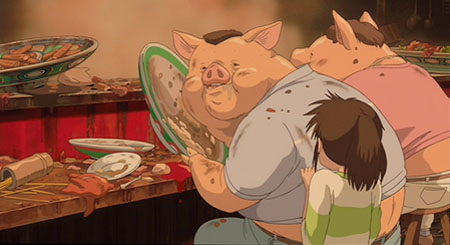
INDELIBLE IMAGE: Lured into the park by a delicious scent, Chihiro’s parents come upon a vacant restaurant filled with sumptuous, exotic dishes. The two immediately begin to fill their plates, ignoring their daughter’s worries that they’ll be punished for taking the food. After the park begins its transformation, Chihiro returns to find her parents bloated and hunched over piles of scraps. She tries to warn her father about what is happening, but when he looks at her she sees only the sweating, engorged face of a pig. The grunting pig ignores Chihiro and climbs over the restaurant’s counter, only to be swatted away by an unseen figure’s reptilian arm. The pig then crashes to the ground with a primal squeal, frightening Chihiro as she cries out for her parents and runs into a street filled with tall, anonymous ghosts.

THREE WEIRD THINGS: Pig parents; “No Face” eats; three heads and a giant baby

WHAT MAKES IT WEIRD: In Spirited Away, Hayao Miyazaki plays on the normal fears of lost children as the basis for an outlandish, frightening fantasy about a young girl being thrust into the incomprehensible life of an adult. The imagination of the setting is so immense that it seems to dwarf the film itself, suggesting a fully realized universe of magic and monsters with borders that extend far beyond the frame of the story.


Disney Trailer for Spirited Away

COMMENTS: Spirited Away begins with the main character, Chihiro, Continue reading 222. SPIRITED AWAY (2001) →