
The Alloy Orchestra Plays Wild and Weird: Short Film Favorites with New Music

DIRECTED BY: D.W. Griffith, Georges Méliès, Edwin S. Porter, Segundo de Chomón, F. Percy Smith, J. Stewart Blackton, Ernest Servaès, Ladislas Starevich, Winsor McKay, Buster Keaton, Eddie Cline, Hans Richter
FEATURING: Jack Brawn, Paul Panzer, Ernest Servaès, Buster Keaton
PLOT: A compilation of twelve strange, fantastic, and experimental films from the dawn of cinema (spanning the years 1902 to 1926) with new scores for each composed by the Boston-based silent film ensemble “the Alloy Orchestra.”

WHY IT WON’T MAKE THE LIST: This presentation won’t make the List solely on formal grounds, because it’s a compilation. You could make a case for several of the individual shorts, however, on the basis of their historical significance, especially “A Trip to the Moon,” “Dream of the Rarebit Fiend,” “Play House,” or “Filmstudie.”
COMMENTS: Hidden off in a corner of the Movie and Music Network‘s catalog, far away from the exploitation films in a quiet place only the cool kids know about, is an obscure little collection of classic cinema. For the most part the Alloy Orchestra’s selections in this compilation aren’t especially rare, at least to silent cinephiles, but wild and weird they certainly are. From trippy nickelodeon snippets to epic hallucinations, these films hail from a thrilling era when cinema was fresh and every new movie was an adventure in invention.
The Orchestra’s musical accompaniment is excellent and appropriate to the material. It’s mostly classical-ish, with a little bit of tasteful electronic ornamentation, and very rarely does it get avant-garde or dissonant enough to threaten the casual listener’s delicate ears. At times it’s electronic-Baroque, often it’s vibraphone and percussion heavy, with a welcome cameos by musical saws and theremins in some dream sequences. Unfortunately, the digitization used here captured some analog rumbling and distortion when the volume got too high, but in general the music is a pleasant accompaniment to the main attraction.
A brief rundown of each slice of weirdness:
- “Those Awful Hats” (1909) – A brief, presumably then-topical joke by D.W. Griffith about ladies wearing elaborate hats in the Continue reading CAPSULE: WILD AND WEIRD (ALLOY ORCHESTRA SILENT FILM COMPILATION)


 Fifty-year-old NYU film grad Pablo Berger chose a familiar story: the Brothers Grimm’s “Snow White and the Seven Dwarfs.” This adaptation came on the heels of Hollywood’s pedestrian Snow White And The Huntsman (which predictably made a gazillion dollars) but represents a much darker, idiosyncratic telling of the tale. Berger grasps an important aesthetic of silent film: its sense of otherworldliness. Berger clearly relishes a hallucinatory texture akin to silent artists such as
  As young Carmen grows, she is never allowed to visit her father. After her grandmother’s death, Carmen is transferred to her father’s estate and sadistic stepmother Encarna. Chopping off Carmen’s hair, butchering her pet rooster, and separating a daughter from her imprisoned, suffering invalid father are the tenets of this quintessentially evil fairy tale mommie dearest.
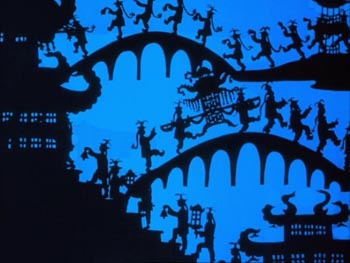 There is a noticeable gap of activity in Reiniger’s filmography from 1938 to the early 1950s. With the rise of Fascism, Reiniger and Koch struggled to flee Germany. Although not Jewish, politically they leaned left, which marked them as subversives. Jean Renoir was among those who aided the couple, but they lived in abject poverty until finally being able to settle in England in 1949. Despite the initial financial failure of Achmed, Reiniger and Koch were respected in film circles and were able to be relatively prolific.