Tag Archives: Silent Film

FELIX THE CAT 1919-1930

In 1999 Image Entertainment released a DVD compilation of “Felix the Cat” cartoons, from the character’s debut in 1919 to 1924. Inexplicably, Image never followed up with a second collection, and allowed Presenting Felix the Cat to go out of print. Naturally, used copies now fetch high prices. This leaves us with another, briefer collection from Slingshot Entertainment, also from 1999, to take up the slack. The Slingshot release can be purchased for slightly less than a McDonalds Happy Meal, and it will not clog your arteries. The presentation is not as extensive as that from Image, but neither edition is ideal.

Felix the Cat predates Mickey Mouse by a decade but was just as popular in the 20s as Walt’s rodent was in the 30s. There is a longstanding dispute over who exactly created Felix, but he was born in the studio of Pat Sullivan. Sullivan’s animator, Otto Messmer, usually (and probably rightfully) receives the bulk of the credit. Felix shot to stardom rapidly, but faded in the 30s when Sullivan was reluctant to make the move to sound, thus paving the way for Mickey’s meteoric ascent. The Felix character was revived in a weak, imitative TV series in the 1950s, and has appeared in two execrable feature films.

Although the quintessential compilation of Felix at his earliest (and best) remains to be released, the still-available Felix The Cat 1919-1930 will have to suffice until then.

In his original incarnation, Felix is boxy looking, almost a cubist parody, as are the dialogue balloons. It adds to the surreal quality of the films. Like most early animation icons, Felix evolved. In 1924, he would become lithe and more appealing, as we recognize him now. Although rounder in looks, Felix has not yet lost his sharp aesthetic edge, although that was to come.

Felix’s debut is in 1919’s Feline Follies. It is an undeniably primitive effort, but does have a surprisingly dark finale. Felix is named “Master Tom” here (he would be renamed shortly). Master Tom is feeling amorous. Luckily for him, a white feline shows up to pacify his raging libido. Naturally, nothing is easy, and Tom is required to serenade his new lady love. With all this activity, Tom neglects his mousing work, leaving his house vulnerable to an army of destructive Mickeys. This gets Tom booted out of home sweet home and, to make matters worse, Tom discovers his feline is unfaithful. What’s a Tom cat to do? Kill himself at the gasworks, of course!

Felix Saves The Day (1922) beings with Felix emerging from his ink pen to play baseball. A runaway ball lands his human playmate in hot water, with Keystone Kops flying over (live action) skyscrapers to make their arrest! Racial stereotyping in the 1920s movies was certainly not exclusive to live action films: with our human baseball hero in a Tower of London like penitentiary, the team is losing to the “Tar Hills,” a team of mammy-styled caricatures. Felix climbs up a row of question marks to alert his bosom mate. The only hope is rain, so Felix pinch hits for the team, driving his baseball straight up to Jupiter, who angrily decides to send a downpour to spoil the game. Felix saves what turns out to be a surreal day.

, Ben Turpin, Douglas Fairbanks, and Will Hays all show up in Felix In Hollywood (1923), making it a delightful time capsule. Felix’s owner is a serious stage actor who laments having to go to Hollywood to ply his trade. Felix transforms into his master’s handbag, hitching a ride. Once in Tinseltown, Felix encounters the celebrities and, removing his tail, turns it into the Tramp’s cane. Felix’s act of plagiarism incurs Charlie’s wrath, but after saving Fairbanks from a mesquiteer, Felix earns the coveted studio contract. (This short was listed in Jerry Beck’s famous “50 Greatest Cartoons,” and was the only Felix cartoon to make the list).

Felix plays a good, if questionably effective, Samaritan in Felix Dopes It Out (1924). A down-on-his-luck alcoholic laments the curse of his gin-blossomed schnoz. Ready to eat a bullet, the Felix stops the act of self-murder with a promise of a cure for the poor fellow’s red nose can be found on the isle of Boola-Boola. With handy question mark in hand, a tub, and some long johns, Felix sets sail. The island is populated by cannibals, who are depicted as ape-like savages. Felix steals the secret cure: “Drink more til your nose turns blue.”

Futuritzy (1928)  is not prime Felix. The cat has his fortune told by a gypsy, and does not like her prediction of misfortune. He goes to an astrologer next, who predicts riches and a pretty girl. There is an interesting homage to Charles Lindbergh (who had made his famous flight the year before). Unfortunately, yet another racial caricature dates Futuritzy in the worst possible way.  

Still from Woos Whopee (1928)In sharp contrast, Woos Whoopee (1928) engages in full-throttled surrealism, with a narrative excuse: Felix gets smashed out of his skull at the Whoopee Club. In his intoxicated, hallucinatory state, Felix has a run in with a frisky street light, various animals, smokes his own tail, gets swallowed by Jonah’s whale (which mutates into an aggressive trumpet), and has to come home to a wife, who mimics his own crouched pacing.

Comicalamites (1928) is inventive, slapstick surrealism. Felix interacts with the animator throughout. Drawn but not inked, our hero gets fleshed out with the aid of a shoeshine man. Felix stumbles upon a weeping feline whose boyfriend has left her. Finding the girl not so pretty, Felix erases her faces a draws her a new one. Now, the potential girlfriend cops a Julie London attitude and catapults Felix in the role of sugar daddy. This means a pretty dress, fine jewelry, and a fur coat. Felix’ scavenger hunt takes him to the bottom of the ocean, making it the most visually sophisticated of the lot.

Despite the title, there are, oddly, no actual 1930 shorts here (the latest dates 1928). However, there is brief footage of Messmer designing billboard animation. The new musical accompaniment is by Jell Roll Morton and His Red Hot Chili Peppers. This release barely makes a dent in Felix’s extensive silent oeuvre, but it is a worthwhile dent.
Comicalamites (1928)

CHAPLIN’S CITY LIGHTS (1931) (CRITERION COLLECTION)

The most recent  feature to see a Criterion treatment is City Lights (1931).

Released three years after the advent of talkies, City Lights remains, for many, quintessential Chaplin. It was possibly inspired, in part, by ‘s The Strong Man (1926), starring

Chaplin labored on City Lights for three years, in part due to difficulties with leading actress Virginia Cherrill, in the role of the Blind Flower Girl (which is how she is billed. Like everyone else in the film she has no name, just a simple description). Chaplin spotted her at a prize fight. She was acutely near-sighted and had the look and personality he was seeking. She was not however, a professional actress. Cherril, being an adult of twenty, was far too old for Chaplin to be interested in romantically. Thus, their relationship off-screen was purely platonic, which, probably added to Chaplin’s dismay of not being able to manipulate her. Cherrill was far from starstruck. She was often tardy and frequently challenged Chaplin. At one point the director fired his leading lady, only to bring her back after realizing that starting anew would be disastrous. A clip (from the Criterion edition) reveals the director once put Cherrill through 342 takes. Yet, despite all this friction, Chaplin extracted a remarkable performance from her.

All of Chaplin’s films are primarily actor’s films, rather than being the work of an accomplished director. Montgomery Clift was among those who intensely studied Chaplin’s performance in City Lights. Indeed, Chaplin’s performance here is quite possibly his best.

However, to say City Lights approaches perfection, or is Chaplin’s best film, proves an exaggeration. It is as maudlin as The Kid (1921) and nearly as episodic as Modern Times (1936), but it’s beauty lies in simplicity; and, as far too many hack artists have proven, simplicity, done well, requires consummate craftsmanship and intelligence. Chaplin still serves as the blueprint for simplicity done right.  This “comedy romance in pantomime” opens with The Tramp discovered sleeping on a city statue, after it is unveiled. Making minimal use of sound, Chaplin’s politico spews garbled gibberish.  Naturally, chaos follows, and it ends, not so subtly, with the Tramp thumbing his posterior at American capitalism before embarking on his city promenade.

The Tramp is menaced by a couple of Newsies, and stops to admire a beautiful statue of a nude woman (a frequently used bit in Chaplin’s film), which everyone else ignores. Shades of things to come. The Tramp is immediately and noticeably more genteel here; far more so than he was when stealing food from babies in his last feature, The Circus (1928).

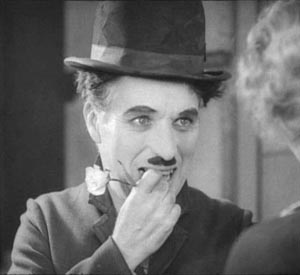
Still from City Lights (1931)Behind the scenes Chaplin was a case study in manic depression and an obsessive perfectionist. For weeks on end, he agonized to come up with a way the Blind Girl could mistake the Tramp for a millionaire. Then, as he was apt to do, he found his source of inspiration from one of his own earlier shorts. The Tramp, avoiding the Kops, zigzags his way through open doors of unoccupied  limos. The Blind Girl  hears a limousine door open and the Tramp emerging. Thus, he becomes her imagined millionaire. When the Tramp discovers the Girl is blind, he lays on the sentiment in a way only he could pull off. It is the Tramp alone, in an apathetic society, who sees the ethereal beauty and spirit in her Dickensesque poverty.


With Her possessing his thoughts, the Tramp comes upon a self-pitying alcoholic millionaire who is attempting to commit suicide by throwing himself into the river. Predictably, slapstick follows. Some of it is awkward, but serves the narrative and conceptual purpose of mocking the super rich.

The millionaire gives the Tramp money to buy more flowers from the Blind Girl and even loans his limo out, but it is only when he’s drunk that he’s so generous. Sober, the millionaire is true to his elitist, miserly ways, does not recognize his new friend, and kicks the Tramp out. In order to obtain money for an operation which cures blindness (remember, it is a fairy tale), our protagonist rummages through a series of jobs, including a gig as a prize fighter. Chaplin had used the employment plot device in his Keystone, Essanay, and Mutual shorts. In City Lights, it serves as a distraction. (He would be more innovative with it in Modern Times). Still, it is not a critical detour, and Chaplin regains his footing for the final act.

The millionaire, having returned from an extended European tour, is drunk again, and runs into the Tramp. After the tramp explains he needs a thousand dollars for the Blind Girl’s operation, his inebriated friend donates to the charity, only to have a fumbled burglary and sudden sobriety transform him into an Indian-giver. Desperate, the Tramp flees, money in hand. Pressing the wad of cash into Her hands, the Tramp secures her operation and prevents Her impending eviction.

With a warrant out for his arrest, the Tramp has an inevitable date with the penitentiary. Time served, he shuffles the streets, an object of ridicule and failure until he happens upon a flower shop, run by the now sighted Flower Girl. She, too, joins in ridiculing the transient. But empathy overcomes her and she gifts the Tramp a single flower, which requires touching him. Recognition means pathos and tragedy and per Chaplin’s creed, cue closeup (Chaplin used closeups for tragedy and reserved long shots for comedy. Naturally, he sometimes broke his own rules, but he generally kept to them). This is the divine mother of all cinematic endings. Despite Chaplin’s (increasing) tendency towards schmaltz, he still does it in a far less dated way than other films of the period. Indeed, his silent features have enough identifiable human drama and strengths to outweigh their shmaltzy weakness in far better than virtually any of the saccharine Hollywood productions of the forties and fifties. His own Limelight (1952) is far more passé, perhaps because Chaplin was really only suited to the art of silent cinema (despite claims that his transition to sound was successful).

As expected, the Criterion Collection is extensive. In its HD treatment, City Lights has never looked better, making it even more timeless. Audio commentary from a Chaplin biographer, a (rare) deleted scene, the documentaries Chaplin Today and Chaplin Studios, beautiful cover art, and Gary Gidden’s massive booklet are priceless.

157. NOSFERATU (1922)

Nosferatu, eine Symphonie des Grauens; Nosferatu, a Symphony of Horror

366 Weird Movies may earn commissions from purchases made through product links.

“It is commonplace to say that silent films are more ‘dreamlike,’ but what does that mean? In ‘Nosferatu,’ it means that the characters are confronted with alarming images and denied the freedom to talk them away.”–Roger Ebert

Must See

DIRECTED BY: F.W. Murnau

FEATURING: Max Schreck, Gustav von Wangenheim, Greta Schröder, Alexander Granach

PLOT: A young clerk named Hutter leaves his wife Ellen to travel to Transylvania with a deed for one Count Orlock to sign so he can purchase a house in Viborg. Orlock, however, is nosferatu, a vampire, and Hutter find himself a prisoner in the Count’s castle as Orlock ships himself to the German port in a coffin. When Orlock arrives the town is shut down for fear of plague, and the vampire takes an interest in Ellen…

Still from Nosferatu (1922)

BACKGROUND:

  • F.W. Murnau’s first seven films, made between 1919 and 1921, are all considered lost. Among them was an adaptation of “Dr. Jekyll and Mr. Hyde.” Nosferatu was his tenth movie.
  • Albin Grau, Nosferatu‘s co-producer, financier and production designer, was an occultist and a German rival of . His production company Prana intended to produce films promoting occultist beliefs, but the company went bankrupt after Nosferatu.
  • Nosferatu is an unauthorized adaptation of Bram Stoker’s novel “Dracula,” barely disguised by changing the names and moving the action from London to Germany. The Stoker estate successfully sued the filmmakers for copyright infringement after release, and the film was ordered to be destroyed (fortunately, many prints survived).
  • Ranked #21 on Empire Magazine’s List of Best Films of World Cinema.
  • ‘s 2000 film Shadow of a Vampire is about the making of Nosferatu, and plays on the notion that the actor Max Schreck might really have been a vampire (an idea fleshed out from a tongue-in-cheek suggestion made by the writer Ado Kyrou in his book “Surrealism in Cinema”).

INDELIBLE IMAGE: What else could it be but Max Schreck, the rat-faced herald of plague and pestilence and the screen’s most bestial bloodsucker? The scene where he rises unnaturally, stiff as a plank, from his coffin in the ship’s hold still presses the primal panic button.

WHAT MAKES IT WEIRD: The experimental use of negative images, sped up film stock, primitive stop motion photography, and the play of shadows to suggest a diabolical world coexisting with our mundane sunlit world creates an uncanny, nightmarish universe. The once new and startling techniques Murnau employs quickly became commonplace, but after nearly a century of disuse they have again become novel through their very archaism.


Trailer for a 2013 re-release of Nosferatu

COMMENTS: At the dawn of cinema, horror movies weren’t diversions meant to give teenage boys an excuse to put a comforting arm around their Continue reading 157. NOSFERATU (1922)

BILL MORRISON’S SPARK OF BEING (2010)

Spark of Being can be watched in its entirety for free on IMDB.

Spark of Being (2010) is an example of an artist resisting an aesthetic anchor. ‘s films are often categorized as non-narrative and experimental, so the idea of this artist tackling such a perennial chestnut such as “Frankenstein; or, the Modern Prometheus” leads us to wonder exactly how he is going to deconstruct such a familiar narrative. Throwing out all preconceived assumptions, Morrison pays homage to Mary Shelly and makes her Gothic creation fresh again with a startlingly literal interpretation. Indeed, Spark of Being may be one of the most faithful cinematic adaptations of the book to date.

Using found footage, Morrison teams with jazz trumpeter Dave Douglas and his electric sextet, Keystone, to illustrate Shelly’s tale. Douglas is an eclectic trumpeter who once worked as a sideman with the John Zorn ensemble Masada. With an original score that is simultaneously mercurial and animated, it is hard to imagine a more perfect composer for Spark of Being. 

Still from Spark of Being (2010)A frequent (and sometimes justifiable) criticism in films this textured is that the style becomes so all-important the end result is a viewer deprived of a heart to identify with. In short, often, a human element is missing. Morrison has referred to this film itself as “the Creature,” and given the agonized condition of footage chosen, Morrison’s creature may be the most pathos-laden performance of the character since . One can only imagine the painstaking process it took in assembling Morrison’s creation into a cogent psyche, imbued with personality as predominant “presence.” A popular comparison might be the collaboration between  and Claude Rains in producing a personality-driven Invisible Man (1933), but Morrison’s approach is more innovative, while still being true to the author’s tenets. Douglas’ music provides an informative touch of flesh stretched over the cranium supplied by archival footage from Ernest Shackleton’s film of an Antarctic expedition. As in the novel, the film opens here in the segment titled “The Captain’s Story.” The viewer steps with the Captain in his interaction with creator and created and the unfolding tragic drama.

Through laboratory footage we meet “A Promising Student” and adopt his sense of ambition and wonder. Educational footage and decayed nitrate, which looks hauntingly like an intensely animated closeup of an Emilio Vedova canvas, bring “The Doctor’s Creation” to violent life.

In “The Creature Watches” antiquarian city crowds, desolate landscapes and achingly lonely images of a child endow the creature with a Chaplinesque essence. The psychedelic beauty of “The Creature’s Education” is extended and sublime. The heartbreaking “Observations Of Romantic Love” segues into the bitter sting of ‘The Doctor’s Wedding” and the inevitable dejection of “The Creature in Society.” In “The Creature Confronts His Creator,” the new Adam dares to accuse a negligent father, and in “The Creature’s Pursuit” it is God who is tried and condemned. A justifiable patricide is, perhaps, the greatest burden of all. It is the stuff of horror, even nearly 200 year old horror served up in our own mythological consciousness.

BILL MORRISON’S DECASIA (2002)

Bill Morrison composed Decasia (2002) as a decomposing homage to Fantasia (1940). Far from being a pedestrian imitation (i.e. Fantasia 2000), Morrison’s film is an astonishingly unique cinematic experience: a diaphanous visual collage juxtaposed to the music of composer Michael Gordon.

There is a breed of  minimalistic new age composers espousing a play-it-safe spirituality. Gordon is not among them. He is a one of a handful of authentic, spiritually challenging voices in 21st century artmusic. Gordon’s rich use of dissonance and atonal language puts him shoulder to shoulder with the likes of such 20th century artists as Luigi Nono and John Coltrane. Gordon’s “Decasia,” composed for the Basel Sinfonietta, is called a “symphony,” and is a response of sorts for those who (often correctly) believe that the symphony, as an art form, was extended to its death in the works of Anton Bruckner and Gustav Mahler. Some would argue that Gordon’s opus, a continuous movement utilizing synthesizer and electric guitar together with full orchestra, does not fit the symphonic criteria. But then, neither did Roy Harris’ iconic work. Like Coltrane’s “Ascension,” Decasia is a demanding journey.  Gordon previously came to prominence with his intimately provocative psychological opera “Alarm Will Sound.” Based on Vincent Van Gogh’s letters to his brother Theo regarding the ear lobe cutting incident, it is desolate and suffocatingly beautiful. “Decasia” is a further development of that aesthetic, moving beyond words to the tragedy of silence, making Morrison a quintessential collaborator.

As new opera directors rethink old chestnuts, so too does Morrison rethink Walt’s innovative concert program of film imagery wedded to music. How Morrison dances with the preexisting music is as original as that ambitious premiere in 1940. Dancing is an apt description, as Decasia begins and ends with a whirling dervish. Morrison’s approach to conveying that decay is as startling as ‘s humanizing “Messiah” and as relentless as Guth’s collaboration with Chaya Czernowin in Mozart’s “Zaide.” Morrison’s aesthetic point of entry manages to be paradoxically unsettling and accessible at the same time: no mean feat. Typically, in many postmodern endeavors it is mystery and spirituality that is forefront, usually (and lamentably) at the expense of expressive directness and all traces of humanity. Morrison does not make that mistake, and the unfolding of his vision is hypnotically entertaining.

Still from Decasia (2002)Using silent film footage and stock reels, Morrison’s imagery is akin to cadavers struggling with the effectiveness (or not) of embalming fluid. Nuns with schoolchildren, missionaries baptizing in a river, a boxer, crashing waves, a man reading a newspaper, a caravan of camels, landscapes, a geisha, miners, and volcanoes rise from the blemishes of  a Dorian Gray portrait, once as handsome and muscular as the square jawed  or as prettified as the coquettish . It is a circular, phantasmagoric dance-to-your-death potpourri. The assemblage of primordial imagery, conjoined with Gordon’s aural language, craft an evocative, textured  experience that is probably most effective on the big screen. The sole advantage to home viewing would be lack of interruption due to grumbling patrons walking out.

By taking this unpreserved archival footage, keeping it intact, and wedding it to the atonal composition, Morrison’s contemplative, non-linear narrative serves the nitrate deterioration like a protective skin. Decasia simultaneously celebrates decay and survival with an unbridled enthusiasm found in the most memorable cinematic experiments of the 1960s.