Tag Archives: Silent Film

HARRY LANGDON’S “THREE’S A CROWD” (1927): SILENT CINEMA’S MALIGNED DARK HORSE

Approaching Harry Langdon’s Three’s a Crowd is a loaded task. This film, possibly more than other from silent cinema, comes with an almost legendary amount of vehemently negative appendage. One time collaborator Frank Capra played the self-serving spin doctor in film history’s assessment of Langdon and this film. He characterized Langdon’s directorial debut as unchecked egotism run amok, resulting in a career destroying, poorly managed misfire and disaster.

That assessment is a grotesque and clueless mockery of film criticism.

The startlingly inept critical consensus, in it’s failure to recognize this dark horse, existentialist, Tao masterpiece, reveals far more about reviewers than it does this film. The complete failure of that consensus to rise to Langdon’s artistic challenges, to appreciate his risk taking towards a highly individualistic texture of this most compelling purist art of silent cinema, only serves to validate the inherent and prevailing laziness in the art of film criticism.

Capra’s statements are frequently suspect. As superb a craftsman as Frank Capra was, he also made amazingly asinine, disparaging remarks regarding European film’s penchant for treating the medium as an art form as opposed to populist entertainment. So, likewise, Capra’s inability to fully grasp Langdon’s desired aesthetic goals and intentions is both understandable and predictable. Samuel Beckett and James Agee are considerably far more trustworthy and reliable in regards to the artistry of Harry Langdon.

Capra credited himself for developing Langdon’s character through several shorts, along with the features Strongman and Long Pants. Actually, Langdon had thrived as a vaudeville act for twenty years and had appeared in over a dozen shorts before he and Capra began their brief, ill-fated collaboration.

Aesthetically, Langdon was Capra’s antithesis and the surprise is not that the two artists Continue reading HARRY LANGDON’S “THREE’S A CROWD” (1927): SILENT CINEMA’S MALIGNED DARK HORSE

SHORT: THE HEART OF THE WORLD (2000)

Must SeeWeirdest!
DIRECTED BY: Guy Maddin

PLOT: “State scientist” Anna studies “the heart of the world” and learns it is in desperate shape, all while trying to chose between suitors: brothers Osip (a mortician) and Nicolai (an actor playing Christ in a passion play), along with “dark horse” industrialist Akmatov.

the_heart_of_the_world

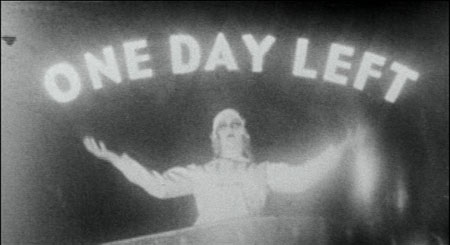
WHAT MAKES IT WEIRD:  Maddin pulls out all the stops in this dreamlike, hyperkinetic tribute to silent films (especially Soviet Constructivist films such as Aelita, Queen of Mars).

COMMENTS:  This six minute minor masterpiece was produced for the Toronto International Film Festival in 2000, where it became an immediate sensation and the hit of the festival.  An incredible technical achievement, the film resurrects simple camera tricks such as multiple exposures, creative use of intertitles, expressionist shadows, and blaring lighting that creates auras or halos around the actors, techniques which were largely forgotten or abandoned when films moved from black and white to color.  Add angular 1920s costumes and sets inspired by Metropolis and Aelita, a propulsive, minimalist theme from Soviet composer Georgi Sviridov, and a blazing fast editing style (it is said that the film averages two shots per second), and you have a film that is packed full of pure cinematic images, almost exhausting to watch, yet all too brief.

There is not time to develop much plot in this fabulous sprint.  The Heart of the World is more an exhibition of virtuoso visual technique than a narrative film.  Although the overwhelming emphasis is on visual style, Maddin does include boldly drawn, archetypal characters to help guide the viewer to the film’s triumphant end.  Their presence begs an allegorical interpretation of the film, although I’m not sure anything coherent can be formulated.  Osip the mortician seems to represent the body, and he is blatantly associated with sexuality (he’s seen dragging a knife across a naked woman’s torso, then later builds a phallic cannon to try to impress Anna).  Nikolai represents the spirit (again rather obviously: the chap dresses like Jesus at the crucifixion).  Anna must chose between the body and the spirit, though its not clear why.  And it’s also not clear what Anna may represent: she begins as a scientist, and ends, presumably, as a self-sacrificing artist.  And why does Akmatov, the capitalist antagonist, suddenly appear to seduce Anna away from the other two with money?  And what does all of this have to do with saving the heart of the world, anyway?

In the end, all that’s clear is this: Maddin has taken the style of a Soviet propaganda film, and turned it into propaganda for the art of cinema.

The Heart of the World is available on the DVD, “The Guy Maddin Collection” (buy), along with the feature films Twilight of the Ice Nymphs and Archangel.

WHAT THE CRITICS SAY:

“…an experiment oozing with creativity, layered in a knowledge of cinematic theory, history, and artistry.” –S. James Snyder, The New York Sun