Tag Archives: Satire

IT CAME FROM THE READER-SUGGESTED QUEUE: EL CONDE (2023)

366 Weird Movies may earn commissions from purchases made through product links.

Recommended

DIRECTED BY: Pablo Larraín

FEATURING: Jaime Vadell, Gloria Munchmeyer,, Paula Luchsinger,

PLOT: Auguste Pinochet, former dictator of Chile and centuries-old vampire, contemplates whether it is time to finally die, and invites his family to his remote compound to discuss the dispersal of the fortune he looted from the country.

Still from El Conde (2023)

COMMENTS: In a world filled with so much death, it is one of the cruelest ironies that the people you want most to die never seem to oblige. Day after day, they go around fouling the very air they breathe and incurring your helpless wrath, a fact that honestly seems to fuel them and stave off their seemingly inevitable demise even longer. Sure, they may give off signs of ill health or mental decline, but they never actually take the crucial stuff of shuffling off, no matter how many Big Macs and Diet Cokes they clutch in their tiny hands. It’s exasperating.

Pablo Larraín feels your pain. Augusto Pinochet finally exited the Chilean presidential palace in 1990, but he continued to linger in the world for another 16 years, and in the public consciousness still after that, his crimes having had an immeasurable effect on the psyche of the nation. It probably explains why so much of Larraín’s career (when not profiling the notable unhappy women of the 20th century) has been devoted to examining Chile’s troubled soul. Still, El Conde marks the first time that he has confronted the man directly, and that appears to be because he has finally figured out who Pinochet really was: an undying, bloodsucking vampire.

Mapping the traits of a legendary monster onto the life of the man who disappeared thousands of dissidents turns out to be a fairly short walk. Pinochet’s hunger for power is attributed to his beginnings as a loyal soldier in the army of Louis XVI, where his distaste for revolution and anti-monarchal movements were born. From there, he goes from country to country helping to stamp out uprisings, until he finally arrives in Chile to lead the violent overthrow of the socialist government of Salvador Allende. Invoking the vampire legend is a canny choice, because it not only connects Chile to the broad historical arc of oppressive dictatorships, but provides a context to help understand the grotesque body count under Pinochet’s rule. It actually becomes more comprehensible to attribute it to a monster.

The luscious black-and-white cinematography (courtesy of Edward Lachman) lends an authenticity to the story of exclusively awful people. Vadell is suitably cadaverous as Pinochet, and his retinue — his duplicitous wife, his loyal majordomo, his venal children — all embrace their evil eagerly. The one character who never really clicks is Carmen, the undercover nun who Luchsinger infuses with a kind of wide-eyed wonder in almost every moment. This is intriguing when she openly encourages Pinochet and his family in their delusions of victimhood and entitlement, confusing when the narrator is telling us that she is an immensely powerful instrument of vengeance, and truly spectacular when she clumsily but eagerly takes on the capacity to fly. Compared with the vampire Pinochet’s austere, imperious flights over Santiago, Carmen’s tumbles in the sky are genuinely enchanting.

Ah, that narrator. She turns out to be the most important character in the piece, as her plummy upper-crust British tones point the way toward the film’s larger thesis. If you have an ear for voices and think she sounds awfully familiar, you’re probably right. It really is too delicious a secret to be spoiled (if you absolutely must know, let me just say that giving it away even by showing you a picture would be Crass), but it speaks to the larger metaphor that Larraín wants to convey. Pinochet, he tells us, did not arise out of the mists unbidden and commence a reign of terror. He was made, birthed by the same forces that always seek to enforce a rigid division of haves and have-nots and to reap the benefits. Ultimately, El Conde is not really concerned with the specifics of Pinochet or even Chile. It’s about the vampires who have sucked the lifeblood of humanity for centuries and (as the epilogue shows us) will continue to do so. We can take some comfort in the knowledge that death comes for everyone, but the evil that feasts on our ideals, our arts, our conception of what it means to be free… that evil is undying and elusive. The wish is not enough.

El Conde is a Netflix exclusive.

WHAT THE CRITICS SAY:

“…kinda funny, very weird… The quirkiness of the characters and their brutal honesty create dialogues brimming with acid humour and sarcasm. This form of communication, along with the surreal situations that take place, make a very original and entertaining piece…” – Lucía Muñoz, Cut to the Take (contemporaneous)

(This movie was nominated for review anonymously. Suggest a weird movie of your own here.)

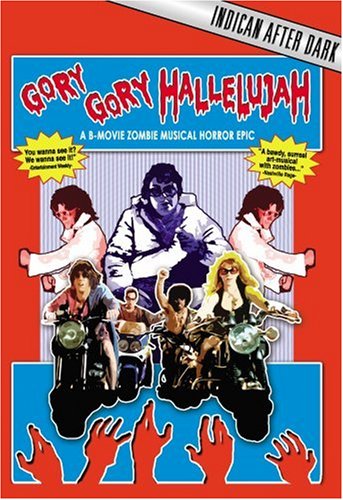
IT CAME FROM THE READER-SUGGESTED QUEUE: GORY GORY HALLELUJAH (2003)

366 Weird Movies may earn commissions from purchases made through product links.

DIRECTED BY: Sue Corcoran

FEATURING: Angie Louise, Tim Gouran, Jeff Gilbert, Todd Licea, Joseph Franklin

PLOT: Four aspiring actors on their way to New York run afoul of increasingly dangerous obstacles, including a group of rowdy Elvis impersonators, a backwards fundamentalist hick town, and a zombie apocalypse.

COMMENTS: Satire, the playwright and Algonquin wit George S. Kaufman opined, is what closes on Saturday night. Nevertheless, aspiring filmmakers frequently turn to satire as a means to walk the line between mass-appeal populism (near-parodistic references to familiar material) and fringe-appeal provocation (harsh critique of sociopolitical foes). All of which is to say, Gory Gory Hallelujah has the aspirational sweat of satire all over it. Unfortunately, Kaufman seems to have its number; Gory Gory bleeds out quickly.

Gory Gory has so many targets for its smug disdain that it plays like a sketch film. The opening salvo takes on the insular and pretentious world of theater, which is admittedly made even more amusing with the reveal that this delusional production of the Gospel is being staged in the theatrical mecca of Seattle. But that’s all forgotten once we set off on a road trip, a genre that revels in wacky mismatched personalities. From there, the targets are set up like the shooting gallery at a fair: here’s the crazy fight with a gang in a bar, here’s the hypocritically moralistic small town, here’s the evil lurking in the woods. The scenes are mileposts, rather than logical stops along the way.

This is a film that is not the slightest bit interested in nuance. Consider our central quartet of heroes, who check an impressive collection of boxes for character stereotypes: militant black man who nonetheless endures countless indignities; self-proclaimed feminist whose sexual and materialistic impulses frequently overrule the cause; nebbishy Jew who finds every opportunity to remind you of his faith; blissed-out hippie flower child whom the film wants to position as closeted, but who is actually ravenously omnisexual. That’s all there is to them; barely 24 hours after having watched the film, I’ve completely forgotten their names, and that’s just fine. They’re not characters; they’re trope delivery systems.

Title notwithstanding, Gory Gory Hallelujah isn’t really a horror film. The screwed-up small town feels like a low-rent retread of Nothing But Trouble, the witches’ coven is just an excuse to take a jab at man-hating lesbians, and the undead are lumbering actors with Green Goddess dressing smeared on their faces. I suspect if you asked director Corcoran and screenwriter Louise, they’d tell you they were making a comedy, a -esque everyone-is-awful romp that lets them flirt with edginess without having to catch any flack. Every once in a while, the film threatens to go somewhere truly daring, like the smarmy land baron’s reference to some “accidental lynchings” that hints at a truly vengeful motivation for the zombie uprising. Most of the time, though, the targets are only the most obvious, offering variations on the theme, “Aren’t these people just awful?” They are. It’s not a revelation.

The closest the film gets to a point-of-view comes in the admittedly unexpected finale, when the death of absolutely everyone presages a revival-hymn closing number that suggests we’ll all be equal in the great beyond. Whereas before everyone was greedily nasty to each other, now they’re all dancing arm-in-arm, united in brotherhood after they’ve cast off the pesky need to breathe. It would make for a solid mission statement if there’d been even a hint of it prior to the closing minutes of the film. As it stands, it’s just one more radical shift in tone for a movie that has already lurched awkwardly from one setpiece to the next. Gory Gory Hallelujah has a lot to be angry about, but just doesn’t have the heart for it. Maybe in the next life.

WHAT THE CRITICS SAY:

“Tripping over the line between silly and stupid, camp comedy “Gory Gory Hallelujah” — the title is the best part — emerges more sub-Troma than subversive…aims for bad-taste hipster satire in the John Waters vein. But co-creator/editor/thesps Sue Corcoran and Angie Louise should have left at least one job — screenwriting — to a third party.” Dennis Harvey, Variety (contemporaneous)

(This movie was nominated for review by Christopher Fox. Suggest a weird movie of your own here.)         

CAPSULE: EDDINGTON (2025)

366 Weird Movies may earn commissions from purchases made through product links.

Recommended

DIRECTED BY:

FEATURING: , Pedro Pascal, , Deirdre O’Connell, Cameron Mann, Micheal Ward, Matt Gomez Hidaka, Luke Grimes

PLOT: Spurred by his dislike of mask mandates and by personal animosity, an asthmatic sheriff in the tiny town of Eddington, NM runs for mayor, a decision that leads to a web of lies and violence and brings him into conflict with BLM protesters, antifa, and a pedophile-conspiracy cult.

Still from Eddington (2025)

COMMENTS: Come with Eddington and venture back in time to distant 2020, when a plague encompassed the Earth. Remember people’s noses constantly sliding out of their masks? Lining up to enter grocery stores spaced six feet apart? Conspiracists seizing upon citations of the word “coronavirus” from before 2019 as evidence of a “plandemic”? A swab roughly jammed up your nasal cavity at a drive-through testing clinic? Kids with assault weapons becoming YouTube celebrities? Banners hanging off cars bearing messages like “YOUR BEING MANIPULATED” [sic]? Incoherent anger and incipient violence in the air everywhere? It’s all here, in a cinematic memorial marking the moment America broke.

Eddington pits Joaquin Phoenix, a sheriff who commands little respect from his counterparts at the Pueblo tribal police, the populace at large, or even his own frigid wife, against Pedro Pascal, the incumbent mayor who’s cloyingly conciliatory in public, a hypocrite in private, and in bed with a data-center development, to boot. Phoenix’s impulsive plan to run for mayor against Pascal is the first of many poorly planned decisions. Things are complicated by incestuous love affairs in the town of about 2,000 lost souls. The politics of the wider world impinge on this microcosm in a sometimes humorous way; BLM protesters numbering in the dozens “block” Eddington’s main street, and a campaign rally at a Mexican restaurant draws even fewer folks. Still, although the political stakes are small, the body count will eventually be shockingly high.

Aster’s mockery is broad when it comes to the young privileged white kids too-eagerly radicalized by the Black Lives Matter movement—despite the fact that there is only one African American in this dusty hamlet, and he’s a policeman. The conservatives are treated with a bit more nuance. Sheriff Joe’s reluctance to mask up has a reasonable basis in asthma, and his wife and mother-in-law’s seductions into conspiracy culture are well-founded in mild mental illnesses greatly exacerbated by the stresses of lockdown. Aster makes every fevered scenario he dredges up from those dark days  feel as crazy and relatable as it really was. The cast is excellent: Joaquin Phoenix stumbles and follows a gut feeling that always leads him astray, Pedro Pascal plays perhaps his least likable character, melancholy Emma Stone mopes in bed until she finally breaks. And, although it is not a particularly weird movie for most of its running time, the climax gets wild and disorienting, as Aster puts Phoenix through misfortunes and anxieties recalling Beau at his most fearful. No one comes out of this experience unscathed; the survivors all suffer from long Covid.

Had Eddington been made in 2015, it would have played like an outlandish satire in the vein of Southland Tales. Coming in 2025, it seems almost like a story you dimly remember scrolling past on your Instagram feed.

WHAT THE CRITICS SAY:

“…a laborious and weirdly self-important satire which makes a heavy, flavourless meal of some uninteresting and unoriginal thoughts…”–Peter Bradshaw, The Guardian (festival screening)

APOCRYPHA CANDIDATE: MUTANT ALIENS (2001)

366 Weird Movies may earn commissions from purchases made through product links.

DIRECTED BY: Bill Plympton

FEATURING: Voices of Francine Lobis, Dan McComas, George Casden, Matthew Brown, Jay Cavanaugh

PLOT: Josie has kept her eyes on the skies for twenty years hoping to witness her father’s return from space; but on his re-entry, he is not alone.

WHY IT MIGHT JOIN THE APOCRYPHA:

“The president’s being eaten by a nose!”

Check the regulations.

COMMENTS: Early on in Mutant Aliens, we observe a young woman’s inner dialogue about whether or not to bang her beau. As a right-shoulder nun and left-shoulder slut exchange arguments, insults, and blows, her beau stands eagerly nearby, stretching out the front of his underpants’ waistband. Within said pants, Plympton manifests a series of metaphors: a launching missile, a locomotive, a hammer-and-anvil, etc. The scene culminates with voracious lovemaking over the woman’s observation console, the thrustful energy knocking her boob into a control lever. On the display screen, she observes an unidentified object as it comes crashing through Earth’s atmosphere.

In many ways, this vignette encapsulates not merely the building blocks of Space Mutants, but perhaps the animation-auteur’s modus operandi: Plympton suffers an insatiable desire to play with shapes and lines, and has spent his career developing plotlines sturdy enough to support his lively doodling. Mutant Aliens is an absurd narrative—Earth astronaut returns after twenty years with a mad yarn about about love and war with space noses and finger-riding space eyeballs—that features every strange curvy-cue, heaving bio-mass, and ultra-violent encounter his fan base has come to expect. Advertisement goons drool and thrust over the prospect of orbitally projected commercials; a bored secretary devises elaborate fornicatory scenarios between her left and right hands; and mutant aliens reign gross-but-cute terror on the various government suits desperately attempting to contain their menace.

Also, there’s Jesus drag racing—in song. Plympton has several axes to grind: against religion (I’m guessing he had to endure plenty of “Satanic Panic” and TV evangelism during his formative years), against Big Media (see also The Tune), against the military-industrial complex (see also I Married a Strange Person), and so on. And though he’s considerably heavy-handed—a lot of throbbing linework and delightfully icky sound effects go into his screeding—it’s hard to object. The cartoonish excess adds up to cartoonish dismissiveness, and his films feel more like jolly, middle finger Fuck Yous! than like some mopey killjoy whingeing through a megaphone.

Sure, sure, bits sag here and there (not unlike the occasional swinging breast or phallus), but by the time you notice a lull, Plympton’s wonderfully distracted pen moves on to another blast of ridiculousness. And this is the biggest draw for Plympton fans: in a way, he does the same thing over and over, within each narrative framework as well as from movie to movie. However, this “same thing” is playing around with his medium as hard as he can while poking the prudish, the pompous, and the otherwise powerful.

And that’s just peachy.

WHAT THE CRITICS SAY:

“Juxtaposing the sentimental and the bizarre comes naturally to Plympton, whose films are truly singular — surreal, lovably crude, and sweet-natured but grosser than heck, with blown-up heads and bitten-off fingers galore. Mutant Aliens is no exception… Weird stuff, I tell you, but it’s terribly cute and good-natured somehow.”–Marrit Ingman, The Austin Chronicle (contemporaneous)

CAPSULE: LES SAIGNANTES (2005)

AKA The Bloodettes, The Bloodiest

366 Weird Movies may earn commissions from purchases made through product links.

DIRECTED BY: Jean-Pierre Bekolo

FEATURING: Adéle Ado, , Emile Abossolo

PLOT: When a high-ranking government official dies, Majolie enlists her best friend to segue the disaster into a business opportunity by throwing a trendy W.I.P.: “Wake for an Important Personality.”

COMMENTS: As said, when the going gets weird, the weird turn pro; and that’s exactly what these plucky heroines do. Set in the neon-drenched perpetual night of Yaounde, Cameroon, twenty years in the future, Bekolo’s genre-hopping Afro-futurist tale depicts a city caught up in the competing influences of power, money, sex, and an ancient elemental force called Mevoungou.

Majolie only discovers her client’s identity when searching his wallet after he suddenly expires from a heart attack during an acrobatic aerialist kink session. To her distress, he’s nearly ninety years old and not just a “granddaddy” but the “SGCC”: Secretary General of the Civil Cabinet. She calls her friend Chouchou to help her out of this mess, then promptly gets drunk.

After killing a bottle of whiskey together, the girls acknowledge the ominous presence of the spirit Mevoungou. Risking the danger of channeling this ambiguous power, they steal the SGCC’s AI driven car to dispose of the official’s body. To further complicate matters, Chouchou’s mother, attended by a bevy of mysterious Bene Gesserit-like priestesses, keeps calling her, arousing the suspicions of an idealistic young cop.

Throughout the course of their night the girls dodge a number of questionable characters, including an insolent cab driver and a nosy neighbor who invites herself along for the ride, along with the mundane inconveniences of a society rife with sexual harassment and government corruption. After bribing a cannibal butcher to chop up the body (he weeps when he tastes SGCC flesh), the girls hit upon the idea of holding a wake—except they need a full corpse to make that happen, and they now only have the head.

Bribing a mortician turns out to be a troublesome task. He’s annoyed at being dragged out his bed in order to supply a body and asks for far too much money. Chouchou doesn’t want to pay him, but Majolie insists the fee will be worth it. In an office decorated with a fish tank full of body parts they continue to haggle over the price. Once they reach a deal, the girls look over the unclaimed bodies to find a good match.

After a narrow escape from the Madame Director of the hospital, the girls dress for the funeral. The Wake for an Important Personality at first goes off without a hitch: a crowd shows up, there’s lots of food and drink, and even the SGCC’s family attends. The only minor disturbance occurs when his wife and daughter tearfully insist the body isn’t his. The girls catch the eye of Minister of State and target him as their new patron. Unfortunately, he too knows how to channel Mevoungou, and they find themselves facing a daunting adversary.

Simple and effective camera techniques (dissolves and double-exposures) conjure a world animated by unseen forces. The futuristic 2025 technology, from camera phones to self-driven cars with English-speaking interfaces, appears disconcertingly accurate (as does the tag line “We were already in 2025, and nothing much had changed”).

Action sequences pay homage to The Matrix, but the derivative fight scenes quickly give way to Majolie and Chouchou’s mesmerizing synchronized dances. In the final showdown they confront their enemy, and in order to preserve their autonomy must also fight off the potentially destructive influence of Mevoungou. Much remains unexplained about this enigmatic entity which kills, and laughs, and dances. It flows through the film like a current of weirdness and, much like in real life, whether the weird brings change for good or ill all depends on how you react to it.

WHAT THE CRITICS SAY:

“…as fascinating as it is obscure… Although the production values of this digitally shot film are threadbare, the bizarre visions of writer-director-editor Bekolo are not.”–Marjorie Baumgarten, Austin Chronicle (contemporaneous)