
Although it may not be extraordinary by 70’s standards, there’s something eerie about dated satires… and an animation of someones head exploding frame-by-frame.
Tag Archives: Satire
LIST CANDIDATE: THE DISCREET CHARM OF THE BOURGEOISIE (1972)

DIRECTED BY: Luis Buñuel
FEATURING: Fernando Rey, Paul Frankeur, Delphine Seyrig, Bulle Ogier, Stéphane Audran, Jean-Pierre Cassel
PLOT: Six friends attempt to have dinner together, but repeatedly fail for increasingly bizarre reasons.

WHY IT SHOULD MAKE THE LIST: A plot so simple it’s barely a plot at all starts out small and, through masterly use of the running gag, steadily builds throughout the film, getting more and more absurd until the apocalyptic finale. And if that’s not enough, there are numerous dream-sequences, sometimes nested inside one another, and not always clearly distinguishable from reality. Also, undead policemen!
COMMENTS: Leaving aside Un Chien Andalou, which will forever be in a class of its own, Discreet Charm might just be Buñuel’s masterpiece. The Academy Awards Committee certainly thought so when they gave it the Oscar for Best Foreign Language Film in 1973. No close-ups of razor-slashed eyeballs this time; this is a nice, gentle, middle-of-the-road crowd-pleaser. Except that that description would be as misleading as taking the title literally. It’s true that there are no pianos full of dead donkeys, but we do get an electrified piano used as an instrument of torture, from which cockroaches stream as the convulsions of the screaming victim create impromptu musique concréte-–an act for which the policeman responsible is first murdered by outraged student radicals (offscreen), and then condemned to return as a gory apparition (onscreen) every Bloody Sergeant’s Day (June 14th, if you’re thinking of throwing a party). There’s definitely something unusual going on here!
So unusual that “whose subconscious are we in now?” is a very pertinent question, 38 years before it was asked in Inception. One particularly bizarre scene turns out to be only a dream, and the action picks up where it left off. But then it turns out that this too is a dream, and the character who dreamed the first dream is not only still dreaming, but dreaming that he’s somebody else! Confused yet? The visibly nervous professional movie critic in the useless featurette on the Region 2 DVD clearly was. He correctly points out that this is a dream within a dream. Not so tricky, since the film explicitly says so. What he seems to have missed is that the dream-within-a-dream is probably a continuation of the previous scene, in which implausible events take place, and characters who don’t appear in the rest of the movie behave very oddly. One of them entertains the assembled company by recounting a dream about his dead mother, which we see. So what he have here is almost certainly a dream within a dream within a dream…
Then again, other incredibly strange things occur which aren’t dreams at all. Or are they? There isn’t any sure way to decide which parts of this film are “real”, and ultimately it doesn’t matter: it’s fiction, so none of it’s real. Still, there’s obviously some strange kind of logic holding it all together, even if we aren’t told what it is. This is why, like David Lynch, Luis Buñuel belongs on the A-list of weird film-makers. Throwing the rules out of the window is enough to make a movie “weird” in the sense of weird-for-the-sake-of-weird, but to reach the next level, you need to replace what you threw out with something else. Buñuel understood this perfectly, and plays with it all the way through the film. A very distinctive object features in what turns out to be a dream, yet reappears in the scene that follows: a subtle clue that we’re still in the dream (there’s absolutely no way Christopher Nolan wasn’t taking notes here). But another dream seems to be genuinely prophetic. And so on: a tangled web indeed!
Almost every joke follows the pattern of the main plot by starting off quite tamely, but turning out to have at least one more layer. The initial appearance of a saintly bishop results in his mild humiliation and all-round embarrassment, due to a silly and quickly resolved misunderstanding that wouldn’t be out of place in a Seventies sitcom. But just when you think Buñuel’s attitude to the church has mellowed with age, it turns out that the unsuspecting monsignor is being set up for a punchline which, when we finally get to it, is as dark as they come.
This film is not weird in the sense that watching it is an endurance test. This is mainstream weirdness with excellent production values. But don’t let that fool you: every single thing that happens here is as off-kilter as the attitudes of the main characters, who honestly believe that the lower classes are subhuman because they don’t know the correct way to drink a dry martini. Discreet Charm may or may not make the List, but it’s definitely on mine.
142. TOKYO GORE POLICE (2008)
Tôkyô Zankoku Keisatsu
“She is the only actress in the world who can look so beautiful just standing in the midst of a gushing spray of blood.”–Yoshihiro Nishimura on Eihi Shiina
“I wouldn’t say I liked being covered in blood… [but] I really love the surrealism and beauty of these scenes, while I’m getting covered in blood which is spurting out everywhere.”–Eihi Shiina
DIRECTED BY: Yoshihiro Nishimura
FEATURING: Eihi Shiina, Yukihide Benny, Itsuji Itao
PLOT: Mutant serial killers known as “Engineers,” who sprout spontaneous bioweapons when wounded, are terrorizing Tokyo. Ruka, a sword-wielding loner addicted to cutting herself, is the star officer of the privatized Tokyo Police Corporation and the best Engineer-hunter on the force. As she investigates the Key Man, the human monster who is creating the Engineers, Ruka finds that secrets buried in her past may influence the future direction of her police career…

BACKGROUND:
- Although he made short films as early as 1995, Yoshihiro Nishimura made a living early in his career supervising gory special effects and makeup for movies like Rubber’s Lover (1996), Suicide Club (2001), and Meatball Machine (2005).
- Tokyo Gore Police was a huge success, and following right on the heels of 2008’s The Machine Girl (for which Nishimura did the effects), it helped popularize the modern Japanese splatterpunk movement.
- The character of the Key Man had shown up in Nishimura’s 55-minute 1995 experimental film Anatomia Extinction.
- Nishimura cites the paintings of Salvador Dali as a key influence on his design style.
- Tokyo Gore Police was co-produced by Nikkatsu, the studio infamous for firing auteur Seijun Suzuki in the 1960s because his films were too weird.
- Fellow Nikkatsu directors Noboru Iguchi (Robogeisha) and Yûdai Yamaguchi (Meatball Machine) directed the television commercial parodies.
INDELIBLE IMAGE: Though many people may be stuck on the genitalia-related mutations (penis cannon, crocodile maw vagina), I believe the quadruple amputee gimp dog lady (whose missing limbs can be fitted with blades or automatic weapons) is the movie’s most bizarre creation. Because her existence is casually revealed without comment or explanation, as a natural part of Tokyo Gore Police‘s unnatural world, in many ways it’s also the most perverse element.
WHAT MAKES IT WEIRD: Tokyo Gore Police earns its spot on the List as the apex of an entire genre of movies: the gory Japanese biohorror B-movie built around absurd violence and crazy mutant creatures. With its bordello of freaks, fountains of blood spurting from decapitated heads, and sick jokes at the expense of our fragile human anatomy, Tokyo Gore Police ticks off all the splatterpunk boxes; heck, it helped draw the boxes. Tokyo Gore Police found the top and easily vaulted over it, and try as they might no one has been able to raise the bad-taste bar—yet. As a bonus, this movie provides something you don’t see in its sillier imitators: a layer of nihilistic social satire and a nightmarish sense of urban despair.
American trailer for Tokyo Gore Police
COMMENTS: While David Cronenberg explored the plasticity of the human body in the West as early as 1983, transforming our very television Continue reading 142. TOKYO GORE POLICE (2008)
CAPSULE: THAT OBSCURE OBJECT OF DESIRE (1977)
That Obscure Object of Desire has been promoted onto the List of the 366 Weirdest Movies ever made. Please visit the official Certified Weird entry. Comments on this post are closed.

DIRECTED BY: Luis Buñuel
FEATURING: Fernando Rey, Carole Bouquet, Angela Molina
PLOT: A rich French businessman courts a beautiful young Spanish woman over the years, but although she sometimes professes to love him, she continually refuses to consummate the relationship.

WHY IT WON’T MAKE THE LIST: Obscure Object is one of Buñuel’s best, but not one of his weirdest. If you merged the two actresses who inexplicably share the role of Conchita into one, you could almost mistake this parody of obsessive bourgeois eroticism for a normal comedy—almost.
COMMENTS: The “gimmick” of two actresses playing the object of desire is the high-concept highlight of That Obscure Object of Desire, but make no mistake: the casting was not a desperation move to salvage some sort of novelty value out of a dull script. Buñuel’s final film is one of his most tightly controlled and plotted movies, the work of a 77-year old master intent on putting the final punctuation on a distinguished career. The story is simple: prosperous, respectable, middle-aged Mathieu meets 18-year old serving girl Conchita and attempts, and fails, to seduce her. She leaves his service, but as the years go on he continues to encounter her, whether by chance or by design, and gradually he works his way closer and closer to her heart—but although she declares her love for him, she never surrenders her virtue. Buñuel and his totally committed trio of actors push the dramatic scenario further than you would think possible: the erotic tension builds and builds until surely, you think, something has to break. Either Conchita will give in or Mathieu will tire of being teased and rid himself of her forever. And yet, after each frustrating encounter, the bourgeois businessman comes back for more, and Conchita is willing to continue the dance. There are moments when rape seems inevitable, but that solution would wreck the game, so they push right to the brink before pulling back and resetting.
It’s not all unbearable erotic tension: Obscure Object is, at heart, a droll and absurd comedy, full of sophisticated, off-kilter jokes; even if you don’t always get them, you feel smarter for chuckling at them. Some gags are obvious: there’s a variation on the old “waiter, there’s a fly in my soup!’ joke—this time, it’s in a martini. One night, Mathieu lures Conchita to his bedroom; Angelia Molina asks “can I change?” and goes into the bathroom to put on her nightgown; she emerges as Carole Bouquet. At other times the humor is more oblique and surreal, and we’re not sure what to make of it. Mathieu tells his story to traveling companions on a train; one is a dwarf, and a professor of psychology—but he only gives private lessons. A Spanish fortune teller carries a pig wrapped in a blanket like a baby. The movie is set in a Europe where terrorist bombings are a background fact of life; one of the revolutionary groups is named “the Revolutionary Army of Baby Jesus.”
This being a Buñuel film, there’s a constant subtle mockery of the unexamined values of the middle class. Mathieu casually tells the strangers in his train compartment how he essentially tries to purchase Conchita off her cash-strapped mother, and how he beats and humiliates the girl after he’s been sexually frustrated. Rather than being scandalized by the shameful confession, everyone takes his side, nods understandingly and comforts the respectable victim. Obscure Object is Buñuel’s attack on what he sees as the capitalist system of romance: men, the class with the capital, protect and provide for women, and in return they receive love and sex. This arrangement, based on inequality, can never satisfy either sex: men will remain emotionally frustrated because women only give in to them out of hardship, and the disenfranchised women use the only weapon at their disposal—their erotic power—to revenge themselves upon men. Just as the characters in The Discreet Charm of the Bourgeoisie never get to eat, Mathieu never gets to… you know.
As for why two women play Conchita, it’s one of those deliberate Surrealist accidents that suggest interpretations that remain obscure. Do Bouquet and Molina represent two sides of the same woman, a divided personality, female duplicity? I lean to the reading that there are two women because Mathieu, the bourgeois man, can’t understand the “object” of his own desire; he no more notices that his love changes before his very eyes than he sees that the society around him is crumbling into anarchy.
According to co-writer and longtime Buñuel collaborator Jean-Claude Carrière, the idea to cast two women in the role of Conchita occurred in an early draft of the script, but was discarded. When production began on the movie Buñuel was unhappy with the woman chosen to play Conchita (Last Tango in Paris’ Maria Schneider) and came close to abandoning the project before resurrecting the idea of using dual actresses in the role.
The Criterion Collection lost the rights to Studio Canal’s Buñuel collection, and therefore the 2013 Blu-ray of That Obscure Object of Desire was released by Lions Gate (buy
WHAT THE CRITICS SAY:
CAPSULE: SLACKER (1991)
DIRECTED BY: Richard Linklater
FEATURING: The citizens of Austin, Texas
PLOT: Slacker spies on the aimless exploits of the slackers of Austin, TX; the camera follows one character for a few minutes, then veers off to chase another through a series of comical, philosophical, and absurd vignettes involving hit-and-run drivers, elderly anarchists and video fetishists.
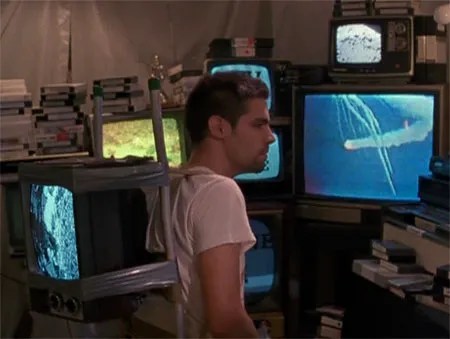
WHY IT WON’T MAKE THE LIST: Slacker is a seminal, interesting, and at times incisive storytelling experiment, but it’s of interest to weirdophiles mainly as the spiritual prequel to Waking Life, which is virtually Slacker remade as a dream.
COMMENTS: The batty cast list—credited characters include “Dostoevsky Wannabe,” “Recluse in Bathrobe” and “Hit Up for Cigarettes”—accurately reflects the mix of mundanity and eccentricity on display in writer/director Richard Linklater’s slice-of-life tour of the coffee shops and crash-pads and on the fringes of Austin, Texas in 1991. Slacker is a character study of the subculture of bright but unambitious dropouts and unemployed postgrads bent on extending their undergrad lifestyles that exists in every college town. At the time of its release it was seen as emblematic of “Generation X”‘s alienation and withdrawal from mainstream culture, but in reality this Bohemian substrata of unmotivated aesthetes and anti-establishment hedonists has always been with us under various names (if the movie had been made in 1291 in Saint-Rémy-de-Provence it would have been entitled Goliard). For this peripatetic essay Linklater borrows the elegant but seldom used narrative device invented by Luis Buñuel for The Phantom of Liberty: two characters walk down the street discussing whether they should leave the country, then the cameraman suddenly gets bored and starts following a man who enters a coffee shop where an insane woman advises him that he should “never traumatize a woman sexually,” then decides instead to see where the guy who just entered the shop wearing a bathrobe is headed to, and so on. The result is a series of vignettes which are occasionally funny, occasionally disturbing, and often repetitive, but which capture a peculiar, laid-back, mad energy of a particular place at a particular point in time. Still, as the film’s oldest character rhapsodizes when remembering Charles Whitman, “this town has always had its share of crazies—I wouldn’t want to live anywhere else.” Memorable characters range from the UFO enthusiast who accosts passersby to explain his theory that we’ve been on the moon since the 1950s to the tomboy who’s looking to fence stolen celebrity gynecology artifacts, cheap. Linklater, who delivers the first of the film’s many discursive monologues himself in the role of “Should Have Stayed at the Bus Stop,” shows an attitude of fond disdain for a town where everyone sleeps in late and is working on an unfinished novel or playing in an unsigned band. The director may have arisen out of the Austin milieu, but if he’s a slacker, then he’s a type-A personality slacker; he’s obviously a much harder worker than the guy who earnestly muses “who’s ever written a great work about the tremendous effort required not to create?” over a cup of cappuccino.
If Slacker has one downside (besides excusably spotty acting by the amateur cast), it’s that the movie turns repetitive and arguably outstays its welcome. Somewhere between twenty and forty-five minutes in we start to get the picture; although the UFO guy and the JFK guy have totally different obsessions, ultimately they’re both just proselytizers with a passion for explaining stuff we don’t care about to us in ridiculous detail. The overall portrait Linklater manages to paint is still very impressive; Slacker may be the most passionate and invigorating movie about doing nothing ever made.
On a personal note, I was lucky enough to see Slacker in Austin, TX in 1991 in a theater in a strip mall (I lived in Dallas at the time but had a friend attending UT with a couch I could crash on). The movie, which was playing nowhere else in the country, had been held over for a second week, and the afternoon matinee showing was standing room only; everyone in the audience but me probably had a friend or two who was an extra in it. I had an aisle seat; a middle-aged woman came in late and stood next to me during the entire show, shooting me nasty looks as she shifted from foot to foot. I recall thinking it ironic that the Austinite had to stand through the whole performance simply because she had slacked off on getting to the show on time.
WHAT THE CRITICS SAY:
(This movie was nominated for review by nicolas, who suggested that all of Linklater’s films were “pretty weird and deep with one or two exceptions.” Suggest a weird movie of your own here.)