Tag Archives: Fantasy

READER RECOMMENDATION: CHRONOPOLIS (1982)

Reader review by Morgan Hoyle-Combs.

DIRECTED BY: Piotr Kamler

FEATURING:

PLOT: In a lost city, that may only be found in time, monolithic figures try to break free from

Still from Chronopolis (1982)

their continuous state of immortality by crafting, and destroying, time itself. Two keys to their demise are a curious white sphere and long legged explorer, both of who have no interest in putting an end to the gods of Chronopolis.

WHY IT SHOULD MAKE THE LIST: Piotr Kamler created one of the few silent stop-motion arthouse films synched with an electrical atmospheric soundtrack that has yet to take on a cult audience. Made with a 1920’s 35mm Debrie Parvo camera over a five year period, Kamler didn’t hesitate to tell a story though calm visuals and masterful animation which beckons a new face to the pure, dreamlike wonders that surrealist cinema has to offer.

COMMENTS: Everyone has some type of love for the strange, somewhere. When I was a teen, I recall searching for movies set in a dystopian steampunk world. The name Chronopolis popped up, but with very little info, let alone links. I shoved the title on YouTube, desperate to see fancy steampunk. Chronopolis was not that; in fact, the video was so pixelated I could hardly tell what was happening. I wanted more. After researching, I finally found the whole movie; it forever changed my perspective on viewing cinema and the world through an eye piece.

The fact that this stop motion movie is rarely spoken of and had a very little release adds more to it’s strange nature, almost like it was intended to be forgotten by time. In reality I think Kamler did not do a fantastic job of publicizing his work. A VHS edition was released from a now deceased video library in Boston in the mid 80’s. The movie earned it’s fame, however, through its inclusion on a 2007 DVD collection of Kamler’s shorts, although this version was cut by 20 minutes or so. Kamler originally stated that there were some gratuitous scenes when he initially released it to the public. I watched both, and found the 66 minute version to be a little darker Continue reading READER RECOMMENDATION: CHRONOPOLIS (1982)

CAPSULE: STRINGS (2004)

DIRECTED BY: Anders Rønnow Klarlund

FEATURING: Voices of James McAvoy, Catherine McCormack, , Julian Glover

PLOT: Hal, Crown Prince of a kingdom of marionettes, disguises himself as a commoner to try to uncover his father’s murderer.

Still from Strings (2004)

WHY IT WON’T MAKE THE LIST: Strings is essentially a stock prince-grows-to-be-a-man-and-saves-the-kingdom high fantasy tale, but with a twist: everyone in the film is not only a marionette, they know they’re a marionette. The gimmick is used meaningfully, but given the standard-issue narrative, it’s not enough to movie this film from the “offbeat curiosity” into the “weird” column.

COMMENTS: Strings‘ basic plot, which involves an undercover prince, a kingdom in peril, intrigue and betrayal, prophecies, virtuous misunderstood rebels, appeals to the “power of love,” and a big battle at the end, is at the same time a bit confusing (with lots of characters, factions and subplots to keep track of) and overly familiar. That hardly matters, however, because the movie’s real pleasures come from admiring the meticulously constructed puppets as they dance across the boldly-lit diorama sets, and even more from the film’s creation of a complete marionette culture and mythology. The hand carved puppets have an Old World, doll-like charm, and although their faces are all frozen in neutral expressions, they exhibit an unexpected range of expressiveness just by raising or lowering their eyelids or tilting their heads that make them only slightly uncanny. The filmmakers make no attempt to hide the marionettes’ strings—even going so far as to title the movie after the darn things—and this is the most interesting and curious aspect of the  production. A dozen or more strings rise up from each character’s body, disappearing into the heavens above. A breathtaking aerial view illustrates why airplane flight would be impossible in this alternate reality, as we see thousands of strings rising above the moonlit clouds stretching up to infinity, each set connected to an invisible creature walking about the world below. The film explores every aspect of their strung-up existence; even the city gates and prison cells operate according to weird marionette logic. I won’t spoil every single thread, but it was fascinating to see the mystical “birth of a marionette” scene, as the mother brings the carved wooden block of a baby to life by painfully summoning strings to descend from the heavens, then attaching them to the lifeless wooden doll. It’s tough to figure out who this movie is aimed at—it’s too dark and weird for the kiddie matinee crowd, and not quite dark and weird enough for us—but that very singularity of vision and lack of a clear marketing angle gives it cult credibility. In the end, despite the fact that we don’t make much of a connection with the archetypal heroes, despise the stock villains, or feel much investment in the restoration of the kingdom, Strings still manages to be a visually beautiful and imagination-stimulating movie. And it finishes with an unexpectedly touching ceremony that takes the marionettes’ central metaphor, alien as it is, and uses it to tug a little on our heartstrings as well as theirs.

Strings contains a couple of nods to Shakespeare: the main character who seeks to avenge his slain father, the king, while being opposed by a deceitful uncle, bears a passing resemblance to “Hamlet.” Even more obviously, the protagonist who grows from a foolish boy to a competent king is named Prince Hal, just like the star of the “Henry IV” and “Henry V” plays.

WHAT THE CRITICS SAY:

“Essence of movie’s weirdness lies in its initial conceit… not quite strange enough to appeal to hardcore arthouse auds who savor the work of Jan Svankmajer, the Brothers Quay and the like, but neither is it cutesy enough to cross over to the mainstream.”–Leslie Felperin, Variety (contemporaneous)

(This movie was nominated for review by “Teodor.” Suggest a weird movie of your own here.)

110. FELLINI SATYRICON (1969)

AKA Satyricon; The Degenerates

“…to eliminate the borderline between dream and imagination; to invent everything and then to objectify the fantasy; to get some distance from it in order to explore it as something all of a piece and unknowable.”–Federico Fellini on his motives for adapting Petronius’ Satyricon

Recommended

DIRECTED BY:

FEATURING: Martin Potter, Max Born, Hiram Keller, Mario Romagnoli

PLOT: Two students, Encolpio and Ascilto, argue over their dual ownership of the handsome slave boy Giton, whom Encolpio loves and Ascilto has sold. Encolpio seeks Giton through a series of adventures that take him across the ancient Roman world, encountering a pompous actor, a wealthy merchant who holds nightly orgies and fancies himself a poet, unscrupulous slavers, and other long dead satirical targets. Eventually Encolpio becomes involved in a plot to kidnap an albino hermaphrodite demigod, is cursed with impotence, and seeks the services of a witch.

Still from Fellini Satyricon (1969)

BACKGROUND:

  • Petronius wrote the rambling, erotic, and highly literary “Satyricon” during the reign of Emperor Nero, 1st Century A.D. It is sometimes considered the world’s oldest surviving novel.
  • The original Roman satire survives only in fragments, which explains the often incoherent nature of the story in Fellini’s movie. Fellini invented a few small details (and one major one, in the hermaphrodite character who replaces the penis-god Priapus’ role in the story) to bridge gaps or help the story flow in the direction he wanted to. The director refers to the fragmentary nature of the source narrative by allowing the story to jump forward in time, and even ends a scene in mid-sentence (as Petronius’ surviving work ends in the middle of a sentence).
  • Fellini’s name appears in the title not out of vanity, but to distinguish the movie from a competing adaptation directed by Gian Luigi Polidoro which was also released in 1969. Polidoro registered the title Satyricon first. United Artists purchased the international distribution rights to both films and sat on Polidoro’s movie while they promoted Fellini’s more marketable name.
  • Fellini used international actors for the main parts (joking that he did so because there were no Italian homosexuals). The director saw that dubbing into Italian was deliberately made slightly out of sync with the actors’ lip movements to create an additional feeling of strangeness.
  •  was offered the small but important role of Trimalchio, but was too ill to accept it (Karloff died in February of 1969).

INDELIBLE IMAGE: Picking a single image to represent Satyricon is like trying to single out one scene that captures the essence of a sprawling carnival. The film is a nonstop parade of extreme imagery, grotesque tableaux and freakish costuming.  No one scene sticks out as more bizarre than another, and nothing is supposed to; everything inside  the borders of the known world of Satyricon is as weird as everything else, from the whorehouse at the center of the empire to the blank spot at the edge of the map where monsters be. Forced to select something, we went with the image appearing five minutes into the film of the actor Vernaccio, dressed in a porcine pink helmet with a fin on top, carefully placing a tiny pill-like object on his outstretched tongue. It’s Fellini’s signal to the Summer of Love crowd that the movie is dosing itself right now—strap yourselves in for the trip to come.

WHAT MAKES IT WEIRD: Fellini seizes upon the fragmentary nature of his classical source material as an excuse to fly off on flights of phantasmagorical fancy; he sets his camera to observe these imaginary denizens of gluttonous old Rome as if they were alien lifeforms. Satyricon is the work of a master filmmaker at his most self-indulgent—but when tremendous talent indulges itself, the results are typically spectacular.


John Landis on the trailer for Fellini Satyricon

COMMENTS: The surviving text of the Satyricon begins with randy bisexual student Encolpio in Continue reading 110. FELLINI SATYRICON (1969)

CAPSULE: LABYRINTH (1986)

Recommended

DIRECTED BY:

FEATURING: ,

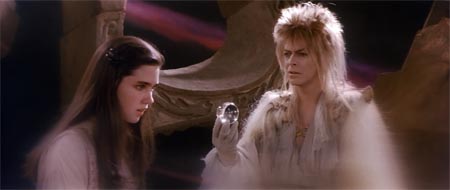
PLOT: A dreamy teenage girl must rescue her kidnapped baby brother by journeying to the Goblin City at the center of a bizarre labyrinth.

Still from Labyrinth (1986)
WHY IT WON’T MAKE THE LIST: Despite the MC Escher-inspired set-design, the unexpected sexual tension between teenaged Connelly and fruitily-dressed goblin king Bowie, and a devout cult following, Labryinth is ultimately just too close to a mainstream Muppet fantasy to place on a List of the 366 Weirdest movies. We’ve passed over slightly stranger movies in this genre—the visually similar Henson-directed The Dark Crystal and the thematically similar Henson-produced MirrorMask—and, although I think Labyrinth is a better film than either of those, it’s difficult to justify certifying this one when its companion films don’t even get to sniff the List.

COMMENTS: In The Wizard of Oz, Judy Garland’s breasts were famously flattened out with tape so the 16-year old could play a pre-pubescent girl. Labyrinth takes a different strategy: 14-old Jennifer Connelly plays exactly her age, portraying a hormonally testy girl-woman caught at the stage where her attention starts to shift from stuffed animals to the well-stuffed pants of strutting rock stars. That shot of rising estrogen distinguishes Labyrinth from other Oz/Alice in Wonderland fairy tale variations, giving it a subtext that goes over the heads of the tots in the audience but leaves adults with additional nuggets to ponder (and no, that’s not another reference to Bowie’s stretch pants).

There’s an impressive amount of imagination on display here, starting with Henson’s puppets, who reveal an almost limitless variety (each individual goblin looks like a representative of its own species) and a nearly human expressiveness (to be honest, the puppets out-act both Connelly and Bowie). The girl’s three companions—the cowardly dwarf Hoggle, the bestial Ludo, and Sir Didymus, the comic relief knight/terrier—are all worthy additions to Henson’s Muppet menagerie, and there is a zoo full of eccentric Wonderland-esque supporting creatures, including walking playing cards, Continue reading CAPSULE: LABYRINTH (1986)

LIST CANDIDATE: TUVALU (1999)

Tuvalu has been promoted onto the List of the 366 Weirdest Movies Ever Made. Please visit the official Certified Weird entry. Comments on this post are closed.

DIRECTED BY:

FEATURING: , Chulpan Khamatova, Terrence Gillespie, Philippe Clay, Catalina Murgea

PLOT: Can a picturesque but dilapidated Turkish bathhouse pass a government inspection, and can love between a poolboy and a female patron flourish after the girl’s father is killed when a piece of the crumbling ceiling falls on him?

Still from Tuvalu (1999)
WHY IT MIGHT MAKE THE LIST: Stylized to the T’s and set in a bleak world where crumbling Romanesque baths sit in fields of rubble, Tuvalu shows all the right cinematic influences and has the instinctual organic oddness necessary to be canonized in the halls of weirdness. In fact, it falls short of making the List of the 366 Best Weird Movies on the first ballot by as slim a margin as is possible. Visually, Tuvalu is a stunner; it only falls short of classic status due to a stiff storyline. While it’s hard to imagine 250 or so more impressive weird movies to make the list ahead of this one, we’re going to hold back for the moment and hold out hope we do locate them; if not, we expect Tuvalu will be back to take up the slack.

COMMENTS: Stylistically, Tuvalu takes its cue from the weird world of , in more ways than one. Director Veit Helmer challenges himself to tell the story with the minimum amount of dialogue possible; only names and very occasional words (“no!,” “technology!”) are spoken. Remarkably, from the context, the characters convey almost as much information to us just by saying each others’ names with the proper inflection, and the story is effectively told entirely on the visual level. The color scheme is 1920s monochrome, sepias for indoor scenes and steel gray for exteriors, with a brief explosion of color appearing in the rambunctious storybook hand-tinting of the fantasy scenes. There are ample references to , too, with certain sequences cranked-up Keystone Kops style, and put-upon poolboy Anton (craggy-faced Lavant) constantly scurrying about his family’s Turkish bath putting out fires started by the eccentric denizens of this timeless movie-caricature world. More recent Tuvaluan influences come from famed French fantasists (in the rapturously baroque Continue reading LIST CANDIDATE: TUVALU (1999)