Tag Archives: Black Comedy

366 UNDERGROUND: INCORPOREAL MAN (2025)

366 Weird Movies may earn commissions from purchases made through product links.

Beware

DIRECTED BY:

FEATURING: None (completely generated by AI)

PLOT: A delusional bum with supernatural abilities tries to fight crime and save democracy.

Still from Incorporeal Man (2025)

COMMENTS: From the beginning, something feels off. Characters move clumsily and the imagery alternates between photorealistic and animated with no consistency at all. Then it becomes clear. This is a feature length film completely constructed with the help of Artificial Intelligence. But let’s not be negatively predisposed, assuming it will be the product of laziness and lack of talent, just because it doesn’t use real cameras and actors. Let’s soberly examine it for what it is, or at least attempts to be.

Director Haradon has a background in AI-made films: The Epic of Gilgamesh (2024) is a feature-length A.I. adaptation of the world-famous poem. Now, with Incorporeal Man, he works on an abandoned script of his own from 2004, bringing it for the first time ever on the “big screen.” The plot revolves around Jim, a disheveled drunkard (partly modeled on Haradon’s physical appearance) coming to town to catch the infamous serial killer “The North Butcher.” Jim develops a friendship with Roger, a cartoonish egg-shaped figure working at the Shit Factory—don’t ask–and through their conversations the protagonist’s background and special traits (like his superpower that allows him to travel through walls) are revealed. Pretty basic exposition, but it works.

Through Roger, Jim finds a job at the Shit Factory, too, studying kung fu in his spare time in hopes of saving the city from criminals and sickos. He mostly goes around talking about himself, though, getting trapped gradually in a series of destructive and self-destructive delusions. It all plays out like a dark comedy, with a protagonist who’s an exaggerated combination of two well known archetypes: half superhero, and half deadbeat detective out of a classic noir. Everything is archetypal, in fact, and mostly plays by the rules of classic narrative, with only the somewhat anticlimactic and ironic finale really making a difference.

If this movie wasn’t made by AI it would be basic, forgettable work. Here it has a distinct grotesque aesthetic, with decomposition and degradation imbued almost in every shot, not only in our low-life characters but in their environments, too. There’s also a nod to classic ian thrillers towards the climax.

For sure, there are some WTF elements along the way, such as the Shit Factory. The factory works mostly as an allegory, though, recalling shitty, alienating work environments most of us can relate to. The sound department is also AI software; it works okay, incorporating realistic voices and some classical tunes. There are some weird sound effects, however, like the farting noise heard whenever our character turns incorporeal to pass through walls.

All in all, this movie may appeal to a certain kind of audience that loves bad cinema. It is a Z-movie that might entertain for how outrageously silly it is. We do have to recognize the passion here. The movie is also available for free—legally—on YouTube, so you can check it out if the concept intrigues you. But a final warning: Incorporeal Man is in essence feature-length AI slop, nothing more.

WHAT THE CRITICS SAY:

“The spirit of the late poet Bukowski becomes a ghost in the machine in the AI-tooled unconventional superhero feature The Incorporeal Man… Fans of Tim and Eric will like it, as this is way stranger and less irritating than the Tim and Eric feature movie.“–Michael-Talbot Haynes, Film Threat (contemporaneous)

65*: SOUTHLAND TALES (2006)

366 Weird Movies may earn commissions from purchases made through product links.

“Some audience members get very angry if they can’t process and understand the story in one viewing, and they see that as a design flaw in the film itself. Other people are more open to obscurity and complexity and the idea of needing to revisit something. Those are my favorite kinds of films.”–Richard Kelly

DIRECTED BY: Richard Kelly

FEATURING: Dwayne Johnson, Seann William Scott, Sarah Michelle Gellar, Justin Timberlake, Nora Dunn, Wood Harris, Christopher Lambert, John Larroquette, , , Mandy Moore, Holmes Osborne, Cheri Oteri, Amy Poehler, , Miranda Richardson, , Will Sasso, Wallace Shawn, Kevin Smith

PLOT: In the near future, a terrorist attack transforms America into a cryptofacist police state. The third anniversary of that attack proves to be a day of great significance, with the launch of a new national surveillance agency, the release of an energy source/mind-altering drug called Fluid Karma, and the debut of an enormous luxury zeppelin improbably named for the wife of Karl Marx. On this day, the fates of multiple citizens collide, including an amnesiac action star who has written a startlingly prescient screenplay, a porn actor overseeing a burgeoning branding empire, a former beauty queen-turned-spymaster, a venal fundamentalist vice-presidential candidate who is being bribed by an assortment of neo-Marxist agitants, an international cadre of cult members whose purported invention of a perpetual motion machine masks an effort to bring about the end of the world, and, maybe most importantly of all, a war veteran and his twin brother searching for each other.

Still from Southland Tales (2006)

BACKGROUND:

  • Kelly envisioned the film as part of an epic multimedia saga. In-film titles identify sections of the movie as chapters 4-6; the first three chapters were released as graphic novels (now out-of-print collectibles).
  • The film had a notorious premiere at the 2006 Cannes Film Festival when Kelly submitted the film before it was completed. He finished neither the editing nor the visual effects in time, and the extremely poor reception received by the work-in-progress prompted him to cut more than 20 minutes prior to general release (including virtually all of’s performance as an Army general). The version shown at Cannes has since been released, although Kelly himself describes the film overall as unfinished.
  • Several members of the cast are alums of “Saturday Night Live.” Kelly intentionally cast them to play up the screenplay’s satirical elements, and in general wanted to give his actors a chance to play against type.
  • Budgeted at $17 million, Southland Tales grossed less than $400,000 at the global box office.

INDELIBLE IMAGE: There’s little agreement as to whether Southland Tales is a good movie or not, but the one thing that seems to be beyond dispute is that is Timberlake’s Venice Beach lip sync to The Killers’ “All These Things That I’ve Done” is the standout scene. Timberlake’s yokel narrator Pilot Abilene spends the bulk of the film drawling overheated speeches that rely heavily on the Book of Revelation, which he delivers in the tone of a pothead conspiracy nut vainly trying to lift the scales from your eyes. But here, as he struts through a rundown arcade in a drug-induced haze wearing a blood-soaked undershirt and cavorting with a kickline of PVC-clad nurses, Pilot Abilene claims the screen for himself, demonstrating more comfort with the film’s absurdities than anyone we’ve seen thus far. It’s the one moment where Kelly’s delivers his commitment to over-the-top imagery with any degree of lightness; instead of the ponderousness of significance that accompanies every other set piece, this dance scene really dances.

TWO WEIRD THINGS: Mirror on delay; rehearsing the performance-art assassination

WHAT MAKES IT WEIRD: Richard Kelly is ambitious to a fault, a spectacularly indulgent filmmaker who never had an idea he didn’t want to film and who makes sure you notice every element of his worldbuilding. Southland Tales is a quintessential Kelly experience, with one layer of Philip K. Dickian paranoid surrealism piled upon another layer of Altmanesque interconnectedness, rinse and repeat. The film has been carefully crafted to confuse, with absurd situations, offscreen backstories, and red herrings combining to keep characters and viewers equally at sea.

Original trailer for Southland Tales (2006)

COMMENTS: What good is a blank check? If cinematic success affords a director the chance to fulfill their dream, what dream should Continue reading 65*: SOUTHLAND TALES (2006)

CAPSULE: ADAM’S APPLES (2005)

366 Weird Movies may earn commissions from purchases made through product links.

Recommended

DIRECTED BY:

FEATURING: Ulrich Tomnsen, , Nikolas Bro

PLOT: Priest with a troubled past tries to provide a way to redemption for a young neo- Nazi.

Still from Adam's Apples (2005)

COMMENTS: An aggressive man arrives at a chapel as part of a social reintegration program. Accompanied by two other ex-criminals, he will strive for personal redemption under the guidance of an enigmatic priest with some controversial methods and a tragic past.

Sometimes redemption is just an apple pie away. A trivial purpose, the baking of an apple cake, motivates the young neo-Nazi protagonist, and becomes his path. However, this tale is not really about him, or at least not only about him. He is mostly a vessel to introduced us to his mentor, the  priest, a tragic figure hauntingly performed by one of today’s most acclaimed European actors, Mads Mikkelsen (a close collaborator of director Jensen).

And what a personality this priest is! Even though he has been struck by many misfortunes in his life, he maintains a sense of confidence in himself and in God’s plan, while striving to remain a role model for others. Not everything is as it seems, though, and it is gradually revealed that his calmness is an effect of his constant denial to acknowledge burdensome tragedies. He will have to confront his demons, abandon hope, and embrace stoicism if he wants to obtain true happiness and find salvation. Shots of the priest in his car—either as a driver or as a passenger—masterfully convey the ups and downs of his mental state.

What we have here is not exactly a character study, however. Hints of the supernatural and the magically realist, like crows and worms that try to prevent the baking of the apple pie mentioned above, give this tale the sense of a religious parable. Moreover, the movie draws a comparison between Mikkelsen’s priest and the Old Testament’s Job, making this movie akin to a modern retelling of the classic tale.

From start to finish, this is a grim and haunting cinematic experience, an art-house oddity with parabolic tones and much religious symbolism. It is recommended mostly for fans of religious dramas in a contemporary setting; ‘s Calvary (2014) and the Danish series “Ride Upon the Storm” by Adam Price are similar, even when they stray away from the weirder aspects of this work.

WHAT THE CRITICS SAY:

“The performances are spot-on, as all play this darkly funny material as if they are in a deadly serious Shakespearean drama, highlighting the situation’s absurdities and asking us to consider how much our reality is shaped by our preconceptions, beliefs and, yes, faith.”–Dan Jardine, Cinemania (festival screening)

Adam's Apples

  • Factory sealed DVD

New starting from: 111.00

Go to Amazon

(This movie was nominated for review by Mauser. Suggest a weird movie of your own here.) 

APOCRYPHA CANDIDATE: BUGONIA (2025)

366 Weird Movies may earn commissions from purchases made through product links.

Bugonia is currently available for purchase or rental on video-on-demand.

DIRECTED BY:

FEATURING: , , Aidan Delbis

PLOT: Aided by his autistic cousin, a troubled man kidnaps a corporate executive, certain she is an Andromedan alien in disguise.

Still from Bugonia (2025)

WHY IT MIGHT JOIN THE APOCRYPHA: Since it improves on its canonically weird source material in every way (except ability to surprise), it has to be Apocrypha worthy, mathematically speaking.

COMMENTS: At first, Jesse Plemons’ Teddy seems like a relatively normal guy, even if his stringy, greasy red hair suggests a serious disinterest in hygiene. He is at least sympathetic in the way he takes care of his mentally-challenged cousin Don; that is, until he convinces Don to join him in undergoing chemical castration, so that the pair can resist temptation and better focus at the task at hand. Their goal? Nothing less than saving humanity from the machinations of our secret alien overlords. Their method? Kidnapping pharmaceutical CEO and “TIME” magazine covergirl Michelle Fuller. Teddy’s studies of subtle morphological clues have convinced him that Fuller is a high-ranking alien. After the abduction, the pair shave her head (to prevent her from using hair-based technology to signal for help) and slather her in antihistamine cream to dampen her psychic powers. The captured Michelle tries to use the powers of persuasion that serve her in the corporate world to threaten and cajole her way out of captivity, repeatedly asking to enter into a dialogue, ready to come to the bargaining table. But Teddy is prepared for her tricks; he’s anticipated every objection and rhetorical tactic she might try. If she tries to convince him he’s out of touch with reality… well, that’s exactly the tack an alien would take. He will accept nothing less than a full confession and an agreement to take Don and him with her on her spaceship at the lunar eclipse to meet her superiors and negotiate the Andromedans’ withdrawal from Earth. The canny Michelle adjusts her strategy to try to find a way to manipulate Teddy from inside his own warped reality. A clue suggesting a shared backstory between the two may provide the leverage she needs. A long second act of psychological cat and mouse games ensues, with the tension effectively relieved by laugh-out-loud moments from clueless Don.

The movie begins with the buzzing of bees from Teddy’s apiary, and the specter of extinction permeates the entire story. Chemicals from Michelle’s corporation may literally be responsible for a recent plague of colony collapse disorder. In Teddy’s view, aliens use humanity in the same way he uses his beehives to extract honey, with humanity no more conscious of their exploitation than his bees are. The problem, as he sees it, is that the aliens have no interest in the generational welfare of humans. As crazy he appears, Teddy ultimately has a point. Whether Michelle is an alien emissary or just a corporate overlord, she leeches off humanity; Andromedan or MBA, she’s a masterful manipulator who ultimately has only her own interests in mind. Teddy’s foil-on-the-windows paranoia may be misplaced, and may lead him to adopt inhumane methods, but his intuition about the imminent collapse of civilization strikes a chord.

Bugonia is Lanthimos’ most straightforward film since The Favourite. For most of the runtime, the story is grounded in reality, if reality of an extreme and outlandish flavor. He seems to have largely abandoned the affected, affectless acting that characterized The Lobster and Killing of a Sacred Deer: thankfully so, as it would have been a crime to hamper Plemons and Stone. (Aidan Delbis, an actor who is actually on the autism spectrum, does provide stilted line deliveries, but they are character-based and attributable to his neurological condition.) Lanthimos also restrains himself from adding the random ultra-wide fisheye lens shots that have proved distracting in his later films. Jerskin Fendrix’s score features the brief bursts of dissonant string quartet music the director is fond of, but the director mostly restricts himself to classical cinematic grammar here. He even uses needle drops from Chapell Roan and Green Day, pop flourishes that would have seemed unthinkably mainstream in his previous outings. He dabbles in some brief surrealism for two black and white flashbacks (that quote from ), and the production design in the final segment earns the appellation “bizarre,” but these pieces are not to really enough to brand the movie as obviously, stylistically weird. Rather, it’s the confluence of outrageous plotting and matter-of-fact adherence to the film’s psychotic worldview that creates the sense of strangeness here. Despite Lanthimos working in a stripped-down, more approachable mode, the material allows him to indulge his love of nihilistic plot twists. Parts will make you squirm, and parts will fill you with moral horror. The closing montage, scored to Marlene Dietrich singing “Where Have All the Flowers Gone?,” ends things on as beautifully bleak of a Lanthimosian note as could ever be imagined: a deep cynicism undercut by a yearning melancholy that testifies to the director’s genuine, bereaved humanism.

WHAT THE CRITICS SAY:

“…the characters might be demented, but Bugonia is a crueller, funnier, sharper proposition, more grounded and gritty than the wigged-out weirdness of the film on which it is based.”–Wendy Ide, The Observer (contemporaneous)

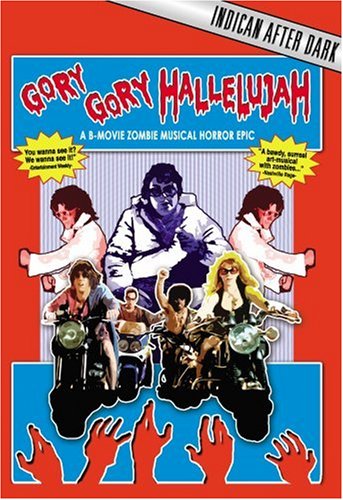
IT CAME FROM THE READER-SUGGESTED QUEUE: GORY GORY HALLELUJAH (2003)

366 Weird Movies may earn commissions from purchases made through product links.

DIRECTED BY: Sue Corcoran

FEATURING: Angie Louise, Tim Gouran, Jeff Gilbert, Todd Licea, Joseph Franklin

PLOT: Four aspiring actors on their way to New York run afoul of increasingly dangerous obstacles, including a group of rowdy Elvis impersonators, a backwards fundamentalist hick town, and a zombie apocalypse.

COMMENTS: Satire, the playwright and Algonquin wit George S. Kaufman opined, is what closes on Saturday night. Nevertheless, aspiring filmmakers frequently turn to satire as a means to walk the line between mass-appeal populism (near-parodistic references to familiar material) and fringe-appeal provocation (harsh critique of sociopolitical foes). All of which is to say, Gory Gory Hallelujah has the aspirational sweat of satire all over it. Unfortunately, Kaufman seems to have its number; Gory Gory bleeds out quickly.

Gory Gory has so many targets for its smug disdain that it plays like a sketch film. The opening salvo takes on the insular and pretentious world of theater, which is admittedly made even more amusing with the reveal that this delusional production of the Gospel is being staged in the theatrical mecca of Seattle. But that’s all forgotten once we set off on a road trip, a genre that revels in wacky mismatched personalities. From there, the targets are set up like the shooting gallery at a fair: here’s the crazy fight with a gang in a bar, here’s the hypocritically moralistic small town, here’s the evil lurking in the woods. The scenes are mileposts, rather than logical stops along the way.

This is a film that is not the slightest bit interested in nuance. Consider our central quartet of heroes, who check an impressive collection of boxes for character stereotypes: militant black man who nonetheless endures countless indignities; self-proclaimed feminist whose sexual and materialistic impulses frequently overrule the cause; nebbishy Jew who finds every opportunity to remind you of his faith; blissed-out hippie flower child whom the film wants to position as closeted, but who is actually ravenously omnisexual. That’s all there is to them; barely 24 hours after having watched the film, I’ve completely forgotten their names, and that’s just fine. They’re not characters; they’re trope delivery systems.

Title notwithstanding, Gory Gory Hallelujah isn’t really a horror film. The screwed-up small town feels like a low-rent retread of Nothing But Trouble, the witches’ coven is just an excuse to take a jab at man-hating lesbians, and the undead are lumbering actors with Green Goddess dressing smeared on their faces. I suspect if you asked director Corcoran and screenwriter Louise, they’d tell you they were making a comedy, a -esque everyone-is-awful romp that lets them flirt with edginess without having to catch any flack. Every once in a while, the film threatens to go somewhere truly daring, like the smarmy land baron’s reference to some “accidental lynchings” that hints at a truly vengeful motivation for the zombie uprising. Most of the time, though, the targets are only the most obvious, offering variations on the theme, “Aren’t these people just awful?” They are. It’s not a revelation.

The closest the film gets to a point-of-view comes in the admittedly unexpected finale, when the death of absolutely everyone presages a revival-hymn closing number that suggests we’ll all be equal in the great beyond. Whereas before everyone was greedily nasty to each other, now they’re all dancing arm-in-arm, united in brotherhood after they’ve cast off the pesky need to breathe. It would make for a solid mission statement if there’d been even a hint of it prior to the closing minutes of the film. As it stands, it’s just one more radical shift in tone for a movie that has already lurched awkwardly from one setpiece to the next. Gory Gory Hallelujah has a lot to be angry about, but just doesn’t have the heart for it. Maybe in the next life.

WHAT THE CRITICS SAY:

“Tripping over the line between silly and stupid, camp comedy “Gory Gory Hallelujah” — the title is the best part — emerges more sub-Troma than subversive…aims for bad-taste hipster satire in the John Waters vein. But co-creator/editor/thesps Sue Corcoran and Angie Louise should have left at least one job — screenwriting — to a third party.” Dennis Harvey, Variety (contemporaneous)

(This movie was nominated for review by Christopher Fox. Suggest a weird movie of your own here.)