Tag Archives: Anime

298. PERFECT BLUE (1997)

Pafekuto buru

“When you are watching the film, you sometimes feel like losing yourself in whichever world you are watching, real or virtual. But after going back and forth between the real and the virtual world you eventually find your own identity through your own powers. Nobody can help you do this. You are ultimately the only person who can truly find a place where you know you belong. That in essence is the whole concept. It is rather hard to explain.”– on Perfect Blue

Must See

DIRECTED BY:

CAST: Voices of , Rica Matsumoto, Masaaki Ōkura; Ruby Marlowe (English dub), Wendee Lee (English dub), Bob Maex (English dub)

PLOT: Japanese pop idol Mima Kirigoe decides to retire from her group CHAM in to become an actress and change her image. She joins a soap opera where the storyline mysteriously reflects her own experiences, endures a stalker who posts intimate details from her life in a fake online diary, and finds several of her co-workers murdered. These events launch her into a psychotic identity crisis.

Still from Perfect Blue (1997)

BACKGROUND:

  • A protégé of , Perfect Blue was the first full-length film Satoshi Kon directed after working as a writer and layout animator.
  • Perfect Blue was based on the novel “Perfect Blue: Complete Metamorphosis” by Yoshikazu Takeuchi. After a failed attempt at a live-action adaptation, Kon was approached to direct an animated version. The screenplay, however, didn’t interest Kon, who was eventually allowed to make any changes he wished as long as he kept three of the story’s elements: “idol”, “horror” and “stalker.” Kon said “the idea of a blurred border between the real world and imagination” was one of his contributions.
  • Sadly, Kon died of pancreatic cancer in 2010 at only 46 years old, with only four feature films to his name.
  • One of Kon’s notable disciples, , wrote a eulogy for that was published in the retrospective “Satoshi Kon’s Animated Works.” Kon’s work has influenced Aronofsky, with the harshest calling Black Swan (2010) a “rip-off” of Perfect Blue. Rumors suggest that Aronofsky bought the rights for a live-action remake of Blue; once the plans didn’t work out, he used them instead to emulate the film’s “bathtub sequence” in Requiem for a Dream.
  • Another of Kon’s western admirers, , placed Perfect Blue among his fifty favorite animated movies. Additionally, it was ranked #97 in Time Out’s list of best animated films of all time and #25 on Total Film’s similar list.
  • Perfect Blue won the Best Asian Film award at the 1997 Fantasia Film Festival (tied with The Legend of Drunken Master) and the Best Animated Film at 1998’s Fantasporto festival.
  • A live action version, Perfect Blue: Yume Nara Samete, which was more closer to the novel, was finally released in 2002. It was quickly forgotten.
  • Rafael Moreira’s Staff Pick for the Certified Weird list.

INDELIBLE IMAGE: Mima’s doppelganger jumping between lampposts provides the most striking of many memorable compositions.

THREE WEIRD THINGS: Lamppost-leaping phantasm; ghost emailing stalker; middle-aged idol

WHAT MAKES IT WEIRD: Though it takes its time, Perfect Blue is an effective psychodrama taking place in the mind of a despairing protagonist. By the time fiction, reality, fears and projections start to cross, and the psychosexual and horror elements enter the scene, you will know for sure that you’re watching an unconventional film, with an atmosphere likely to remind you of both a giallo and a ian psychic labyrinth.


UK trailer for Perfect Blue

COMMENTS: For the first half of its (short) running time, Perfect Continue reading 298. PERFECT BLUE (1997)
285. DEAD LEAVES (2003)

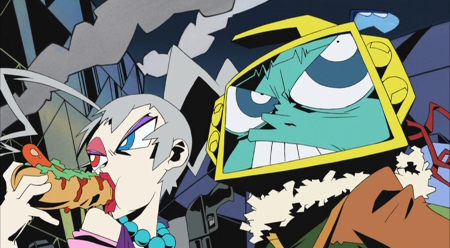
“A guy with a TV for a head and a girl with a panda-like mark on her face find themselves naked on Earth with no recollection of how they got there. After attempting to violently acquire food and clothes, they get arrested and sent to the Lunar prison Dead Leaves… and things get weirder from there.”–Dead Leaves synopsis from the listicle “15 Bizarre Anime That Make You Wonder ‘Wtf Did I Just Watch?’

DIRECTED BY: Hiroyuki Imaishi

FEATURING: Voices of Takako Honda, Kappei Yamaguchi; , Jason Lee (English dub)

PLOT: Pandy, a woman with mismatched eyes, and Retro, a man with a television for a head, awaken naked with no memories and immediately go on a crime spree. Quickly arrested, they are sent to Dead Leaves, a prison housed on what remained of the crumbling moon, where they have sex and then arrange a prison break. Pandy grows pregnant and comes to term in a day, and faces a giant caterpillar monster with the help of her precocious newborn son.

Still from Dead Leaves (2003)

BACKGROUND:

  • The directorial debut of Hiroyuki Imaishi, who had worked as an artist on many animes, including the TV version of “Neon Genesis Evangelion” and it’s bizarre theatrical incarnation.
  • Released as an OVA (original video animation, a common direct-to-video release strategy in Japan).
  • Dead Leaves was made with the American and European secondary markets in mind. The English dub was made contemporaneously with the Japanese version.

INDELIBLE IMAGE: Dead Leaves‘ images, while carefully painted, streak by almost too fast for the eye to register, leaving an impression of havoc rather than focusing on particular images. Since the main characters—especially monitor-faced Retro—appear most often, it’s their faces that stick most in the memory.

THREE WEIRD THINGS: TV-headed Retro-reprobate; penis drill; inexplicable psychedelic caterpillar

WHAT MAKES IT WEIRD: Dead Leaves moves so fast and makes so little sense that it’s the equivalent of putting an ultraviolent manga in a high-speed blender and trying to read it while the pieces swirl around. The plot is nearly incomprehensible, but somehow involves mutant clones and a psychedelic caterpillar. Weird? Hell yes. Recommended? Well, definitely not to epileptics. Even for older folks with a healthy neurobiology, the breakneck pacing is as likely to induce a headache as an adrenaline rush. It’s definitely one-of-a-kind, though, and as an experiment in compressing as much berserk and illogical anime flavor as possible into as short a running time as possible, it’s worth a look.


Short clip from Dead Leaves

COMMENTS: Although the director advised the audience at Dead Continue reading 285. DEAD LEAVES (2003)

LIST CANDIDATE: TWILIGHT OF THE COCKROACHES (1989)

Gokiburi-tachi no Tasogare

366 Weird Movies may earn commissions from purchases made through product links.

DIRECTED BY: Hiroaki Yoshida

FEATURING:  Kaoru Kobayashi, Setsuko Karasuma, Kanako Fujiwara

PLOT: A colony of cockroaches lives in happy comfort in the apartment of a lonely slob, but that all changes the day a girlfriend moves in and takes over cleaning the place and eradicating the pests.

Still from Twilight of the Cockroaches (1989)

WHY IT SHOULD MAKE THE LIST: As noted elsewhere on this site, the bar for weirdness in Japanese anime is set pretty high, because the genre itself is such a wild frontier. Twilight of the Cockroaches sets itself apart by being half-animated and half-live-action, and by being about the politics of cockroach tribes. If that in itself isn’t compelling enough, any film whose IMDB page’s plot keywords list includes the phrase “talking turd” pretty much demands our consideration.

COMMENTS: The present author is aware of exactly two commercial films in which cockroaches make up the majority of the cast. One of them is Joe’s Apartment, and I’m reveiwing other one now. Of the two, Twilight of the Cockroaches wins easily for “weirdest cockroach movie.” The comparison has to stop there, because the two movies are entirely opposite in tone. A critter’s eye view of a society of anthropomorphic non-humans, Cockroaches has more in common with Watership Down or The Secret of Nimh than an MTV-sponsored slacker comedy. It pounds in a heavy political message, possibly related to Hiroshima or Auschwitz, though the director declared it to be about Japan; fan bases debate it to this day. Fill in your own country and political philosophy here.

But for those of you without too much book-learnin’, this is a movie about cockroaches. Naomi is a cockroach waif—“19 in cockroach years”—who serves as our narrator and has “never experienced terror.” She and the rest of her vermin society reside in the apartment of Saito, a human bachelor whose deadly sins include sloth and gluttony, allowing the cockroaches to live in fat contentment. The roaches worship Saito as a god, giving thanks for his sloppy leftovers as they mistake his neglect for benevolence. Sage, the “great leader” of this society, is a reassuring father to his people, ringing with praise for their benevolent human. Naomi is engaged to the stable suitor Ichiro, but she pines for Hans, a warrior cockroach from another tribe. Hans brings grim stories of other apartments where cockroaches fight for survival against humans determined to annihilate them, which is shocking news to Naomi in her peaceful utopia.

Hans returns to his side of the apartment complex, while Naomi contracts wanderlust, exploring the outside world in her quest for the truth. She sets across the vacant lot next to the apartment to find Hans, braving all kinds of hazards—and meeting a helpful turd—along the way. The elders of Naomi’s tribe lament how entitled and shiftless the modern generation is, as the young ones scoff at the warnings that the good times could abruptly end. That foreshadowing comes to pass when Saito, somehow, gets a girlfriend, who moves in with him and brings with her a holocaust of housecleaning and bug-killing. This forces the roaches to confront the error of their complacency. It will be up to Hans’ militarized comrades to show the way forward for roachkind.

The slow, lethargic pace of this film, scored to soulful, lonely piano solos, makes it a chore to sit through. And yet, just when you’re ready to take the film on the serious terms it so obviously desires, it throws talking poop at you. Scenes like a pie-eating party that turns into a pie-throwing party are slapstick; while when Naomi is trapped in a roach motel with other bugs, themselves dying, working together to lift her out, are creepy. The tone is all over the place, and on top of that the visuals flash from blaring daylight reality to shadowy animation. Moments of drama are punctuated by the realization that you’re being compelled to sympathize with a bunch of cockroaches. At the very least, it’s a unique effort in all kinds of ways, with some imaginative technical shots, but it’s also a shoestring budget with blockbuster ambitions. Furthermore, the lack of a DVD release means you’re stuck watching VHS tapes with very phoned-in English dubbing. The choppy result is a hard film to know how to take, but one thing is certain: a bug’s life ain’t always easy.

WHAT THE CRITICS SAY:

“Somebody please get that rolled-up newspaper and smack Japanese writer-director Hiroaki Yoshida in the head with it. COCKROACHES doesn’t even qualify as a camp classic. Besides being thoroughly deranged, it’s also slow, dull, and numbingly mediocre.”–TV Guide

246. BELLADONNA OF SADNESS (1973)

Kanashimi no Beradonna

“With all of this splendid weirdness—Michelet’s occult/feminist novel, Fukai’s ravishingly beautiful, X-rated illustrations, and Satoh’s brain-shredding score—what could possibly go wrong? Everything, according to director Yamomoto.”–Dennis Bartok, explaining Belladonna of Sadness‘s commercial failure at the time of its release in the liner notes to the Cinelicious Blu-ray release.

Recommended

Weirdest!

DIRECTED BY: Eiichi Yamamoto

FEATURING: Voices of Chinatsu Nakayama, Aiko Nagayama, , Katsuyuki Itô, Masaya Takahashi

PLOT: In medieval Europe, peasants Jean and Jeanne go to their local Lord to bless their unconsummated marriage, but the royals gang-rape the bride instead because Jean cannot afford the outrageous matrimonial tax. Later, Jeanne is visited by a demon who promises to give her power to oppose the Lord’s might and get revenge. At first she resists, but as the Lord’s outrages mount, she finally gives herself to Satan fully and becomes a powerful witch.

Still from Belladonna of Sadness (1973)

BACKGROUND:

  • This film was the third part of a trilogy of adult animation features on Western themes commissioned by legendary anime pioneer Osama Tezuka (famous for the television manga adaptations “Astro Boy” and “Kimba the White Lion”) and his Mushi studio. The first in the series was 1969’s erotic version of “The Arabian Tales,” A Thousand & One Nights (also directed by Yamamoto). Nights was a commercial hit (although it remains unavailable on home video), so the studio went ahead with Cleopatra in 1970 (which Yamamoto co-directed with Tezuka). Cleopatra was a commercial and artistic flop, but the studio went ahead with Belladonna of Sadness anyway. Tezuka left Mushi before the final film was completed, and Belladonna bombed even harder than Cleopatra. Mushi went bankrupt soon after. Belladonna was exhibited in only a handful of lower echelon theaters in Japan and only lightly released outside of that country until 2015’s rediscovery and reappraisal.
  • The unlikely source material for Belladonna of Sadness was Jules Michelet’s 1862 non-fiction book “Le sorciere” (AKA “Satanism and Witchcraft“), a sympathetic treatment which cast the practice of witchcraft as a protest against the feudal system and the power of the Church.
  • “Belladonna” literally means “beautiful woman” in Italian, but it is also the name of a toxic hallucinogenic plant thought to have been used in ancient witchcraft rituals.

INDELIBLE IMAGE: Without a doubt, the initial rape scene. Although the movie contains shocking, unforgettable, wild and weird imagery throughout, the expressionistic violation of Jeanne, showing her being split in twain like a wishbone as her crotch emits a bloody geyser that morphs into crimson bats who fly away, was the only one that made me mutter out loud “wow”!

THREE WEIRD THINGS: Bloody rape bats; Satan is a dick; surrealist daisy chain orgy

WHAT MAKES IT WEIRD: Belladonna of Sadness is like watching Saturday morning cartoons mixed with high art mixed with hentai, laced with acid. It’s some damned thing that you’ve never seen before.


U.S. release trailer for Belladonna of Sadness

COMMENTS: We owe a huge debt of gratitude to whoever’s idea it Continue reading 246. BELLADONNA OF SADNESS (1973)

LIST CANDIDATE: ANGEL’S EGG (1985)

Tenshi no Tamago

DIRECTED BY:

FEATURING: Voices of Mako Hyôdô, Jinpachi Nezu, Kei’ichi Noda

PLOT: In a desolate city, an angelic young girl cherishes an egg.

Still from Angel's Egg (1985)

WHY IT MIGHT MAKE THE LIST: This haunting animation more or less entirely forgoes dialogue and narrative for a large helping of theistic symbolism and rich visuals.

COMMENTS: It’s often said that we anime fans fetishize the “otherness” of anime—or, put less pretentiously, it’s often said we like stuff simply because it’s Japanese.

To be honest, there’s some accuracy to that. But can you blame us? As one of the only non-Western entertainment mediums to gain measurable popularity here, anime represents, for many of us, the one substantial deviation from our entertainment norms. Hell, for many people, it’s more or less the only reminder that a norm even exists.

Of course, it’d be obscenely simplistic to say that’s what makes a work like Angel’s Egg so deeply engaging—but it’s definitely a factor.

Released in 1985, this 71-minute OVA (non-theatrical video feature) is the brainchild of director Mamuro Oshii (best known, at least around here, for his sci-fi philosophy-fest Ghost in the Shell) in collaboration with artist Yoshitaka Amano. One of the earlier efforts—and his second OVA—on Oshii’s extensive resume, Egg showcases that familiar blend of surrealism, introspection, and distinctly grit-flavored sci-fi that defines not only Oshii’s own work, but also a great deal of anime’s other “weird” offerings (End of Evangelion and “Serial Experiments Lain” come to mind).

Like so many of the movies featured here, Angel’s Egg largely supplants narrative with hefty symbolism and visual indulgence. Set in a grey and empty city of desolate Victorian/Gothic architecture—every single frame of it rendered with almost dizzying artistic excellence—the film follows a young girl who ekes out a lonely existence scavenging among the ruins and, for reasons known only to her, collecting hundreds of glass bottles of water. The girl tends to a large egg, carrying with her everywhere, believing that it holds a beautiful bird within it.

One day, a young man wielding a cross-shaped staff intrudes on the girl’s lifeless world, following her to her lonely abode. Other stuff happens, but really, to try and describe any aspect of this film with words is to sell it short.

Angel’s Egg is—again, like so many of the List’s films—a work of cinema defined by more than what happens on screen. It is defined by its atmosphere; a heavy, heavy atmosphere. The Gothic elements of this animation extend well beyond the architecture. Every frame of this film oozes ghostliness and desolation. The girl and the young man exist in a world of crumbling greyness and deafening silence, and every moment of the film’s striking visuals, ominous choral soundtrack, and heavy, lingering shots ensures that the viewer shares in every bit of the characters’ haunting isolation. Some may Continue reading LIST CANDIDATE: ANGEL’S EGG (1985)