Tag Archives: Anime

LIST CANDIDATE: NIGHT ON THE GALACTIC RAILROAD (1985)

Ginga-tetsudo no Yoru; AKA Night on the Galactic Express

DIRECTED BY: Gisaburo Sugii

FEATURING: Voices of Mayumi Tanaka, Chika Sakumoto

PLOT: In a fictional town in a fictional universe during the annual star-worshiping festivities, a boy and his friend find themselves on a metaphysical train that takes them on an existential journey through space. Oh, and everybody is a cat.

Still from Night on the Galactic Railroad (1985)

WHY IT MIGHT MAKE THE LIST: Even without delving into the film’s brutally in-depth takes on loneliness, death and depression, Railroad is a tripper’s paradise, filled to the brim with such weirdness as glowing, candy-flavored herons, self-replicating apples, stairways that lead to the center of the universe, and beaches where each grain of sand is a jewel filled with fire. Rich in imagery and philosophy, it treads that always intriguing line between children’s entertainment and adult existentialism.

COMMENTS: A little background is very useful when approaching Night on the Galactic Railroad, else it might sucker punch you into hating it. Based on a 1927 book by Kenji Miyazawa, the film takes many liberties with the foundations of what was a very personal story to turn the novel into something with a distinctly anime flavor. The most controversial of these decision is to have (almost) everybody in the film drawn as a cat, an early indication that realism and logic will be thrown out the window despite the fact the film follows a very human path in regards to its character’s crises. The explanation for this decision has never really been given, but some have suggested it was simply due to the fact that it was easier to animate a cat than a human. Who knows if this is true, but nevertheless this town of star-worshiping felines all have very human characteristics. It isn’t difficult to sympathize with Giovanni, our young protagonist, as he is ostracized by his peers, bullied and insulted; he has no time to socialize due to his commitment to pick up milk for his sick mother.

Esoteric creative decisions lend even the relatively dull first fifteen minutes of the film an undeniable beauty. Tilted camera angles and close ups as Giovanni goes about his work in a publishing house after school turn the mundane into the mysterious, the bland into something otherworldly. The opening scenes’ dedication to create an alien world out of the familiar, along with the stillness and quiet tension on show, is closer to than anything else I have seen within (or outside of) the animation genre.

The film doesn’t stay on this route, though, and soon whisks us out of the medieval town. Giovanni and his only friend, Campanella, leave the occult stargazing festivities (complete with Carnivale-style masks) and find themselves on a train hurtling through space.

While the audience sits in a mild shock at these events, the two cats Continue reading LIST CANDIDATE: NIGHT ON THE GALACTIC RAILROAD (1985)

CAPSULE: VAMPIRE HUNTER D (1985)

DIRECTED BY: Toyoo Ashida

FEATURING: Voices of Kaneto Shiozawa, Michie Tomizawa, Seizô Katô

PLOT: Millennia in the future, vampires rule over much of the land; one woman fights back, enlisting the aid of a mysterious stranger in her quest to kill Count Lee, a vampire of great power.

VampireHunterD1985

WHY IT WON’T MAKE THE LIST: Vampire Hunter D is undeniably a groundbreaking classic of Gothic anime that conveys a wonderfully realized retro-future. However, aside from some unlikely Bakshi-an monsters and a couple of bursts of eyebrow-raising gore, Toyoo Ashida’s film rests firmly in the realm of the traditionally fantastic.

COMMENTS: It seems only right that I admit to the reader from the start that this movie stands as the only anime film I have ever seen. Through all my years of pursuing leads on offbeat movies, I have somehow missed what is perhaps one of the largest figurative boats ever launched. That said, my experience with Vampire Hunter D has done much to open my eyes. With a limited budget and an unlimited tap of imagination and artistic talent, Toyoo Ashida and Ashi Productions created a stellar vision of a far-flung future world tormented by Dark Ages evil.

Beginning with the title card, “This story takes place in the distant future—when mutants and demons slither through a world of darkness”, the action quickly takes off as a young Hunter—armed with a cross, electric whip, and bayonnetted laser gun—pursues an obviously infernal beastie. The encounter quickly goes south when her horse is slaughtered and, from nowhere, a humanoid creature appears and bites her on the neck. Now she must find a way to destroy this powerful being before becoming a vamp herself. Fate provides her with the assistance of a mysterious stranger, whom she comes to learn is also a Hunter of considerable strength.

From that introduction, the movie proceeds apace with run ins with eldritch creatures, the haughty vampire “nobles,” as well as human scum in the form of a mayor’s son and his cronies. To ward off the nasties that lurk outside, city-dwellers have made barriers combing both the Old and New World Techs, using crosses and energy fields to repel the undead. As with all townsfolk living in the shadow of great evil, they are wary both of strangers and those possibly afflicted. This leaves the heroine, Doris, and the eponymous “D” with scant safe havens. Unsurprisingly (but still very satisfactorily), they seem to need none.

There are splashes of weird to be found throughout the movie. That “D” has two personalities (and, one learns, two faces) adds a compelling layer to his character. On the one hand he strives to maintain an honorable existence while fighting the scourge of vampires around him; on the other (in this case, left) hand, he harbors a secret about his true nature. His scuffles with a flippant space-warping mutant, a Golem that really likes the word “Golem,” a three-headed sex medusa, and ultimately the sinister Count Lee provide brushes with the strange. Particularly worth noting is the Count’s castle: a forbidding heap of ancient ruin atop a massive industrial wasteland.

With its little nods to Stoker’s original work (e.g. a property known as “old man Harker’s” and a strangely Victorian-looking portrait of an unspecified “ancestor”), neat twists in the vampire genre (the local sheriff sports a six-pointed badge with an overlaid cross), and its temporal mélange, Vampire Hunter D provides a unique take on the legend. Be warned, though: do your best to stop the movie after it fades to black on the final scene. Somehow, this chilling adventure is capped by what stands as one of the worst end-credits songs I’ve ever had the misfortune to hear.

WHAT THE CRITICS SAY:

“The middle of the film features a wonderfully hallucinatory journey across wasted landscapes into the chief vampire’s labyrinthine castle… the rest, especially the showdown with the chief vampire, is anticlimactic in comparison.”–Richard Scheib, Moria: The Science Fiction, Horror and Fantasy Film Review (DVD)

222. SPIRITED AWAY (2001)

Sen to Chihiro no Kamikakushi

“It was just too bizarre.

“Honestly, when I watched Spirited Away for the first time back in 2008, I didn’t like it for the same reason as you. I just found it too weird.”

–IMDB message board dissenters on Spirited Away

Must See

DIRECTED BY:

FEATURING: Voices of Rumi Hiiragi, Miyu Irino, Mari Natsuki; , Jason Marsden, (English dub)

PLOT: While moving to a new town, ten-year-old Chihiro and her parents take a detour to a seemingly abandoned amusement park in rural Japan. Once the sun sets, the park transforms into an otherworldly resort for spirits and gods overseen by the cruel witch Yubaba. Now separated from her parents, Chihiro must learn to survive among an array of weird creatures as she attempts to reunite her family and return home.

Still from Spirited Away (2001)

BACKGROUND:

  • Hayao Miyazaki had announced his retirement from feature filmmaking in 1998, after completing Princess Mononoke. He came out of retirement in 2001 to make Spirited Away.
  • Disney Studios had distributed Studio Ghibli’s previous film, Princess Mononoke, in the United States, with disappointing results. They put little money into marketing the film, but strong reviews and word of mouth turned it into a hit, and Disney’s partnership with Ghibli was cemented from that point on.
  • Spirited Away won the Academy Award for Best Animated Feature (along with 52 wins granted by other organizations).
  • Spirited Away is the highest-grossing film of all time in Japan.
  • Hayao Miyazaki had announced his retirement from feature filmmaking in 2001, after completing Spirited Away. He came out of retirement in 2004 to make Howl’s Moving Castle.

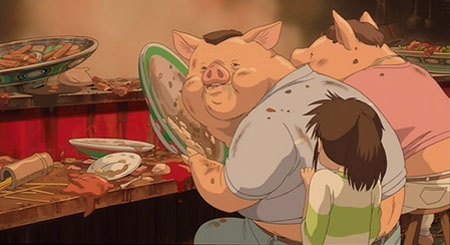
INDELIBLE IMAGE: Lured into the park by a delicious scent, Chihiro’s parents come upon a vacant restaurant filled with sumptuous, exotic dishes. The two immediately begin to fill their plates, ignoring their daughter’s worries that they’ll be punished for taking the food. After the park begins its transformation, Chihiro returns to find her parents bloated and hunched over piles of scraps. She tries to warn her father about what is happening, but when he looks at her she sees only the sweating, engorged face of a pig. The grunting pig ignores Chihiro and climbs over the restaurant’s counter, only to be swatted away by an unseen figure’s reptilian arm. The pig then crashes to the ground with a primal squeal, frightening Chihiro as she cries out for her parents and runs into a street filled with tall, anonymous ghosts.

THREE WEIRD THINGS: Pig parents; “No Face” eats; three heads and a giant baby

WHAT MAKES IT WEIRD: In Spirited Away, Hayao Miyazaki plays on the normal fears of lost children as the basis for an outlandish, frightening fantasy about a young girl being thrust into the incomprehensible life of an adult. The imagination of the setting is so immense that it seems to dwarf the film itself, suggesting a fully realized universe of magic and monsters with borders that extend far beyond the frame of the story.


Disney Trailer for Spirited Away

COMMENTS: Spirited Away begins with the main character, Chihiro, Continue reading 222. SPIRITED AWAY (2001)

199. CAT SOUP (2001)

Nekojiru-so

“Many animators participated in the creation of Nekojiru-so, but I wonder how many of the animators fully understood the concept and manifested that understanding in the animation. When Yuasa and I explained things during animation meetings, we really didn’t understand it ourselves either.”–Tatsuo Satō, Cat Soup director, DVD commentary

RecommendedWeirdest!

DIRECTED BY: Tatsuo Satō

FEATURING: Not applicable (the film is animated with no dialogue)

PLOT: After nearly drowning in a bathtub, a young anthropomorphic cat sees his sick older sister being led away by a purple figure, follows it, and engages in a tug of war in which he recovers part of her body. He then returns home where he finds the sister still ill and convalescing, and gives her the part he recovered from the purple figure. She recovers from her sickness, and the pair embark on a series surreal adventures throughout the cartoon cosmos, although the sister is only half-alive until they eventually locate a mystical flower that restores her.

Still from Cat Soup (2001)
BACKGROUND:

  • Cat Soup is based on a series of manga by the artist Nekojiru (a pseudonym that actually translates as “cat soup”). Although Nekojiru’s stories were also dreamlike, they were more structured than this adaptation, and little of Cat Soup is taken directly from her works. Nekojiru committed suicide in 1998.
  • Technically, the Japanese title translates as something like “Cat Soup Flower.”
  • Director Tatsuo Satō specializes in television anime and has directed episodes of “Martian Successor Nadesico,” “Ninja Scroll: The Series,” and “Bodacious Space Pirates.”
  • Co-writer also produced and was the animation director; he has since directed his own feature (2004’s Mind Game) and several shorts and TV episodes, while continuing to work as an animator on other projects.
  • Because it was an OVA (“Original Video Animation” in anime parlance, meaning direct-to-DVD with no theatrical release), Cat Soup was not eligible to compete in many film festivals, although it did take honors at a few (including recognition as Fantasia’s Best Short Film of 2001).

INDELIBLE IMAGE: Choosing a single image from Cat Soup, which is a 30-minute barrage of insane, enchanting, and frequently disturbing visions made by animators who had been freed from almost any constraints on what they were allowed to imagine, is a tall task. We selected a still from the scene which literally enacts the title. Making this “cat soup” involves dressing up in mouse dominatrix gear and chopping up the yummy kitties with a giant pair of scissors.

WHAT MAKES IT WEIRD: In some ways I envy the reviewer who was the first to get to Cat Soup and dub it “Hello Kitty on acid.” (Although I actually haven’t been able to track down the critic who first said that; perhaps the description is so obvious that everyone just assumes someone else came up with it before they did). I think a better description, perhaps, would be “Hello Kitty goes to Hell,” because the acidic hallucinations here all occur in the context of cat spirits wandering a weird world halfway between life and death, a place where God appears as a carnival magician and cuts planets in half and slurps their molten cores like soup. The brisk 30 minute runtime is the perfect length for this nearly plot-free pageant of morbid feline surrealism, which hits your surreal receptors hard, but doesn’t last so long you build up a tolerance to the insanity.


English-language DVD trailer for Cat Soup

COMMENTS: Cat Soup is a short feature that flummoxes even anime Continue reading 199. CAT SOUP (2001)

CAPSULE: PORCO ROSSO (1992)

DIRECTED BY:

FEATURING: Voices of , Kimberly Williams-Paisley, Susan Egan (English dub)

PLOT: A bounty-hunting pig-man (a victim of an unexplained curse) flies his seaplane through the Adriatic between World Wars, battling air pirates and a hotshot American rival.

Still from Porco Rosso (1992)
WHY IT WON’T MAKE THE LIST: Although it has its strange, and its sublime, moments, I would rate this as flying pig oddity as relatively minor Miyazaki—which, of course, means it’s still well worth seeking out.

COMMENTS: Porco Rosso is set in a precise, but unreal, historical place and time: the Italian Adriatic, in between the great wars. But its pig-man hero isn’t the only fantastic element here. In this alternate history, the Adriatic sea is its own far-flung multi-island kingdom with its own political intrigues, a realm where seaplane pilots are legendary demigods, like the mythologized gunfighters of Westerns. The local hot spot is a floating hotel only accessible by watercraft, with a valet to parks seaplanes. There are Italian fascists and references to WWI, but this universe evolves out of old movies rather than history: it’s a mixture of Casablanca and romantic aviation movies like Wings or Hell’s Angels, a world where you expect to see the Red Baron and Mata Hari sharing a drink in the corner of a flyboy saloon.

Although with its Humphrey Bogart-esque antihero Porco Rosso often seems more adult-oriented than Miyazaki’s usual fare, at other times the drawing style and caricatures are more indebted to Saturday morning cartoons than his later work. Observe the big-mouthed, howling anime schoolkids, and the cartoonish, kid-like antics of the pirate buffoons, who are drawn as goggles and pillars of teeth surrounded by bristles. Despite the flying duels and machine guns, the danger level here is minimal: no one dies onscreen, and the abducted schoolgirls treat their capture by pirates as a fantastic adventure, hanging out in the gun turret with their captors and screaming “whee!” as they dive off the stranded plane into a giant life preserver. The mixed tones are odd, but Miyazaki makes them harmonize well.

Clearly, the weirdest element of Porco Rosso is its hero’s porcine curse, which is never fully explained and is scarcely even wondered at by the movie’s denizens. Perhaps his piggish visage only reflects the way Porco sees himself. Perhaps the curse is the result of a mystical vision he saw after he was the only survivor of a massive dogfight, where he saw dozens of fighter pilots soaring upwards to heaven. Whatever the cause of his condition, symbolically, his bestiality sets Porco apart from ordinary citizens: “laws don’t mean anything to a pig,” he explains. Still, his snout and porky complexion can’t keep this charismatic pig from having two love interests, and there is an ambiguous suggestion at the ending that he may regain his humanity. I doubt Miyazaki was aware of the English-language idiom “when pigs fly,” meaning something so exceedingly rare as to be impossible, when he conceived Porco Rosso. Still, it’s probably safe to say you’ll enjoy this movie when pigs fly.

In 2015, Disney upgraded Porco Rosso to Blu-ray.

WHAT THE CRITICS SAY:

“That a pretty great adventure movie can rest comfortably alongside a strange tale of identity and morality that is itself set against the rise of Fascism is proof enough that we’re in the hands of a master storyteller…”–Tim Brayton, Antagony and Ecstasy (DVD)