Tag Archives: Allegory

LIST CANDIDATE: THE ORNITHOLOGIST (2016)

O Ornitólogo

366 Weird Movies may earn commissions from purchases made through product links.

DIRECTED BY:

CAST: Paul Hamy, Xelo Cagiao Teijo, Han Wuen, Chan Suan

PLOT: After being swept away by rapids, Fernando, an ornithologist looking for black storks, finds himself in a mysterious forest where he’ll undergo a transformative spiritual journey mirroring the life of Saint Anthony of Padua.

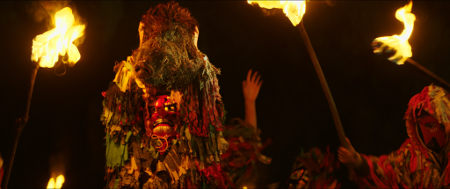
Still from The Ornithologist (2016)

WHY IT SHOULD MAKE THE LIST: The Ornithologist is the allegorical tale of an atheist ornithologist’s conversion through a succession of increasingly bizarre occurrences. Given that these moments vary from slightly odd to truly surreal, the film plays the weirdness card, although the limited number of remaining slots in the List make its inclusion uncertain.

COMMENTS: The first shots of The Ornithologist, after an introductory quote by Saint Anthony, depict a dark, calm river with a bird and plant life, accompanied by the ambient sounds of nature. After the film’s weird notes kick in, the atmosphere remains remarkably the same: quiet and naturalistic, persistently treating the strange sights of Fernando’s mystical journey as perfectly normal. The stunningly shot setting, a Portuguese forest that director João Pedro Rodrigues populates with strange images and figures, also persists for the entirety of the movie (save for the very last, and very weird, scene).

After he crashes his kayak, the titular protagonist is rescued by two female Chinese pilgrims, on their way to Santiago de Compostela, with whom he spends the night. This moment marks the film’s first foray into Fernando’s symbolic journey, as well as a turn to a darker tone. When a menacing sound is heard, the frightened pilgrims assume it’s a demonic entity just as quickly as Fernando casually rebuts their belief, claiming there’s no God or Devil. Shocked by his lack of faith, they oblige him to sleep outside of their tent, and the next morning finds him tied to a tree.

From that point on, the steps on the ornithologist’s conversion grow progressively surreal; some are blatant in their symbolism (such as the appearance of the Holy Spirit as a white dove), others more obscure (naked amazons shooting him with a rifle, only to have a quick chat with him after he revives). Most are blasphemous and/or contain homoerotic undertones. They include Fernando’s baptism in urine (!), sex with a mute shepherd named Jesus (!!!), and the appearance of what appear to be embalmed animals in the woods, among other outrageous stops in his mystical-existential self-discovery arc.

These episodes are consistently engaging and reveal Rodrigues’ fascination with Christian iconography, mysticism and eroticism (a potently heretical mix), as well as his intention to filter universal religious symbols through his personal sensibilities. The “enlightenment quest” narrative will likely remind weirdophiles of ’s El Topo or The Holy Mountain, but the film is stylistically much closer to ’s Uncle Boonmee Who Can Recall His Past Lives. Like that film, The Ornithologist‘s bizarre and phantasmagorical apparitions seamlessly blend in the environment as if they were no less natural than a tree or a bird. Accordingly, our main character remains stoic throughout his adventure. Speaking only when needed (that is, sparsely), his language, like the film’s, is mostly non-verbal. Actor Paul Hamy subtly conveys feelings of confusion and curiosity; interestingly, he has explained in interviews that he likes physical expression, comparing himself to a sculpture that the director shapes in front of the camera. The Ornithologist displays this particularly well, as Hamy’s character is aloof and his metamorphosis occurs internally, manifesting itself mostly in his careful physicality and expressions.

Even if you have difficulty relating to Fernando, it’s apparent that this is a very personal affair for Rodrigues. At one point near the end, the director himself literally steps into the shoes of the main actor. The character’s name changes to António (another reference to Saint Anthony), signalling that his transformation is complete. Fernando is not meant to be an avatar of the audience but, rather, of his creator; as a result, viewers without familiarity or investment in the narrative of Saint Anthony may find themselves estranged. The story is clearly very important to Rodrigues, and ultimately asserts itself as vaguely autobiographical. This is not to say, however, that its deeper meaning is impenetrable. Surely, watching The Ornithologist is, above all, an experience, and the beautiful cinematography and pervading atmosphere, languid and sometimes sinister, will please the adventurous viewer. But I believe exploring the film’s symbolism is a rewarding enhancement. Like Fernando, we feel shipwrecked and disoriented in such a strange environment, but by the end, we’ll probably have changed.

WHAT THE CRITICS SAY:

“Rodrigues toys with his audience with the deadpan playfulness of Luis Buñuel, whose films The Ornithologist sometimes recalls in its tricky approach to religious themes… If nothing else, the film reminds one of how strange and beautiful existence can be.”–Ben Sachs, The Chicago Reader (contemporaneous)

LIST CANDIDATE: MOTHER (2017)

mother! has been promoted to the List of the 366 Weirdest Movies ever made. Please read the official Certified Weird entry. Comments are closed on this post.

DIRECTED BY:

FEATURING: Jennifer Lawrence, Javier Bardem, , Ed Harris, Brian Gleeson, , Kristen Wiig

PLOT: A poet with writer’s block and his younger wife live alone in a remote house until their domestic tranquility is interrupted by an ever-increasing number of guests.

Still from mother! (2017)

WHY IT MIGHT MAKE THE LIST: Writer/director Aronofsky lets the movie all go to hell—mother! is his most irrational and difficult film, and also his most provocative, with one scene that’s likely to send anyone with maternal instincts packing to the exits. It’s a Hollywood movie with an outsider’s boldness, and it’s going to be punished harshly at the box office for transgressing society’s norms—mostly by blaspheming against coherent realist narrative, the biggest taboo of all. Fans of this site will want to check it out in theaters if at all possible; whether you love it or find it a letdown, it’s a rare “event movie” in the weird genre.

COMMENTS: In its first week of release, the highly anticipated mother! has already been buried at the box office; and even though I have my reservations about the movie’s overall artistic success, let’s pause for a moment out of respect for a fallen brother (er, mother!) who dared to brave the multiplexes with a message of glorious excess, confused metaphor, baby abuse, and general cinematic dementia. Its birth was improbable, its life brief, and we may not see its like for many years.

The scenario is something like a ian joke mixed with paranoia, although the film develops its own crazy identity as it goes on. Wifey Jennifer Lawrence is dealing with a flood of unwanted guests who treat the home she’s trying to refurbish as a bed and breakfast; her husband, grateful for the distraction from his writer’s block, encourages them. It doesn’t help her shaky mental outlook that she’s chugging some sort of urine-colored alka selzer and hallucinating hearts clogging the toilet. Early on, mother! plays like a black comedy, with the audience laughing each time the doorbell rings and a new guest arrives. This black humor contrasts with ongoing gynecological horror imagery: a vaginal bloodstain on her hardwood floor, with the blood trickles tracing a Fallopian diagram on the walls of Jennifer’s womblike basement. The dreamlike flow of the first hour that quickly escalates into the nightmarish once a pregnancy arrives at the same time her poet husband publishes a poetry sensation that brings a horde of cultlike fans to their remote homestead. Over-the-top apocalyptic chaos follows, with a religious wrap-up that left some audience members scoffing out loud. Subtle and focused mother! ain’t; weird, it is.

mother! is susceptible to multiple interpretations, which may be a problem in a movie that appears to aspire to allegory rather than mystification. Apparently, Aronofsky intends the audience to read the film as an environmental parable about Mother Earth. But it can also be seen as a metaphor for fear of procreation (the strangers who sew chaos in the house act just like unruly children), and at the end it becomes a (heavy-handed) Christian allegory (with Lawrence as Mother Mary, paying an even heavier price for humanity’s sins than her son does). And all along, with its poet/God hero, it’s simultaneously playing as an allegory for the artist, and for the way the audience appropriates His work and gives it their own interpretation—yeah, there’s some heavy meta there.

mother! is already infamous for its divisiveness. It was booed by audiences at the Venice Film Festival and CinemaScore audiences gave it a rare “F” rating, while critics have graced it with generally favorable reviews (68% on Rotten Tomatoes at this time, through the usual dissenters are particularly hyperbolic). 2009’s Antichrist (which also refused to give its parent protagonists proper names) may have been the last movie to create a big a chasm between those championing a film as an audacious triumph and those dismissing it as pretentious twaddle. One thing is for sure: simply dropping a superstar like Lawrence into your surrealist movie won’t make mainstream audiences embrace its uncomfortable weirdness. But J-Law should earn a lot of artistic credibility and respect from a role that was quite a bit riskier than ‘s relatively sane and reserved turn in Black Swan.

WHAT THE CRITICS SAY:

“Its dread has no resonance; it’s a hermetically sealed creep-out that turns into a fake-trippy experience. By all means, go to ‘mother!’ and enjoy its roller-coaster-of-weird exhibitionism. But be afraid, very afraid, only if you’re hoping to see a movie that’s as honestly disquieting as it is showy.”–Owen Gleiberman, Variety (contemporaneous)

CAPSULE: COLOSSAL (2016)

DIRECTED BY:

FEATURING: , Jason Sudeikis

PLOT: An alcoholic woman discovers that she unwittingly controls a giant monster who is attacking Seoul.

Still from Colossal (2016)

WHY IT WON’T MAKE THE LIST: The premise is strange, but the execution is not as bizarre as it might have been, tending more to light psychological drama.

COMMENTS: The two opening scenes of Colossal are well-matched. In the first, a Korean girl loses her doll in a park, only to find a giant gray monster looming over the skyscrapers of distant Seoul. 25 years later, a tipsy Gloria (Hathaway) meets her own personal disaster among the skyscrapers of New York City when her boyfriend kicks her out of their apartment and onto the streets after she shows up drunk again.

Two women, facing two monsters, which, the movie suggests, may really be the same thing: the Seoul-stomper is somehow connected to Gloria’s screwed-up life. After her world falls apart and she moves back to her quiet hometown, things go to hell as she takes a job in a bar run by old friend and would-be lover Oscar (Sudeikis). That Korean monster, spotted one night 25 years ago, starts appearing again in Seoul almost nightly, although it usually does little more than scratch its head and stumble around aimlessly. These appearances, which naturally go viral on CNN and social media, all seem to happen while Gloria is blacked out. Meanwhile, Gloria ups her drinking and finds herself a boy toy, a handsome younger man without much backbone. That development doesn’t please Oscar, who’s given her a job, TV, and a new suite of furniture in hopes of finally winning his childhood sweetheart.

After this setup, we expect the movie dive into a wacky kaiju/romantic comedy mashup, but things get darker, as the metaphor extends from the monster merely representing Gloria’s alcoholism to embrace co-dependency and abuse—it a conflation of all of her bad choices, along with some misfortunes that befall her through no fault of her own. The script lets the symbolism get away from it a little bit, and neither the mechanism through which the monster manifests itself, nor its origin story, nor its final disposition, quite live up to the cleverness of the original conceit. The movie has serious (if not colossal) tone problems: too many innocent Koreans are killed for it to be an effective comedy, but the premise is too ridiculous to generate the tension needed for action/horror thrills. Colossal does find a way forward, by staying so committed to its allegory that you keep watching just to figure out how it will all be resolved. Sudeikis provides another reason to tune in, as he turns out to be a powder keg with a secret of his own. Colossal had the potential to level much more real estate than it did—lover’s spats and millennial introspections outnumber kaiju battles by at least two-to-one—but you should still find a lot to enjoy lying about in the rubble.

Spain’s Nacho Vigalondo first burst onto the indie scene with the tightly-wound time travel bibelot Timecrimes. Since then, he’s been continuing to make smart movies with sci-fi/fantasy/horror themes, and someday may produce an oddity ready-make for the List of the Weirdest Films Ever Made. This isn’t it, however.

WHAT THE CRITICS SAY:

“…a unique and bizarre and surprising and original piece of filmmaking… From its weird little prologue to a nearly perfect ending, ‘Colossal’ is a trip in multiple meanings of that word.”–Richard Roeper, Chicago Sun-Times (contemporaneous)

LIST CANDIDATE: TWILIGHT OF THE COCKROACHES (1989)

Gokiburi-tachi no Tasogare

366 Weird Movies may earn commissions from purchases made through product links.

DIRECTED BY: Hiroaki Yoshida

FEATURING:  Kaoru Kobayashi, Setsuko Karasuma, Kanako Fujiwara

PLOT: A colony of cockroaches lives in happy comfort in the apartment of a lonely slob, but that all changes the day a girlfriend moves in and takes over cleaning the place and eradicating the pests.

Still from Twilight of the Cockroaches (1989)

WHY IT SHOULD MAKE THE LIST: As noted elsewhere on this site, the bar for weirdness in Japanese anime is set pretty high, because the genre itself is such a wild frontier. Twilight of the Cockroaches sets itself apart by being half-animated and half-live-action, and by being about the politics of cockroach tribes. If that in itself isn’t compelling enough, any film whose IMDB page’s plot keywords list includes the phrase “talking turd” pretty much demands our consideration.

COMMENTS: The present author is aware of exactly two commercial films in which cockroaches make up the majority of the cast. One of them is Joe’s Apartment, and I’m reveiwing other one now. Of the two, Twilight of the Cockroaches wins easily for “weirdest cockroach movie.” The comparison has to stop there, because the two movies are entirely opposite in tone. A critter’s eye view of a society of anthropomorphic non-humans, Cockroaches has more in common with Watership Down or The Secret of Nimh than an MTV-sponsored slacker comedy. It pounds in a heavy political message, possibly related to Hiroshima or Auschwitz, though the director declared it to be about Japan; fan bases debate it to this day. Fill in your own country and political philosophy here.

But for those of you without too much book-learnin’, this is a movie about cockroaches. Naomi is a cockroach waif—“19 in cockroach years”—who serves as our narrator and has “never experienced terror.” She and the rest of her vermin society reside in the apartment of Saito, a human bachelor whose deadly sins include sloth and gluttony, allowing the cockroaches to live in fat contentment. The roaches worship Saito as a god, giving thanks for his sloppy leftovers as they mistake his neglect for benevolence. Sage, the “great leader” of this society, is a reassuring father to his people, ringing with praise for their benevolent human. Naomi is engaged to the stable suitor Ichiro, but she pines for Hans, a warrior cockroach from another tribe. Hans brings grim stories of other apartments where cockroaches fight for survival against humans determined to annihilate them, which is shocking news to Naomi in her peaceful utopia.

Hans returns to his side of the apartment complex, while Naomi contracts wanderlust, exploring the outside world in her quest for the truth. She sets across the vacant lot next to the apartment to find Hans, braving all kinds of hazards—and meeting a helpful turd—along the way. The elders of Naomi’s tribe lament how entitled and shiftless the modern generation is, as the young ones scoff at the warnings that the good times could abruptly end. That foreshadowing comes to pass when Saito, somehow, gets a girlfriend, who moves in with him and brings with her a holocaust of housecleaning and bug-killing. This forces the roaches to confront the error of their complacency. It will be up to Hans’ militarized comrades to show the way forward for roachkind.

The slow, lethargic pace of this film, scored to soulful, lonely piano solos, makes it a chore to sit through. And yet, just when you’re ready to take the film on the serious terms it so obviously desires, it throws talking poop at you. Scenes like a pie-eating party that turns into a pie-throwing party are slapstick; while when Naomi is trapped in a roach motel with other bugs, themselves dying, working together to lift her out, are creepy. The tone is all over the place, and on top of that the visuals flash from blaring daylight reality to shadowy animation. Moments of drama are punctuated by the realization that you’re being compelled to sympathize with a bunch of cockroaches. At the very least, it’s a unique effort in all kinds of ways, with some imaginative technical shots, but it’s also a shoestring budget with blockbuster ambitions. Furthermore, the lack of a DVD release means you’re stuck watching VHS tapes with very phoned-in English dubbing. The choppy result is a hard film to know how to take, but one thing is certain: a bug’s life ain’t always easy.

WHAT THE CRITICS SAY:

“Somebody please get that rolled-up newspaper and smack Japanese writer-director Hiroaki Yoshida in the head with it. COCKROACHES doesn’t even qualify as a camp classic. Besides being thoroughly deranged, it’s also slow, dull, and numbingly mediocre.”–TV Guide

250. THE CREMATOR (1969)

Spalovac Mrtvol

366 Weird Movies may earn commissions from purchases made through product links.

“The Lord arranged it very well when he told people: ‘Remember, dust thou art and to dust thou returnest.’ A crematorium, dear friends, is clearly a God-pleasing object, because it helps God to speed up the transformation of people into dust.”–Kopfrkingl, The Cremator

Recommended

DIRECTED BY:

FEATURING: , Ilja Prachar, Milos Vognic, Jana Stehnová, Jirí Lír

PLOT: Kopfrkingl is a crematorium operator in Czechoslovakia in the late 1930s who holds odd opinions about the liberating nature of death, based largely on his self-study of the Tibetan Book of the Dead. Because he has German blood, an old army buddy recruits him into the Czech branch of the Nazi party. His beloved wife’s half-Jewish parentage, however, soon becomes an issue that threatens his advancement both in the party, and in his chosen profession.

Still from The Cremator (1969)

BACKGROUND:

  • The movie is based on a novel by Ladislav Fuks, a Czech who had been a forced laborer (arbeitseinsatz) during the Nazi occupation. Fuks collaborated with director Juraj Herz on the screenplay.
  • Although he was their contemporary, Herz did not consider himself part of the In school he studied puppetry (in the same class as ) rather than film, and had few friends in the New Wave clique. (One exception was director , who plays the small role of Dvorák in The Cremator). He did sneak in to film screenings at FAMU (the national film school that incubated the New Wave movement) and filmed a segment for the 1966 anthology Pearls of the Deep, which was rejected because of its length (30 minutes).
  • The Cremator began filming during the Prague Spring, but was interrupted by the Soviet invasion in 1968, which made completing it a challenge. The film was released and screened but removed from circulation soon after.
  • Czechoslovakia submitted The Cremator to the Oscars as Best Foreign Film, but the Academy did not grant it an official nomination.
  • The Cremator won best film, actor (Rudolf Hrusínský) and cinematography (Stanislav Milota) at the Sitges Film Festival, but not until 1972, three years after its initial release.

INDELIBLE IMAGE: Most likely it’s frequently tuxedoed cremator-in-chief Rudolf Hrusínský’s round face, the subject of so many closeups, that will stick with you the most. We chose to highlight the moment when he is invited into the rear tent at the freaskshow to gaze at the embalmed two-headed specimens and faces ravaged by syphilis, in which he shows a strange fascination.

THREE WEIRD THINGS: Buddhist Nazism; the throne in Lhasa; girl in black

WHAT MAKES IT WEIRD: A WWII drama soaked in an atmosphere of Gothic psychological horror, The Cremator seems like a screenplay might have written if he’d lived to see the Holocaust. Distorted lenses and madcap montages track the cremator’s bent descent from eccentric mortician to megalomaniacal tool of ultimate evil.


Second Run DVD trailer for The Cremator

COMMENTS: The IMDB categorizes The Cremator as, among other Continue reading 250. THE CREMATOR (1969)